Category Archives: teaching

Conversation with the author

THis is partially cross-posted from my English class blog, http://englishwfc.wordpress.com/     with the addition of what happened since the post was written.

I’m teaching collaboratively in a year 7 English class. Since we’re studying Allan Baillie’s Little Brother, I thought I’d muster up enough courage to email the author himself, in the hope that he’d join our ning and interact with the students. What better way to create an authentic learning situation?

Well, guess what!? Allan Baillie has joined! He is part of our ning! I tell you, a day that moves like any other day, when frustration mounts, as it has a habit of doing – receiving an email reply from the renowned Australian author himself really turned things around for Maria and me. We were so thrilled!

Not so thrilled were we when we couldn’t find a trace of any such excitement on the boys’ faces. What? Are you kidding? Here we are organising the author himself for your information and enjoyment, and you can’t even stretch your face into a half-smile? What’s going on? Besides typical adolescent disengagement with anything that isn’t a game or related to free time or sport or TV.

Still, today was productive. A few days ago, Maria prepared the boys for questions by developing what would have been for any other class (I’m sure) a rich discussion leading to rich questions. Only it was like squeezing water from a stone. Seriously. And yet, these boys are never as predictable as we think they are, and today they happily entered their questions into the ning, demonstrating thoughtful and responsible online behaviour. We were proud, and we told them so.

I think for us, as teachers, it’s a lesson about the fact that the boys will never be as excited or appreciative as we are. How can we expect them to be? And I think, as we look into the ning activity, we can see that so much has happened – not even looking at the invisible activity which goes on in the background in the form of brainstorming, discussion, etc. – and in the end the ning is a transparent receptacle of this development and these breakthroughs.

Well, last night, I received an email notification to say that Allan Baillie had answered one of the students’ questions. Then another, and another, and soon most of the boys had received a reply to their question. I was so pleased! I think the boys should be too.

It’s very special that our boys are receiving individual answers to their questions. Here is an example:

Dear Mr Baillie,
I have read the book, Little Brother and I really liked the book. When I read it I felt like I was in Cambodia! I have one question, how did you feel when you were in Cambodia at the time of the Khmer Rouge?

Allan’s response:

I was Cambodia in 1969 and I visited some Frenchmen running a rubber plantation.
They slapped a revolver in my hand and took me on a night hunt in the plantation. They warned me about careless shooting because we were going into an area controlled by a few bandits. Harmless, they said, and charming. The bandits were just sick and tired of the corruption of the government. Called themselves Khmer Rouge. We stopped and I shot four coconuts.

I hope that this little exercise will be a lightbulb learning moment for the boys. We’ve been discussion the thinking behind the writing and creation of characters, and now that they’ve had a conversation with the author himself, I hope they’ll understand the power of the story, and the man behind the story.

Dangerous new (cyber)world

I firmly believe that we should educate students for their world.

There’s no doubt that they will function in an online and networked world, even more than they are doing now.

Yesterday our staff listened to Susan McLean’s talk about the dangers of the cyberworld. I became increasingly uncomfortable as the horror stories unfolded at the expense of a more balanced view, or even in terms of focusing on how we could manage cybersafety education.

I want to share my letter to the principal in the hope of opening up a conversation which will fill in the gaps to create a balanced picture of what we should be doing to educate our students as citizens of their future world.

To balance out last night’s presentation on cyberbullying, I would like to suggest that you look at ACMA which provides excellent links to resources and free PD.

 For example, here is the page for teens with practical help

 Here is the school page

There is free professional development

You can browse the site – it is set out clearly, and very helpful.

 I hope that our staff have been discerning in understanding that Susan McLean has presented a very extreme picture, describing the worst case scenarios (many of them), which should be acknowledged for what they are – worst case scenarios. It was difficult not to be affected by her stories; I know I was starting to panic and my instinct to run and save myself kicked in.

 What was unmistakable – Susan only mentioned that online involvement could be positive at the beginning and end of the presentation – she didn’t give examples. Her language was emotionally charged, and her numerous horror stories were dramatic.

It would be a shame if staff who were already resistant to technology and strangers to online possibilities in education, were to run even further away from technology – especially as we are a laptop school. We have to remember that we are educating students for their technology-rich world, not our world or the world of our own schooling.

 Just yesterday I was moderating comments in my fiction blog – no comments will be published until I approve them. I’m encouraging comments to inspire discussion around books and reading, and I noticed a student had commented on a student review of the new Harry Potter movie. The comment was fine, but the last sentence inappropriately put down a boy who had received a scholarship. I found the boy, had a little chat with him about what was inappropriate in the comment (he understood), and asked him to resubmit the comment without the negative part. This is part of students’ ongoing education – who else will teach them how to behave online if we don’t?

 We need, more than ever, to understand the power of these technologies, and educate our students to use them responsibly. The only way we will understand these from the inside is if we play with them ourselves. I would be more than happy to show you my Facebook and Twitter involvement – they are an important part of my professional development and educational support.

 What is also imperative, is that we don’t mix up the problematic online activities of our students in their leisure time with the technology that can be used to support teaching and learning, eg. Blogs, nings, etc.

 When you have time, please have a look at the 7M ning – we are thrilled to have Allan Baillie, author of our literature study, ‘Little Brother’, as part of our ning, ready to join the students in discussion. What better way to learn about the book than have the author answer questions – this is authentic learning. The boys and Maria and I are excited that Allan has agreed to join us, and we spent yesterday’s lesson reading his life story on his website in preparation for our interaction with him.

 I hope you accept my email in the spirit it has been written. I believe that we need to educate our students for their world. We should not bury our heads in the sand, but accept the challenge, moving past our own discomfort with technology, and taking up our responsibility to educate responsible citizens.

Thanks to Lisa Dumicich for the link to ACMA on Twitter.

I would be extremely  interested in hearing what you think about this issue of cybersafety and the use of Web 2.0 technologies in education. Please enter into the conversation.

Powerful Learning Practice presentation is finished!

Well, when I say finished, I mean that the first layer of our presentation is complete. Whitefriars College Powerful Learning Practice cohort has documented their PLP journey on a blog which is the platform for all the projects, experimentation and reflection during the course of this year.

Marie Salinger and I have spent long hours pulling the presentation together, and at the end of it we feel deeply satisfied. As I was saying to Marie earlier today, the experience reminds me of the ‘Stone soup’ story:

a tale in which strangers trick a starving town into giving them some food. It is usually told as a lesson in cooperation, especially amid scarcity. In varying traditions, the stone has been replaced with other common inedible objects, and therefore the fable is also known as button soup, wood soup, nail soup, and axe soup (from Wikipedia).

It really was exactly like that – at first we thought we didn’t have enough for the presentation but gradually we gathered things from here and there, pooling our resources and forcing reflection and evaluation, until we surprised ourselves with the result.

So we have the first layer. And as Marie Salinger has said,

It has been a very positive and affirming experience to take the time to do this. Evaluating, reflecting on , summing up and consolidating the work we have been doing for the past nine months has been a very worthwhile endeavour.

Now that we have the blog as a space for sharing, we can continue to add to it as we go. I’m going to link to a new blog which follows the progress of 7M Ning, and I hope other team members will do the same. What would be even more encouraging – if the blogs inspired other members of the school community to have a go. It would be fantastic to see blogs for each faculty, documenting progress, reflecting, evaluating and celebrating.

Here is a short audiovisual reflection and summary of our journey.

[youtube=http://www.youtube.com/watch?v=zwH16mU2oYY&feature=player_embedded]

Here is a link to the blog.

Reflecting again (still)

Last post I wrote a reflection for the culmination of my participation in the  Powerful Learning Practice program. Still, I felt I hadn’t drilled down to what was essential for me.

Listening to Howard Rheingold this morning, and rethinking things, I wrote another reflection.

My participation in PLP has been life changing. I know it smacks of evangelical fervour, and I’ve often written about this in my blog, but PLP came just at the point that I was ready for it. I’d just completed SLAV 23 things, and started a blog. Everything was new to me. Nothing was easy, I wasn’t a natural, probably more of a technophobe than anything, but something pulled me in. Jenny Luca must have read my blog somehow, and emailed me about joining the PLP cohort of Australian schools. It all avalanched from there. Soon I was blogging, wikiing, ninging, twittering, flickering, and having a great time.

Thinking about it more seriously, I realize there’s a big discrepancy between my personal awakening to online participation and what I’ve been able to do in convincing other educators at my school or anywhere else about what I see as a crucial path we must take in order to make learning relevant and engaging for students. Yes, I’ve made steps, and for me, these steps have been significant. I’ve been reflecting and sharing knowledge and resources in this blog, I’ve explored the literacy possibilities with Flickr’s image sharing, I’ve supported English and Art faculties with wikis, I’ve created a blog to inspire reading in the community, I’ve been working on a ning as a platform for learning, collaborating with a wonderful English teacher, I’ve sent countless links and resources to teachers as a result of my own connection to my online network. But it’s not enough. It hasn’t moved a significant portion of my school, it hasn’t changed the way my principal thinks, or other the way faculty heads function. Although, I suppose I shouldn’t underestimate small victories, such as the approval for an external fiction blog (read here and here).  On the whole, though, it’s often resulted in friends, family, colleagues casting a critical eye or making derogatory comments, telling me to get off the computerand get a life. Basically, I haven’t convinced many people that what I’ve spent an enormous amount of my own time on is worth anything.

It has, however, connected me to a network of people who are my lifeline. People I otherwise wouldn’t have met or known about. People who are experts in different fields, who are brilliant, engaged, supportive. It has crossed borders, transcended nationality, age-group, ignored physical apprearance and status – it’s been fantastic. I agree with many great speakers I’ve listened to: it’s not about the technology tools, it’s about literacies. Our students need critical thinking to navigate the flood of information and media that comes their way. They are learning outside of the classroom – and social media and technologies such as Youtube and Facebook provide a platform for communication, collaboration and collective action which is more important to them than their textbooks. One day it’s about organizing a large gathering through Facebook, and next thing, it’s organizing political action. None of it comes from teachers or parents; it wouldn’t spark that level of engagement.

I’m seeing the power of collective response to disaster. Why aren’t we thinking in terms of social capital? Why aren’t we thinking about how to mobilize people to do things using social media? What are we doing at school? How can we spark this level of engagement? Should we rethink the ways we are teaching, the content?

You can see that this isn’t about technology tools, although all of this is made possible through technology. These are the things that drive me today – as an educator, parent, citizen. I don’t have the answers but the questions are driving me forward, connecting me to others who find the conversation valuable. This is what my PLP experience has been about. Life is a series of new starts. That’s why we feel we never reach our destination. We’re always starting out with new questions and new problems to solve. That’s why it’s a journey.

Spider’s web

Photo courtesy of moonjazz.

The Powerful Learning Practice experience is coming to an end, and it’s time for us to gather our thoughts and share what we’ve done.

I’ve been putting off my reflection because, frankly, the thought of gathering my thoughts about this relatively short, but intense, period of PLP participation, is overwhelming. Scouting around in blogs and Twitter links, I came across something which describes what I consider to be the focus of what is most valuable from my PLP experience: connectedness. 

I love the way Lisa Huff compares the spider’s web-weaving in Walt Whitman’s A Noiseless Patient Spider  with our reaching out to connect with others through technology.

Whitman, writing in the 1800’s, observes how a spider ceaselessly launches forth filament to explore his surroundings, to travel from one place to another, to bridge his world. Whitman notes mankind’s similarity to the spider. We too ceaselessly seek to connect, to make sense of the world, to reach out to others.

 Technology of the 21st century is connecting us like never before. We blog, we podcast, we collaborate via wikis, webcams, e-mails, discussion boards. We explore endless information easily summoned with a few clicks. We are living in the midst of sweeping technological changes that are reinventing the way we live, learn, laugh. At the heart of this change, however, is the basic spirit of exploration–that same spirit Whitman captured some two hundred years ago.

This is what I have learned since joining the PLP team – how much richer my life has become through connections with people globally via technology. I’m connected through people’s blogs, wikis, through Twitter, and other Web 2.0 applications, to a limitless network of resources, ideas, discussions and creativity. At the risk of sounding evangelical (once again), this is a life-changing experience. It’s not just a matter of acquiring some technological skills with tools, it’s what we have in common with Whitman’s spider as we ‘ceaselessly seek to connect, to make sense of the world, to reach out to others.’

Coming down to earth a little, I must say that my fervour about 21st century learning, and that of my team members, is shared by few in our school community, and I hear it’s the same everywhere. At times it’s lonely, other times frustrating, to be convinced that networked learning and teaching are in step with our fast-paced, global world, and to know that our current education system supports an outdated society. Trying to take tiny steps in convincing others is perhaps the only way to move forward, taking care not to alienate others, but to support them, model new ways of teaching, and to celebrate small successes.

What have I enjoyed the most?

  • writing my personal and fiction blogs
  • reading others’ blogs, wikis; commenting; taking part in discussion
  • creating and supporting nings, joining others’ nings
  • the support of my personal learning networks on Twitter, Facebook, Friendfeed, etc.
  • sharing information and ideas
  • ‘converting’ others to the networks
  • discovering amazing people with great talents and wonderful minds
  • seeing engagement and joy in students, especially after the new ways of teaching have been a struggle to implement
  • being able to participate in professional development opportunities online at many different times
  • lifting up the minds of young people, seeing the spark in their eyes, hearing excitement in their voices
  • collaborating with others towards common goals
  • discovering unexpected and wonderful links to links to links
  • feeling energized by the depth of what’s out there
  • loving the learning

What have we learned, and what have we achieved? We’ve learned so much, and at the same time, we have so much more to learn. We’ve achieved a great deal, and yet we’ve only just begun.

What I’m sure of is that there are people I can rely on for help, ideas, support, resources, inspiration. These are the people I connect to as a teacher. I can never be bored, will never feel isolated, will always look forward to more.

Wisdom from the periphery

As always, I’m amazed by the wisdom of the people who form my online network. My last post was written out of the frustration I was feeling when I was temporarily overwhelmed by a sense of isolation – it seemed to me that I was speaking a foreign language amongst many of those around me. It wasn’t long before I started to receive comments from other educators – intelligent, diverse and encouraging comments. My sense of isolation was short-lived. These people have become colleagues regardless of their geographical location. They have become valuable friends and colleagues, sharing their views based on experience and reflection. I feel inspired and supported by these people; thankyou to all of you.

I would recommend you read all the comments, and I’d like to take the opportunity to feature the last comment I’ve received so far, because it would be a shame to leave it buried. I admire Paul Stewart’s deep thinking, and I think he eloquently expresses what many of us can relate to:

A wonderful post. It’s a reminder that we’re not all on the same page. Teachers are an eclectic bunch, and this should be a good thing – I abhor homogeneity, as do kids – but I can appreciate your frustration that our differences result in division. Ironically, it is our diversity that should unite us – it’s what makes us interesting to our students.

That said, I find it difficult to understand how educators – people charged with the responsibility of extending our youth, could be so reluctant to understand the context in which today’s youth develop. These teachers often see school as separate to the world outside, rather than an essential part of it.

Now I don’t buy into the whole digital natives nonsense (now there’s a flawed concept that has got more mileage than it deserved) but I do believe it is the role of any educator to constantly seek out new ways to engage, stimulate and challenge their students. Educators should be provocative. They should be unsettling (but in a good way).

And students? Well, students should be constantly shedding their skin in a classroom. They should be pushed to embrace change by experiencing it.

Now of course, you don’t need to use technology every minute of a lesson to achieve such outcomes, but it puzzles me that some teachers can so easily dismiss the opportunities that lie in technology: the chance to produce rather than consume, the chance to collaborate across time and space, the chance to make a mark upon society without using a spray can. Technology gives students so many tools to analyse, design, produce and investigate and these should not be denied to kids simply because a teacher is unfamilar with such tools.

I added dumplings to a chicken curry I made the other day and one of my progeny stuck out his bottom lip and refused to eat. After much coaxing, he tried one, then two… Ten minutes later he stuck out his bowl for seconds. I was pleased but I wish it didn’t have to be so hard. It’s sometimes like that with teachers (and they do not have the defence of youth to excuse their reactions to new experiences).

Your post really made me think of how different people are. As I get older, I am increasingly aware that I am approaching a time when there will be fewer days in front of me than there are behind me, and that makes me want to pack in as many new experiences as possible. The thought of doing something the same way twice kind of depresses me. The thought of teaching the same lesson that I taught five years ago, ignoring all the incredible changes that have happened in the world, now that would lead to ennui so crippling, I wouldn’t get out of bed.

I don’t think you’re alone in getting frustrated in having to justify your position, but that’s the lot of innovative people. By pushing the boundaries, you (by definition) place yourself on the periphery. There will always be a need to supply justifications to employers (they have a right to ask) but I hope we can move to a place in education where the innovative and bold are not subject to the sort of scepticism you allude to in your post.

Thankyou for taking the time to reply so thoughtfully, Paul. This line made me sit up and take notice:

These teachers often see school as separate to the world outside, rather than an essential part of it.

How many of us have thought about whether what we do at school has anything to do with the outside world? That would make an interesting survey, don’t you think?

Don’t bag technology – ask what it means first

I’ve been feeling discouraged lately in my conversations with people about education. Maybe I’ve been talking to a small sample of people, but I’m feeling really peeved at the moment (and it may be because of lack of sleep).

I’m not sure if the endless circular conversation – between those who see the value of technology in education and those who dont’ – is even worth the effort. Yes, I’m not in a very positive frame of mind currently. I don’t find I have the energy or patience to continue, but I still want to reflect on what the problem is.

It’s not a problem that centres on technology at all. It’s a problem that centres around the very human aspect of dialogue. Dialogue which depends on two (or more) people listening to each other and making a real effort to understand what the other person is saying.

I’m sick and tired of entering into a conversation where I’m asked to justify my belief that technology is an important aspect of transformed learning, learning that has to change with the times in order to prepare us all for the way the world works and the way it will work in our students’ future. Most of the time I find that I’m cornered into petty justification because the other person is coming from a personal conviction and will, at all costs, aim to knock me off my beliefs to prove an ultimately negative point. This is not a dialogue. Cornering someone so that they desperately try to stick up for their beliefs while ignoring the larger argument is not dialogue. It radically narrows the scope of information which would otherwise offer a larger, more informative picture.

An example:

Me: I believe that technology offers new possibilities in learning (*very aware that this is a broad and ambiguous statement which needs comprehensive explanation*)

Other: What’s all the hype about technology? Does it really teach ‘them’ anything? Or is it a just a gadget, the latest fad?

Me: Technology offers possibilities for creating and connecting with others.

Other: I know all about that. It’s been proven that kids no longer have personal skills because they are using technology too much.

Me: They are learning the skills of online interaction

Other: I read/saw on TV how dangerous online involvement is, and how it isolates kids, how it takes them into dangerous zones which their parents don’t know about, how bad it is.

Me: You have to look at the real evidence. The media is often one-sided and sensationalises a small part of the picture

Other: But I heard an interview about it and these people are reliable; this information is authoritative.

Me: There are many wonderful connections kids can make to the real world and real people outside the classroom to make learning relevant

Other: (confused look) What are they learning by talking to each other? Is there any academic value?

And then the conversation reverts back to All Things Negative in terms of Any Kind of Change with regard to What Is Considered Sacred about Education, and it’s Sacred because That’s The Way It Was, and That’s The Way It’s Always Been, so all of this new stuff is Bad. We should probably go back to Grammar and stay safe teaching Facts. Numbers, Dates. Like my own education where I studied the Victorian Year Book and copied out fascinating information about how much rainfall and wheat we had in Victoria in  a certain year (the one that had passed). Fascinating facts about sheep and sewerage, I’ll never forget that (except for the facts themselves).

Ok, so now you’ve fully realised how down I am about this argument. I just have to point out that the worst thing about that kind of ‘discussion’ is that you never end up saying what you want to say, but you end up sounding like a crazed evangelist, ready to die for your cause – and I hate that. I’m not a crazed evangelist, I have much more to say and show you if only you would listen. The problem is about listening and wanting to hear, not about technology itself. It’s an age-old problem of failure to listen.

If I had a chance to talk to the ‘other person’ without being pushed into a corner, I would question their negative association with the word ‘technology’. I think this is a wide-reaching association. Technology = computers, dangerous  online involvement, unhealthy focus on what is not real, and therefore what takes you away from real, people-to-people contact.

But technology is also TV. Do you watch TV? Does it stop you from going out of the house? (If so, then it’s your personal problem) Or does it offer a window into the world?

Do you use a telephone? Does it stop you from seeing your friends and family in person? Or does it offer you an opportunity to chat more often in between visits?

All technology!

Yes, it changes the way we live. Some of us held off getting a mobile phone in the early days (we didn’t need it? we’d lived without it), but now we can’t imagine going out without it? Good or bad? It’s something worth investigating more deeply. But it’s here to stay, and it’s technological capacities are growing fast. Change is difficult; some of us jump on the bandwagon and others yell insults at the bandwagon from afar. What we need to remember is that, like it or not, the way we function in the world is changing, and we would be wise to jump on so that we know what we’re dealing with. So that we know what kind of support and education we need to give our kids. So that they’re ready for their world. Are we thinking about this? Are we looking forward or backward?

This morning I followed a link posted by @scmorgan on Twitter which led me to an article on the Edutopia website:

Kids create and critique on social networks.

The first couple of paragraphs grabbed my attention.

In the common conception, kids plus social networking equals an online popularity contest conducted in grammar-free instant-messaging lingo — not exactly an educator’s dream world. But the Chicago-based Digital Youth Network, a digital-literacy program funded by the John D. and Catherine T. MacArthur Foundation, has tapped into the networking phenomenon to encourage creativity and learning.

The Digital Youth Network runs a private Web site called Remix World, which is modeled on popular online social networks such as Facebook and MySpace.

This ning works like Facebook where students can create a space (their page) which is their own style, and where they can post their work and receive feedback from their peers, take part in discussion, and give and receive constructive criticism. Sharing with the class (or other classes) is more engaging because they care more about what their peers have to say than what their teacher has to say, and they want to show what they can do. They develop confidence in themselves when they realise they can help out or contribute to a discussion. It’s all there for the class to see; their contribution amongst everyone else’s. They don’t remain invisible or unheard. They have a place, a voice, a unique style.

When students are motivated to create work that they share online, it ignites an independent learning cycle driven by their ideas and energized by responses from peers.

That’s the theory, but let’s hear it from the kids

Twelve-year-old Jalen (also the subject of an Edutopia video profile) is among those who’ve taken their work to a larger audience on YouTube and elsewhere. “I post online because I don’t want it to just be on my computer, where nobody can see it,” Jalen says of his work, which includes graphic art, videos (both remixed mash-ups and some using original footage), and computer games. “I get positive and negative feedback, but it helps me get better and better,” he says.

“One guy on YouTube told me it was a good video, but the timing was off,” he remembers of one project that got mixed feedback. “So I went back and edited it.”

The article also talks about another student who created his own social network. He didn’t follow a prescriptive set of teacher-created instructions.

“I didn’t learn from anywhere particularly,” Mosea says about creating his network. “I just experimented.”

Experts say that, even more than the digital world in general, collaborative Web 2.0 tools in particular can motivate self-directed learning.

Students creating and publishing online within their own community is the first step to compelling learning, but the deepest learning takes place in the commenting and conversation which follows:

“While the ability to publish and to share is powerful in and of itself, most of the learning occurs in the connections and conversation that occur after we publish,” argues education blogger Will Richardson

Of couse, this kind of learning is not automatic or without its problems. But this is where the teaching part of it comes in. Teacher support is more important than ever for these new experiences to be successful. It’s not a matter of handing over to technology, stepping back and expecting self-directed learning to naturally take place. Nothing could be further from the truth, as teachers who have worked with online networks have discovered.

Researcher Christine Greenhow cautions that the virtual world can also present its own barriers to independent learning. “Students can get easily distracted,” she observes. “There are so many nonlearning paths, so we need to help them stay focused.”

And there’s the rub. If those against technology think that kids just jump in and need no supervision, they’re wrong. Wherever kids are and whatever they do, they need supervision and support. As parents, we shouldn’t leave them to their online activities without taking a real interest in what’s going on – and I don’t mean looking over their shoulders with a critical eye. I mean engaging in conversation where we learn what they’re doing, and why they like doing it. Or even trying some of these things out ourselves. As teachers, we shouldn’t leave them with the laptop and Google, and expect them to navigate a positive and successful learning experience.

To finish, I apologize for my rave – I think it’s something I needed to get off my chest to reduce mounting frustration.

Finally, technology is about the people who use it. Let’s demystify it, let’s try to understand it before we judge it, let’s acknowledge that it’s increasingly the way the world functions, and learn how to make the most of it.

What does teaching well mean to you?

I was reading Allanah King’s blog, and she had posted a slideshow about ‘Teaching well’ which had been created collaboratively by some of our PLP people. Darren Kuropatwa initiated and coordinated the project in Google Docs.  Here is how he explained it:

WANNA PLAY?
I’m thinking of something that has legs to grow but has a low participation threshold. Something along the lines of
Presentation Tennis. I’ll serve the first ball in the next couple of days. Would anyone be willing to be part of my “seed team” to get the ball rolling? I’m looking for a few good people to help me get the ball rolling. Your commitment to this is very small: 1 slide. Details below …

WHAT WE’LL DO
We will collaboratively create a 20 slide presentation (not counting the title slide) called “Teaching Well”. 20 slides in 10 pairs of contrasts: “Teaching well is more like < slide 1 > than it is like < slide 2 >.” or however else you want to create contrast.

Each day one slide is added to the deck that builds on those that came before. The final 4-6 slides must bring the presentation to some sort of close.

For me, it was a truly satisfying experience which demonstrated the richness of collaboration.  The end result is much greater than each person’s individual contribution.  Here is my slide

teachingwell

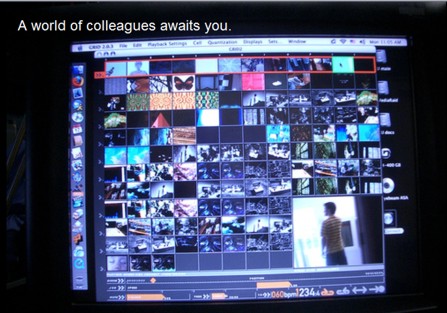
And this is the complimentary slide by Susanne Nobles

worldcolleagues

Have a look at the slideshow here. This would be a great collaborative project for both students and teachers, used as a slideshow or even printed off as posters.

Teach the child

Today I read Steve Shann’s recent blog post which I won’t try and fail to summarise.  I welcomed the introspective, quiet depth of his post. After my recent focus on the promotion of technology – always as a way to enhance learning and teaching – Steve’s anecdotal reflection led me back to the business of teaching young people, which is always about relating to them, and understanding them, awakening their understanding and wonderment. Sometimes we might get lost in perfecting rubrics, we might get stuck on assessment, ticking off technology skills – and then I always feel like something isn’t right, until I come back to what is essential – the kids.

In his post, Steve mentions how he feels about

some of what goes on in our classrooms, with children being made to perform unchildlike tasks, often to please a teacher, parroting back information for which they can see no use and to which they feel no connection.

Then he shows this video

[youtube=http://www.youtube.com/watch?v=f2p5augniQA&feature=player_embedded]

I don’t know about you, but this was one of the most powerful things I’ve seen in a while.  Steve wrote:

I found it deeply moving. As I watched those little faces live the song, I was catapulted back in time over 55 years ago when, as a very young child, the world was a place of heart-quickening wonder.

It’s good to see something like that and be reminded that we are teaching young people, not curriculum, not to the test or the marks. I’d like to believe that if we hold onto that, and when we inspire learning in our students, that they’ll follow through with the rest.

Steve’s post was about much more than this, and I recommend you read the whole thing.

Power of the network

The last couple of days have been very interesting. I’d like to share what I have learned since I shared on this blog a discussion about favouring an external blog to an internal one.

Above all, I learned that I could depend on the people in my network. Who are these people? Some of them I’ve met face to face; some I’ve come to know through my involvement in online networks; a few I’ve only just met in the course of this blog issue.

Amazingly,  over 200 people read my last blog post. Much as I’d like to convince you otherwise, I don’t normally record such a readership. How did I receive such a response?

After writing out my response to the Computer Systems Manager, then posting this with my response to him, I sent a link to the post out on Twitter, asking for people to enter into the discussion. I wanted to generate discussion, and to collect people’s views and perspectives. Discussion is a healthy and powerful thing. It’s a good idea to find out what others think even if they don’t agree with you, and in some cases, particularly when they don’t agree with you, since it pushes your thinking.

Apart from clarifying my own thinking with regard to the value of Web 2.0 technologies and their role in learning and teaching, in writing out this issue I gained valuable insights from others using the Web 2.0 platforms. Herein lies the power of these technologies – not in the technology itself, but in the powerful connections with people, people with unique backgrounds, experiences, qualifications, talents, and ideas.

The people who commented my post were educators or involved in education in some way. They responded quickly, and they came from around Australia (Melbourne, Sydney, Brisbane, Canberra and Perth) and overseas (Hong Kong and USA).  Click on their names next to the comments and read their profiles and their blogs to make their acquaintance.

My online networks are full of professionals whose reading and links, ideas and talents, I follow. If I need an idea, advice, professional reading, teaching material, and more, I go to this network. And I try to be helpful in return. Anyone who has experienced the collective wisdom of online networks will tell you the same. It is not about the technology.

Our students will go into the world needing support and continued learning. If we help them understand and navigate appropriate networks, we will be laying the foundations for support systems. We should allow them to learn within supervised online environments, teaching them how to write and interact appropriately and in a safe way, to share ideas and solve problems with relevant groups of people, etc.

As educators, our view of what is essential for student learning needs to change. Our students’ world will be fast-paced and changeable, requiring adaptability and resourcefulness. Our students will need to know how to find what they need, and who to trust. They will hopefully be able to discern who to follow and how to behave.

Change is never easy. One of my mentors, and co-founder (with Will Richardson) of the Powerful Learning Practice model, Sheryl Nussbaum-Beach, has just written a blog post about change, which she prefaces with the following quotations:

 “It’s not that some people have willpower and some don’t. It’s that some people are ready to change and others are not.”  James Gordon, M.D.

“Change has a considerable psychological impact on the human mind. To the fearful it is threatening because it means that things may get worse. To the hopeful it is encouraging because things may get better. To the confident it is inspiring because the challenge exists to make things better.” King Whitney Jr.

Sheryl uses the metaphor of her recent house renovation to deconstruct the journey towards building change, towards the creation of something new. She documents this process insightfully, and I recommend you read the entire post.   I thought I’d pull out some of the phrases that resonated with me in Sheryl’s post.  She talked about the challenge of

keeping the momentum and the dream of the transformation alive

She also said:

There are times I wanted to throw in the towel and thought as outdated as the home was at least there was peace and comfort.

 things will look worse before they get better

Fear is a big part of it too

Trust is another issue. Do the experts I have hired to make these changes a reality have the know how and wisdom to make it all happen

I’d like to end my post with another one of Sheryl’s quotes:

 For change to take hold and redefine people and the places they live and grow there needs to be a time of inquiry, reflection, and visioning.

I’m grateful that I have people with whom to share my inquiry, reflection and visioning.