Category Archives: Web 2.0

Jenny Luca’s talk about ning

[vodpod id=Groupvideo.3221019&w=425&h=350&fv=id%3D21FC3FE2-3DEF-371F-3217-11EF739CE05F]


more about “Jenny Luca – Ning“, posted with vodpod


I’ve just listened to Jenny Luca’s presentation from the elh09 conference in Lorne. This is the slideshow that accompanied her talk. You’ll find it here on her personal wiki. I’ve had to put the live stream (well, it was at the time) of Jenny’s presentation into the next post; I couldn’t seem to send both at once from Vodpod. More about Jenny’s talk in the next post.

The research process is full of twists and turns

whichway

Photo courtesy of Hulalulatallulahoo p

My younger son, currently in Year 9, is taking part in an interesting research project outside of the school. His school has made a smart decision to run several programs which take the students out of the classroom and textbooks. This makes a lot of sense at a time when disengagement with normal classroom routine is possibly at its peak. Putting young people in a different learning environment, giving them a bigger-picture problem to solve, and a choice about how they are to present their findings, is a smart move. In his case, my son’s school has joined with La Trobe University and some of its lecturers, tutors and student teachers, in order to support a two-week research project.

What interests me as an educator and teacher librarian, is the affective aspect of the research process. After a week, my son is feeling overwhelmed and insecure; he feels he’s a failure because he hasn’t come very far. As I talk with him about how he’s feeling, I wish that a discussion of these feelings were part of the support given to the students.

It was a relief to me when I read Carol Kuhlthau’s research into the affective stages of research. I’ve written about this in a previous post. I discovered it was normal to feel confused and overwhelmed at the start of your research because you hadn’t defined what the question was. It was normal to feel the same way before you had found relevant information to support your research. It was normal to feel happier and more confident having found those resources, but also to plummet again when you faced the task of synthesizing this information into some sort of argument or presentation. And so, as each new stage of the process is faced, it would be so good to acknowledge that the way you’re feeling is to be expected.

Reflection is a good thing, and leads to self-awareness. The more you understand how you’re feeling, the less frustrated you’ll feel. Instead, you’ll be able to navigate these different stages of information seeking and synthesis, or any other learning process.

I wonder how we deal with this as educators. How can we identify how students feel and empathise with them, or provide context, if we don’t understand our own internal processes? I’m not sure that teachers’ busy schedules, with the ongoing face-to-face teaching of classes, interspersed with constant correction and preparation, allow them the time to stop and reflect. And that’s a great shame.

Blogs are an excellent way to routinely reflect on teaching practices, and document highs and lows, problems and celebrations. On the one hand, blogging has been embraced by so many people that there seems to be a hundred blogs for every topic imaginable. Blog writing is often made fun of, in the same way as superficial twittering. On the other hand, there are few educators in my school who blog, who see the point of blogging, or who regularly read blogs.

Recently, as I’ve mentioned before, I started a blog to record the progress of my collaborative teaching of a year 7 English class with Maria. It’s called English@wfc and it’s a space for me to write down what we do in class, how the students responded, how Maria and I felt, what worked and what didn’t, and what we learned from this. For me, this is a valuable exercise; it doesn’t take long, but it’s useful both for me and, I hope, for teachers if they would read it.

This blog also has a list of links to English-related blogs – all fantastic. Some of them are

As a teacher, I’m so much more comfortable and happier to function as a learner, continuing my own education and understanding, learning as I go, learning from others, with students – instead of just being the provider of information or the so-called expert. I appreciate looking into others’ teaching experiences, just as I enjoy writing out my own.

I hope that, as a parent, I’m able to support my son in his research agony through discussion, broadening his understanding and developing self-awareness. I hope that, as a teacher, I can provide the empathy and wisdom to go with the provision of information.




Green Pen Society – Gold Rush

quoteflections

Paul C. from Quoteflections has invited bloggers to a GPS group with a monthly theme. Not sure what GPS is? Find out on Paul’s blog.

Paul writes prolifically on his rich blog, and regularly drops in on me here with valuable comments. Against my better judgement – no, that doesn’t sound right – despite the fact that I might find it challenging to write a monthly post of substance, I decided to take up the offer.

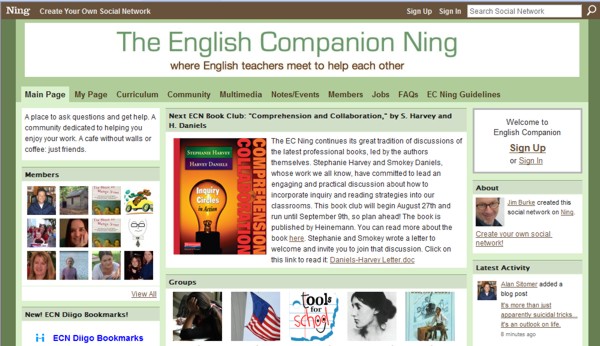
Gold Rush is the August GPS theme, which means I get to recommend a website which is valuable to me. I’ve chosen the ning, The English Companion. 

englishcompanion

Created by Jim Burke, the English Companion Ning is a rich learning environment for English teachers. The subtitle reads ‘where English teachers meet to help each other’.

The English Companion ning has 6,146 members – I think that’s a good indication of how valuable educators find it.

So far I’ve been busy and have only dipped in and out, but this ning has so much discussion and sharing of resources and ideas, that I don’t know where to start. Although I may not the best person to talk about The English Companion since I haven’t been involved in conversations yet,  I can definitely see how rich it is.

Just a quick tour through the tabs at the top:

Under Curriculum – there’s a whole variety of stuff on teaching: texts, writing, reading, through discussion, with technology, with blogs and wikis, and assessment, research, lit and language.

under multimedia: photos, videos and showcase

Events –  Poetry round table, Ning book club

Community: Forum, blogs, groups, Diigo bookmarks

There’s so much here, I’ll just give you a taste.

Looking around recently, I found some great Shakespeare resources which support our curriculum, and I added them to my English wiki.

Shakespeare Resource Centre.
50 best Shakespeare sites
Romeo and Juliet resources and activities from Teachit.co.uk (free registration)
Romeo and Juliet Enhanced e-text with modern translation
Discover Shakespeare on the Folger Shakespeare Library
Shakespeare teaching resources on the Folger Shakespeare Library
Romeo and Juliet Interactive folio and study guide

What I love the most about the ning is the plethora of discussions on every topic imaginable. It’s like the cornucopia of English teaching. Here’s an example:

Kate Messner started a conversation about using Twitter in the classroom:

I’m meeting with our ed-tech coordinator next week about creating a classroom Twitter feed that allows my ELA classes to share what they’re doing & reading with followers as well as connect with other classes & authors. Since it would be a classroom feed, only I would have access to it and could carefully screen conversations before sharing them.

All I can say is go in, have a look for yourself. It’s a rich community of educators, all with ideas, questions, practical suggestions. The English Companion is a giant staffroom with many and varied conversations.

Conversation with the author

THis is partially cross-posted from my English class blog, http://englishwfc.wordpress.com/     with the addition of what happened since the post was written.

I’m teaching collaboratively in a year 7 English class. Since we’re studying Allan Baillie’s Little Brother, I thought I’d muster up enough courage to email the author himself, in the hope that he’d join our ning and interact with the students. What better way to create an authentic learning situation?

Well, guess what!? Allan Baillie has joined! He is part of our ning! I tell you, a day that moves like any other day, when frustration mounts, as it has a habit of doing – receiving an email reply from the renowned Australian author himself really turned things around for Maria and me. We were so thrilled!

Not so thrilled were we when we couldn’t find a trace of any such excitement on the boys’ faces. What? Are you kidding? Here we are organising the author himself for your information and enjoyment, and you can’t even stretch your face into a half-smile? What’s going on? Besides typical adolescent disengagement with anything that isn’t a game or related to free time or sport or TV.

Still, today was productive. A few days ago, Maria prepared the boys for questions by developing what would have been for any other class (I’m sure) a rich discussion leading to rich questions. Only it was like squeezing water from a stone. Seriously. And yet, these boys are never as predictable as we think they are, and today they happily entered their questions into the ning, demonstrating thoughtful and responsible online behaviour. We were proud, and we told them so.

I think for us, as teachers, it’s a lesson about the fact that the boys will never be as excited or appreciative as we are. How can we expect them to be? And I think, as we look into the ning activity, we can see that so much has happened – not even looking at the invisible activity which goes on in the background in the form of brainstorming, discussion, etc. – and in the end the ning is a transparent receptacle of this development and these breakthroughs.

Well, last night, I received an email notification to say that Allan Baillie had answered one of the students’ questions. Then another, and another, and soon most of the boys had received a reply to their question. I was so pleased! I think the boys should be too.

It’s very special that our boys are receiving individual answers to their questions. Here is an example:

Dear Mr Baillie,
I have read the book, Little Brother and I really liked the book. When I read it I felt like I was in Cambodia! I have one question, how did you feel when you were in Cambodia at the time of the Khmer Rouge?

Allan’s response:

I was Cambodia in 1969 and I visited some Frenchmen running a rubber plantation.
They slapped a revolver in my hand and took me on a night hunt in the plantation. They warned me about careless shooting because we were going into an area controlled by a few bandits. Harmless, they said, and charming. The bandits were just sick and tired of the corruption of the government. Called themselves Khmer Rouge. We stopped and I shot four coconuts.

I hope that this little exercise will be a lightbulb learning moment for the boys. We’ve been discussion the thinking behind the writing and creation of characters, and now that they’ve had a conversation with the author himself, I hope they’ll understand the power of the story, and the man behind the story.

Dangerous new (cyber)world

I firmly believe that we should educate students for their world.

There’s no doubt that they will function in an online and networked world, even more than they are doing now.

Yesterday our staff listened to Susan McLean’s talk about the dangers of the cyberworld. I became increasingly uncomfortable as the horror stories unfolded at the expense of a more balanced view, or even in terms of focusing on how we could manage cybersafety education.

I want to share my letter to the principal in the hope of opening up a conversation which will fill in the gaps to create a balanced picture of what we should be doing to educate our students as citizens of their future world.

To balance out last night’s presentation on cyberbullying, I would like to suggest that you look at ACMA which provides excellent links to resources and free PD.

 For example, here is the page for teens with practical help

 Here is the school page

There is free professional development

You can browse the site – it is set out clearly, and very helpful.

 I hope that our staff have been discerning in understanding that Susan McLean has presented a very extreme picture, describing the worst case scenarios (many of them), which should be acknowledged for what they are – worst case scenarios. It was difficult not to be affected by her stories; I know I was starting to panic and my instinct to run and save myself kicked in.

 What was unmistakable – Susan only mentioned that online involvement could be positive at the beginning and end of the presentation – she didn’t give examples. Her language was emotionally charged, and her numerous horror stories were dramatic.

It would be a shame if staff who were already resistant to technology and strangers to online possibilities in education, were to run even further away from technology – especially as we are a laptop school. We have to remember that we are educating students for their technology-rich world, not our world or the world of our own schooling.

 Just yesterday I was moderating comments in my fiction blog – no comments will be published until I approve them. I’m encouraging comments to inspire discussion around books and reading, and I noticed a student had commented on a student review of the new Harry Potter movie. The comment was fine, but the last sentence inappropriately put down a boy who had received a scholarship. I found the boy, had a little chat with him about what was inappropriate in the comment (he understood), and asked him to resubmit the comment without the negative part. This is part of students’ ongoing education – who else will teach them how to behave online if we don’t?

 We need, more than ever, to understand the power of these technologies, and educate our students to use them responsibly. The only way we will understand these from the inside is if we play with them ourselves. I would be more than happy to show you my Facebook and Twitter involvement – they are an important part of my professional development and educational support.

 What is also imperative, is that we don’t mix up the problematic online activities of our students in their leisure time with the technology that can be used to support teaching and learning, eg. Blogs, nings, etc.

 When you have time, please have a look at the 7M ning – we are thrilled to have Allan Baillie, author of our literature study, ‘Little Brother’, as part of our ning, ready to join the students in discussion. What better way to learn about the book than have the author answer questions – this is authentic learning. The boys and Maria and I are excited that Allan has agreed to join us, and we spent yesterday’s lesson reading his life story on his website in preparation for our interaction with him.

 I hope you accept my email in the spirit it has been written. I believe that we need to educate our students for their world. We should not bury our heads in the sand, but accept the challenge, moving past our own discomfort with technology, and taking up our responsibility to educate responsible citizens.

Thanks to Lisa Dumicich for the link to ACMA on Twitter.

I would be extremely  interested in hearing what you think about this issue of cybersafety and the use of Web 2.0 technologies in education. Please enter into the conversation.

Powerful Learning Practice presentation is finished!

Well, when I say finished, I mean that the first layer of our presentation is complete. Whitefriars College Powerful Learning Practice cohort has documented their PLP journey on a blog which is the platform for all the projects, experimentation and reflection during the course of this year.

Marie Salinger and I have spent long hours pulling the presentation together, and at the end of it we feel deeply satisfied. As I was saying to Marie earlier today, the experience reminds me of the ‘Stone soup’ story:

a tale in which strangers trick a starving town into giving them some food. It is usually told as a lesson in cooperation, especially amid scarcity. In varying traditions, the stone has been replaced with other common inedible objects, and therefore the fable is also known as button soup, wood soup, nail soup, and axe soup (from Wikipedia).

It really was exactly like that – at first we thought we didn’t have enough for the presentation but gradually we gathered things from here and there, pooling our resources and forcing reflection and evaluation, until we surprised ourselves with the result.

So we have the first layer. And as Marie Salinger has said,

It has been a very positive and affirming experience to take the time to do this. Evaluating, reflecting on , summing up and consolidating the work we have been doing for the past nine months has been a very worthwhile endeavour.

Now that we have the blog as a space for sharing, we can continue to add to it as we go. I’m going to link to a new blog which follows the progress of 7M Ning, and I hope other team members will do the same. What would be even more encouraging – if the blogs inspired other members of the school community to have a go. It would be fantastic to see blogs for each faculty, documenting progress, reflecting, evaluating and celebrating.

Here is a short audiovisual reflection and summary of our journey.

[youtube=http://www.youtube.com/watch?v=zwH16mU2oYY&feature=player_embedded]

Here is a link to the blog.

Still kicking.

Forty years ago astronaut Neil Armstrong did something no one had ever done before. On July 20, 1969, he set foot on the moon. We all know what he said when he stepped onto the moon’s surface and looked at the Earth above him: “That’s one small step for a man, one giant leap for mankind.”

Meanwhile, back on Earth 40 years later, some of us are still struggling with less cosmic achievements, like the Recurring External Blog Saga which you  may have read about here and here. Unlike Armstrong, and more like Prometheus, unable to move forward, having been chained to a rock by Zeus, my way forward with technology in my own school is often just too hard.

Jacob Jordaens, Der gefesselte Prometheus, c. 1640 Rheinisches Bildarchiv

This morning I received yet another email criticising my move to an external blog for reading promotion. Yes, I know you’ve heard all this before, but imagine how I feel then. I’m definitely over it. Nevertheless, for every attempt to drag me back, to find fault with what I do, there are encouraging moments.

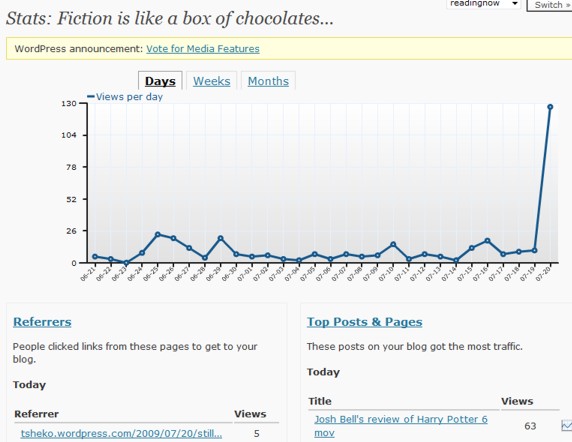
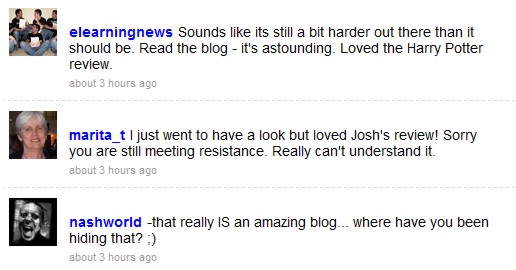
Today several things happened that demonstrated the advantages of the Web 2.o platform for things like reading promotion. Firstly, a student had posted a passionate review of the recent Harry Potter movie. I had only just posted that late last night, and already this morning there was an encouraging comment from Marita Thomson, a teacher librarian from The Kings, Parramatta. I know I was pleased to receive positive feedback, so I imagine the student was even more pleased. But wait, there’s more. Two more encouraging comments – one from Sean Nash and another from Paul Stewart. Here, let me show you.

fictionblogcomments

I’ve said it before, and I’ll say it again – sharing online opens up communication and possibilities. It’s encouraging and enriching. I really don’t get why people don’t get it.

So, while my Web 2.0 colleagues and I are moving forward slowly, I hope our small steps are paving the way for a more comprehensive change of mindset in the future, in which case I could also say,

“That’s one small step for a man, one giant leap for mankind.”

Reflecting again (still)

Last post I wrote a reflection for the culmination of my participation in the  Powerful Learning Practice program. Still, I felt I hadn’t drilled down to what was essential for me.

Listening to Howard Rheingold this morning, and rethinking things, I wrote another reflection.

My participation in PLP has been life changing. I know it smacks of evangelical fervour, and I’ve often written about this in my blog, but PLP came just at the point that I was ready for it. I’d just completed SLAV 23 things, and started a blog. Everything was new to me. Nothing was easy, I wasn’t a natural, probably more of a technophobe than anything, but something pulled me in. Jenny Luca must have read my blog somehow, and emailed me about joining the PLP cohort of Australian schools. It all avalanched from there. Soon I was blogging, wikiing, ninging, twittering, flickering, and having a great time.

Thinking about it more seriously, I realize there’s a big discrepancy between my personal awakening to online participation and what I’ve been able to do in convincing other educators at my school or anywhere else about what I see as a crucial path we must take in order to make learning relevant and engaging for students. Yes, I’ve made steps, and for me, these steps have been significant. I’ve been reflecting and sharing knowledge and resources in this blog, I’ve explored the literacy possibilities with Flickr’s image sharing, I’ve supported English and Art faculties with wikis, I’ve created a blog to inspire reading in the community, I’ve been working on a ning as a platform for learning, collaborating with a wonderful English teacher, I’ve sent countless links and resources to teachers as a result of my own connection to my online network. But it’s not enough. It hasn’t moved a significant portion of my school, it hasn’t changed the way my principal thinks, or other the way faculty heads function. Although, I suppose I shouldn’t underestimate small victories, such as the approval for an external fiction blog (read here and here).  On the whole, though, it’s often resulted in friends, family, colleagues casting a critical eye or making derogatory comments, telling me to get off the computerand get a life. Basically, I haven’t convinced many people that what I’ve spent an enormous amount of my own time on is worth anything.

It has, however, connected me to a network of people who are my lifeline. People I otherwise wouldn’t have met or known about. People who are experts in different fields, who are brilliant, engaged, supportive. It has crossed borders, transcended nationality, age-group, ignored physical apprearance and status – it’s been fantastic. I agree with many great speakers I’ve listened to: it’s not about the technology tools, it’s about literacies. Our students need critical thinking to navigate the flood of information and media that comes their way. They are learning outside of the classroom – and social media and technologies such as Youtube and Facebook provide a platform for communication, collaboration and collective action which is more important to them than their textbooks. One day it’s about organizing a large gathering through Facebook, and next thing, it’s organizing political action. None of it comes from teachers or parents; it wouldn’t spark that level of engagement.

I’m seeing the power of collective response to disaster. Why aren’t we thinking in terms of social capital? Why aren’t we thinking about how to mobilize people to do things using social media? What are we doing at school? How can we spark this level of engagement? Should we rethink the ways we are teaching, the content?

You can see that this isn’t about technology tools, although all of this is made possible through technology. These are the things that drive me today – as an educator, parent, citizen. I don’t have the answers but the questions are driving me forward, connecting me to others who find the conversation valuable. This is what my PLP experience has been about. Life is a series of new starts. That’s why we feel we never reach our destination. We’re always starting out with new questions and new problems to solve. That’s why it’s a journey.

Spider’s web

Photo courtesy of moonjazz.

The Powerful Learning Practice experience is coming to an end, and it’s time for us to gather our thoughts and share what we’ve done.

I’ve been putting off my reflection because, frankly, the thought of gathering my thoughts about this relatively short, but intense, period of PLP participation, is overwhelming. Scouting around in blogs and Twitter links, I came across something which describes what I consider to be the focus of what is most valuable from my PLP experience: connectedness. 

I love the way Lisa Huff compares the spider’s web-weaving in Walt Whitman’s A Noiseless Patient Spider  with our reaching out to connect with others through technology.

Whitman, writing in the 1800’s, observes how a spider ceaselessly launches forth filament to explore his surroundings, to travel from one place to another, to bridge his world. Whitman notes mankind’s similarity to the spider. We too ceaselessly seek to connect, to make sense of the world, to reach out to others.

 Technology of the 21st century is connecting us like never before. We blog, we podcast, we collaborate via wikis, webcams, e-mails, discussion boards. We explore endless information easily summoned with a few clicks. We are living in the midst of sweeping technological changes that are reinventing the way we live, learn, laugh. At the heart of this change, however, is the basic spirit of exploration–that same spirit Whitman captured some two hundred years ago.

This is what I have learned since joining the PLP team – how much richer my life has become through connections with people globally via technology. I’m connected through people’s blogs, wikis, through Twitter, and other Web 2.0 applications, to a limitless network of resources, ideas, discussions and creativity. At the risk of sounding evangelical (once again), this is a life-changing experience. It’s not just a matter of acquiring some technological skills with tools, it’s what we have in common with Whitman’s spider as we ‘ceaselessly seek to connect, to make sense of the world, to reach out to others.’

Coming down to earth a little, I must say that my fervour about 21st century learning, and that of my team members, is shared by few in our school community, and I hear it’s the same everywhere. At times it’s lonely, other times frustrating, to be convinced that networked learning and teaching are in step with our fast-paced, global world, and to know that our current education system supports an outdated society. Trying to take tiny steps in convincing others is perhaps the only way to move forward, taking care not to alienate others, but to support them, model new ways of teaching, and to celebrate small successes.

What have I enjoyed the most?

  • writing my personal and fiction blogs
  • reading others’ blogs, wikis; commenting; taking part in discussion
  • creating and supporting nings, joining others’ nings
  • the support of my personal learning networks on Twitter, Facebook, Friendfeed, etc.
  • sharing information and ideas
  • ‘converting’ others to the networks
  • discovering amazing people with great talents and wonderful minds
  • seeing engagement and joy in students, especially after the new ways of teaching have been a struggle to implement
  • being able to participate in professional development opportunities online at many different times
  • lifting up the minds of young people, seeing the spark in their eyes, hearing excitement in their voices
  • collaborating with others towards common goals
  • discovering unexpected and wonderful links to links to links
  • feeling energized by the depth of what’s out there
  • loving the learning

What have we learned, and what have we achieved? We’ve learned so much, and at the same time, we have so much more to learn. We’ve achieved a great deal, and yet we’ve only just begun.

What I’m sure of is that there are people I can rely on for help, ideas, support, resources, inspiration. These are the people I connect to as a teacher. I can never be bored, will never feel isolated, will always look forward to more.