Category Archives: Web 2.0

Moving forward and pulling back

Well, hello. Haven’t been around the blog lately. Mid-year holidays and taking time out of my head for a change. And, to tell you the truth, I’ve needed the break. No blog ideas put up their hands in their usual impatient manner. Nothing was hammering inside my head, clamouring to come out. No clear thoughts were forming, no ideas were sprouting. For a while there, I thought I’d dried out for good. Until I realised that I was looking back, only I’m not sure if I’m having second thoughts, or if I’m giving things a second look over.

Our PLP presentation is very close now. I can’t deny feeling unprepared. How have we, as a team, moved forward in changing teaching and learning in our school? How far have we come, if at all?

The answer is simultaneously a great deal and hardly at all. Taking part in the PLP ning, connecting to a rich network of educators, great minds, variety of personalities and viewpoints, forming a personal learning network that I don’t feel I could do without  – this is a new dimension that has changed my life as a teacher and a learner. The Art and English wikis, the personal and reading blogs, the ning I created to support students and teachers at my school are initial experiments, attempts to engage students in new ways, to share resources, to present different types of media as possibilities for discussion or creativity, to use technology for the purpose of re-envisaging education.

But how far does this go in making any difference to the way teaching and learning occur at my school? How many eductors have seen these things, and if they do, how many are convinced that I’m offering them something valuable, something worth trying out? The answer is – not many.

Dean Shareski’s post has resonated with me today. He describes the architecture of learning as transformative where there’s no going back.

The landscape of learning is changing. Rethinking what control means, understranding the power of sharing and transparency all work to topple many of the foundations our schools are built upon.

His post strikes a chord with me at this stage of my journey:

I know this, you know this but after spending 3 days amongst 18,000 in the educational technology field, I still say very few else know this. I made this observation (jump down to #4) last year at NECC and while the number may have increased slightly, those who really have any sense of the changes that are possilbe and perhaps inevitable in education is strikingly small. Yet sometimes the conversations amongst them would indicate they think everyone understands. A good example took place in the last session I attended on a panel discussion on Web 2.0. The panel was made up of all people that I and many in the audience knew very well either because we’ve spent time with them or know them from varoius online circles. The panel and audience were calling them by their first names and having a good discussion One lady stood up and felt frustrated since she didn’t know these people, these terms and most of the content of the conversation. That wasn’t her fault that’s ours. The assumption amongst folks who live and breath social media is that most teachers know about but they just don’t understand social media. We jump in with disucssion about Web 2.0 when they aren’t ready for that discussion since they have absolutely no prior knowledge. I”m not against having these kinds of discussions but it’s a bit like Christopher Columbus and crew arguing over how they would organize and structure the new world when most of the old world didn’t even know it existed and if they did, had no idea why or how they would get over to see it, let alone settle there. It’s not a totally useless discussion but perspective is important.

This is what I’m finding unsettling at this stage –  Dean’s analogy with Columbus. Should I feel unsettled knowing that I’m trying to populate a new world with people who deny its existence? Am I going about this the wrong way? Should I be happy to go slowly with a minority of takers? Am I being naive and unrealistic? Is trying to change teaching and learning in a school insane or egotistical? Am I unrealistically trying to change society itself? Can individuals make this change or is it only possible for politicians?

But then again, I’m pulled back by a comment on Dean’s blog by a teacher who attended NECC:

I paid my own way, as did many of the classroom teachers and a few of the administrators I met, because we are hungry to learn and starving for people who have the knowledge and experience to teach us. Of course, there were sessions and conversations at NECC that were way over my head, but hearing them and trying to understand gives me guideposts and goals for my future development.

If my new, recent direction in learning and teaching came ‘out of the blue’, then why shouldn’t other people make that transition? If a teacher cares about students and thinks about the best ways to inspire students to learn, then who’s to say my little steps, and those steps of my fellow PLP members, or anyone else who is struggling through relevant and engaging teaching and learning – who’s to say these things won’t make a difference?

Should we despair that our efforts are mere drops in the ocean, or should we appreciate our small steps?  So many rhetorical questions…

Dean points us to Tom Carroll’s article, If we didn’t have the schools we have today, would we create the schools we have today? written 8 years ago and still very pertinent:

If we continue to prepare teachers as we have always prepared them, we are going to continue to recreate the schools we have always had. We have to start preparing teachers differently. If we are going to continue preparing educators to work as solo, stand-alone teachers in self-contained, isolated classrooms, we are going to perpetuate the schools we have today.   If we want schools to be different, we must start today to prepare teachers differently… significantly differently.

Yes, I do feel a few can make a difference, but it’s a slow and laborious process. Why isn’t teacher training aligned with the educational needs of students today? Who should we be influencing in order to revise teacher training, in order to go to the source of the problem?

I might stop before another flood of questions is unleashed. Please come in and help stop the flood.
Don’t bag technology – ask what it means first

I’ve been feeling discouraged lately in my conversations with people about education. Maybe I’ve been talking to a small sample of people, but I’m feeling really peeved at the moment (and it may be because of lack of sleep).

I’m not sure if the endless circular conversation – between those who see the value of technology in education and those who dont’ – is even worth the effort. Yes, I’m not in a very positive frame of mind currently. I don’t find I have the energy or patience to continue, but I still want to reflect on what the problem is.

It’s not a problem that centres on technology at all. It’s a problem that centres around the very human aspect of dialogue. Dialogue which depends on two (or more) people listening to each other and making a real effort to understand what the other person is saying.

I’m sick and tired of entering into a conversation where I’m asked to justify my belief that technology is an important aspect of transformed learning, learning that has to change with the times in order to prepare us all for the way the world works and the way it will work in our students’ future. Most of the time I find that I’m cornered into petty justification because the other person is coming from a personal conviction and will, at all costs, aim to knock me off my beliefs to prove an ultimately negative point. This is not a dialogue. Cornering someone so that they desperately try to stick up for their beliefs while ignoring the larger argument is not dialogue. It radically narrows the scope of information which would otherwise offer a larger, more informative picture.

An example:

Me: I believe that technology offers new possibilities in learning (*very aware that this is a broad and ambiguous statement which needs comprehensive explanation*)

Other: What’s all the hype about technology? Does it really teach ‘them’ anything? Or is it a just a gadget, the latest fad?

Me: Technology offers possibilities for creating and connecting with others.

Other: I know all about that. It’s been proven that kids no longer have personal skills because they are using technology too much.

Me: They are learning the skills of online interaction

Other: I read/saw on TV how dangerous online involvement is, and how it isolates kids, how it takes them into dangerous zones which their parents don’t know about, how bad it is.

Me: You have to look at the real evidence. The media is often one-sided and sensationalises a small part of the picture

Other: But I heard an interview about it and these people are reliable; this information is authoritative.

Me: There are many wonderful connections kids can make to the real world and real people outside the classroom to make learning relevant

Other: (confused look) What are they learning by talking to each other? Is there any academic value?

And then the conversation reverts back to All Things Negative in terms of Any Kind of Change with regard to What Is Considered Sacred about Education, and it’s Sacred because That’s The Way It Was, and That’s The Way It’s Always Been, so all of this new stuff is Bad. We should probably go back to Grammar and stay safe teaching Facts. Numbers, Dates. Like my own education where I studied the Victorian Year Book and copied out fascinating information about how much rainfall and wheat we had in Victoria in  a certain year (the one that had passed). Fascinating facts about sheep and sewerage, I’ll never forget that (except for the facts themselves).

Ok, so now you’ve fully realised how down I am about this argument. I just have to point out that the worst thing about that kind of ‘discussion’ is that you never end up saying what you want to say, but you end up sounding like a crazed evangelist, ready to die for your cause – and I hate that. I’m not a crazed evangelist, I have much more to say and show you if only you would listen. The problem is about listening and wanting to hear, not about technology itself. It’s an age-old problem of failure to listen.

If I had a chance to talk to the ‘other person’ without being pushed into a corner, I would question their negative association with the word ‘technology’. I think this is a wide-reaching association. Technology = computers, dangerous  online involvement, unhealthy focus on what is not real, and therefore what takes you away from real, people-to-people contact.

But technology is also TV. Do you watch TV? Does it stop you from going out of the house? (If so, then it’s your personal problem) Or does it offer a window into the world?

Do you use a telephone? Does it stop you from seeing your friends and family in person? Or does it offer you an opportunity to chat more often in between visits?

All technology!

Yes, it changes the way we live. Some of us held off getting a mobile phone in the early days (we didn’t need it? we’d lived without it), but now we can’t imagine going out without it? Good or bad? It’s something worth investigating more deeply. But it’s here to stay, and it’s technological capacities are growing fast. Change is difficult; some of us jump on the bandwagon and others yell insults at the bandwagon from afar. What we need to remember is that, like it or not, the way we function in the world is changing, and we would be wise to jump on so that we know what we’re dealing with. So that we know what kind of support and education we need to give our kids. So that they’re ready for their world. Are we thinking about this? Are we looking forward or backward?

This morning I followed a link posted by @scmorgan on Twitter which led me to an article on the Edutopia website:

Kids create and critique on social networks.

The first couple of paragraphs grabbed my attention.

In the common conception, kids plus social networking equals an online popularity contest conducted in grammar-free instant-messaging lingo — not exactly an educator’s dream world. But the Chicago-based Digital Youth Network, a digital-literacy program funded by the John D. and Catherine T. MacArthur Foundation, has tapped into the networking phenomenon to encourage creativity and learning.

The Digital Youth Network runs a private Web site called Remix World, which is modeled on popular online social networks such as Facebook and MySpace.

This ning works like Facebook where students can create a space (their page) which is their own style, and where they can post their work and receive feedback from their peers, take part in discussion, and give and receive constructive criticism. Sharing with the class (or other classes) is more engaging because they care more about what their peers have to say than what their teacher has to say, and they want to show what they can do. They develop confidence in themselves when they realise they can help out or contribute to a discussion. It’s all there for the class to see; their contribution amongst everyone else’s. They don’t remain invisible or unheard. They have a place, a voice, a unique style.

When students are motivated to create work that they share online, it ignites an independent learning cycle driven by their ideas and energized by responses from peers.

That’s the theory, but let’s hear it from the kids

Twelve-year-old Jalen (also the subject of an Edutopia video profile) is among those who’ve taken their work to a larger audience on YouTube and elsewhere. “I post online because I don’t want it to just be on my computer, where nobody can see it,” Jalen says of his work, which includes graphic art, videos (both remixed mash-ups and some using original footage), and computer games. “I get positive and negative feedback, but it helps me get better and better,” he says.

“One guy on YouTube told me it was a good video, but the timing was off,” he remembers of one project that got mixed feedback. “So I went back and edited it.”

The article also talks about another student who created his own social network. He didn’t follow a prescriptive set of teacher-created instructions.

“I didn’t learn from anywhere particularly,” Mosea says about creating his network. “I just experimented.”

Experts say that, even more than the digital world in general, collaborative Web 2.0 tools in particular can motivate self-directed learning.

Students creating and publishing online within their own community is the first step to compelling learning, but the deepest learning takes place in the commenting and conversation which follows:

“While the ability to publish and to share is powerful in and of itself, most of the learning occurs in the connections and conversation that occur after we publish,” argues education blogger Will Richardson

Of couse, this kind of learning is not automatic or without its problems. But this is where the teaching part of it comes in. Teacher support is more important than ever for these new experiences to be successful. It’s not a matter of handing over to technology, stepping back and expecting self-directed learning to naturally take place. Nothing could be further from the truth, as teachers who have worked with online networks have discovered.

Researcher Christine Greenhow cautions that the virtual world can also present its own barriers to independent learning. “Students can get easily distracted,” she observes. “There are so many nonlearning paths, so we need to help them stay focused.”

And there’s the rub. If those against technology think that kids just jump in and need no supervision, they’re wrong. Wherever kids are and whatever they do, they need supervision and support. As parents, we shouldn’t leave them to their online activities without taking a real interest in what’s going on – and I don’t mean looking over their shoulders with a critical eye. I mean engaging in conversation where we learn what they’re doing, and why they like doing it. Or even trying some of these things out ourselves. As teachers, we shouldn’t leave them with the laptop and Google, and expect them to navigate a positive and successful learning experience.

To finish, I apologize for my rave – I think it’s something I needed to get off my chest to reduce mounting frustration.

Finally, technology is about the people who use it. Let’s demystify it, let’s try to understand it before we judge it, let’s acknowledge that it’s increasingly the way the world functions, and learn how to make the most of it.

Don’t drop the Internet!

Well, we’re winding down at school with this week being the last in term 2. I’m thinking about all the things I’d like to explore in depth online, but at the same time, I’m hoping to enjoy interests that get shoved aside during the term.

It’s Sunday night and I thought I’d indulge in a light-hearted post, in anticipation of the term holidays. Here are two videos parodying the internet.

Web crash 2007 is a humorous parody of the causes and consequences of a major internet crash (which I can’t embed, unfortunately)

The IT Crowd is a favourite comedy show in our house. Here’s the episode when the IT guys manage to convince Jen that they’re handing over ‘The Internet’ to her.

[youtube=http://www.youtube.com/watch?v=iDbyYGrswtg]

The humour of these two videos rests in the mystery and awe which used to surround the internet. A little like how the old TV shows used to depict computers – either as robots or massive machines with flickering lights. I think that Web 2.0 technology is still viewed with varying degrees of mystery, although it’s usually not awe but a kind of negative or fearful reaction that is demonstrated. I suppose that it’s part of human nature to resist change, but I think that approaching something new with caution is a good thing, while criticising it without looking into it at all is not a good thing.

Timelines and Twitter

Yesterday I was at a SLAV professional development session with the dynamic duo, Ross Todd and Carol Gordon – something I might write about in a later post (although I might not, considering Judith Way has taken copious notes and will no doubt do a brilliant write up in Bright Ideas – and she has). I was uncertain whether to take comprehensive notes or not, so that I could sit back and enjoy listening to and watching the speakers. I ended up splitting myself three ways – a solution to my indecision – and jotting down some things on paper, some in a word document and tweeting out interesting one-liners and links on Twitter.

Twitter is always so satisfying during conferences because while you’re sharing information and links, you’re getting immediate feedback from your network who are either retweeting or responding in some way.

At one point during the afternoon session while we were working on transforming an enquiry unit,  I tweeted out a request for online timelines, and unsurprisingly received 3 replies, so I thought I’d share them with you.

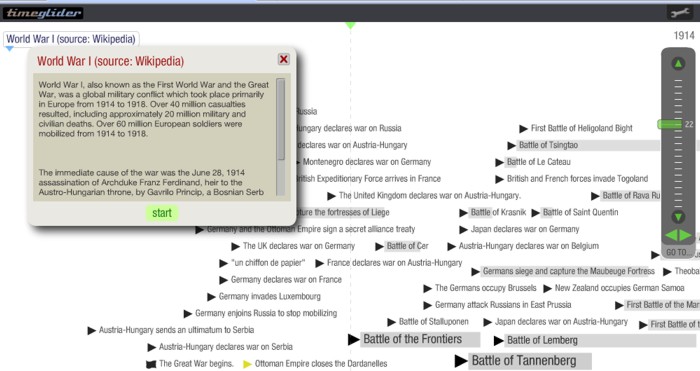
Paul Stewart shared a link to his blog post about Timeglider which used to be called Mnemograph. Interesting, the name change. The former does sound more ‘futuristic’ while the latter sounds like some kind of wondrous ancient machine housed in a museum.  Paul describes Timeglider in his post:

Mnemograph is a web-based timeline application. It can be used for a range of purposes. I attempted to chart the growth of Web 2.0 technologies. After a few minutes of initial confusion, I quickly found my way around and was throwing in images, text and hyperlinks with gay abandon. My first effort in Mnemograph is below. Additional information can be accessed by double-clicking items on the timeline. In this particular case, I have included links to original pages via the incredible Wayback Machine, a web archive of 85 billion webpages). I thought it appropriate to complement a timeline with the web’s most significant piece of temporal devotion.

I can’t seem to embed Paul’s example, so here’s the link. 

And here’s one of the examples given on the site:

timeglider

Martin Jorgensen shared this link to a post about Our Story, stories built with interactive timelines. Martin writes:

OurStory allows users to design a timeline using images and text. Stories built using this tool most often appear as sequences of events that lead to a conclusion. Some of the examples I’ve seen are simply one event leading to another, but others are more subtle.

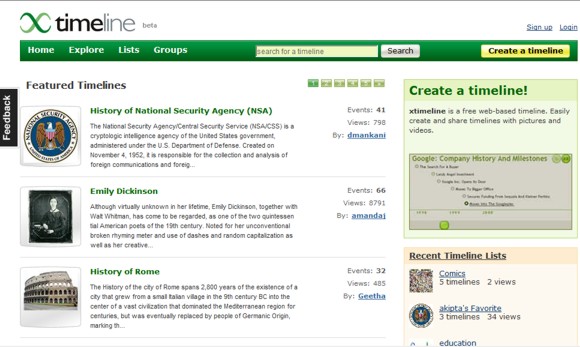
Allison Kipta shared a link to Timeline. You can create a timeline or browse existing timelines which have been featured on the site.

timeline

What I love about shared resources which are housed in blogs is the opportunity to explore the blog and discover all the other resources and ideas by the authors. In this way, I’ve found Twitter an invaluable resource and opportunity to discover and connect with amazing people and their work.

What does teaching well mean to you?

I was reading Allanah King’s blog, and she had posted a slideshow about ‘Teaching well’ which had been created collaboratively by some of our PLP people. Darren Kuropatwa initiated and coordinated the project in Google Docs.  Here is how he explained it:

WANNA PLAY?
I’m thinking of something that has legs to grow but has a low participation threshold. Something along the lines of
Presentation Tennis. I’ll serve the first ball in the next couple of days. Would anyone be willing to be part of my “seed team” to get the ball rolling? I’m looking for a few good people to help me get the ball rolling. Your commitment to this is very small: 1 slide. Details below …

WHAT WE’LL DO
We will collaboratively create a 20 slide presentation (not counting the title slide) called “Teaching Well”. 20 slides in 10 pairs of contrasts: “Teaching well is more like < slide 1 > than it is like < slide 2 >.” or however else you want to create contrast.

Each day one slide is added to the deck that builds on those that came before. The final 4-6 slides must bring the presentation to some sort of close.

For me, it was a truly satisfying experience which demonstrated the richness of collaboration.  The end result is much greater than each person’s individual contribution.  Here is my slide

teachingwell

And this is the complimentary slide by Susanne Nobles

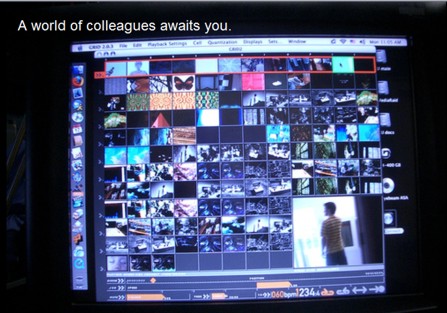
worldcolleagues

Have a look at the slideshow here. This would be a great collaborative project for both students and teachers, used as a slideshow or even printed off as posters.

What blogging means to Iran

Further to my last post, I’m adding a video posted by @Zadi on Twitter,

[youtube=http://www.youtube.com/watch?v=_TW7BzkuUKg]

The video tells us that Iran is the third largest nation of bloggers. For Iranians, a blog provides a safe place to write about forbidden topics and speak out with eloquence and anger against repression of the current regime and the need for change. The narrator of the video defines the blog as the true voice of the next generation.

A powerful example of the changing face of communication using Web 2.0 technologies.

You may also want to have a look at these images of recent happenings in Iran.

Iran uses Twitter to shout out

Today on FriendFeed I read Howard Rheingold’s message:

Smartmobbery moves to the core of world events more and more frequently

and this link to Smartmobs, a Website and Weblog about Topics and Issues discussed in the book Smart Mobs: The Next Social Revolution by Howard Rheingold.  Here you can read Twitter: Following the Aftermath of the Iranian Election

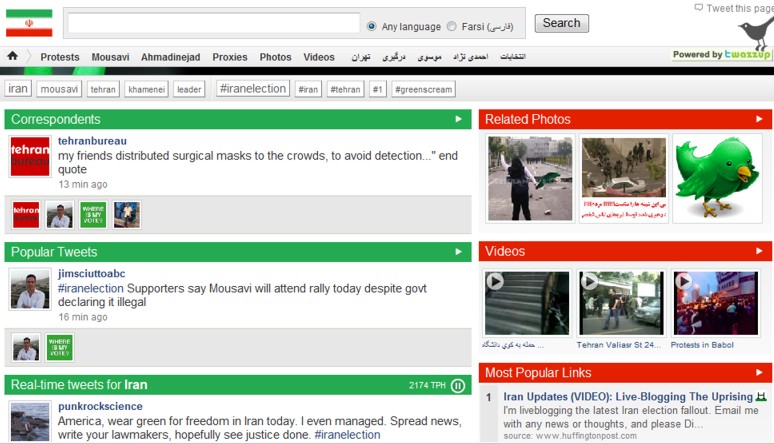
Twitter appears to be one of the most reliable channels to receive a first-person account of what is happening in the aftermath of the 2009 Iranian “election”.  Tor Henning Ueland is actively compiling a a list of Iranians using Twitter.  Also, you can follow the realtime results for the #iranelection here.

The power of microblogging is obvious here. Twitter has moved to a crucial role in communicating news when other forms of communication, such as official news, mobile phones, sms chat, and websites are no longer functioning. Twitterer @Persiankiwi is being followed by many, many people – 4,916 when I last checked. These are the sorts of things he has tweeted:

websites being shut down fast. having trouble accessing tweeters. #Iranelection20 minutes ago from web

students arrested last night at tehran uni: Mansoor Mousavi, Vahid Sarfi, Amir Afzali, Kazem Rahimi. #Iranelection23 minutes ago from web

advice to people joing march. tavel toether with friends. do not travel alone. keep track of friends. #Iranelection26 minutes ago from web

 I’ve selected other tweets which give current updates on the situation in Iran, as well as the urgency of the people.

nR: RT @persiankiwi My twitter was hacked. am back in again. they are shutting down all internet services. #Iranelection
 
@NorwAnon They insist to take exam to show e.th is normal. No news about our exams but if I’ll tweet it!about 3 hours ago from Twitstat Mobile

It’s 4th day that SMS service is down. #IranElectionabout 3 hours ago from mobile web

I’m calling my friends to get some fresh news but they don’t answerabout 3 hours ago from mobile web

I have an exam @ 14 (At national time). I’m a little worried, ppl are going to street again tomorrow morning and afternoon!about 10 hours ago from Twitstat Mobile

@mahdi: I use this to update my twitter account http://www.twit2d.comabout 13 hours ago from Twitstat Mobile

RT @mahdi @keyvan: Oh oh! Hearing that they have brought tanks to cities!about 13 hours ago from Twitstat Mobile

@_Sober : Rasht, 3 minibus security guards on Gaz square surrounding the square.about 15 hours ago from Twitstat Mobile

RT @StopAhmadi It’s getting rough in Rasht tonight. Armed forces waiting for ppl to make their move to beat them #IranElectionabout 15 hours ago from Twitstat Mobile

RT @HatefRad They arrested Guilan university students and took them to an unknown place! #IranElectionabout 16 hours ago from Twitstat Mobile

 I can’t find my friends on streets.about 17 hours ago from mobile web

 They attacked protestors students in Guilan university. Blood and violence here… #IranElectionabout 17 hours ago from mobile web

Police arrested 100+ protestors in Rasht. #IranElectionabout 18 hours ago from mobile web

It’s third day they disabled SMS service #IranElectionabout 18 hours ago from mobile web

Mousavi’s meeting with the Supreme Leader http://bit.ly/si7rq (via… http://ff.im/3ZxBNless than 5 seconds ago from FriendFeed

RT @reuterswire Ahmadinejad due in Russia on first trip since vote: YEKATERINBURG, Russia (Reuters). http://tinyurl.com/mt7bpkless than a minute ago from web

RT: @alirezasha: lost in lots of rumors and lies in news/چرا نمیشه به اخبار اعتماد کرد؟about 1 hour ago from TwitterFox

Twitter Users Put CNN to Shame on Iran Riot Coverage #iranelectionabout 1 hour ago from TwitterFox

RT: @Change_for_Iran: We’re trying to stop Masood from going outside! there is no way they will listen to us right now. #iranelectionabout 9 hours ago from TwitterFox

@Change_for_Iran what can we do? where are you? #iranelectionabout 9 hours ago from TwitterFox

RT: @Change_for_Iran:typing as fastest as I can in bth English&Farsi,Still we need outside help,I really don’t want to be captured by Ansarabout 9 hours ago from TwitterFox

@flashpolitique we are moving either toward a north korean style dictatorship or a more open and democratic societyabout 9 hours ago from TwitterFox in reply to flashpolitique

URGENT GET THIS OUT TO IRANIANS: ghalamnews confirms mousavi & karroubi WILL BE AT MARCH IT IS ON 100% AS OF NOW #iranelection2 minutes ago from web

RT @persiankiwi please tell all – march is NOT CANCELLED today. Mousavi is in danger of being killed. #Iranelectionabout 1 hour ago from web

Many roads are blocked in Tehran right now, it is like martial law out there right now. Government is panicking #iranelectionabout 1 hour ago from web

RT @persiankiwi I am online for few minutes. total communication blackout here. gov panicking. very dangerous. #Iranelectionabout 1 hour ago from web

intrepidteacher No matter what happens nothing will be the same in Iran again. I have been waiting for this my whole life. #iranelection

Irannews

Many pictures have been posted. Here are a couple:

http://twitpic.com/7fmr0 

 http://twitpic.com/7fmo8

Here are more videos and pictures of demonstrations in Iran 

http://tehranlive.org/

[youtube=http://www.youtube.com/watch?v=EyssJGHsGyw&feature=player_embedded]

I’m following developments on Twitter about the situation in Iran with interest – regular updates and personal information from people who are in the thick of these riots make this kind of news more dynamic than news from a traditional source. This is the new journalism.

This is very disturbing. I could read the updates all night, but I’m going to stop. Here is the last tweet I’ve read:

RT @drewb : #Iranelection web blocks via @IranPishi : “cant update topics on twitter anymore.cant open any webpage. hope you can see this.
You would have to be shortsighted to have read these developments and not recognised the role Twitter has played in new communication possibilities.

Everything is amazing, nobody is happy

Here’s something that made me smile –  the comedian, Louis CK, talks about how we take technology for granted.

[youtube=http://www.youtube.com/watch?v=jETv3NURwLc]

As Louis CK says, ‘those were simpler times’ when we had little of the technological possibilities we have now. I think we’re all guilty of taking new technology for granted. I still remember the dial phone, and yes, the zeros took ages to come back. One of our phones had a dial that used to get stuck and you had to help it back. Bad luck if you wanted to phone in quickly to be first caller for something. There are so many things that have been developed since I was born, it’s embarrassing. My boys find it hard to believe that when I was their age there were no microwaves(at least not in my part of the world). Definitely no mobile phones. We used to think we were lucky that a friend worked for the telephone company and gave us a couple of phones so we could have them in different rooms. When I was in primary school, we were one of the first families in our circle of friends to have a remote control for the TV. Some people would say, why do you need a remote? Why can’t you just get up and change the channel? Who would say that now? I used to think that mobile phones were an unnecessary luxury, and now I have a fit if I’m out without my phone. How happy I was when I used an electric typewriter with a corrector ribbon! How frustrated I am when my webpage takes too long to load.

But, as Louis CK says, we’re quick to get frustrated with technology without giving a thought to how incredible it is. I think that’s human nature. We get used to new technologies so quickly, and we complain about what’s not working, but we don’t often extol the virtues of our machines. Are we basically negative in our perceptions and reactions?

It’s funny to read Top 30 failed technology predictions.  Some of my favourites are:

“There is no reason anyone would want a computer in their home.” — Ken Olson, president, chairman and founder of Digital Equipment Corp. (DEC), maker of big business mainframe computers, arguing against the PC in 1977.

“A rocket will never be able to leave the Earth’s atmosphere.” — New York Times, 1936.

“Flight by machines heavier than air is unpractical (sic) and insignificant, if not utterly impossible.” – Simon Newcomb; The Wright Brothers flew at Kittyhawk 18 months later.

“The energy produced by the breaking down of the atom is a very poor kind of thing. Anyone who expects a source of power from the transformation of these atoms is talking moonshine.” — Ernest Rutherford, shortly after splitting the atom for the first time.

“The cinema is little more than a fad. It’s canned drama. What audiences really want to see is flesh and blood on the stage.” -– Charlie Chaplin, actor, producer, director, and studio founder, 1916

“The Americans have need of the telephone, but we do not. We have plenty of messenger boys.” — Sir William Preece, Chief Engineer, British Post Office, 1878.

“Home Taping Is Killing Music” — A 1980s campaign by the BPI, claiming that people recording music off the radio onto cassette would destroy the music industry.

“Television won’t last. It’s a flash in the pan.” — Mary Somerville, pioneer of radio educational broadcasts, 1948.

Here’s a funny one:

“Rail travel at high speed is not possible because passengers, unable to breathe, would die of asphyxia.” — Dr Dionysys Larder (1793-1859), professor of Natural Philosophy and Astronomy, University College London.

It’s easy for us to laugh at these in retrospect, but what kinds of things are we saying today? I’m particularly interested in critical or sceptical things we say about technology in education. I’m hearing things like

  • we have the intranet so we don’t need to ‘go out’
  • mobile phones have no educational use and should be banned
  • computer games are a waste of time and should be banned
  • social networking, like Facebook, is a waste of time and has no educational value
  • I do all my professional reading in peer-reviewed journals; why would I want to read blogs?
  • Twitter is used by people to say superficial and unnecessary things

When we say these things we are making a major mistake, and that mistake is based on the fact that we are thinking in terms of our world, not the world of  our students, and definitely not the world of the future. Currently in education there is a significant pull away from Web 2.0 technologies. We can’t stop these things by banning them or criticizing them. We can try to understand what draws our students into these applications. What motivates them to create online games, get involved in Second Life, join Flickr groups, write blogs – become engrossed in things outside of school in a way we didn’t think was possible in school. I think that we, as educators, should seriously think about what kind of world our students will be living in once they leave school. Whatever the answer to that is, it won’t be our world.

We should be interested in what young people are doing outside of school because it may help us understand how to engage them at school.

[youtube=http://www.youtube.com/watch?v=0fu4vmiXxwc&feature=player_embedded]

How have you changed as a writer because of online spaces?

On Twitter I read that Will Richardson was doing a day-long workshop on ‘How have you changed as a writer because of online spaces and communities?’

Considering the deliberate and concentrated direction ‘out’ I’ve been following in the last year, when blogging through a Web 2.0 learning process took me out of the library and into the world, I thought it would be a good idea for me to ponder this question:

‘How have you changed as a writer because of online spaces and communities?’

Well, the short and simple answer is easy: I never was a writer until I started a personal blog, and so that simple step in setting up a blog, like so many people did before me, has given me the gift of a space I can personalise with my thoughts. Over 30 years ago, when I finished secondary school, I lost my excuse for writing. Having enjoyed writing in English classes more than anything else at school, there was no reason or opportunity to do it anymore. So when I started my blog, tentatively at first, it was a joyful reunion with a process I had long missed.

And so, back to the question, ‘how have I changed as a writer because of online spaces and communities’? Blogging has not only given me the chance to write, but it has given me an audience, and it has connected me to people. When I say audience, it’s not a big one, but I’m not talking to the air either. If I have something to say or share or ask, it’s great when I get a response, a thrill when I start a conversation, and brilliant if it involves people from different parts of the world. If I’m thinking or doing the same thing as someone in another country, then the world is brought closer, the unknown seems more familiar, what was foreign becomes more friendly.

The online communities I’ve joined since – Twitter, wikis, nings, etc., have taken my writing into the interactive zone. I’ve responded, supported, elaborated, argued, bounced off others, shared people’s successes, empathised, and generally had a great time with people I didn’t know, or hardly knew, and now with whom I share a great affinity. To describe this affinity, I will just say that if I’m ever in need of anything – moral support, information, advice – then the people in my network will instantly respond.

And back to the question again – my writing has changed even in its sincerity, its authenticity; I think it has thrown off its carefully constructed facade, its attempt to impress, to sound correct, to please, to conform to the status quo. It’s become transparent and unselfconscious, playful and casual, flexible and possibly courageous.

If my writing has changed in these ways because of online spaces and networks, then it must be clear to all that it is a human, and not technological, development. It’s about me, not my technology skills. The technology has provided the medium, the connections, but it has centred on human interaction.

These are the reasons why I’m exploring and pushing Web 2.0 platforms for learning and teaching at school. Using online spaces and communities for writing will connect students to each other and to others outside the classroom. Writing will become meaningful, and learning enjoyable.

Tweeting from space – NASA on Twitter


 Some time ago, when talking about Twitter, I mentioned an astronaut using Twitter to share his journey to space – @Astro_mike, or Mike Massimino, a NASA astronaut, mission specialist for STS-125. You can see Mike along with the rest of the team on the NASA website.   Receiving real-time tweets as he prepared for launch, as he described his experiences in space, and in his readjustment to gravity on earth, he offered a unique perspective, much different to a newspaper article or even interview.

Although not as thrilling as the real-time follow, I decided to share selected tweets throughout his journey. Since the latest tweet is on top, you’ll have to start at the bottom.

  Finished a physical exam with the doctors, all is good, I am cleared to resume driving a car, flying, and light exercise3:34 AM May 28th from TwitterBerry

Going to our crew return ceremony, watch it live at 4PM central at www.ustream.tv/nasa2explore6:34 AM May 27th from TwitterBerry

Woke up with slightly sore back and lower legs, my muscles are re-adjusting to gravity11:24 PM May 26th from web

Getting re-adjusted to gravity, let go of a small bag of groceries and must have expected it to float, luckily no damage1:26 PM May 26th from web

On day 12 on a night pass over India I say 2 shooting stars entering the atmosphere below me, streaks of light below, I made 2 wishes11:41 PM May 25th from web

favorite moment on last full day was night pass over Australia with thunderstorms and city lights below and universe above, a heavenly view11:37 PM May 25th from web

Could not land for 2 days so spent most time looking out windows – this was a gift – listening to music looking at Earth and stars for hours11:34 PM May 25th from web

From orbit: got a call from President Obama, it was a great event for our crew and very thoughtful of the President11:49 PM May 21st from web

From orbit: Just saw Orion’s nebula in the night sky – the sights make all the hard work and risk worthwhile for me7:35 AM May 21st from web

From orbit: Night pass over Australia, the city lights give stunning signs of life on our planet within the darkness of nighttime7:34 AM May 21st from web

From orbit: Just a video conference with my family, it was great to see them7:33 AM May 21st from web

From orbit: As I closed my eyes to sleep last night I thought “these eyes have seen some beautiful sights today”12:39 AM May 21st from web

From orbit: Flying over the Pacific Ocean at night there were some thunder storms, it is so cool to see lightning go off below the clouds10:33 PM May 20th from web

From orbit: The stars at night in space do not twinkle, they look like perfect points of light and I can clearly see the milky way galaxy10:33 PM May 20th from web

From orbit: Viewing the Earth is a study of contrasts, beautiful colors of the planet, thin blue line of atmosphere, pure blackness of space8:08 AM May 20th from web

From orbit: We see 16 sunrises and sunsets in 24 hrs, each one spectacular as the sun lights up the atmosphere in a spectrum of colors8:06 AM May 20th from web

From orbit: The Earth is so beautiful, it is like looking into paradise8:04 AM May 20th from web

From orbit: Getting ready for bed, sleeping in space is cool, tie down your sleeping bag and float inside of it, very relaxing6:27 PM May 19th from web

From orbit: Eating chocolates in space, floating then in front of me then floating and eating them like I am a fish6:26 PM May 19th from web

From orbit: At the end of my spacewalk, I had time to just look at the Earth, the most awesome sight my eyes have seen, undescribable10:43 PM May 18th from web

From orbit: Getting more accustomed to living in space today and getting ready for our big rendezvous with hubble12:16 AM May 14th from web

I’m going to put my spacesuit on, next stop: Earth Orbit!!11:11 PM May 11th from TwitterBerry

Final check with the doctors, getting ready for breakfast. We launch today!!8:52 PM May 11th from TwitterBerry

I’ll tweet when I can from orbit, but it might not be much, follow us after the launch 24/7 on NASA TV, www.nasa.gov/ntv and NASA twitter9:59 AM May 11th from web

Just got up, met with the doctors for a routine checkup, now will start a final review of the spacewalks with my crew – 2 DAYS FROM LAUNCH8:34 PM May 9th from web

Just finished dinner with my crew and our spouses, this is our first night in quarantine in florida after 5 quarantine days in houston10:26 AM May 9th from TwitterBerry

I don’t know about you, but I got enormous satisfaction out of the succinct, personal tweeting by @Astro_Mike.

 You can read Mike’s journal on the NASA site. You can also read the crew profiles and interviews on the site.

I think it would be a unique way to teach about space, don’t you? Do you know any other real-time Twitter-documented journeys that could be used for learning?