Category Archives: Web 2.0

Power of the network

The last couple of days have been very interesting. I’d like to share what I have learned since I shared on this blog a discussion about favouring an external blog to an internal one.

Above all, I learned that I could depend on the people in my network. Who are these people? Some of them I’ve met face to face; some I’ve come to know through my involvement in online networks; a few I’ve only just met in the course of this blog issue.

Amazingly,  over 200 people read my last blog post. Much as I’d like to convince you otherwise, I don’t normally record such a readership. How did I receive such a response?

After writing out my response to the Computer Systems Manager, then posting this with my response to him, I sent a link to the post out on Twitter, asking for people to enter into the discussion. I wanted to generate discussion, and to collect people’s views and perspectives. Discussion is a healthy and powerful thing. It’s a good idea to find out what others think even if they don’t agree with you, and in some cases, particularly when they don’t agree with you, since it pushes your thinking.

Apart from clarifying my own thinking with regard to the value of Web 2.0 technologies and their role in learning and teaching, in writing out this issue I gained valuable insights from others using the Web 2.0 platforms. Herein lies the power of these technologies – not in the technology itself, but in the powerful connections with people, people with unique backgrounds, experiences, qualifications, talents, and ideas.

The people who commented my post were educators or involved in education in some way. They responded quickly, and they came from around Australia (Melbourne, Sydney, Brisbane, Canberra and Perth) and overseas (Hong Kong and USA).  Click on their names next to the comments and read their profiles and their blogs to make their acquaintance.

My online networks are full of professionals whose reading and links, ideas and talents, I follow. If I need an idea, advice, professional reading, teaching material, and more, I go to this network. And I try to be helpful in return. Anyone who has experienced the collective wisdom of online networks will tell you the same. It is not about the technology.

Our students will go into the world needing support and continued learning. If we help them understand and navigate appropriate networks, we will be laying the foundations for support systems. We should allow them to learn within supervised online environments, teaching them how to write and interact appropriately and in a safe way, to share ideas and solve problems with relevant groups of people, etc.

As educators, our view of what is essential for student learning needs to change. Our students’ world will be fast-paced and changeable, requiring adaptability and resourcefulness. Our students will need to know how to find what they need, and who to trust. They will hopefully be able to discern who to follow and how to behave.

Change is never easy. One of my mentors, and co-founder (with Will Richardson) of the Powerful Learning Practice model, Sheryl Nussbaum-Beach, has just written a blog post about change, which she prefaces with the following quotations:

 “It’s not that some people have willpower and some don’t. It’s that some people are ready to change and others are not.”  James Gordon, M.D.

“Change has a considerable psychological impact on the human mind. To the fearful it is threatening because it means that things may get worse. To the hopeful it is encouraging because things may get better. To the confident it is inspiring because the challenge exists to make things better.” King Whitney Jr.

Sheryl uses the metaphor of her recent house renovation to deconstruct the journey towards building change, towards the creation of something new. She documents this process insightfully, and I recommend you read the entire post.   I thought I’d pull out some of the phrases that resonated with me in Sheryl’s post.  She talked about the challenge of

keeping the momentum and the dream of the transformation alive

She also said:

There are times I wanted to throw in the towel and thought as outdated as the home was at least there was peace and comfort.

 things will look worse before they get better

Fear is a big part of it too

Trust is another issue. Do the experts I have hired to make these changes a reality have the know how and wisdom to make it all happen

I’d like to end my post with another one of Sheryl’s quotes:

 For change to take hold and redefine people and the places they live and grow there needs to be a time of inquiry, reflection, and visioning.

I’m grateful that I have people with whom to share my inquiry, reflection and visioning.

School library blog – stay in or go out?

Recently I’ve moved my school library book review blog from an internal one within the school intranet (Sharepoint) to an external WordPress one. Just today I received an email from our Computer Systems Manager:

Do you realise that by using the WordPress site, you are denying most of our students easy access to your work. Sure, a few students might check it out in the Library at lunchtime but by the time most students get home, other priorities will have come to the fore. So, why not place your blog in the public section of the College Intranet? There you will get the best of both worlds, public access and, immediate and unhindered student access.

I should explain that we are a laptop school, but that internet access has to be booked by teachers, and is otherwise accessible to students before school, at recess and at lunchtime.

It was difficult to answer this email without writing a thesis! This is the best I could do:

 In answering your email, I started thinking about the meaning of ‘Sharepoint’ – a place where the school shares resources, information, etc.  Sharepoint’s  centralised, sharing facility is a powerful way to synchronise and share resources and activity in the school.  Yes, I did realise that by transferring my fiction blog to WordPress, students wouldn’t be able to access it during class times. I made the decision to move after using Sharepoint for almost a year, and I didn’t make that decision lightly, but based on important considerations.

 Funnily enough, the sharing within Sharepoint was limiting what I wanted to achieve with the blog. Sharepoint is an excellent school-based resource, but it didn’t meet our needs entirely. Firstly, there were restrictions, such as the fact that I couldn’t link to specific posts, so that when I posted more than one post, I couldn’t link to a specific one which had been pushed down by others.  I also couldn’t embed videos. Book and film trailers are popular with students, and often lead them to reading and discussing books.

 Access during classtimes did not increase readership, and I can only estimate this through anecdotal evidence with the Sharepoint blog, because, unlike WordPress, it doesn’t provide me with valuable data on readership.  As you say, students can only access the blog during lunchtime and recess, but they wouldn’t be able to read it in class anyway, unless given permission by the teacher, or when the teacher specifically books the internet. Since the move to WordPress, I’ve actually had an increasing number of emails from staff who prefer the appearance and options within WordPress, and following from their interest, I’ve been booked into classes  to introduce the blog and talk about books.  The blog is not generally something students are reading, unless I set a challenge or competition, but teachers who realise its potential are beginning to use it as an interactive medium for students.  

 Author visits are expensive, and so I find that embedding videos of author interviews  allows students to ‘get to know’ authors as real people, people they can relate to. When I show students the blog and give them time to browse, they inevitably veer towards the videos – not surprising considering their preference for media. We do what works in encouraging students to appreciate books and authors, and we must do what works best in engaging students in learning.  When students use Web 2.0 technologies, they are also learning netiquette – an important skill considering the dominance of technology in their future lives of work.

 The sharing aspect is the most important feature of external blogs . Just as teacher librarians and librarians encourage students to join local and larger libraries, so do we strive to share our reviews and comments with students and teachers in other schools, even in other countries. Every comment received is emailed to me for moderation before it is published.  I write the fiction blog for the whole school community, and I hope to extend our community to include other schools. We benefit from this interaction, and it enriches our discussion. Currently I’m compiling a list of excellent reading blogs of interest to both staff and students, which will be added to the blog as widgets.

 The work we do with Web 2.0 technologies at Whitefriars can be shared with others, and I find this enriching. I share, and I receive tenfold if not more. The School Library Association of Victoria blog, Bright Ideas, features what schools in Victoria are doing online, and our school has a positive profile throughout the state already, through its educational projects in wikis, blogs and nings.

 There are many more reasons for our choice to go with the WordPress blog, but it’s important to note that it is based on our commitment to Web 2.0 technologies rooted in the latest pedagogy. We are not ignoring Sharepoint, we are just selecting the best application for our needs.  As with any technology, it must be rooted in best pedagogical practice. Choice of online space should also be dictated by student learning within the context of the school’s mission statement. If we educate our young men ‘to take their place in society as valued individuals’, then  learning should take place not only in the classroom, but within the context of broader society. This, then, is the most appropriate context for blogs.

 I apologize for the wordy reply, but I thought it was important to give you a detailed answer. In conclusion, let me suggest you look at the Global Teacher website where you will find lists of school library blogs (under ‘Bookrooms’), school blogs and teacher blogs.

I appreciate the opportunity to define my reasons for external blogs in education, and also to receive excellent advice from my professional network. Just as you would ask friends for advice, so I ask my Twitter network for opinions and ideas. In a short space of time, seven people offered support for the use of external blogs. One even provided me with a  link to the exact webpage where I could find my school’s mission statement! (Thanks, Marita)

Here are some of the points raised in Twitter supporting Web 2.0 applications:

  • a global audience is important
  • so students can have input from a wider audience – authors, scientists, explorers – who knows who else can assist their learning
  • develop netiquette
  • students can see their work published.
  • Can share work with parents, grandparents.
  • Can make networks.
  • Show people they can use ICT.
  • schools should have policies that have been thoughtfully crafted by all stakeholders
  • online policies should be consistent with the Vision and Mission Statements of the school

I’m really interested in hearing your views on this subject. How would you answer this email? What approach would you take? I’m wondering if my answer is too heavy-handed. What do you think?

Learning from a phone?

One of The Simpsons episodes shows us futuristic learning that can go wrong.

[youtube=http://www.youtube.com/watch?v=mqU-EhfchkI]

Judy O’Connell gives us a more realistic idea of how technology can change teaching in her blog when she talks about  the soon-to-be-released Educate: The Ultimate iPhone and iTouch App for Teachers.

Educate is an iPhone/iTouch application designed to support teaching professionals at school, uni or college. It will allow you to:

  • plan your lessons
  • monitor student attendance and progress
  • engage with learning by posting content to your Moodle learning space, and accessing critical tools, eg. voice recorder and camera.
  • implement effective teaching strategies
  • collaborate with other Educate users through Facebook to discuss pedagogical practice.

It does make the robot look rather clunky.

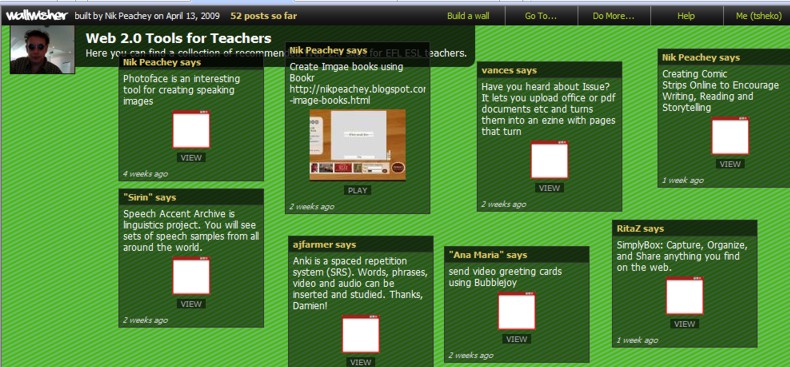
Wallwisher

I discovered Wallwisher when I came across Wallwishers created by Nik Peachey and Ackygirl through Ackygirl’s link.

Wallwisher

Looking through the FAQs, I discovered the following information about Wallwisher:

Wallwisher is an Internet application that allows people to express their thoughts on a common topic easily.

A wall is basically the ‘web page’ where people actually post messages.

You don’t need to sign up to use the Wallwisher, but you do need to provide an email address. A temporary account will be created for you using your email address so that you can come back and make changes to the wall.

Have a look at FAQs for more information about how to use Wallwisher.

You can also share the Wall, embed it in a website or organise an RSS feed for Wallwisher.

I like the collaborative aspect the best,  the fact that it looks better than a list, it links to things easily, and you can even embed a video.

It would be an excellent way to brainstorm ideas and collaborate for students and teachers alike.

What are your ideas on the potential of Wallwisher?

Our own process

I’ve been talking a lot about process in the learning journey, so it’s a little surprising that process has flown out the window for me in my conception of what our team is doing for the PLP (Powerful Learning Practice) project.

Tonight the Australian teams had a live meeting with Sheryl Nussbaum-Beach, and I decided to cast aside the old familiar feeling of being seen as the idiot in asking a question, a question which I probably should not have been asking so far into the session, but one which I was certainly glad I asked.

21st century learning is the theme for schools involved in the PLP learning journey, and each school presents their 21st century project to the entire cohort. I must say, I’m a little apprehensive (so what’s new?) about our project, as I explained during our Elluminate meeting tonight. Yes, we’re creating a ning, and the ning will be testament to what we’ve done using Web 2.o technologies, and to ways we’ve enhanced teaching and learning in the school. As I said to Sheryl and others, I don’t know if that’s enough. Maybe we’re just putting up disjointed projects, and we need a unifying one. Is the ning this unification? Do we need connections outside of the school?

Sheryl’s answer was loud and clear (and I had trouble keeping up with my notetaking, but it doesn’t matter because the session was recorded). She said that the project was not the ning, and we should stop thinking about it as the ning. The project is about the learning. It’s about what we are trying to change and accomplish in our school community, whether that ‘s building community, creating an awareness of 21st century learning, helping start conversations, etc.

It’s about the big goal.  We need to look and see what others have done, then work on developing a comprehensive action plan. Our team should be having regular discussions about how to manage change, and we should be looking at strong evaluation at the end of the journey. Have we accomplished what we set out to do? The success or lack of success is not the aim of the project, it’s the evaluation. Haven’t I been saying this to students all this time? I need to remember that I’m a learner first, and teacher second.

How will we prove mastery? Will we use computer-mediated analysis? Could we, for example, look at blog posts for evidence of teacher discussion? Could we track/count how many times people have posted? How are we going to measure our big picture project?

We need evidence of change and successes in the way teaching and learning happens in our school. We need to be able to show the principal and school leaders evidence and examples of how we’ve grown, how much we’ve shifted, and what we still want to do.

At the moment, I feel that we are still treading water. Good things are happening around the school, but we are yet to come together and have a deeper conversation. We are yet to fuse. I’d like to have more discussions, not just with individuals, but with the whole team. This is part of the process. Realising what isn’t happening, what needs to happen, is part of it. Our last meeting was productive, and we need to do that more often. It’s not easy, but it should be a priority.

Having thought about this overnight, I think we should focus on what we always tell our students –  QUESTIONS.  Too quickly we run to embrace answers, to set things in stone, convince ourselves we’re there. Questioning broadens the scope of our vision, helps to unpack and redefine.

As for me, I’m hoping that my lack of clarity at this point is a good sign that I’m still on the way.

Ever felt you’re waiting for the click?

Design a teacher education program

Jayson Richardson, an assistant professor in the Department of Educational Leadership, University of North Carolina-Wilmington, wrote an interesting post, Rethinking teacher preparation, on the ‘Education Futures’ website.  He said:

Let your mind wonder for just a moment. As yourself this question: If I could redesign an entire teacher education program, what would it look like?

Here is my vision of a teacher education program. I imagine a teacher preparation program that:

  • Challenges the individual. No one in this program would say “But I thought getting an education degree was easy!”
  • Is rigorous enough to attract intellectual, innovative, thought-leaders
  • Robustly develops a student’s ability to solve problem, become a critical thinker, and work collaboratively.
  • Is packed with upper level courses in history, ethics, mathematics, law, economics, policy, research, engineering, biology, anatomy, chemistry, and computer sciences (just to name a few).
  • Is academically challenging so that becoming a educator is professionalized at the level of doctors, lawyers, MBAs, etc.
  • Stresses global, national, and local issues. Students would not only understand where Cambodia is, but have some understanding of its politics, culture, history, and relationship to the rest of the world.
  • Mandates each student study abroad.
  • Mandates the individual gain proficiency in a foreign language.
  • Forces the pre-teacher to act on the tenants of social justice and peace education. This individual would be a skilled conflict mediator.
  • Produces teachers who are intercultural leaders.

How many of these points would you agree with? I wonder how many of these points are currently taught in teacher education programs?

I like the point about student teachers developing the ‘ability to solve problems, become a critical thinker, and work collaboratively.’ If we consider these skills important for our students, then we ought to do the same as teachers. Ideally, school programs and timetables should support teachers getting together, brainstorming ideas, solving problems and pooling their skills, knowledge and talents. Yes, we have teacher meetings, but how much of this time is taken up by the practical aspects of our work, and how much is devoted to a discussion of ideas, even just reflection about teaching experiences, what worked and what didn’t?

Although I don’t think overseas travel could ever become mandatory unless it was subsidised (yeah, right…), I do think we should stretch out to the world as much as we can. It’s easy to become isolated in Australia, and with tools such as Skype, blogging, Twitter, etc., it’s easy to make global connections, both for our own professional development (hey, that sounds formal and boring – for our own enjoyment!) and for the extension of our students’ experiences.

Which of these points do you consider important for teacher education?

What else would you add to this list?

Creativity, a sense of purpose and belonging

In his latest post (6 May), Will Richardson asks this question:

So when I read Jay Cross’s latest piece in CLO magazine, I wondered how many schools could point to someone, anyone, who is in charge of learning. By that I mean someone who manages the culture of the school by focusing not on outcomes as much as how learning is writ large in the system.

Learning is occurring at my school this week. Learning with a capital L. We are coming to the end of a pilot project where the entire Year 8 cohort, along with its teachers, has been involved in researching a big picture question culminating in a multimedia presentation of their choice.  Normal classes have been suspended, and each teacher has stepped into the continuum at different points, providing the support needed at that time. Teachers have been in a unique situation, supporting not content, but skills; and this often meant that they were learning alongside the students, at times from the students. The process seems to have taken on a life of its own, and teachers have reported being surprised that students’ projects are taking shape, and that they are on task and engaged, even excited.  Trust in the students’ abilities and creativity has been growing.

This is the part of the project that gets me going – the learning process of both students and teachers. This is what I hope we can record, make transparent, discuss collaboratively, reflect upon, project into the future with. I’ve been enjoying discussions with teachers at different stages of the project: the initial feeling of not knowing how to begin, being overwhelmed by the enormity of something new and big, the joy and relief with the first successful day, the surprise when students took the task and ran with it, in all different directions, in a variety of ways, the excitement upon seeing things take shape, and the anticipation of the final presentation.

I’d like to record all of this. I think that this discussion is the guts of the learning. It’s exciting to see shared discussion in a shared project, and I wish it would happen more often. For a change, the teachers are not in charge, they are facilitators, they are not in control, but are taking one step at a time, and trusting in the students, they are not keepers of the content, but observers of the process.

This is learning. I hope we can capture this for reflection and evaluation. We can base next year’s project on what we have observed, what we’ve learned. I hope we can come together for discussion, reflection and evaluation, modifying the assessment rubric from experience of what the process has involved. Teachers have been talking excitedly not of perfect products or best products, but of the learning leaps for individual students.

I read Will Richardson’s latest post (6 May) and he says

I wonder how many of us can look at our colleagues and answer the question “How does that person learn?” And think of the leaders in our schools in that light as well.

This week, Year 8 teachers have seen with new eyes how their students learn. I think they’ve had an insight into their own learning process. Learning has been shared by teachers and students alike.What does Will Richardson say about teachers’ learning? In discussing Jay Cross’s latest piece in CLO magazine, Will wonders if any schools have one person

 ‘who is in charge of learning. By that I mean someone who manages the culture of the school by focusing not on outcomes as much as how learning is writ large in the system. Someone who also understands the ways in which social Web technologies accentuate the need for the learning skills we’ve desired all along: creativity, critical thinking, independent thought, collaboration, etc…

And it really is about a culture that supports, celebrates and shares learning.

The Year 8 immersive project has given those involved a taste of the learning culture which supports, celebrates and shares learning.

In the article about Chief Learning Officers in companies, Jay recommends looking at the workplace through different lenses: from the point of view of the anthropologist, the Web 2.0 specialist, the informal learner.

Some of the questions posed through these lenses are:

From the anthropologist:

Are people sharing the information or are they just hoarding?

Are people taking time for reflection, or are they so busy they only live in the moment?

Are they experimenting and taking risks, or are they doggedly following the rules?

Are people working collaboratively or are they in isolation?

Through the Web 2.0 lens:

Are people using instant messaging, social networks, search engines and multimedia resources that are as good as or superior to those they are accustomed to in their homes?

Are discoveries recorded and shared with one another and documented for future use?

Do workers have blogs or other means to express themselves?

The informal learning lens:

Are there comfortable places for people to talk?

Are workers intrinsically motivated to learn and increase their professionalism, or are they waiting for their next class?

Is informal collaboration encouraged?

Are people learning from observing others… and reflecting on experience?

These are questions I’ve chosen which are most pertinent to the school situation. As Will says, do we or should we have a CLO in our schools,

 … people to lead that work, …  who understand deeply the passion-based, self-directed potentials for learning in a connected world, and the importance of a vision for true learner-centered classrooms and curricula for everyone in the building.

Do you have such leaders in your school?

(Now, I’m not sure about this, but it seems that the Chief Learning Officer is like our Training (or Learning) and Development Manager in Australia).

What’s it worth? A teacher’s beliefs.

Yesterday I unexpectedly leaped into a heated argument with a very close friend who had come to visit from interstate. It was one of those fires that flare up suddenly from a small spark, blazing fiercely long enough for onlookers to look alarmed and consider calling for help, and then burn down gradually, leaving those involved in a slightly shaky state, surveying the damage.

The offending spark was a question about why my friend’s daughter didn’t have Facebook, and if she did I’d be able to view her photos from the Ball she was attending that night. Remember, these friends live interstate.

Now, you can imagine, with a blazing argument, most of what goes on is reactive, and each person becomes locked in to a mainly defensive position, taking each comment personally and wanting to come back strongly enough to defend their position. There isn’t any room for thought or even fair appraisal of what the opponent has said. Luckily, the latter occurred as the fire burned down; concession and reconciliation was possible in the smouldering stage.

I can only speak for myself in this argument, and I will.

I reacted to my friend’s initial painting of Facebook and MySpace as bad places (which, I think, he must have said unconsciously, because he later denied it), places where, at best, young people wasted their time with inane conversations, and, at worst, young people exposed themselves graphically involved in the worst behaviour.

If I hadn’t been so defensive, I would have said that I’d been there not so long ago. I was initially against my older son interacting online, either msn or Facebook/MySpace. I gave many reasons, but one I pushed the strongest was that online interaction was not real, it was virtual. It was unnatural, it took away from the time spent with people face to face, it was potentially dangerous because it increased solitary time with virtual friends, etc. Why didn’t he use the phone if he wanted to talk to someone? How could he be ‘friends’ with all those people? That wasn’t friendship.

Funnily enough, these were some of the points my friend expressed, in between dodging my line of fire. I wonder (always wonder) when I’ll learn that the conversation ends when the other person feels attacked.

What has happened from the time I held my friend’s convictions and now? Several things. Instead of making conclusions about social networking and online environments from the outside, based on what I’d read, on media reports (which are mainly negative and engender fear in parents and teachers), I decided to play around with these things myself. What happened? I connected with people I hadn’t talked to for years (even decades), I saw photos of where they lived, saw status updates of what they were up to – no, not just what they had for breakfast –  they were about to become parents, or they were travelling overseas, etc. No, I didn’t have deep relationships with all of these people, but I did appreciate suddenly having a general view of what my ‘friends’ were up to, and many of these are scattered all around the world.

I also saw a different side to young people, definitely different to the picture that is often painted in the media, or even in conversations held by people who have little to do with adolescents or university-age students. I saw these people supporting each other with positive comments, engaging in humorous and often witty dialogue, planning events and meetings, putting out interesting links to things they had read or music they listened to, venturing to express opinions they might not in real life.

One of my main points in the aftermath of the argument was that social networking supports real-life interaction. The young people I observe are less isolated than I used to be at their age, not only because they can chat to a group of friends at home in between homework, but because they use these connections to meet up and do something together. They inititate interest groups, they gather friends for events, they learn to function as social beings – important skills for life and work. They do this because these spaces belong to them. They’re not forced to create a group and contribute to discussion; they choose to because of personal interest.

Which brings me to my next point. How much of this initiative and cooperation do we see in schools, in the classroom? Do we see discussion, do we see young  people sharing their interests and passions? Or do we see disengagement, boredom, solitary struggle in place of collaborative effort? Is there room for students to take initiative, pursue interests, work together to solve problems, get involved in real-world research and enquiry.

Are we getting the best out of our young people at school?

To finish my rave, yes! I agree with my friend that there is potential danger in online involvement. And I believe we should discuss these dangers. We should take every opportunity to educate our young people about the irreversible nature of what they put out the web. But we could also create a safe, online environment for them to use at home when they need help with homework, or when they want to share ideas for a project. A place they could become teachers as well as learners. An exciting place where they are enriched by the diverse contribution of others. Where they learn to respect each other. Where they are not afraid to ask questions.

As an educator, I’ve been pushing my boundaries, often painfully, against what I felt comfortable with. But I want to keep my eyes open, and I’m trying to re-evaluate constantly, and I know that I must do that if I’m to have any part in educating young people for their future. No, not going with all the latest fads, not embracing new things without thought, but thinking deeply, and listening to the dialogue in my own online network, asking the deep questions….

Teaching 21st century literacies

Howard Rheingold  has written an article for City Brights on 21st century literacies.  His opening paragraph asks essential questions for the future (and present) of education:

Will our grandchildren century grow up knowing how to pluck the answer to any question out of the air, summon their social networks to assist them personally or professionally, organize political movements and markets online? Will they collaborate to solve problems, participate in online discussions as a form of civic engagement, share and teach and learn to their benefit and that of everyone else? Or will they grow up knowing that the online world is a bewildering puzzle to which they have few clues, a dangerous neighborhood where their identities can be stolen, a morass of spam and porn, misinformation and disinformation, urban legends, hoaxes, and scams?

And here in a nutshell is the definition for 21st century literacies in plain English. What concerns me, and many others, is that the shift from traditional literacy to these 21st century literacies is not occurring in schools on any significant scale. An understanding of the critical need for a focus on these literacies isn’t happening from the top down, nor from the bottom up. And it’s not going to happen unless we, educators, step out of our teaching role and immerse ourselves in the 21st world as learners.

As far as I know, on the whole Australian schools still view online involvement for students as ‘a dangerous neighborhood where their identities can be stolen, a morass of spam and porn, misinformation and disinformation, urban legends, hoaxes, and scams?’ This is part of the reason for inaccessibility and filtering; for the rules prohibiting the use of online games and mobile phones at school. We talk about integrating technologies into the curriculum, but we still view these technologies as the enemy.

Perhaps many of us are uncomfortable about using new technology. We figure our students are naturals, that they’ll figure out the technology thing by themselves, better without us. Howard Rheingold questions the term ‘digital natives’ applied to our students:

Just because your teens Facebook, IM, and Youtube, don’t assume they know the rhetoric of blogging, collective knowledge gathering techniques of taggers and social bookmarkers, collaborative norms of wiki work, how to tune and feed a Twitter network, the art of multimedia argumentation – and, by far most importantly, online crap detection.

Rheingold makes it very clear how urgent it is for our students to be educated in 21st century literacies:

If you think that forgetting to teach your kids the facts of life is dangerous, wait until you witness the collision of a global superempowered infrastructure with a population of illiterate users.

There’s no mincing of words. According to Rheingold, our students will be illiterate if we don’t redefine our concept of literacy. What literacies are we teaching our students at present? Are these in line with the world in which they will live and work? We may not like digital media as much as our students, but isn’t our job as educators preparing them for their future? Their future is digital, global and networked. Digital literacy is not so much about the mechanics of digital tools; it is much more than that:

The most important critical uncertainty today is how many of us learn to use digital media and networks effectively, reasonably, credibly, collaboratively, civilly, humanely.

One of the commenters identifies the importance of teaching critical reading skills. Howard adds that ‘some, perhaps many, view critical thinking as a frivolous distraction from “the basics”… Others say that there is nothing new about this requirement’.  For teacher librarians, teaching critical reading and critical thinking has been part of their role for some time. As a teacher librarian,I find this problematic –  not the fact that we are delegated this teaching role, since we are ‘information specialists’, and our role must evolve in line with developments in the world of information – but that this teaching is seen as somehow separate from ‘the real curriculum’, that we come in for one lesson or two at most, and teach ‘information skills’ as discrete skills. We all know that this doesn’t work, that the integration of critical, digital literacies must be integrated fully in everyday teaching, and that curricular material must be selected with this teaching aim in mind. Our choice of medium must support the teaching of these literacies. If we use blogs, wikis or nings, it is not because we are ticking off our use of Web 2.0 technologies for the sake of being recognised as Web 2.0 savvy, it’s because we recognise that a networked learning  environment is the best way to prepare our students for their future. If we teach our senior students to critically evaluate newspaper articles and advertisements, shouldn’t we finally take the leap to teaching them the skills they need to navigate the deluge of online information?  They’re not reading editorials as much as they’re watching YouTube videos. Will they continue to get their news from newspapers? Or will they prefer real-time, real-people news reports on Twitter?

What are your thoughts? Let’s have a discussion.

Reblog this post [with Zemanta]

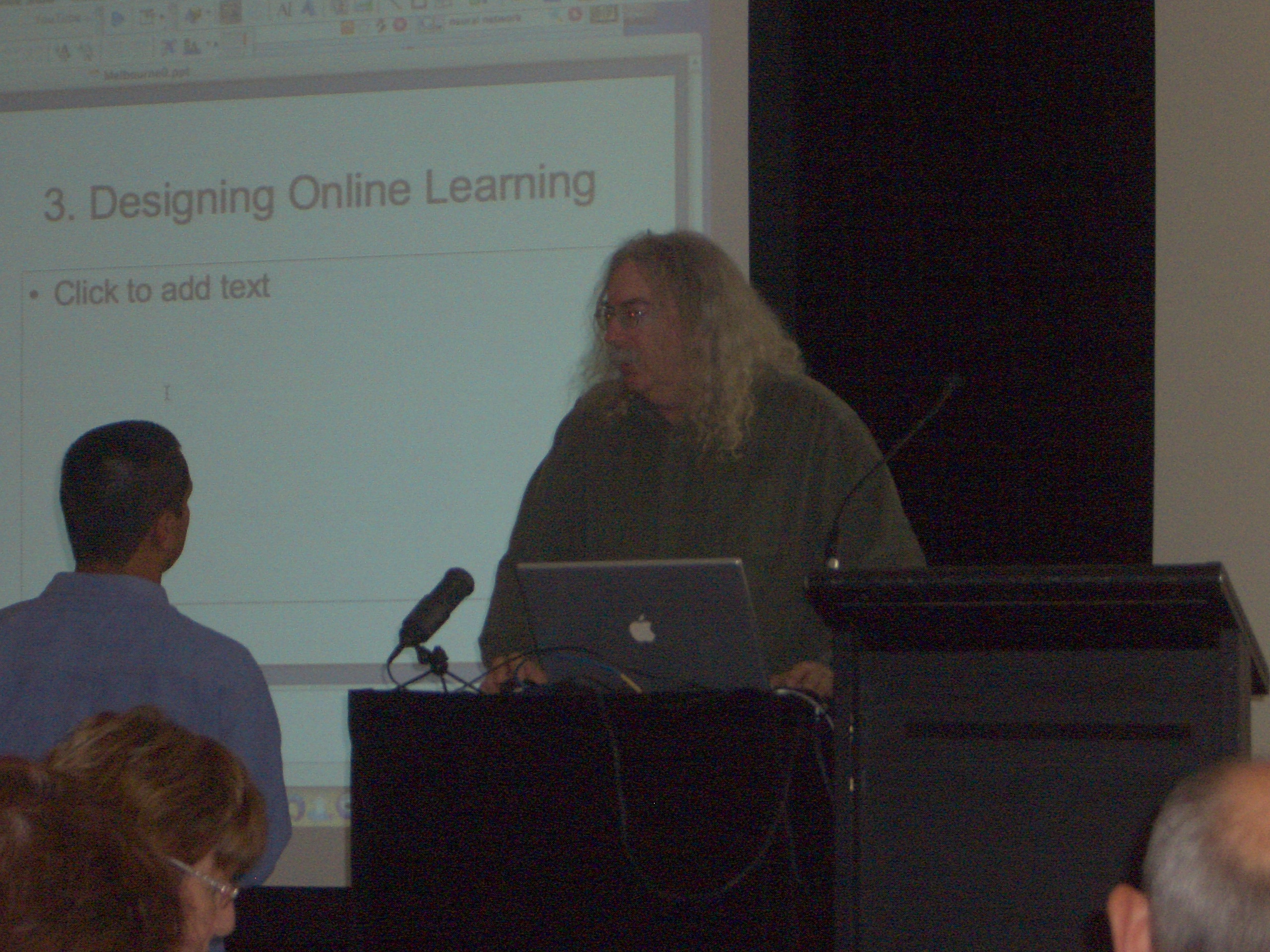
Stephen Downes in Melbourne

cimg68631

Why did I go to a professional event on the first day of my Easter holidays? Two words: Stephen Downes.

Stephen started by prompting reflection:

Reflect on how you learn in your job today?
How do you learn to use new technology and keep up with events and announcements? How do you learn new policies and procedures?

Then he made an interesting, perhaps controversial, comment. He said
there’s a distinction between the way we learn and the way learning is taking place in universities, etc.

What does that mean?

As I’ve mentioned earlier, my first-year uni son has confirmed for me that he learns in the same way that I did 30 years ago. Lectures and tutorials. Online forum? No. Sharing notes in Google docs? No. Creation of personal learning network using RSS, Delicious or Diigo, or Twitter. Absolutely not.

I know that some tertiary institutions are more progressive with online learning, but these are not the established, traditional ones so sure of their reputation that they forfeit self-assessment. Maybe I’m being unkind. After all, they provide experts. One expert per subject. Are the students learning how to learn in a global context where experts are scattered?

Stephen says we need interactivity in our learning; we need to learn from people. Instead of relying on traditional models of learning, we need to build our own interaction network, placing ourselves, not the content, at the centre.

I’m thinking about secondary school students. A teacher picks the content which is the agenda for learning. What about the interests, the passion of the individual student that could drive authentic learning? Isn’t there room for passion-driven learning in our curriculum?

Stephen says to employ a wide range of technologies to build our network. We need to pick and choose the technologies that are most comfortable to us. Pull is better than push, we should be able to choose our sources. He tells us to speak in our own voice and listen for authenticity; share our knowledge and our experiences, opinions.
We need to make networked learning a habit and a priority. He said someone had coined the phrase ‘interaction is like breathing for the brain’. If interaction isn’t provided, we have to make it ourselves, for example, if we’re at a lecture like this, we should blog it. Hence this post.

Stephen sees information and knowledge as people-centred. That is, we should bring knowledge in, but also translate it into our own way of seeing the world, and then share it, creating a network for people to remix in their own way. This is one of my favourite new concepts of knowledge – it evolves depending on who does what with it; we’re all unique, and so is our take on knowledge.

But how do we control knowledge as we pull it in? We simplify it, and summarise it in our own words, using our own vocabulary. Make it relevant to us, take what’s important to us now. Shouldn’t students be taught to learn this way?

And then it really got interesting. Stephen said, it’s better to shun formal lectures (certain irony here) in favour of informal learning, eg. the Google Reader approach to learning; learning from people we’ve decided we want to speak to us.

And what about this: Do connect to your work at home and on vacation but feel free to sleep at the office; most work environments are dysfunctional;your learning takes place when it takes place. Your best time might not be 9 to 5; ideas and learning happen when they happen.

And here’s one for those of you who, like myself, often feel overwhelmed by the flood of knowledge they’ve pulled down on themselves. You don’t want to assimilate all that knowledge. Let go, it will come back if it’s important; information is a flow, not a collection of objects.

Self-directed learning is a theme with Stephen. You and nobody else is reponsible for your own learning. These principles ought to inform how we teach as well as how we learn, and that’s what connectivism and Learning 2.0 is all about. Self-directed learning rejects passivity, so get up and walk out if what you’re hearing doesn’t interest you. Be pro-active; take responsibility for learning.

There’s a lot more to Stephen’s talk than I’ve managed to outline here. This will do from me.

Have a look at the Connectivism and Connective Knowledge Online Course. created by Stephen and George Siemens.

If I had to say one thing that I came out thinking about today, it would have to be that learning is personal, and that we must be pro-active about finding, organising and creating our own knowledge, about what we learn and who we learn from. And in this way, if we learn transparently, we model learning for our students.