The new language – it’s more than just smiley faces

I was just reading Silvia Tolisano’s post on her Langwitches blog about 21st century writing.

My children (16, 18, 20) are writing more and more. Their friends do too… Probably not in the way some of you can imagine… nor think of as writing…but nonetheless they are writing. They are texting… 8000 texts (per month) sent and received… Can you imagine probably 5-10 words on average per text…40,000 -80,000 words per month: A collaborative monthly story of their lives in WRITING!

Silvia quotes the US National Council of Teachers of English:

Good writing may be the quintessential 21st century skill.

Just as the nature of and expectation for literacy has changed in the past century and a half, so has the nature of writing. Today people write as never before—texting, on blogs, with video cameras and cell phones, and, yes, even with traditional pen and paper.  People write at home, at work, inside and out of school.

How has this impacted on the ways that we teach writing in our classrooms? From what I’ve seen in my parts in Australia, not at all. Seriously. We still focus solidly on textual responses and evaluations. As important as these are to critical thinking and understanding of contemporary issues and literary texts, writing has taken off in a life of its own mainly outside of school. Have we considered this kind of writing at all? Are we only concerned that adolescent texting will result in the complete disintegration of language? Well, why aren’t we talking about it?

Last night I read about Jenny Luca’s  talented young daughter in her post A story about longing, loving and coming to a realisation.

I am one very proud mother tonight. This is the work of my beautiful daughter; it’s her multimodal creative response for an English assignment based around the theme of ‘Romance and Relationships’. It’s all her own work, inspired by thepoet Rives and his ‘Story of mixed emoticons‘ that we used as stimulus material in our English classes.

I just love Jenny’s daughter’s modern take on a love story where she uses emoticons so creatively while developing an engaging storyline. I just wanted to share this because I think it shows that ingenuity and ideas can be expressed through any kind of language. If you’re sceptical you may be imagining the Bible written in emoticons, but that’s not what I’m suggesting. I’m suggesting that we open up our classroom tasks to include a richer variety of options so that young people can find a medium they can relate to.

Without further ado, here’s Jenny’s daughter’s story

[youtube=http://www.youtube.com/watch?v=OHMWb7r9snE]

And here is Rives’ TED talk which inspired this piece.

[youtube=http://www.youtube.com/watch?v=eYyN_6GmzWI]

How does my Art wiki grow

My art wiki is growing fat in places. I thought I’d point to the areas which have expanded the most in the hope of reaching Visual Arts teachers and students.

The blogs page in Blogs and Nings has really expanded. Blogs are my favourite way of finding art resources since they often represent specialised interest areas. It’s a very personal and rich way of discovering art. Blogs are  a labour of love, expressing the unique personality of the author. I can’t think of a more inspiring way to learn.

Here are some examples:

Roberto Bernardi, La Tavolozza , 2010, oil on canvas, 22 x 30″
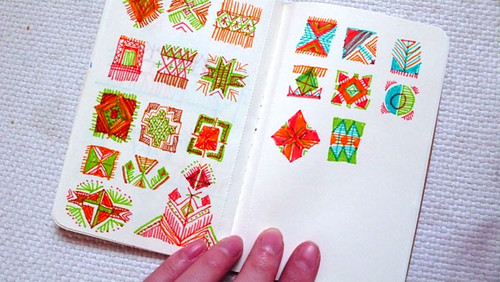
100 best art blogs Massive list here divided into useful sections (you might have to give up your day job for this)
Art Studio Secrets Some very practical video demonstrations (under ‘Demonstrations’)
Art in the real world “In The Real Art World” alerts you to the best exhibitions of representational “realism” which are on at the moment anywhere in the world.
Sketchcrawl A communal blog for compulsive sketchers
Ephemera assemblyman A beautiful blog of many different examples of art, illustration, design and more.
Urban sketchers This blog features sketches and often equally colorful stories behind the scenes by invited artists correspondents in more than 30 countries around the world. Some are architects and illustrators, others are graphic designers, web developers, painters or educators, all sharing the same passion for drawing on location.
Samuel Michlap Concept artist, illustrator, fine artist and more.
Painting perceptions Perceptual painting is painting life from a personal vision and experience not just recording appearance. As Cézanne said, “Painting is nature seen through a temperament.”
Lines and colors Lines and Colors is a blog about drawing, sketching, painting, comics, cartoons, webcomics, illustration, digital art, concept art, gallery art, artist tools and techniques, motion graphics, animation, sci-fi and fantasy illustration, paleo art, storyboards, matte painting, 3d graphics and anything else I find visually interesting.
Paper forest showcasing great paper stuff, 2D, 3D and animation.

[youtube=http://www.youtube.com/watch?v=c0vZ_TMCeBM]

The Image/Flickr page is bursting with links to wonderful sharing people on Flickr – a cornucopia of imagery to inspire students looking for ideas in different media and styles.

Here’s a small sample:

by Irina Troitskaya on Flickr

Guggenheim Museum’s flickr sets
Flickr photostream by laura@popdesign Laura writes the Animalarium blog.
Flickr origami set2by Eric Gjerde
Flickr origami setby Eric Gjerde
All Eric’s origami and tessellation sets are
here.See Eric Gjerde’s website Origami tessellations
Art21’s flickr photostream
Bibimorvarid’s Art&Design set
Bibimorvarid’s photostream
Papercraft and mail art– by Corduroy Cat
Altered playing cards by Corduroy Cat.
Atcs and inchies by Corduroy Cat.
Corduroy Cat’s contacts and groups on Flickr (lots of stuff to explore here)

The Images/Design page is another rich resource; here are only some of the links:

Ernst Haeckel, Kunstformen der Nature


Blickfang – the eye-catching covers of Weimar Berlin.
Thirty book covers from Poland (from A Journey From My Skull)
Kunstformen der Natur (art forms of nature) by Ernst Haeckel (flickr set saved by Eric Gjerde)
The Grammar of Ornament by Owen Jones. Eric Gjerde has scanned this book and shared it on Flickr.
Styles of Ornament by Alexander Speltz. Tessellation related photo plates from Alexander Speltz’s 1906 book, “Styles of Ornament”. Eric Gjerde has scanned this book and shared it on Flickr.
Digital library for the decorative arts and material culture
Great style illustrations by Iv Orlov
Typographic art
Design Online: Design Online is an electronic library from the University of the Arts, London, containing a digitised record of Design magazine for the years 1965 to 1974. There are around 100 pages in each magazine, which are available as full screen size black-and-white or colour images.

Erwin Poell

There’s so much animation out there,   I love collecting examples. Amazing creativity to be discovered in this section, and fun to watch.

Phosphoro – is an award-winning student 2D animation (Read about it here. )

[youtube=http://www.youtube.com/watch?v=gjt46NsFseU&feature=player_embedded]

Of course, the wiki contains much, much more than this.  Some sections are more comprehensive than others, but you can be sure that I’m always on the lookout for new resources to support the teaching and learning of Art-related studies.

Why don’t you have a look for yourself?


Is our own education system like Hogwarts?

Is it just me or is this scene reminiscent of our own education systems?

From now on you’ll be following a carefully structured, ministry approved course.

I can’t imagine why you’d need to use spells in my classroom; you’ll be learning in a secure, risk-free environment.

What use is that when we’re going to be attacked? It won’t be risk free.

It is the view of The Ministry that a theoretical knowledge will be sufficient to get you through your examinations which, after all, is what school is all about.

And how is theory supposed to prepare us for what’s out there?

There is nothing out there!

See the parallels with our own school system, specifically with regard to preparing our students for the digital age?

Who’s still saying

There’s nothing out there?

Edit or post now?

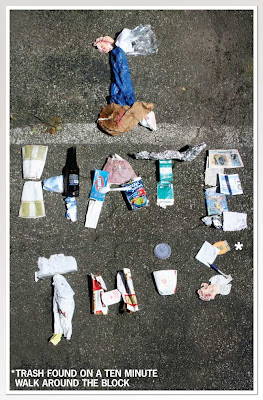
Chris Beesley is a graphic designer/illustrator living in Fairfield, Conneticut. His post, Seeking balance in a self-imposed spotlight,  raises a question relevant to bloggers, although he writes specifically as a graphic designer.

Here’s my big question; do I post more raw materials that haven’t been fully vetted yet, accepting that some may be real garbage and I may get judged as such? Or do I hold back most of the untried pieces until I’ve had an opportunity to really think about them, accepting the fact that some of the good stuff may never see daylight?

Chris posted this photograph to make a point about the rubbish he’d picked up around his neighbourhood while on a walk.

Looking back I’m glad I posted it, and I still believe that the poster was a good idea but there are definitely some things I might have changed had I waited.

Obviously, Chris is talking about his reputation based on the quality of his work, but his questions reminded me of the dilemma facing bloggers in general – with so much flying in from social media, do you go with your desire to get something out there while it’s current, and while your ideas are fresh, or do you wait until you’ve carefully edited your post?

Are blog readers more forgiving, not expecting the same quality of writing and thinking as they would from newspapers, magazines and journals?

It’s obvious that my posts would fail if assessed as coherent, well planned and properly researched writing, but aren’t blogs intrinsically more informal?

I really like Chris’ photo – mainly for its concept; it’s clever. I like the fact that he threw it together on the spot following his idea. There’s something to be said for this kind of spontaneous post.

Don’t you think?

Copyright kills creativity and culture

Can people ever be original again?

And what kind of future do we have if we can copy and paste, download and remix almost everything but we get into trouble for it?

I came across a very interesting documentary in a blog post on Brain Pickings. It’s 24 minutes long but well worth watching.

a new documentary from Yale Law & Technology, offering 24 densely compelling minutes of insight into various facets of intellectual property in the age of remix. From appropriation to sampling to creative influence to reuse, the film is an anthology of conversations with some of today’s most notable remix artists and media theorists, exposing the central paradox of contemporary copyright law: How can something originally intended to incentivize people to create serve to hinder new forms of creativity?

[vodpod id=Video.3661499&w=425&h=350&fv=]

more about “Walking on Eggshells: Borrowing Cultu…“, posted with vodpod

I’ve pulled out some of the ideas in the video which resounded with me –

  • You’re only aware of a portion of your influences at a time. Things work through you; you’re not always in control, and when you create something, it’s in the world and others can use it.
  • everything is cannibalising itself, eating itself (interesting way of putting it)
  • postmodernism is the end of everythingL meaning collapses under the weight of too many perspectives. With the internet, everything happens faster and faster. You’re not living in a real way, you’re experiencing references.
  • music is every tune you’ve ever heard pulled out and mixed together.
  • Remixing is like using the remote control, flipping through stuff. Remixing is like flipping through culture.
  • Look at all the references in Bugs Bunny; we always knew there were references even if we didn’t fully get them.
  • If copyright was applied to Bach, Beethoven, etc. they’d all be in trouble.
  • Now, in the recording age, music is not to be made – it’s to be consumed.

Here’s an interesting discussion of the emerging remix culture with Lawrence Lessig, founder of Creative Commons, acclaimed street artist Shepard Fairey, whose iconic Obama “HOPE” poster was recently acquired by the National Portrait Gallery, and cultural historian Steven Johnson, whose new book, “The Invention of Air,” argues that remix culture has deep roots in the Enlightenment and among the American founding fathers.

[youtube=http://www.youtube.com/watch?v=jybMQQblE-8&feature=player_embedded]

We have so much rethinking to do. It often seems that our thinking got stuck in the nineteenth century. Social media has enabled access, sharing and remixing of so much, surely we need to think of possibilities and not restrictions.

We can’t invent new colours, but we can work with a varied palette to create our own vision.


Whose job is it to teach responsible online behaviour?

Everybody’s talking about it: online behaviour.

We’ve come around, finally and reluctantly, on the whole, to accepting that social media is part of our world, young people as well as adult. Even television shows and radio stations are tweeting and blogging – how more mainstream can you get?

On the negative side, we also hear about  bad behaviour online, and the confusion arising from changes to privacy, particularly on Facebook. Many people have spoken out about what needs to be happening in schools, including Jenny Luca and Will Richardson. There are many passionate responses to Facebook’s handling of privacy on the web.

Some people are leaving Facebook.

Some people are staying.

It’s interesting that morning programs on television are often featuring conversations about social media, Twitter and Facebook in particular. This morning Channel 7’s morning program featured a spokeswoman talking about Facebook privacy and the inappropriate content that was being shared outside the users’ immediate circle of Facebook friends. I was surprised that the tone was reasonable, and many interesting points were raised, for example, the question as to why people post strong and even abusive comments to people on Twitter when they wouldn’t behave that way if they met these people face to face.

That’s the difference – face to face interaction compared to faceless interaction. Facebook, ironically, is faceless. When we get involved in a passionate discussion we may be talking to friends of friends who are faceless to us. We don’t expect to meet them, and we don’t exercise the same caution that we would if we knew we’d be seeing them in person. It’s the same with road rage.

For me, that’s the message we need to get out to students. Don’t get me wrong – I’m an advocate of the connective power of social media, but I think that students should be reminded that while they are chatting with ‘friends’ in the privacy of their bedrooms, their conversations are very public.

Facebook is very easy to use. It’s easy to add friends, photos, applications, become fans and group members. But it isn’t easy to wade through the new privacy regulations. Even with a manual it confuses me. And it’s not something young people (or anyone) are likely to do any more than they would happily peruse a legal document. Changes occur without enough notice, it’s easy to let it all go and hope for the best.

The Australian government’s cybersafety program directed by The Australian Communications and Media Authority has published units of work designed to teach responsible online behaviour.

But who is responsible for teaching this? Will it be taught by the few educators who have independently decided it’s important, or across the school following a directive from principals?

I worry that while primary schools may consider this an essential part of the curriculum, just as they educate children about bullying, drug-taking, etc., secondary schools may be confused as to whose role this is.  It may not fit into an already overcrowded curriculum. It may be perceived that secondary students are old enough to be responsible or that what they do in their private time is no concern of the school.

I would like to run parent sessions on Facebook, but it’s blocked for staff and students in our school. The leaders of our school have made this decision in the best interests of our students. Fair enough, but have they thought the issue through? Blocking Facebook at school prevents education. It indicates serious handwashing.

Parents are talking about feeling helpless and ignorant when it comes to their children’s online activities. We could say that they should monitor their children’s Facebook activity, but until what age? Try monitoring a 16 year old and see what happens.

Parents should be educated but then so should school leaders and teachers. The only way to understand something is to get into it and see how it works. It’s not a matter of saying ‘it’s not for me’; we can’t afford to say that anymore. We can’t keep blaming parents, schools, the government.

I remember a primary school principal once saying that what the students did out of school wasn’t his responsibility (when I raised the issue of pornography sites being passed around online). We can no longer separate school and home. Online interaction out of school spills into school interaction.

We are all responsible. We should all become educated. We should all educate where appropriate.

Images can change the world

Recently I came across this TED talk by co-founder of Getty Images, Jonathan Klein. Jonathan Klein talks about how images have the power to shed light on understanding, to transcend borders, religions, and to provoke us to take action. It’s a powerful talk using powerful images.

[ted id=826]

Although we’ve used images as communication since the beginning of time, it seems that our use of images has increased with services like YouTube, Flickr and other image-sharing applications. The internet enables easy access to images through online museums, image libraries and image-based search engines.

How much more powerful and persuasive is a cleverly created film compared to a similar text?

Currently this advertisement is showing on TV; I think it’s very clever.

[youtube=http://www.youtube.com/watch?v=Zk4TzacO7Rk]

And how amazing is it to see a video of historical event?

[youtube=http://www.youtube.com/watch?v=wss_urnuB7o]

What’s an example of powerful imagery or film that you’d like to share?

Pass the blog (quickly,it’s hot!)

As much as I enjoy writing blogs, I love reading them. There’s nothing more exciting than discovering a new blog – a new voice, source of ideas and information.

Just today I noticed that Bright Ideas Blog – a blog many of us have at the top of their reading list – has kindly included my blog in a list of blog nominations.  It’s a ‘pass the parcel’ kind of activity, at the end of which we all end up with an enormous list of new blogs to investigate. Wonderful!

I’ve found out from What Ed Said that ‘it’s part of an initiative called ‘Vale a pena ficar de olho nesse blog’, which means ‘It’s worth keeping an eye on this blog’. Great idea.

For those I am awarding below, here are a few rules to follow:

1- Copy and display the picture of the award given to you;

2- Link back to the blog that nominated you;

3- Nominate 10 different blogs yourself;

4- Inform the people you nominated, so they can in turn, continue the chain and spread the word about other great blogs out there.

My Google Reader is bursting at the seams and needs house-cleaning. I revise it fairly regularly  to keep it relevant to my needs. Over time, my reading focus changes.

Whereas I enjoyed educational blogs with a technology focus initially, now I read these less, since I discover new technologies in Twitter and Facebook.

Whereas I used to read The Great Bloggers, the big guys, I now also like to read the less well known bloggers who might have more time for face to face teaching and so share detailed experiences of what works and what doesn’t.

Whereas I used to read like-minded blogs, now I enjoy reading different voices to push my thinking.

Whereas I used to read education blogs only, blogs about the future of education, or blogs about my own subject areas, eg literature and languages,  now I’m discovering terrific science, maths, art, animation blogs.

I think the best thing about blogs is that they have a voice. Unlike professional, formal, peer-reviewed information, blogs reflect the author. Reading the blog means getting to know the person with the voice.

I had trouble selecting these blogs, keeping to the limit.  In no order whatsoever, and not all of these what you would call educational blogs:

Lisa Hill’s literature blog – ANZ LitLovers LitBlog

The Animation Blog

BibliOdyssey (Books, illustrations, science, history, visual materia obscura).

Art21 blog an amazing art resource for education

Urban Sketchers

Urban Sketchers is a nonprofit organization dedicated to raising the artistic, storytelling and educational value of location drawing, promoting its practice and connecting people around the world who draw on location where they live and travel. We aim to show the world, one drawing at a time.

The Daring Librarian – Gwyneth Jones – Twitter bio: The Daring Librarian: Celt. Teacher Librarian & Technology Specialist. Redhead. Digital Collaborator. Victorian Steampunk. Second Lifer. Goofball.

Sean Nash at Nashworld Must always mention Sean Nash – nobody else like him

CMIS Fiction Focus I trust this blog to keep me up to date with books and reading for our young people

Steve Collis on HappySteve – Love this blog, fingers in many pies and fun to read.

New blogger – Nicholas Cowall: Music solo performance at Braemar (Nicholas has recently burst into the blogosphere with energy and passion; an example to all teachers. AND he has a schedule which is not for the faint-hearted, so he puts to shame those who claim not have time for blogging and the like.)


Button up, we’re out in the open

css.php