Google image search on the fly

Google’s new experimental Similar Images feature in Google Labs has improved image searching with the addition of ‘similar images’, allowing you to narrow your search and change your mind on the fly. Have a look here. It’s in its experimental stages.

[youtube=http://www.youtube.com/watch?v=6fD2t4d2Ln4&feature=player_embedded]

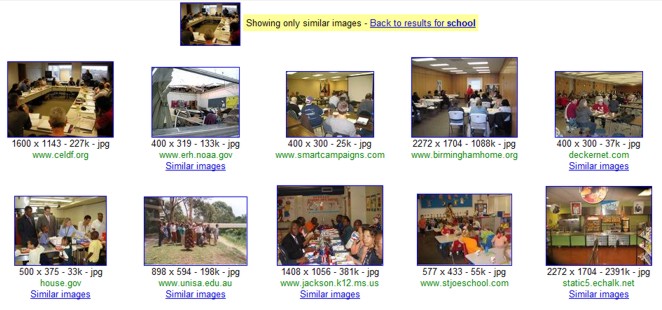
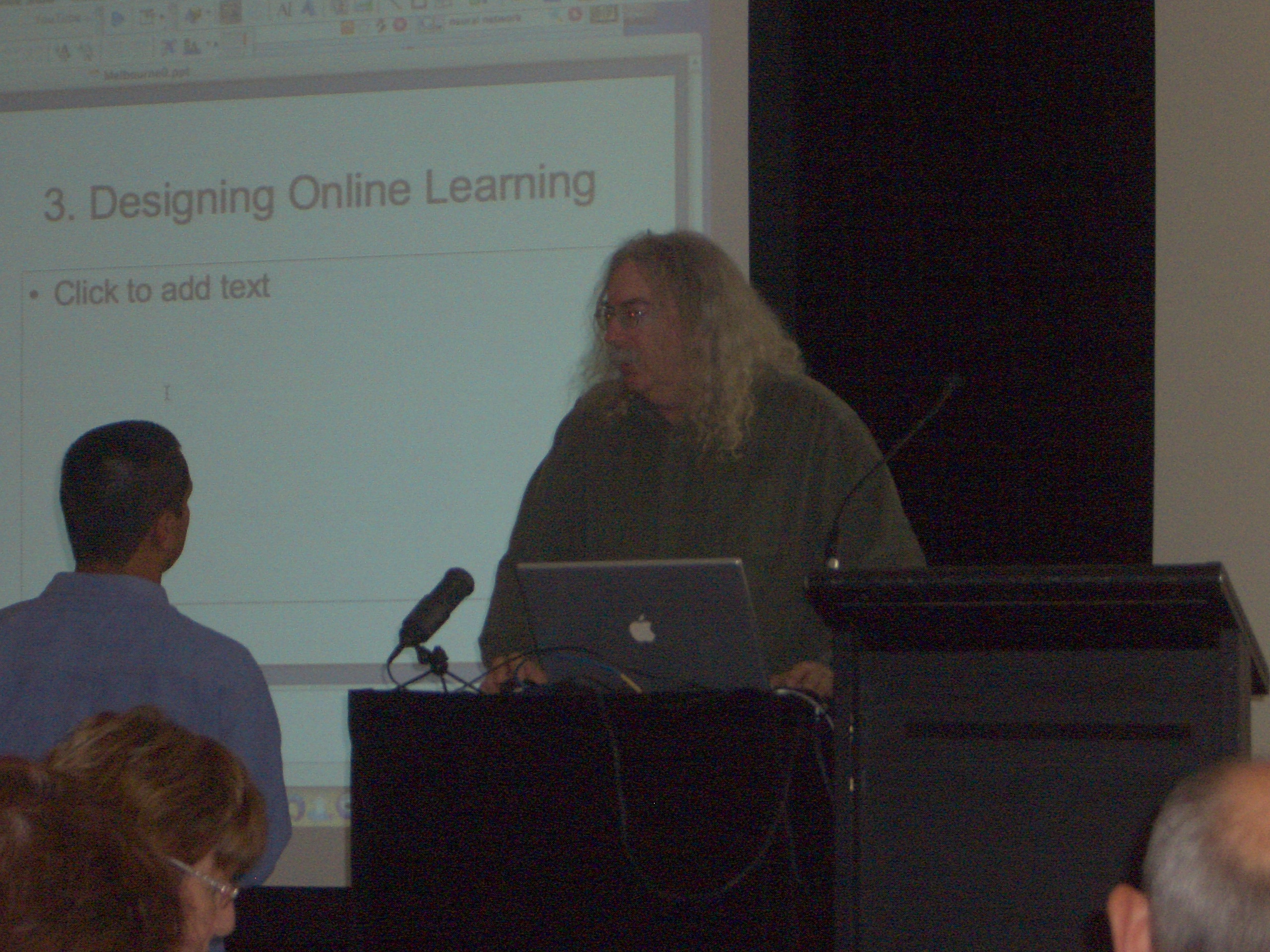
I searched ‘school’ and, predictably, got all types of ‘school’ images.

googleimagesearch1


What I specifically wanted was images of classroom interiors so I clicked on ‘similar images’ under the one result.

googleimageschool

I think this is an easy way to get rid of unwanted results and refine your search.

What do you think?

TED talks wiki

If you enjoy TED talks on video, feast your eyes on the TED talks wiki, which is like a cornucopia of TED, an overabundance of these tantalising talks.  Getting through these all might take you – lets see, say about …. a year!

The talks are searchable by speaker, or you can search by first name of speaker alphabetically.

Since I’ve just blogged about Howard Rheingold, I thought I’d use him as an example of the quality of these talks. His talk, Way-new collaboration, is about the coming world of collaboration, participatory media and collective action — and how Wikipedia is really an outgrowth of our natural human instinct to work as a group.

The TED talks site also gives you a summary of the speaker’s biography as well as a link to more details. Here is Howard Rheingold’s bio:

Writer, artist and designer, theorist and community builder, Howard Rheingold is one of the driving minds behind our net-enabled, open, collaborative life.  

The site also lists other talks in the series or on the same theme, as well as related theme, and related tags. Altogether, it’s an excellent way to hear experts and inspirational speakers talk about a large variety of topics. It’s also an excellent way to discover interesting people. It’s easy to keep up with the latest talks; you can subscribe to the TED newsletter, or subscribe to RSS feeds.

It’s wonderful how much variety there is within a theme. Tales of invention includes the following topics and more:

Legendary designer Philippe Starck‘s lively ruminations on his own creative process suggest how the patterns of a civilization might affect, say, the design of a citrus juicer. Jan Chipchase investigates the worldwide impact of mobile phones — and the impact of culture on next-generation mobile technology. Explorer and adventurer Bill Stone, meanwhile, fires up a rapt audience with his ambitious plan to harvest energy from the moon.

Copyright lawyer Larry Lessig gives a brief history of creative freedom and copyright, and talks about how contemporary copyright law could strangle future artistic invention and interpretation. William Kamkwamba tells how he built a windmill from scrap metal when he was 14 years old. And Amy Smith shares her transformative low-tech tools for saving life in the developing world.

As usual, the comments are an interesting continuation of the conversation.

I’ll leave you with Larry Lessig, one of our foremost authorities on copyright issues, with a vision for reconciling creative freedom with marketplace competition.

[ted id=”187″]

Reblog this post [with Zemanta]

Teaching 21st century literacies

Howard Rheingold  has written an article for City Brights on 21st century literacies.  His opening paragraph asks essential questions for the future (and present) of education:

Will our grandchildren century grow up knowing how to pluck the answer to any question out of the air, summon their social networks to assist them personally or professionally, organize political movements and markets online? Will they collaborate to solve problems, participate in online discussions as a form of civic engagement, share and teach and learn to their benefit and that of everyone else? Or will they grow up knowing that the online world is a bewildering puzzle to which they have few clues, a dangerous neighborhood where their identities can be stolen, a morass of spam and porn, misinformation and disinformation, urban legends, hoaxes, and scams?

And here in a nutshell is the definition for 21st century literacies in plain English. What concerns me, and many others, is that the shift from traditional literacy to these 21st century literacies is not occurring in schools on any significant scale. An understanding of the critical need for a focus on these literacies isn’t happening from the top down, nor from the bottom up. And it’s not going to happen unless we, educators, step out of our teaching role and immerse ourselves in the 21st world as learners.

As far as I know, on the whole Australian schools still view online involvement for students as ‘a dangerous neighborhood where their identities can be stolen, a morass of spam and porn, misinformation and disinformation, urban legends, hoaxes, and scams?’ This is part of the reason for inaccessibility and filtering; for the rules prohibiting the use of online games and mobile phones at school. We talk about integrating technologies into the curriculum, but we still view these technologies as the enemy.

Perhaps many of us are uncomfortable about using new technology. We figure our students are naturals, that they’ll figure out the technology thing by themselves, better without us. Howard Rheingold questions the term ‘digital natives’ applied to our students:

Just because your teens Facebook, IM, and Youtube, don’t assume they know the rhetoric of blogging, collective knowledge gathering techniques of taggers and social bookmarkers, collaborative norms of wiki work, how to tune and feed a Twitter network, the art of multimedia argumentation – and, by far most importantly, online crap detection.

Rheingold makes it very clear how urgent it is for our students to be educated in 21st century literacies:

If you think that forgetting to teach your kids the facts of life is dangerous, wait until you witness the collision of a global superempowered infrastructure with a population of illiterate users.

There’s no mincing of words. According to Rheingold, our students will be illiterate if we don’t redefine our concept of literacy. What literacies are we teaching our students at present? Are these in line with the world in which they will live and work? We may not like digital media as much as our students, but isn’t our job as educators preparing them for their future? Their future is digital, global and networked. Digital literacy is not so much about the mechanics of digital tools; it is much more than that:

The most important critical uncertainty today is how many of us learn to use digital media and networks effectively, reasonably, credibly, collaboratively, civilly, humanely.

One of the commenters identifies the importance of teaching critical reading skills. Howard adds that ‘some, perhaps many, view critical thinking as a frivolous distraction from “the basics”… Others say that there is nothing new about this requirement’.  For teacher librarians, teaching critical reading and critical thinking has been part of their role for some time. As a teacher librarian,I find this problematic –  not the fact that we are delegated this teaching role, since we are ‘information specialists’, and our role must evolve in line with developments in the world of information – but that this teaching is seen as somehow separate from ‘the real curriculum’, that we come in for one lesson or two at most, and teach ‘information skills’ as discrete skills. We all know that this doesn’t work, that the integration of critical, digital literacies must be integrated fully in everyday teaching, and that curricular material must be selected with this teaching aim in mind. Our choice of medium must support the teaching of these literacies. If we use blogs, wikis or nings, it is not because we are ticking off our use of Web 2.0 technologies for the sake of being recognised as Web 2.0 savvy, it’s because we recognise that a networked learning  environment is the best way to prepare our students for their future. If we teach our senior students to critically evaluate newspaper articles and advertisements, shouldn’t we finally take the leap to teaching them the skills they need to navigate the deluge of online information?  They’re not reading editorials as much as they’re watching YouTube videos. Will they continue to get their news from newspapers? Or will they prefer real-time, real-people news reports on Twitter?

What are your thoughts? Let’s have a discussion.

Reblog this post [with Zemanta]

Stephen Downes in Melbourne

cimg68631

Why did I go to a professional event on the first day of my Easter holidays? Two words: Stephen Downes.

Stephen started by prompting reflection:

Reflect on how you learn in your job today?
How do you learn to use new technology and keep up with events and announcements? How do you learn new policies and procedures?

Then he made an interesting, perhaps controversial, comment. He said
there’s a distinction between the way we learn and the way learning is taking place in universities, etc.

What does that mean?

As I’ve mentioned earlier, my first-year uni son has confirmed for me that he learns in the same way that I did 30 years ago. Lectures and tutorials. Online forum? No. Sharing notes in Google docs? No. Creation of personal learning network using RSS, Delicious or Diigo, or Twitter. Absolutely not.

I know that some tertiary institutions are more progressive with online learning, but these are not the established, traditional ones so sure of their reputation that they forfeit self-assessment. Maybe I’m being unkind. After all, they provide experts. One expert per subject. Are the students learning how to learn in a global context where experts are scattered?

Stephen says we need interactivity in our learning; we need to learn from people. Instead of relying on traditional models of learning, we need to build our own interaction network, placing ourselves, not the content, at the centre.

I’m thinking about secondary school students. A teacher picks the content which is the agenda for learning. What about the interests, the passion of the individual student that could drive authentic learning? Isn’t there room for passion-driven learning in our curriculum?

Stephen says to employ a wide range of technologies to build our network. We need to pick and choose the technologies that are most comfortable to us. Pull is better than push, we should be able to choose our sources. He tells us to speak in our own voice and listen for authenticity; share our knowledge and our experiences, opinions.
We need to make networked learning a habit and a priority. He said someone had coined the phrase ‘interaction is like breathing for the brain’. If interaction isn’t provided, we have to make it ourselves, for example, if we’re at a lecture like this, we should blog it. Hence this post.

Stephen sees information and knowledge as people-centred. That is, we should bring knowledge in, but also translate it into our own way of seeing the world, and then share it, creating a network for people to remix in their own way. This is one of my favourite new concepts of knowledge – it evolves depending on who does what with it; we’re all unique, and so is our take on knowledge.

But how do we control knowledge as we pull it in? We simplify it, and summarise it in our own words, using our own vocabulary. Make it relevant to us, take what’s important to us now. Shouldn’t students be taught to learn this way?

And then it really got interesting. Stephen said, it’s better to shun formal lectures (certain irony here) in favour of informal learning, eg. the Google Reader approach to learning; learning from people we’ve decided we want to speak to us.

And what about this: Do connect to your work at home and on vacation but feel free to sleep at the office; most work environments are dysfunctional;your learning takes place when it takes place. Your best time might not be 9 to 5; ideas and learning happen when they happen.

And here’s one for those of you who, like myself, often feel overwhelmed by the flood of knowledge they’ve pulled down on themselves. You don’t want to assimilate all that knowledge. Let go, it will come back if it’s important; information is a flow, not a collection of objects.

Self-directed learning is a theme with Stephen. You and nobody else is reponsible for your own learning. These principles ought to inform how we teach as well as how we learn, and that’s what connectivism and Learning 2.0 is all about. Self-directed learning rejects passivity, so get up and walk out if what you’re hearing doesn’t interest you. Be pro-active; take responsibility for learning.

There’s a lot more to Stephen’s talk than I’ve managed to outline here. This will do from me.

Have a look at the Connectivism and Connective Knowledge Online Course. created by Stephen and George Siemens.

If I had to say one thing that I came out thinking about today, it would have to be that learning is personal, and that we must be pro-active about finding, organising and creating our own knowledge, about what we learn and who we learn from. And in this way, if we learn transparently, we model learning for our students.

9 great reasons why teachers should use Twitter

twitterforteachers


Laura Walker posted 9 great reasons why teachers should use Twitter.

Twitter is often represented as a facile activity for people who have nothing better to do than given minute by minute reports on what they had for breakfast or what TV show they were watching. In fact, that’s missing the point that many other people are getting.  Take the time and effort to build a Twitter community of people who share your interests, as well as people who push your boundaries for good debate, and you’ve got a forum for life.

The nine reasons that Laura Walker gives for why teachers should use Twitter are:

  1.  Together we’re better
  2.  Global or local
  3. Self-awareness or reflective practice
  4. Ideas workshop and sounding board
  5. Newsroom and innovation showcase
  6. Professional development and critical friends
  7. Quality-assured searching
  8. Communicate, communicate, communicate
  9. Getting with the times has never been so easy!

Go past the points and look into the meat of Laura’s reasons. Don’t be  put off by all the negative press; find out for yourself.

Student bloggers speak out eloquently

On the blog Free resources from the net for special education Paul Hamilton has written a very interesting post sharing his views on student blogging in Jan Smith’s grade 6 class, and a video where he interviews his students about their blogging. If you have any doubts about the value of student blogging, then watch this video. You’ll meet students with different capabilities and interests, explaining what they have learned from blogging. They’re very expressive and specific about how their writing has improved with blogging – and not all of these students like writing. You’ll also notice that they’re able to focus on their special interests and passions in their blog writing, and you’ll see how much work they’ve put in with research and visual presentation, and how proud they are of their efforts. It confirms for me what I’ve been raving about of late – that learning occurs when it’s student-driven, passion-driven, and authentic, with an audience consisting not only of the teacher, but of peers and even people all over the world.

When I listened to the kids on this video talk about their blogging experiences, I was amazed at their ability to reflect and evaluate their learning since taking up blogs. They have become experts in their area of interest. Their passion has driven their depth of research, and they’re more likely to learn from each other than from information presented to them by their teacher out of context and unattached to people they know.

Listen to the girl who loves blogging. She describes blogging as ‘another part of me’.  She blogs outside of school hours because she loves it. When asked to explain why blogging is better than normal classroom writing, she lists the feedback (‘The whole world sees my writing’); the fact that she can speak out and let people know what she has to say, that she can write. What does she write about? What has happened. She writes about what she has read, what has happened in her life, and in the rest of the world.

Take a look at the video. If you jotted down the advantages of blogging as these kids speak, you’d have a decent presentation for principals or staff in general in defence of student blogging.

[googlevideo=http://video.google.ca/videoplay?docid=-5516786120599905125&hl=en]

Best online collaboration tools 2009

Robin Good has published Best online collaboration tools 2009.  It’s an enormous mindmap, difficult to read even if you shrink it.  If you hover over the central title you get two links. The first is a note which says

Collaborative map idea by Robin Good of MasterNewMedia.org realised during the Learning Trends 2008 event with the cooperative contributions of over 150 people on November 16 2008 and during the following weeks. You can email Robin Robin.Good@masternewmedia.org if you want to add to it.

The second link takes you to Robin Good’s website.

In an attempt to get an overview, I looked at the mindmap as a linear text in a word document; it’s enormous.

Here are the headings:

event-scheduling; chat; instant messaging; audio-conferencing; screen-sharing; video-conferencing; large audience webinars; web conferencing; co-browsing; whiteboards; web presenting; multimedia presentations; work grouping; document-sharing wikis; file-sharing; mindmapping and diagramming; collaborative reviewing; collaborative writing; project management.

The tools for each of these headings are hyperlinked. I’m overwhelmed by the number of tool here. Still, only one way to explore them – one at a time.

Here’s one of the many tools under the heading of Workgrouping. I wasn’t sure what that was when I read it, but the first tool listed is a ning, and I know what that is – an online platform for the creation of a social network. I chose randomly, and here’s what I found out about Yammer.

Yammer is a private communication tool for a company in which you can control privacy settings (very much like a ning).  The formatting reminds me of Twitter and Facebook: there are status updates, information shared on a discussion board, groups formed, and members have profiles/bios with layers of background information. Its attraction to commercial companies? The same as what would (or should) attract nings to schools. It connects people within the company in one place, allowing this to be divided into the required spaces within that company. Members share news, information, questions, links; bios provide valuable background information, such as the information provided in Facebook and nings. You look up a person, and you can follow them, as on Twitter. That means, if you think someone is interesting, you can keep updated about what they’re working on or what they’re reading (as on Twitter, Facebook). This kind of knowledge sharing reduces redundant questions asked by people. I think it also gives a good measure of control to the individual member, allowing independent research into people or projects, and allowing them to take the initiative of forming public or private groups.

I wonder if commercial companies will embrace these online tools before schools do?  And if so, will schools finally sit up and take notice when they see that the world of work is taking them seriously? Or will schools become the innovators?

By the way, for a while now, when I mention a ning, I get some sort of guffaw as a response, and then the inevitable question: ‘Why is it called a ning?’ Well, I decided to look it up. According to Wikipedia, the word ‘ning’ is Chinese for peace.

Ning is an online platform for people to create their own social networks [2], launched in October 2005.[1] Ning was co-founded by Marc Andreessen and Gina Bianchini. Ning is Andreessen’s third company (after Netscape and Opsware).

The word “Ning” is Chinese for “peace” (simplified Chinese: ; traditional Chinese: ; pinyin: níng), as explained by Gina Bianchini on the company blog, and it is also a surname in Chinese.

Still, I think, to attract more credibility, they could have gone with a name which didn’t allude to a nonsense poem by Spike Milligan.

YouTube Symphony Orchestra forms

A little while ago I wrote a post about the wonderful collaborative project, the YouTube Symphony Orchestra. Musicians from all over the world were invited to audition online, and were selected to play together in New York in April this year.

Here’s the line-up of YouTube Symphony Orchestra musicians

[youtube=http://www.youtube.com/watch?v=e5erqEbn4uw&feature=player_embedded]

The video makes me smile; so many different nationalities represented, all collaborating in this project, transcending language barriers with their music.

Equally as interesting is the unique way each musician has chosen to introduce themselves in their video, giving a brief glimpse into their world, adding their own graphics and sound.

Over 3,000 people from over 40 countries auditioned for just 90 prize slots in the orchestra.  I know some people think this is gimmicky, but I like it.

Spreading the word to stop the word

Twitter informed me that Jenny Luca was spreading the word to stop the word. In her post, Jenny joins the push for awareness to stop the inappropriate and discriminative use of the word ‘retard-ed’. The post is a response to the incredible Laura Stockman’s blog carnival. Laura is donating a flip video camera to the cause.

Here are the rules for the carnival:

  • To be entered you MUST have at least one blog POST that focuses ending the use of the r-word.
  • Your post MUST be on how the r-word makes you feel, how you will help Spread the Word to End the Word, or have to do with the Spread the Word to End the Word campaign.
  • Your post MUST be entered on 3.31.09.
  • Once your post is up, please leave a comment here so that I know you are entered. It would be great if you could leave your name or the name of your class/school and a link to the post. I will create a new post on my blog that day with a list of all of the bloggers who have spread the word!
  • Everyone who posts and leaves their link here will be entered into a random drawing to win the Flip Video Camera! I will draw the name of the winner on April 1st!

Like Jenny, I remember the ‘r’ word being used freely at school, not just primary school, and I still hear it now. I’m ashamed to say that I often don’t bat an eyelid when I hear it because it’s used so flippantly that it doesn’t even arouse offence. Clearly, this is not acceptable, and we must think about the implications of this attitude, and then do something about it. This goes for all words that discriminate against and offend people, whether they discriminate against disability, race, religion, gender or any other group that stands out as different.

Why don’t we have a class collection tin for charity and create awareness by penalising students for using the ‘r’ word or name-calling in general? We might be surprised to discover how often we use inappropriate language.

There’s no nice way to use the word ‘retard’. As John McGinley says in the video, using the word ‘retard’ or ‘retarded’ is an act of cowardice because you’re discriminating against a group of people who can’t defend themselves.

[youtube=http://www.youtube.com/watch?v=x7dyueB1C88&feature=player_embedded]


Betsy says it so well in her post.

There is no shame in having a developmental delay or a disability of any kind. Trust me, some of the greatest human beings you will ever meet are ones that you may have just walked right by without even noticing or acknowledging. Do them and yourself a favor and see others as fully living and loving human beings, no matter what the differences.

Please stop using the R word – replace it with respect.

Finding your passion

Of course, I’m referring to Sir Ken Robinson’s book The Element which I’m not going to summarise here because I’ve only just been dipping in and out, chewing bits and gazing out, pondering. What I have taken out with joy, the joy that comes from connecting your life context with the book’s message, is that you have to find your passion. You. You have to find your passion. Yes, your students have to find their passion in order for true learning to happen, but – and now I’m taking over here, so you’re hearing my own rave, not Ken’s – YOU, the teacher, must put yourself before the student, and find YOUR passion. Because if you will, you’ll take off and become a better teacher, and if you don’t, you may never know the teacher you could have been.

For me, finding your passion is synonymous with finding your inner strength. We’re all different, you knew that, I didn’t have to tell you, obviously. When we find what we’re passionate about, and we connect it to what we do and how we do it, then we’ve found an eternal spring. We don’t force things, we don’t find it difficult, we don’t find it boring. We need to trust ourselves.

I’ve had the privilege of working with teachers who have done just that. They love teaching – which doesn’t mean they’re forever stuck in an evangelistic fervour, no, they have their days – and they love the kids they’re teaching (moments, again). They’ve found their passion, and it’s in connecting with students and making a difference in their lives.  Yes, for the English teacher, it’s about the grammar at times, the punctuation, the ability to write a coherent introductory paragraph, but actually, no, it’s about the relationship with the students, a relationship that builds trust, admits to liking the student, develops confidence, unleashes the often hidden talent that is unique to that student.

And I just want to say one more thing – as a teacher you can’ t do any of that unless you’re in touch with your own passion. You need to unlock yourself before you try unlocking anyone else. If you’re bored, you’ll burn out. It’s yourself you need to reignite. You start burning, you’ll heat up those around you.

I apologize for my fervent bombast. I blame Ken Robinson for getting me fired up. Read the book: The element. How finding your passion changes everything.

Or watch this video where Sir Ken Robinson talks about aspects of his book

[youtube=http://www.youtube.com/watch?v=2UooOCbBrj8]

Button up, we’re out in the open

css.php