Tag Archives: learning

Learning is a waste of time?

A day of conversations.

Good to record these and then reflect and analyse.

Firstly, a conversation with a Year 7 student who was ‘unable’ to do any work during English class because his laptop wasn’t working (note: he managed to remain undetected for most of the writing session before we realised, and then his visit to the computer centre was uneventful because he forgot to take the obligatory note, and the second visit left him without a computer until the end of the day). During our conversation, I told him that he should put the session down to valuable life lessons – taking the initiative to solve the problems instead of sitting aimlessly and wasting time, etc. – and he said these lessons were irrelevant because he was going to change schools the following year anyway. (My eyebrows raised involuntarily). He continued: the new school didn’t have a laptop program until the senior  years, and all his problems would be gone. What problems? You know, internet not working, things disappearing. He would get more work done. So, after a respectful pause, I asked him what he thought his future life of work would be like, wouldn’t it include functioning with technology? With all its glitches? And he would have to continue to problem-solve because there would always be problems? Yes, he agreed, but in the meantime he’d get more work done at school without the technology. It would all be in the book; easy to find and keep. (Has he heard of the technicality of losing the book?)

Hmm…

Get more work done…

Funny he should say that. Later in the day we had a meeting of the teachers involved in the Year 8 immersive project (mentioned in previous posts). I was late to the meeting, and I came in at the point where  groups of teachers were doing a post mortem on the project. The group I veered towards was engaged in passionate discourse, expressing negative views. There were too many points to remember them all, but the gist of it was that the big picture week-long, student-driven project didn’t work and was a waste of time. A waste of time because it took time away from the real work that had to be taught.  If it weren’t for the project, they would have ‘got more work done’. Work that was valuable.

Hmmm…

I ventured to say (I never learn, do I?) that all the problems and difficulties expressed were part of the teachers’ learning process, and that a collective discussion of these would result in a very different project next time – properly scaffolded, rubric based not on theory but on specific skills and capabilities demonstrated (or not) during the course of the project. The need to provide consistency throughout the different classes, the need to maintain seamless transfer between teachers, to deconstruct the questions at the beginning, to check for understanding, to get feedback from students on each day’s progress, etc. – all these observations I thought were valuable reflections, driving the discussion towards collective analysis and future improvement. But what I viewed as positive, some viewed as evidence that the project was a waste of time. The project took valuable time away from real work.

Interesting….

Not entirely surprising, though. I think you have to expect the initial digging in of heels, the panic and confusion when things are not spelled out, when teachers are just as much learners as the students, when stepping out onto unchartered territory. I can’t say that I”m not uncomfortable in new situations – of course I am. But if at least half of the teachers see the positive elements of the project, the rationale behind passion-based, student-driven, enquiry-based learning, then I hope that the scales will tip in favour of trying this out a second time. View this as a first draft, and collaborate towards an improved second draft.

Hopefully…

And please, consider the definition of ‘work’. Think about what it means to ‘get something done’. Or maybe you’d rather refocus on ‘learning process’ and navigate your learning  instead of getting it done.

Any thoughts?
The rules of school, or what is worth knowing?

It’s a great day when I discover a great blog, or, should I say, a person whose writing reveals someone I would love to meet. Just yesterday I came across Steve Shann’s blog, Birds fly, fish swim, and I don’t think I’ll be able to read anything else until I finish reading his posts.

In his post today, Steve describes what happened when he blasted his Year 11 students for not taking their writing responsibilities seriously on the class ning. The responses that followed in the ning were surprising (to me, at least) and revelatory. Here’s what one student (eloquently) said in this post entitled ‘Play the game’:

…in Years 11 and 12, it’s barely even about the learning at all. … In most subjects, we learn how to pass the exams… how to structure an essay, how to deliver a speech the way they want it, etc. School is all about how you play the game these days. It’s all about doing what you can to get an A, regardless of what you’re learning. … And I guess it does teach you stuff about the real world. Teaches you to try to beat the system, that menial busywork sometimes is what you need to do to do well in life, and, most importantly, no matter how much you hate your job, the best revenge is success.
I don’t think this is what the people who planned this school system had in mind. I guess those guys at the Board of Studies think that the system as it stands is a genuine attempt to educate kids in the subjects they selected for us. Simply put, they’re wrong.
…The reason why we (I) am having trouble with this course at times is because I have been trained to think like that. I do what I can to do well in the HSC. And I think some others in the class (although they may not know it) think the same way. Blogs aren’t marked, so I don’t do them; projects require organised creativity as opposed to just knowing shit, and suddenly I’m confused; Dr. Shann asks for dedication to the course but he can’t put a date or a number on it, so we just don’t try, et cetera, et cetera. 

I’ve already vented my dislike of teaching to the test, so I won’t say it again. Instead I’ll pull the same paragraph out of Greg Thompson’s post on his blog, Constructing meaning, as Steve did. Only I’ll include a little more of it because I think it’s worth the read:

Standardized textbooks work nicely for standardized testing. However, they do not do much for the idea that life is a big picture. Integration of content into a whole is hard work. It is far easier to teach a fractured curriculum because the result demanded is a standardized test that seeks the ability to see myopically, one subject at a time. Dr. McLeod is correct. This fractured approach has long been the model for education. The assembly line reality of the industrial age required each worker to do one thing and to do it well. Employee A did not need to know what Employee B did to complete their task five feet further down the line. That worked. Today, standardized testing requires each student to know how to do each thing in exactly the same way in order to produce the same product. The world they live in however, requires them to see the integrated picture. The test does not fit with reality.

I really do think that we must keep in mind the integrated picture when we teach, but it’s not going to happen unless we move things around in our education system, and in the way our classes and curriculum are structured. I can’t blame Steve’s students for not doing anything that falls outside of what is required for the final testing in year 12. Sometimes, when I talk to teachers about changing the way they teach, trying something new or integrating technologies into their curriculum to promote engagement and creativity, they will take on the challenge in the middle years, but the final 2 years of school really are devoted solely to the teaching of content that will get students their final ENTER score. If I were teaching senior years, I’d be torn between feeling responsible for students’ final scores, and wanting to  teach skills relevant to the world they were just about to jump into. It’s no doubt possible to do a bit of both, but I don’t think it’s easy, especially when students have been so carefully prepared for the test-readiness game.

Steve closes his post on a positive note. He quotes a student’s reflection which gives hope to teachers looking for evidence of a yearning for learning beyond the test.

English Extension and Studies of Religion are the only classes that allow us to be creative and have a relaxed teaching style that is more about us becoming educated, reflective, well-rounded individuals (if you’ve seen ‘The History Boys’, that is exactly what I’m talking about).

So what I’m saying is, give us a prod every now and then like you did today, because we are trying to untrain ourselves from what we know, or at least I am.

I hope that most students, deep-down, will want their schooling to help them become ‘educated, reflective, well-rounded individuals’, and not only young people whose formative years are summarised and evaluated in the one final ENTER score.

Process, process, process

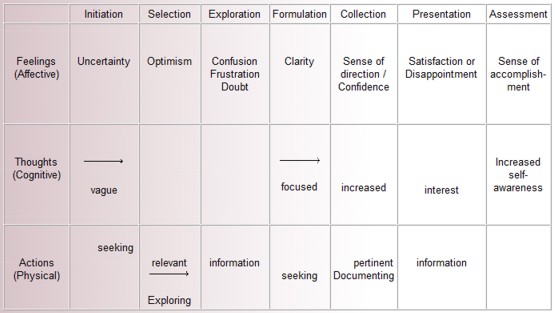
Kuhlthau

 Kuhlthau, 2004.

The Year 8 immersive big picture project has come to an end. After an intense and productive week, students presented their perspective on what makes the human race worth saving with creativity and technical flair. Though the bell sounded the end of the week, the learning process, I imagine, will continue visibly and invisibly beyond the project itself. 

I’ve always been more interested in the unseen learning, the mental moments and shifts in between the visible structure.  Supported by a 7 day continuum, uninterrupted by regular classes, if learning moments were audible or contained in comic speech bubbles, we would have heard ‘ping!’ and ‘zap!’ and ‘kaboom!’ If learning was a visible chemical reaction, we would have seen from discussion and interaction marvellous blended colours and awesome explosions.

 Watching and assessing the presentations (mainly film or photostory), a  spectrum of topics and creative approaches was noticeable, as well as depth of thought and synthesis.  Some of the presentations were obviously stronger, and others weaker, but sitting next to the teacher who knew the class well, I was able to glean valuable insights such as whether the student had come a long way, pushed boundaries or surprised with hidden talents. Choice and big picture questions had allowed students to connect with topics of interest, and some had run with this. If the idea behind this project (or one of them) was to engender passion-based learning, then this was successful in a good number of final products, but the architecture of learning and teaching is multi-layered, and in the aftermath, there is much to be reflected upon and pulled apart.

These are some of my thoughts throughout the week as I roamed from room to room:

  • the confusion and mess at the start is normal, and should be a warning  point to students and teachers
  • Carol Kuhlthau’s graph of ups and downs in the affective domain during the research process may be useful to provide an insight into what can initially be a frightening undertaking
  • teachers are just as much learners in this situation, and a forum throughout the process would be great support as well as make transparent the learning journey if recorded
  • there was a noticeable difference between some classes in terms of concepts grasped and degree of synthesis, so teacher support in unpacking questions, leading discussion and debriefing at different stages of the process cannot be underestimated
  • time needs to be taken by teachers to equip themselves for this journey
  • assessment encompasses the whole process through recording in One Note and is more valuable than the assessment of just the final product
  • a celebration involving the entire project cohort is an important part of the journey, and although this was done by some teachers to some degree, there was insufficient time to do this properly
  • the learning process will continue silently after the last day, and we should not lose this but provide opportunities for discussion and reflection, and record these.

I’m looking forward to a recorded presentation of this journey, especially comments from students and teachers about how they felt at different stages, and what they learned along the way.

Creativity, a sense of purpose and belonging

In his latest post (6 May), Will Richardson asks this question:

So when I read Jay Cross’s latest piece in CLO magazine, I wondered how many schools could point to someone, anyone, who is in charge of learning. By that I mean someone who manages the culture of the school by focusing not on outcomes as much as how learning is writ large in the system.

Learning is occurring at my school this week. Learning with a capital L. We are coming to the end of a pilot project where the entire Year 8 cohort, along with its teachers, has been involved in researching a big picture question culminating in a multimedia presentation of their choice.  Normal classes have been suspended, and each teacher has stepped into the continuum at different points, providing the support needed at that time. Teachers have been in a unique situation, supporting not content, but skills; and this often meant that they were learning alongside the students, at times from the students. The process seems to have taken on a life of its own, and teachers have reported being surprised that students’ projects are taking shape, and that they are on task and engaged, even excited.  Trust in the students’ abilities and creativity has been growing.

This is the part of the project that gets me going – the learning process of both students and teachers. This is what I hope we can record, make transparent, discuss collaboratively, reflect upon, project into the future with. I’ve been enjoying discussions with teachers at different stages of the project: the initial feeling of not knowing how to begin, being overwhelmed by the enormity of something new and big, the joy and relief with the first successful day, the surprise when students took the task and ran with it, in all different directions, in a variety of ways, the excitement upon seeing things take shape, and the anticipation of the final presentation.

I’d like to record all of this. I think that this discussion is the guts of the learning. It’s exciting to see shared discussion in a shared project, and I wish it would happen more often. For a change, the teachers are not in charge, they are facilitators, they are not in control, but are taking one step at a time, and trusting in the students, they are not keepers of the content, but observers of the process.

This is learning. I hope we can capture this for reflection and evaluation. We can base next year’s project on what we have observed, what we’ve learned. I hope we can come together for discussion, reflection and evaluation, modifying the assessment rubric from experience of what the process has involved. Teachers have been talking excitedly not of perfect products or best products, but of the learning leaps for individual students.

I read Will Richardson’s latest post (6 May) and he says

I wonder how many of us can look at our colleagues and answer the question “How does that person learn?” And think of the leaders in our schools in that light as well.

This week, Year 8 teachers have seen with new eyes how their students learn. I think they’ve had an insight into their own learning process. Learning has been shared by teachers and students alike.What does Will Richardson say about teachers’ learning? In discussing Jay Cross’s latest piece in CLO magazine, Will wonders if any schools have one person

 ‘who is in charge of learning. By that I mean someone who manages the culture of the school by focusing not on outcomes as much as how learning is writ large in the system. Someone who also understands the ways in which social Web technologies accentuate the need for the learning skills we’ve desired all along: creativity, critical thinking, independent thought, collaboration, etc…

And it really is about a culture that supports, celebrates and shares learning.

The Year 8 immersive project has given those involved a taste of the learning culture which supports, celebrates and shares learning.

In the article about Chief Learning Officers in companies, Jay recommends looking at the workplace through different lenses: from the point of view of the anthropologist, the Web 2.0 specialist, the informal learner.

Some of the questions posed through these lenses are:

From the anthropologist:

Are people sharing the information or are they just hoarding?

Are people taking time for reflection, or are they so busy they only live in the moment?

Are they experimenting and taking risks, or are they doggedly following the rules?

Are people working collaboratively or are they in isolation?

Through the Web 2.0 lens:

Are people using instant messaging, social networks, search engines and multimedia resources that are as good as or superior to those they are accustomed to in their homes?

Are discoveries recorded and shared with one another and documented for future use?

Do workers have blogs or other means to express themselves?

The informal learning lens:

Are there comfortable places for people to talk?

Are workers intrinsically motivated to learn and increase their professionalism, or are they waiting for their next class?

Is informal collaboration encouraged?

Are people learning from observing others… and reflecting on experience?

These are questions I’ve chosen which are most pertinent to the school situation. As Will says, do we or should we have a CLO in our schools,

 … people to lead that work, …  who understand deeply the passion-based, self-directed potentials for learning in a connected world, and the importance of a vision for true learner-centered classrooms and curricula for everyone in the building.

Do you have such leaders in your school?

(Now, I’m not sure about this, but it seems that the Chief Learning Officer is like our Training (or Learning) and Development Manager in Australia).

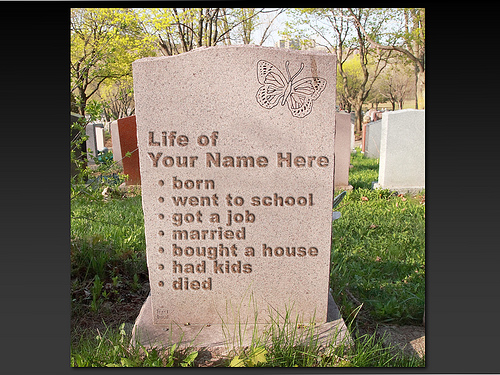
We want dot-points

dotpointgrave

Thanks to cogdogblog for the photo.

My older son has started university this year. His core subjects are Psychology and Politics, and Logic is one of his breadth subjects. Today he was telling me that some of the students in one of his Psychology classes were complaining about a particular lecturer. They thought he was too vague. What did they mean by ‘too vague’? The lecturer gave them material to read, but he didn’t specify what exactly they were supposed to learn, he didn’t give them dot points, and he didn’t make it clear what they needed for the assessment task or exam.

In other words, he expected them to read and think for themselves, to learn instead of just memorising dot points to satisfy exam criteria. According to my son, his lectures were more about making students think about things. eg. in a lecture about sensation and perception he might present an example that encouraged students to reconsider the way they perceived things, to deconstruct how they perceived reality.

What is going on in our education system that produces such an attitude to learning ?

Of course, this is a complex question which cannot be answered simply but, in my opinion, this is the result of teaching to the test, of putting all the pressure onto a final mark, an ENTER, which will allow access into a university course, which, in turn, will provide students with a job. Nothing wrong with employment. Nothing wrong with wanting further education. What is wrong, then?

The lamentable thing here is that academic success is based on performance which is made up of mastering discrete chunks of information. Why? In order to pass the assessment task or test. What is missing here is the desire to learn something because it’s interesting, because a deeper understanding enriches your life. What is also missing is the thinking behind the learning, the ability to independently read and understand, construct meaning, evaluate information, solve problems and construct creative solutions.

If students at tertiary level claim they cannot learn without the summaries or the dot points, then shouldn’t we reassess what we are teaching them? Shouldn’t we consider which skills are most important to them in their lives?

These students compared two lecturers: the one who frustrated them with the open-ended teaching method, and the one they preferred, who provided dot-point summaries, and provided notes, telling them that this was all they needed to know for the exam, and anything else they didn’t need to worry about.

My son liked the unpopular lecturer’s teaching style because it was more philosophical, more interesting because it required higher order thinking.  He said that it wasn’t the case that this lecturer would include in the exam things they hadn’t covered, it’s just that he didn’t present his information in pre-digested chunks.

What do other educators think about this? Do you see this as an isolated or general problem? What do you think are the most important skills students should leave school with? Are we preparing our students for their future world?

Reblog this post [with Zemanta]

Teaching – what’s it all about?


I’ve been reflecting about teaching – you know, the existential part – what’s it all about, what are our essential aims as teachers, how do we connect to students individually and as a group to engage and stimulate meaningful and creative learning? The usual.

Often I think about how I learn. I imagine myself as the student sitting in the classroom listening to the teacher and participating in the lesson. It’s easy for me to do this when I’m teaching collaboratively, and I can do that as a teacher librarian. The beauty of coming into a class as a teacher librarian is that I’m not the principal driver, and so I have a certain distance conducive to reflection which can be very satisfying. It’s not unusual to experience a cloud of ideas during the lesson, although these are not always fully formed ideas as much as reactions and hunches. More challenging is taking the time to record these ideas, reflect on them, and come up with planned solutions.

The one class that I teach collaboratively on a regular basis is an English class with possibly one of the best teachers I have met. This teacher’s leitmotif and driving conviction is ‘It’s not about what you teach them, it’s the connections you make’. Absolutely. If you don’t connect to the student, they haven’t picked up. If they haven’t picked up, they’re not going to hear anything you say. And once they pick up, they need to want to stay on that line. And that’s all about a personal connection. The teacher I’m referring to makes the positive connection with each individual student, and then goes on to create the group connection. This really is the best learning scenario – a student who’s happy with the relationship with his/her teacher, feeling accepted, acknowledged, liked, respected, and also confident as an accepted member of the class. This is where learning can take place. If you look into a classroom you can immediately see where this is happpening and where it is not. We’ve all seen it before: the class where students look distracted, bored, all looking in different directions, eyes switched off, and the class where facial expressions are turned on, students are bursting to contribute, focussed discussion or activity is taking place.

It is the affective domain that may be overlooked in teaching. It’s easily done; you have the curriculum content to cover, and you focus on delivering the material while keeping the class in order. It would be good to take a look at Blooms affective taxonomy, and I’m going to re-blog Kent Manning’s excellent post for this purpose.

Most educators are familiar with the traditional Bloom’s Taxonomy, but what I didn’t know, or had forgotten from my EDUC 101 days is that Mr. Bloom developed a taxonomy for the affective domain as well.

Let me explain.

Our school district has a “Growing with Character” system goal so when I happened upon Bloom’s Taxonomy of Affective “Transformation” it caught my eye.

It goes like this:

Level 5: Internalizing Values

Character acts on value systems as an individual, rather than in response to group expectations; uses teamwork effectively, values others for their intrinsic merit rather than external qualities.

Level 4: Organization

Character prioritizes values, resolves conflicts, develops personalized value system; balances freedom and responsibility and accepts standards of moral behavior.

Level 3: Valuing

Character demonstrates belief in a value system that manifests itself in solving problems for others and in valuing cultural and individual differences.

Level 2: Responding to Phenomena

Character participates in solutions, works with a team, helps others.

Level 1: Receiving Phenomena

Character listens to others respectfully.

Source: Bloom, Krathwohl, & Masia, 1964.


The dominant words in Bloom’s affective taxonomy are ‘values’ and ‘valuing’. With citizenship as the focus, the real learning takes place not within the facts and information themselves, but in the evaluation of these facts. We’re teaching the students as people and future citizens of the adult world, more than we are teaching information.

As always, I value people’s comments and look forward to hearing from you.

Stephen Downes in Melbourne

cimg68631

Why did I go to a professional event on the first day of my Easter holidays? Two words: Stephen Downes.

Stephen started by prompting reflection:

Reflect on how you learn in your job today?
How do you learn to use new technology and keep up with events and announcements? How do you learn new policies and procedures?

Then he made an interesting, perhaps controversial, comment. He said
there’s a distinction between the way we learn and the way learning is taking place in universities, etc.

What does that mean?

As I’ve mentioned earlier, my first-year uni son has confirmed for me that he learns in the same way that I did 30 years ago. Lectures and tutorials. Online forum? No. Sharing notes in Google docs? No. Creation of personal learning network using RSS, Delicious or Diigo, or Twitter. Absolutely not.

I know that some tertiary institutions are more progressive with online learning, but these are not the established, traditional ones so sure of their reputation that they forfeit self-assessment. Maybe I’m being unkind. After all, they provide experts. One expert per subject. Are the students learning how to learn in a global context where experts are scattered?

Stephen says we need interactivity in our learning; we need to learn from people. Instead of relying on traditional models of learning, we need to build our own interaction network, placing ourselves, not the content, at the centre.

I’m thinking about secondary school students. A teacher picks the content which is the agenda for learning. What about the interests, the passion of the individual student that could drive authentic learning? Isn’t there room for passion-driven learning in our curriculum?

Stephen says to employ a wide range of technologies to build our network. We need to pick and choose the technologies that are most comfortable to us. Pull is better than push, we should be able to choose our sources. He tells us to speak in our own voice and listen for authenticity; share our knowledge and our experiences, opinions.
We need to make networked learning a habit and a priority. He said someone had coined the phrase ‘interaction is like breathing for the brain’. If interaction isn’t provided, we have to make it ourselves, for example, if we’re at a lecture like this, we should blog it. Hence this post.

Stephen sees information and knowledge as people-centred. That is, we should bring knowledge in, but also translate it into our own way of seeing the world, and then share it, creating a network for people to remix in their own way. This is one of my favourite new concepts of knowledge – it evolves depending on who does what with it; we’re all unique, and so is our take on knowledge.

But how do we control knowledge as we pull it in? We simplify it, and summarise it in our own words, using our own vocabulary. Make it relevant to us, take what’s important to us now. Shouldn’t students be taught to learn this way?

And then it really got interesting. Stephen said, it’s better to shun formal lectures (certain irony here) in favour of informal learning, eg. the Google Reader approach to learning; learning from people we’ve decided we want to speak to us.

And what about this: Do connect to your work at home and on vacation but feel free to sleep at the office; most work environments are dysfunctional;your learning takes place when it takes place. Your best time might not be 9 to 5; ideas and learning happen when they happen.

And here’s one for those of you who, like myself, often feel overwhelmed by the flood of knowledge they’ve pulled down on themselves. You don’t want to assimilate all that knowledge. Let go, it will come back if it’s important; information is a flow, not a collection of objects.

Self-directed learning is a theme with Stephen. You and nobody else is reponsible for your own learning. These principles ought to inform how we teach as well as how we learn, and that’s what connectivism and Learning 2.0 is all about. Self-directed learning rejects passivity, so get up and walk out if what you’re hearing doesn’t interest you. Be pro-active; take responsibility for learning.

There’s a lot more to Stephen’s talk than I’ve managed to outline here. This will do from me.

Have a look at the Connectivism and Connective Knowledge Online Course. created by Stephen and George Siemens.

If I had to say one thing that I came out thinking about today, it would have to be that learning is personal, and that we must be pro-active about finding, organising and creating our own knowledge, about what we learn and who we learn from. And in this way, if we learn transparently, we model learning for our students.

Finding your passion

Of course, I’m referring to Sir Ken Robinson’s book The Element which I’m not going to summarise here because I’ve only just been dipping in and out, chewing bits and gazing out, pondering. What I have taken out with joy, the joy that comes from connecting your life context with the book’s message, is that you have to find your passion. You. You have to find your passion. Yes, your students have to find their passion in order for true learning to happen, but – and now I’m taking over here, so you’re hearing my own rave, not Ken’s – YOU, the teacher, must put yourself before the student, and find YOUR passion. Because if you will, you’ll take off and become a better teacher, and if you don’t, you may never know the teacher you could have been.

For me, finding your passion is synonymous with finding your inner strength. We’re all different, you knew that, I didn’t have to tell you, obviously. When we find what we’re passionate about, and we connect it to what we do and how we do it, then we’ve found an eternal spring. We don’t force things, we don’t find it difficult, we don’t find it boring. We need to trust ourselves.

I’ve had the privilege of working with teachers who have done just that. They love teaching – which doesn’t mean they’re forever stuck in an evangelistic fervour, no, they have their days – and they love the kids they’re teaching (moments, again). They’ve found their passion, and it’s in connecting with students and making a difference in their lives.  Yes, for the English teacher, it’s about the grammar at times, the punctuation, the ability to write a coherent introductory paragraph, but actually, no, it’s about the relationship with the students, a relationship that builds trust, admits to liking the student, develops confidence, unleashes the often hidden talent that is unique to that student.

And I just want to say one more thing – as a teacher you can’ t do any of that unless you’re in touch with your own passion. You need to unlock yourself before you try unlocking anyone else. If you’re bored, you’ll burn out. It’s yourself you need to reignite. You start burning, you’ll heat up those around you.

I apologize for my fervent bombast. I blame Ken Robinson for getting me fired up. Read the book: The element. How finding your passion changes everything.

Or watch this video where Sir Ken Robinson talks about aspects of his book

[youtube=http://www.youtube.com/watch?v=2UooOCbBrj8]

Tinkering as a mode of knowledge production

Listen to John Seely Brown’s talk where he addresses the Carnegie Foundation for the Advancement of Teaching, Stanford, CA, 2008.

[youtube=http://www.youtube.com/watch?v=9u-MczVpkUA&feature=player_embedded]

I am what I create is how John Seely Brown defines our new identity.

I’d like to paraphrase what John says in his talk ‘Tinkering as a mode of knowledge production’, and also to offer some of my own thoughts.

Here’s the gist: Since many of the skills that we learn today have become obsolete several years ago, we must find a way to get today’s kids to embrace change, to want to constantly learn new kinds of things, to find a way to play with creating knowledge on the fly by experimenting with things. Notice how different this is to the traditional learning of finite knowledge imparted by the omniscient teacher . How do we initiate this tinkering, this creating of knowledge? John Seely Brown says we need to look for ways to foster the imagination; if there’s no imagination, there’s no creativity. And he places the tinkering learners within a new culture of sharing, in peer-based learning communities, where kids learn from each other. The challenge, he says, is to find new learning environments. We need to go back in time, so to speak, to the comprehensive classroom that had students of all ages in it, where the teacher was the organiser, the facilitator, and where students’ learning was as much from other students as from the teacher. We need to construct an environment where we are constantly learning from and teaching each other. And now for the tinkering.

What is tinkering? John Seely Brown sees it as the creation of something concrete as opposed to abstract or theoretical learning out of context.

Let me take my imagination and build something from it. Build something concrete instead of decontextualised knowledge. Once we’ ve created this concrete thing, we can see if it hasn’t worked, why doesn’t it work, and ask questions: how to build it better. We expect this thing to do something.

Why do we need this new learning environment? We live in a different type of world, one of rapid change. We need to find ways to tinker with ideas, ask good questions, and be able to take criticism. We need to learn in this architectual studio, where all work in progress is made public .

This makes so much sense to me. Currently, as part of our project for the Powerful Learning Practice program in which our school is involved, we have decided to create a NING, a whole-school online learning network, in order to bring the members of our school together, learning from each other, sharing, and making all our processes and projects transparent. In the new learning environment Brown speaks of, we are all able to witness each other’s struggle, understanding the process each of us is going through. What a powerful way of learning with and from each other. As Brown says, when the design is finished, and you overhear the master critiquing another’s design, this has tremendous meaning to us as well because we’ve been part of the process of the each other’s constructing of design. In this distributed learning environment, you learn to accept criticism. You want to be critiqued, you appreciate criticism, you learn from it. Brown sees this as one of the key platforms for lifelong learning and in embracing change.

Today’s networked technology allows us to build distributed communities of practice. Instead of us physically working shoulder to shoulder with others, our avatar is working shoulder to shoulder with others. We have infinitely more powerful tools to craft things, to mash this up. Creativity takes on new possibilties through tinkering – our tools not only allow us to create but also remix. In a short space of time, we can take what we see from others, rework it and recreate it, then give it back to the community for further reworking. How much better is this than isolated learning and creating?

The second message in John Seely Brown’s talk is something I’m very excited about. It’s a positive statement about young people today, and I urge everyone to think about it seriously, because it counters the many negative statements that are thrown out about young people in the age of technology. We are on the cusp of the creation of a new identity. In prior decades a lot of kids grew up thinking ‘I am what I wear’, or what my parents own, or how much money we have. Identity came from material possessions. I’d like to add to that by saying that identity also came from what we did for a living. Our occupation was who we were. It was the name of the occupation that was important, not the internal workings and processes of these occupations.

Here is the most exciting part of Brown’s talk for me : JUST MAYBE, he says, just maybe we are entering into a world now where our own identity gets defined by what we’ve created and what others have added to it.

This is a sense of identity constructed for myself. I passed something onto others, and they have been able to do wondrous things with this as well.

I can relate to this so well. When my children were younger and I was unable to teach full-time for several reasons, I was a ‘housewife’. I was not a teacher, I was not a thinker, I was not someone with creative talents, I was defined by my title. Now that I’m a teacher once again, I’m pushing beyond this title too. In my writing (which is really a remashing of my reading of others’ thinking with my own thinking) in my blogs and personal learning networks, I’m stretching my identity to include much more of my potential, and I’m doing this shoulder to shoulder with many others around the world. Technology is allowing me to recreate myself along with others – unlimited by my geographic location, unlimited by time zones. I’m creating my own identity within a new learning community. I’m a teacher, but what’s most satisfying and comfortable for me, I’m a learner.

As John Seely Brown says THIS IS A DIFFERENT WORLD.

What is School? Look again

As educators, we all want to engage our students in learning. We also know that this can be challenging, and some of us wonder what we can do about it.

Sometimes I think we need an artist to show us what school is really like. Why do I say that? An artist often presents the familiar in a new way, allowing us to see something for the first time, as it were.


This is not a pipe – Magritte

When I think about traditional education, the type of education our children are still receiving, it seems to be artificial, contrived, divorced from life. Perhaps this is the reason young people are bored and disengaged at school, why their potential is not always realised. Am I being too negative?

Have a look at a short presentation with segments from the book  The underground history of American education by John Taylor Gatto where he talks about  education creating empty children without independent thought or individual identity. This would obviously apply to education outside of America. He suggests that we have lost the value found in earlier educational practices where people worked in the context of family work or apprenticeship.

Gatto lists the recipe for creating ’empty children’, for example, you should remove children from the business of work, grade according to age, keep them under surveillance all the time with no private space or time, fill time with collective experiences, grade children and make sure they know their rank, forbid useful knowledge, eg. how to repair a car , build a house, etc.

We could never go back to the time where practical education around family businesses prepared all young people for the world of work, but are we actually thinking about how our teaching is preparing students for the world, or even living and functioning in the world, or are we not thinking about that at all?

I would really appreciate some feedback and opinions here. Please comment.