Tag Archives: learning

What have I learned from VCE?

This article in The Age resounded with me – Surely there’s a better test was written by Alexandra Adornetto, Year 12 VCE student at Eltham College and, at 17, already an author of a popular children’s trilogy starting with The shadow thief.

Of Alexandra’s initial questions,

How have I been shaped by my learning experiences? What skills have I developed that are valuable and transferable in the workplace? What lessons have I learned about the value of education?

– I wonder most about the last one: What lessons have I learned about the value of education? Or even, what have I learned about learning?

Alexandra’s answer is negative; she sees students having to work

within a system that reduces achievement to a game where strategies are more important than ideas.

Her cynicism flows from the fact that

the sum total of my education will soon amount to nothing more than a figure — an ENTER score that will determine which percentile I fall into statewide and which courses I will be eligible to apply for.

I agree with Alexandra when she says that

the system fails to recognise the diversity of skills and most subjects do not allow students to demonstrate skills in a form other than a written exam.

I’ve started reading Rethinking rubrics in writing assessment by Maja Wilson, which, at one point, talks about decontextualised teaching of literacy through ‘separate literature, speech, and composition courses’. In the past ‘Reading, speaking, and writing were simply a means to dialogue with professors, peers, and the community at large about matters of public interest.’

Andrea Lunsford (1986) describes an integrated, language-rich environment that supported powerful literacy.

Classroom activity… was built around “oral disputation.” One  student chose and presented a thesis, often taken from reading or class discussion, and defended it against counterarguments offered by other students and the teacher. In addition, students regularly gave public speeches on matters of importance to society, in forums open to the entire college and the surrounding community… the students learned more from their peers than from their teachers … this model of oral evaluation and the form of student speaking societies provided an audience, a full rhetorical context, and motivation for discourse, features woefully lacking in later “set” essays and written examinations.

Maja Wilson goes on to imagine how ideal this kind of learning would be. This would be the antithesis of the VCE as we know it, and as described by Alexandra. Instead of receiving ‘a static score from faceless evaluators’, a student could receive a type of assessment ‘not to rank’ the written content, but purely as feedback to aid learning and develop abilities.

Assessment would be free to interact positively with learning since ranking … was not its main objective.

In her article, Alexandra goes on to point out the many skills students possess in activities they do outside of school which are not taken into consideration in the VCE assessment.

Life skills, innovative ideas and community involvement — what intelligent nation needs these? It’s obviously much safer to work towards the goal of conformity. Here is just the beginning of a list of skills that exam results cannot possibly hope to reflect: interpersonal skills, the ability to entertain, how articulate we are as speakers, our ability to work as part of a team, the ability to deal with challenges and invention.

I’ve often thought the same, and when I see the curriculum packed to bursting with content that teachers struggle to cover, I’m not surprised that they often lament the lack of time to develop important skills.

It doesn’t take long to figure out that our current system does not reward creativity or cater to the diversity of skills and abilities possessed by students. What it does reward are formulaic learners and those with a good memory.

I don’t claim to be an expert, but I noticed a difference between, for example, the Psychology course offered within the VCE  and that within the International Baccalaureate. VCE Psychology seemed to be largely a matter of content memorisation, whereas IB Psychology involved higher order thinking.

Alexandra comments:

Other knowledge-based subjects such as legal studies, psychology and history ask us not to apply knowledge but simply to recall and regurgitate the contents of our hefty textbooks.

It’s interesting how Alexandra’s suggested solutions harken back to the older system of assessment described by Wilson in her book:

Clearly an overhaul of the current system with a review of its goals and objectives is in order. Until universities take a radical look at their selection procedures, nothing is likely to change. How much more sensible would it be to include an oral exam (where you might talk through your ideas or your achievements) as a percentage of our final assessment?

I like the way Alexandra thinks, I like her suggested alternatives:

Perhaps the presentation of a folio of achievements would go a long way in presenting us as individuals with a unique contribution to make. Perhaps a hands-on project in a preferred area of study should be a compulsory assessment task.

Yes, Alexandra is cynical about the merits of VCE, and grim in her description of the final exams:

As for us, we will be writing furiously for three hours, surfacing only to check the clock and take periodic sips from our water bottles from which we have assiduously removed the labels in compliance with yet another inane regulation, designed to eliminate cheating.

What do you think? Is she being too harsh?

As for me, I hope that this year’s VCE students will at least be able to demonstrate the extent of their study efforts, not like the poor girl during this year’s English exam whose watch stopped, freakishly, at the same time as the wall clock, and was caught out at the end with only two thirds of her examination paper completed. So much frustration and upset – two years of effort spoiled by a fateful turn of events.

I recommend The English Companion ning which has a rich discussion between Maja Wilson and educators of her book.
Should teachers be more like conductors? TED tells

Orchestra conductor Itay Talgam has discovered that the secrets of good conducting shed light on leadership in general. I found the messages in this TED talk to be very relevant to teaching.

[ted id=663]

Itay Talgam’s TED biography observes that Talgam

finds metaphors for organizational behavior  — and models for inspired leadership — within the workings of the symphony orchestra. Imagining music as a model for all spheres of human creativity, from the classroom to the boardroom, Talgam created the Maestro Program of seminars and workshops.

Talgam’s workshops aim to help everyday people develop a musician’s sense of collaboration, and a conductor’s sense of leadership: that inner sense of being intuitively, even subconsciously connected to your fellow players, giving what they need and getting what you need. It’s this art of listening and reacting in the moment that makes for a swinging jazz combo, a sublime string quartet, a brilliant orchestra — and great teams at work.

Talgam talks about the conductor’s ability to use a small gesture to suddenly create order out of the chaos. When he asks who we should thank for the success of the performance, he is asking what the role of the conductor really is. In the same way as the teacher, the conductor is the single leader responsible for the success of his people. The question is – how does he create music out of the chaos?

According to Talgam, it’s not all about complete control of the orchestra. It’s about the joy of enabling other people’s stories to be heard at the same time – the story of the orchestra, that of the audience, unseen stories of people who made the concert hall and even those who made the instruments.

Talgam shows examples of different styles of conducting. There is the example of the conductor who is so clear about what he wants that he becomes overclear. Talgam describes this type of conductor as having a strong sense of responsibility. This type of conductor insists that there’s only one story to be told, only one interpretation of the music, and that’s his interpretation. In this case, the musicians feel they are not allowed to develop, but are only used as instruments. 

Talgam insists that leadership of the orchestra can be achieved with less control, or with a different kind of control.

One of the conductors is shown conducting with his eyes shut, confusing the onlooker with his apparent withdrawal from control. Talgam explains that, in this case, the musicians get their cues by looking  at the conductor’s face and gestures, and then looking at each other, with the first players of each section leading. This conductor claims that the worst damage he could do to  his orchestra would be to give them an overly clear instruction which would prevent them from listening to each other.

In another example, the conductor explains that by not telling the musicians exactly what to do, he’s opening a space for them to put in another layer of interpretation, another story. Talgam explains that this method without clear instructions works because it’s as if the musicians are on a rollercoaster, whereby the forces of that process put the action into place. You know what to do and you become a partner. This experience is exciting for the players. 

And what happens when there’s a mistake? The conductor’s body language is enough. When it’s needed, the authority is there  but authority is not enough to make people partners. This kind of conductor is there 100 percent but not commanding, not telling them what to do, instead enjoying the whole experience with them. In this case the conductor creates process but he also creates the conditions in the world in which this process takes place. The soloist is allowed to be autonomous and is consequently proud of his work. Developing a partnership brings about the best music.

I think we can take a fair bit out of this talk and apply it to teaching. Teaching is like conducting or leading. What resounds with me is the fact that overly explicit instructions and tight control can be at best limiting, and quite possibly suffocating. Setting up the process and allowing room to move seems like a good way to teach. Realising that your interpretation is not necessarily that of everyone else opens up rich possibilities for learners. Understanding that members of the orchestra or class learn from each other. Getting to the point where you know the students so well that they can read your every nuance, and standing back and smiling, just enjoying the process unfolding before you, is possibly every teacher’s dream.

When, as a teacher or leader, you create the environment, give support, and then step back – you get to the wonderful point of ‘doing without doing’. As Itay Talgam says,

if you love something give it away.

Design the school of the future, but do it now (GPS)

As I’ve said in my previous post, Green Pen Society is Paul Cornies’ brainchild, and has brought together bloggers (thinkers, writers) from different parts of the world.

It’s my turn to devise a theme for October’s post, and I’ve chosen the theme of school design, namely:

What would your ideal school look like? Design the school of the future – but do it now!

A tweet from @kentmanning led me to the designers’ website of the award-winning International School in The Hague, Design Share: designing for the future of learning, and I started thinking about what was essential pre-thinking for a school design. These statements make a lot of sense:

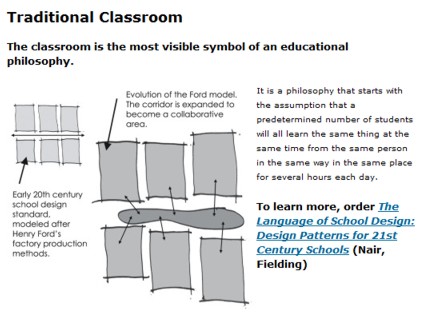
The classroom is the most visible symbol of an educational philosophy.

It is a philosophy that starts with the assumption that a predetermined number of students will all learn the same thing at the same time from the same person in the same way in the same place for several hours each day.

Personally, I never felt comfortable with that assumption, and as early as kindergarten, which I attended on and off from the age of 2, in order to learn English (Russian was my first language at home), I knew I was starting from a different place in terms of what I had to learn.  Further on, in early primary school, I remember sitting obediently, silently, while students took turns to read aloud (and struggle through) the one reader for the year, whereas I had finished it at home in the first week. Statistically, I would not have been the only student, although my respect for authority kept me squarely on my chair, not even moving to fiddle with ruler or doodle in the margins.

How many of us learned to daydream away the waiting time in classes which expected all students to learn at the same pace and level?

tradschool

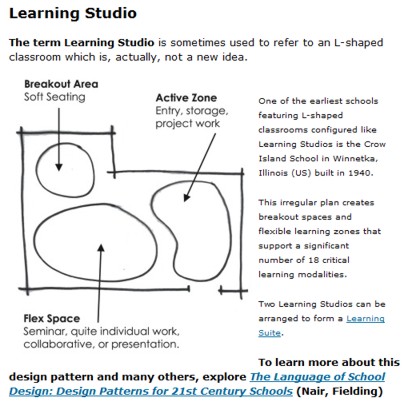
In contrast to the traditional classroom design is the Learning Studio. The L-shaped room includes 3 separate but open areas: Active Zone, Breakout Zone and Flex Space.

learningstudio

 The L-shaped classroom was first built in 1940, but the classrooms in the schools in which I’ve taught look like the first design, with rows of students sitting facing the front. Wait, there has been a change – we don’t have single rows any more. Do we think that having 2 or 3 students sit together in rows is a significant enough change to classroom design?

I think the trouble lies in the need to rethink the philosophy behind our learning spaces. How do we learn? How do we teach? What I’m still seeing is the predominance of the teacher as ‘sage on the stage’ and the students listening and responding in turn, or writing their own responses for only the teacher to read and correct.

If learning is to be student-driven, research-based and collaborative, then our learning spaces definitely need to take this into account. If we are to stop separating learning into discrete disciplines, and realise that in life we function in an integrated way, then we surely need to redesign our schools. But a physical reconstruction will have no effect unless we all start with a communal rethinking of the philosophy of learning and teaching.

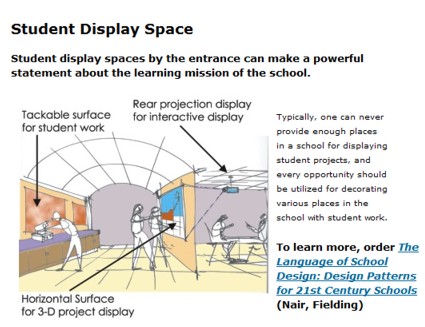
One of the aspects of design in the index of this book is that of display space for student work.

studentdisplay

I know that there are schools that display student work around the school, and I think this is a great idea, and should be taken into account when designing the school. If the school takes pride in what students have created and displays it everywhere, not just in designated subject classrooms, then the message is that the school belongs to the students.

 As a teacher librarian, I also think that the library should be the centre of the school – physically and philosophically. It should be a central working, displaying, playing and meeting place, welcoming of all the different subjects and activities. It is, after all, a place which specialises in the location and use of information and ideas, as well as one which encourages leisure and relaxation in the form of reading and discussion.

Public libraries are changing their image and moving away from strictly controlled quiet areas, where people read or research in isolation, to places offering diverse learning programs, meeting places and leisure activities. I think school libraries should learn from them, as well as from book shops which create a welcoming environment and put the customer first, providing attractive and helpful displays and signage. And there’s nothing wrong with injecting a sense of fun. This applies to all aspects of learning in the school; learning should include time allocated to playing with ideas or tinkering with things – because that’s where the creativity steps in, especially in collaboration – instead of focusing on completing tasks for grades. Spaces in the school should be designed for this tinkering.

I’ve posted this TED talk video previously but I think it’s worth revisiting at this point.

Gever Tulley uses engaging photos and footage to demonstrate the valuable lessons kids learn at his Tinkering School. When given tools, materials and guidance, these young imaginations run wild and creative problem-solving takes over to build unique boats, bridges and even a rollercoaster!

[ted id=588]

Tinkering allows for learning through discovery and this type of learning is richer than learning from the assimulation of theoretical information.

As far as physical design goes, I’d love to see spaces that

  • encourage connection, collaboration, discussion, performance and celebration;
  • transparency and flexibility between rooms and to the outside;
  • a natural outdoor environment maintained partially  by students;
  • places to socialise in free time;
  • spaces for quiet, reflective or creative projects.

Of course, technology will become more and more ubiquitous. I think that technology is developing so quickly that we won’t need to think about design in terms of spaces housing cumbersome computer equipment, but spaces to provide for the learning and interaction of social networking using small, handheld technology.

Although, it would be kind of cool to have a school in a Jetsons-type world…

win-pics-jetsons

The yeast to activate learning

Jabiz Raisdana, AKA @intrepidteacher, shared an interesting post a few days ago, which he entitled Singing Hearts, in which he wrote about how a group of eighth graders in Missouri connected with his 3 year old daughter in Qatar.

Like many stories of connections made across time zones, cultures, and age groups this one involved some risk taking, some curiosity, some opened minds, and I hope some learning.

After reading The last child in the woods , which spurred Jabiz to increase his daughter’s contact with nature, he and his daughter went outdoors with their cameras to explore their surroundings,

even if our immediate surroundings was an empty dry desert field covered in garbage and construction refuse. 

The result of this little expedition was a photo essay which Jabiz shared with his twitter network, and which then resulted in @wmchamberlain sharing the blog post with his class and receiving more than 40 comments which you can read on Kaia’s post.

[youtube=http://www.youtube.com/watch?v=KEY7raV7rH4&feature=player_embedded]

In this little expedition, Kaia not only connected with the outside world in a physical sense, but also the world of people beyond her immediate environment.

Hello from New Zealand.
Kaia
We really liked looking at the pictures of the backyard and the desert! Amazing stuff, you did a great job with the descriptions. We thought that it must be very hot in the desert, its been raining here in New Zealand today so the desert seems exciting and interesting. (Room 8 Melville Intermediate School, New Zealand)

Those pictures were awesome. You did a great job speaking in your first photo essay. You took ordinary things that everyone passes by and made them look wonderful. I like your blog and I will visit it more often. You can visit my blog at jacob-everybodysbog.blogspot.com Thanks and keep up the good work. (Jacob)

With her father as her guide, Kaia has connected with people in his learning network, people who are interested in learning from others, regardless of location, age or race. A simple photo story has been of interest to others who have contributed their thoughts and a little of themselves.

 Although, at such a tender age, Kaia would not fully understand the meaning of her experience, she has surely felt, to some extent, the power of connecting beyond her home and immediate family.

She is still too young to really grasp the connections that she is making, but in a few years these connections and this type of interaction will be ubiquitous in her life. I hope that her teachers are ready to help her continue on this journey.

Jabiz reflects on his feelings as a father who has shared his young daughter’s experiences with his online network:

… having Kaia exposed like this made me hyper aware of how vulnerable I am making her…

… I started to think about how much trust we ask that parents put in us as teachers. Kaia’s blog started as a way to share photos with family, it has quickly become a way that we are documenting her life. And now, it is becoming a way that she is connecting with people throughout the world. This is scary. Part of me wants to pull back and keep her our little secret. But if we want our students to feel comfortable and be cautious online, we must be able to do the same with our own children.

Jabiz’s blog reflection on the positive and negative potential consequences of his experiences ends in questions he poses directly to his readers:

What do you think? What is the value in this experience? Is the risk of exposing ourselves and our children online worth the connections that will be made and the lessons that will be learned?

I was amongst the commenters following Jabiz’s post, and so was John Strange, Professor of Professional Studies at The University of South Alabama.

John Strange says:

My response was you will not get the yeast to activate a closed system. They must engage the world. It is so important to energize learning through the techniques you, Mr. Chamberlain and others are using. I am not concerned about the issues of letting people into our lives. I think it is absolutely essential if we are to move forward with true learning, for all of us.

If I hesitate  when reading ‘ I am not concerned about the issues of letting people into our lives’, then I only do so momentarily, because the example of Jabiz supporting his little girl’s learning is an excellent model for us as educators and parent. If we hold the hands of our young and vulnerable students and our own children, and then still go outside of our private little worlds, then we learn to navigate the richness of connections with what is beyond our step.

For me, personally, every day spent reading what other people share online, in the form of blogs, Twitter posts or photos on Flickr, opens up a new window to the lives and experiences of others. There’s no way I could go back to what I had before. Could we even go back to pre-Google days?

I like John Strange’s concept of networking being the yeast to activate learning – it surely is.

Just in reading this one post, I’ve learned so much, and connected with so many people. It’s disappointing when someone contributes a comment and doesn’t provide a link. A blog, for example, provides knowledge of the author, and we can ‘know’ each other through our contributions in writing or pictures. We share what we think is appropriate, while preserving our privacy, and I think this is what we need to teach our students. Their digital footprint can be modelled on ours, and this not something we can do theoretically.

Apart from learning about Jabiz and his daughter, Gaia, I’m happy to have discovered John Strange who shares so much of himself online through blogs, points of contact and photos. Take a look at his page to see an excellent example of the richness of digital identity.

Random facts I learned from Flickr today

They may be random, but I’m still learning.

Flickr is fun to browse, but more and more, I’m discovering Flickr to be an interesting way to learn. The photos take me into places I’ve never been, to things I normally wouldn’t see, often providing interesting background information.

Here are a few random things I learned from Flickr photos today

This photo was taken in Russia by seriykotik1970

russianbuilding

An art nouveau building near my office that was gutted by fire last week. Sadly it’ll now probably be demolished and ‘rebuilt’. In Moscow fires of this sort are often started deliberately by unscrupulous developers.
Designed by Lev Kekushev in about 1910.
Photographed in 2007

Turkish roosters are very colourful

turkishcock1

turkishcock2

Smarthistory is a group on Flickr which complements the website smarthistory.org. The purpose of this website and Flickr group is to enhance or replace the traditional art history textbook.

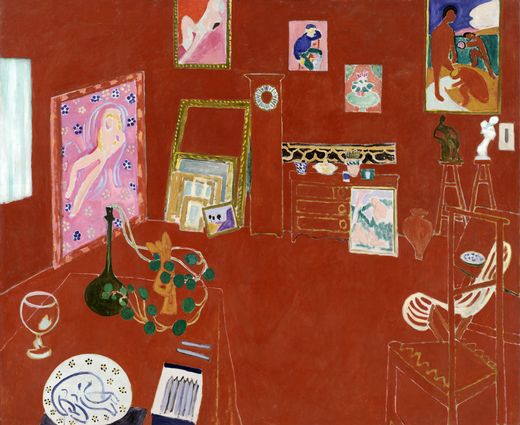
For example, you can learn about Matisse’s Red Studio from a short video using Flickr pictures of art collected by group members. 

Redstudiomatisse

If you read About Smarthistory, you will understand the motive behind the creation of this website and Flickr group:  

We are dissatisfied with the large expensive art history textbook. We find that they are difficult for many students, contain too many images, and just are not particularly engaging. In addition, we find the web resources developed by publishers to be woefully uncreative. We had developed quite a bit of content for our online Western art history courses and we had also created many podcasts, and a few screencasts for our Smarthistory blog. So, it finally occurred to us, why not use the personal voice that we use when we teach online, along with the multimedia we had already created for our blog and for our courses, to create a more engaging “web-book” that could be used in conjunction with art history survey courses. We also realized that this content would be useful to museum visitors and other informal learners. We are committed to joining the growing number of teachers who make their content freely available on the web.

Smarthistory is an excellent example of what can be done to create high-quality, free educational resources through collaboration. You’ll understand the scope of this project when you look at the site map which provides a hyperlinked timeline of art history. I also like to check out the discussion in groups.

The best thing about learning on Flickr is that you don’t expect to.  That’s why it’s so enjoyable.

How do you explain a ning without sounding silly?

This is cross posted from my other blog, English@wfc

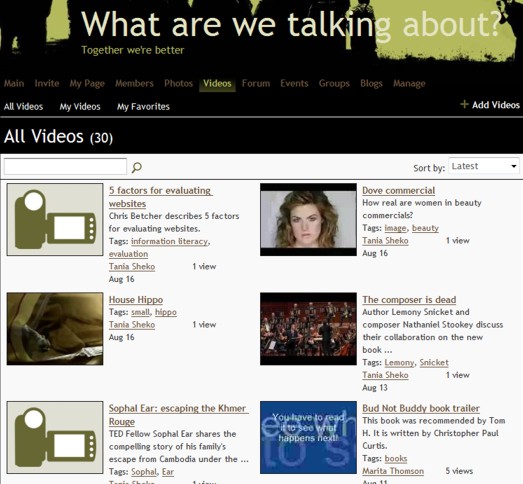
 ningvideos

Following our school’s involvement in Powerful Learning Practice, our team has been asked to present to the whole staff next Monday. Maria and I will be talking about the ning in our English classes. We decided to present collaboratively, with Maria doing most of the talking and me driving the ning tour. Our idea was that teachers would find the ning more relevant and convincing if a classroom teacher presented. Sadly, I think that they would be less likely to listen if a teacher librarian was presenting, because we’re associated with the library (which means we’re seen as chained to the library circulation desk and focus on books).   Today we got together to decide how we were going to proceed.

The most difficult thing is deciding what is essential – we don’t have more than 10 minutes or so. We don’t want to overwhelm everyone but if we don’t present in some detail, it won’t make much sense to anyone.

For me, the essential part of the ning in supporting the English curriculum has not been the technology, but the possibilities for discussion and interactions. Within online discussions, every student gets an equal chance to participate in discussion at his own pace. The authentic audience and connections with others form a community of learners. Instead of responding to the teacher, students interact with each other; their learning is social. Although it’s not exactly Facebook, the ning has provided a Facebook-like platform for classroom learning.

What we’d like to stress is that the teaching is more important than ever. Yes, the ning is technology, but that’s not the focus. The ning is not some technical textbook with multiple choice questions and answers making the teacher redundant. Scaffolding the learning process is even more vital than ever to ensure rich discussion and push students’ thinking towards  critical and reflective responses.

During our planning session,  Maria and I focused on identifying the way the ning enhanced teaching and learning beyond traditional teaching methods.  We anticipated teachers wanting to hear why they should tackle the technology, what was special about the ning. That’s a fair enough question: there’s no point in using technology for its own sake. So let’s see…  Well, as I’ve already said, there’s the authentic, peer audience, and the interaction within that, and secondly, there’s the threaded discussion. When students are asked to write down their thoughts in class, it’s normally just the teacher who collects and reads them. Perhaps a few might be read out in class. The ning provides the transparency for all students to read everyone’s contributions, but also to reply to a specific one. Students can read every other student’s ideas, and respond to any of these.

Apart from the connection to the other students in the class, our class was joined by The Kings’ School boys in Parramatta. The ning has also provided an opportunity to bring in an expert, in our case,  our book’s author, Allan Baillie, who was able to answer specific questions of each boy individually. We provided authentic, engaging learning. The boys got a kick out of having their questions answered by the man himself.

I also love the simple fact that the ning contains everything so neatly – from a teacher’s point of view, assessment is made easy because everything that has been written is easy to find. I imagine it will be easy to see development in the boys’ writing as the year goes on.

Using videos to spark discussion has never been so easy. I embed videos when I come across them (handy for on-the-spot activities), and all the discussion following the viewing is neatly recorded underneath. Students regularly practise literacy without even realising. Somehow they think that discussion of a video isn’t real work. Videos are great for visual literacy -something I’ve noticed doesn’t come easily to young people regardless of what is said about the internet generation. They need lots of practice ‘reading’ visual clues, following visual narrative and interpreting and critically analysing visual messages. Of course, audio is also important, and our class has also enjoyed videos with music.

We plan to show teachers the variety of resources that can be included in the ning. Our videos cover many subjects – even grammar, information literacy (eg. evaluation of websites) and responsible online behaviour. I’ve started embedding TED talks which I think will be suitable for this age group. I’ll be looking to include more TED talks because they’re so inspiring.

I hope our presentation will demystify the ning and similar technology and open up practical suggestions for the use of such technology in the classroom. As long as the internet connection works! Keep our fingers crossed.

Spider’s web

Photo courtesy of moonjazz.

The Powerful Learning Practice experience is coming to an end, and it’s time for us to gather our thoughts and share what we’ve done.

I’ve been putting off my reflection because, frankly, the thought of gathering my thoughts about this relatively short, but intense, period of PLP participation, is overwhelming. Scouting around in blogs and Twitter links, I came across something which describes what I consider to be the focus of what is most valuable from my PLP experience: connectedness. 

I love the way Lisa Huff compares the spider’s web-weaving in Walt Whitman’s A Noiseless Patient Spider  with our reaching out to connect with others through technology.

Whitman, writing in the 1800’s, observes how a spider ceaselessly launches forth filament to explore his surroundings, to travel from one place to another, to bridge his world. Whitman notes mankind’s similarity to the spider. We too ceaselessly seek to connect, to make sense of the world, to reach out to others.

 Technology of the 21st century is connecting us like never before. We blog, we podcast, we collaborate via wikis, webcams, e-mails, discussion boards. We explore endless information easily summoned with a few clicks. We are living in the midst of sweeping technological changes that are reinventing the way we live, learn, laugh. At the heart of this change, however, is the basic spirit of exploration–that same spirit Whitman captured some two hundred years ago.

This is what I have learned since joining the PLP team – how much richer my life has become through connections with people globally via technology. I’m connected through people’s blogs, wikis, through Twitter, and other Web 2.0 applications, to a limitless network of resources, ideas, discussions and creativity. At the risk of sounding evangelical (once again), this is a life-changing experience. It’s not just a matter of acquiring some technological skills with tools, it’s what we have in common with Whitman’s spider as we ‘ceaselessly seek to connect, to make sense of the world, to reach out to others.’

Coming down to earth a little, I must say that my fervour about 21st century learning, and that of my team members, is shared by few in our school community, and I hear it’s the same everywhere. At times it’s lonely, other times frustrating, to be convinced that networked learning and teaching are in step with our fast-paced, global world, and to know that our current education system supports an outdated society. Trying to take tiny steps in convincing others is perhaps the only way to move forward, taking care not to alienate others, but to support them, model new ways of teaching, and to celebrate small successes.

What have I enjoyed the most?

  • writing my personal and fiction blogs
  • reading others’ blogs, wikis; commenting; taking part in discussion
  • creating and supporting nings, joining others’ nings
  • the support of my personal learning networks on Twitter, Facebook, Friendfeed, etc.
  • sharing information and ideas
  • ‘converting’ others to the networks
  • discovering amazing people with great talents and wonderful minds
  • seeing engagement and joy in students, especially after the new ways of teaching have been a struggle to implement
  • being able to participate in professional development opportunities online at many different times
  • lifting up the minds of young people, seeing the spark in their eyes, hearing excitement in their voices
  • collaborating with others towards common goals
  • discovering unexpected and wonderful links to links to links
  • feeling energized by the depth of what’s out there
  • loving the learning

What have we learned, and what have we achieved? We’ve learned so much, and at the same time, we have so much more to learn. We’ve achieved a great deal, and yet we’ve only just begun.

What I’m sure of is that there are people I can rely on for help, ideas, support, resources, inspiration. These are the people I connect to as a teacher. I can never be bored, will never feel isolated, will always look forward to more.

Don’t bag technology – ask what it means first

I’ve been feeling discouraged lately in my conversations with people about education. Maybe I’ve been talking to a small sample of people, but I’m feeling really peeved at the moment (and it may be because of lack of sleep).

I’m not sure if the endless circular conversation – between those who see the value of technology in education and those who dont’ – is even worth the effort. Yes, I’m not in a very positive frame of mind currently. I don’t find I have the energy or patience to continue, but I still want to reflect on what the problem is.

It’s not a problem that centres on technology at all. It’s a problem that centres around the very human aspect of dialogue. Dialogue which depends on two (or more) people listening to each other and making a real effort to understand what the other person is saying.

I’m sick and tired of entering into a conversation where I’m asked to justify my belief that technology is an important aspect of transformed learning, learning that has to change with the times in order to prepare us all for the way the world works and the way it will work in our students’ future. Most of the time I find that I’m cornered into petty justification because the other person is coming from a personal conviction and will, at all costs, aim to knock me off my beliefs to prove an ultimately negative point. This is not a dialogue. Cornering someone so that they desperately try to stick up for their beliefs while ignoring the larger argument is not dialogue. It radically narrows the scope of information which would otherwise offer a larger, more informative picture.

An example:

Me: I believe that technology offers new possibilities in learning (*very aware that this is a broad and ambiguous statement which needs comprehensive explanation*)

Other: What’s all the hype about technology? Does it really teach ‘them’ anything? Or is it a just a gadget, the latest fad?

Me: Technology offers possibilities for creating and connecting with others.

Other: I know all about that. It’s been proven that kids no longer have personal skills because they are using technology too much.

Me: They are learning the skills of online interaction

Other: I read/saw on TV how dangerous online involvement is, and how it isolates kids, how it takes them into dangerous zones which their parents don’t know about, how bad it is.

Me: You have to look at the real evidence. The media is often one-sided and sensationalises a small part of the picture

Other: But I heard an interview about it and these people are reliable; this information is authoritative.

Me: There are many wonderful connections kids can make to the real world and real people outside the classroom to make learning relevant

Other: (confused look) What are they learning by talking to each other? Is there any academic value?

And then the conversation reverts back to All Things Negative in terms of Any Kind of Change with regard to What Is Considered Sacred about Education, and it’s Sacred because That’s The Way It Was, and That’s The Way It’s Always Been, so all of this new stuff is Bad. We should probably go back to Grammar and stay safe teaching Facts. Numbers, Dates. Like my own education where I studied the Victorian Year Book and copied out fascinating information about how much rainfall and wheat we had in Victoria in  a certain year (the one that had passed). Fascinating facts about sheep and sewerage, I’ll never forget that (except for the facts themselves).

Ok, so now you’ve fully realised how down I am about this argument. I just have to point out that the worst thing about that kind of ‘discussion’ is that you never end up saying what you want to say, but you end up sounding like a crazed evangelist, ready to die for your cause – and I hate that. I’m not a crazed evangelist, I have much more to say and show you if only you would listen. The problem is about listening and wanting to hear, not about technology itself. It’s an age-old problem of failure to listen.

If I had a chance to talk to the ‘other person’ without being pushed into a corner, I would question their negative association with the word ‘technology’. I think this is a wide-reaching association. Technology = computers, dangerous  online involvement, unhealthy focus on what is not real, and therefore what takes you away from real, people-to-people contact.

But technology is also TV. Do you watch TV? Does it stop you from going out of the house? (If so, then it’s your personal problem) Or does it offer a window into the world?

Do you use a telephone? Does it stop you from seeing your friends and family in person? Or does it offer you an opportunity to chat more often in between visits?

All technology!

Yes, it changes the way we live. Some of us held off getting a mobile phone in the early days (we didn’t need it? we’d lived without it), but now we can’t imagine going out without it? Good or bad? It’s something worth investigating more deeply. But it’s here to stay, and it’s technological capacities are growing fast. Change is difficult; some of us jump on the bandwagon and others yell insults at the bandwagon from afar. What we need to remember is that, like it or not, the way we function in the world is changing, and we would be wise to jump on so that we know what we’re dealing with. So that we know what kind of support and education we need to give our kids. So that they’re ready for their world. Are we thinking about this? Are we looking forward or backward?

This morning I followed a link posted by @scmorgan on Twitter which led me to an article on the Edutopia website:

Kids create and critique on social networks.

The first couple of paragraphs grabbed my attention.

In the common conception, kids plus social networking equals an online popularity contest conducted in grammar-free instant-messaging lingo — not exactly an educator’s dream world. But the Chicago-based Digital Youth Network, a digital-literacy program funded by the John D. and Catherine T. MacArthur Foundation, has tapped into the networking phenomenon to encourage creativity and learning.

The Digital Youth Network runs a private Web site called Remix World, which is modeled on popular online social networks such as Facebook and MySpace.

This ning works like Facebook where students can create a space (their page) which is their own style, and where they can post their work and receive feedback from their peers, take part in discussion, and give and receive constructive criticism. Sharing with the class (or other classes) is more engaging because they care more about what their peers have to say than what their teacher has to say, and they want to show what they can do. They develop confidence in themselves when they realise they can help out or contribute to a discussion. It’s all there for the class to see; their contribution amongst everyone else’s. They don’t remain invisible or unheard. They have a place, a voice, a unique style.

When students are motivated to create work that they share online, it ignites an independent learning cycle driven by their ideas and energized by responses from peers.

That’s the theory, but let’s hear it from the kids

Twelve-year-old Jalen (also the subject of an Edutopia video profile) is among those who’ve taken their work to a larger audience on YouTube and elsewhere. “I post online because I don’t want it to just be on my computer, where nobody can see it,” Jalen says of his work, which includes graphic art, videos (both remixed mash-ups and some using original footage), and computer games. “I get positive and negative feedback, but it helps me get better and better,” he says.

“One guy on YouTube told me it was a good video, but the timing was off,” he remembers of one project that got mixed feedback. “So I went back and edited it.”

The article also talks about another student who created his own social network. He didn’t follow a prescriptive set of teacher-created instructions.

“I didn’t learn from anywhere particularly,” Mosea says about creating his network. “I just experimented.”

Experts say that, even more than the digital world in general, collaborative Web 2.0 tools in particular can motivate self-directed learning.

Students creating and publishing online within their own community is the first step to compelling learning, but the deepest learning takes place in the commenting and conversation which follows:

“While the ability to publish and to share is powerful in and of itself, most of the learning occurs in the connections and conversation that occur after we publish,” argues education blogger Will Richardson

Of couse, this kind of learning is not automatic or without its problems. But this is where the teaching part of it comes in. Teacher support is more important than ever for these new experiences to be successful. It’s not a matter of handing over to technology, stepping back and expecting self-directed learning to naturally take place. Nothing could be further from the truth, as teachers who have worked with online networks have discovered.

Researcher Christine Greenhow cautions that the virtual world can also present its own barriers to independent learning. “Students can get easily distracted,” she observes. “There are so many nonlearning paths, so we need to help them stay focused.”

And there’s the rub. If those against technology think that kids just jump in and need no supervision, they’re wrong. Wherever kids are and whatever they do, they need supervision and support. As parents, we shouldn’t leave them to their online activities without taking a real interest in what’s going on – and I don’t mean looking over their shoulders with a critical eye. I mean engaging in conversation where we learn what they’re doing, and why they like doing it. Or even trying some of these things out ourselves. As teachers, we shouldn’t leave them with the laptop and Google, and expect them to navigate a positive and successful learning experience.

To finish, I apologize for my rave – I think it’s something I needed to get off my chest to reduce mounting frustration.

Finally, technology is about the people who use it. Let’s demystify it, let’s try to understand it before we judge it, let’s acknowledge that it’s increasingly the way the world functions, and learn how to make the most of it.

Everything is amazing, nobody is happy

Here’s something that made me smile –  the comedian, Louis CK, talks about how we take technology for granted.

[youtube=http://www.youtube.com/watch?v=jETv3NURwLc]

As Louis CK says, ‘those were simpler times’ when we had little of the technological possibilities we have now. I think we’re all guilty of taking new technology for granted. I still remember the dial phone, and yes, the zeros took ages to come back. One of our phones had a dial that used to get stuck and you had to help it back. Bad luck if you wanted to phone in quickly to be first caller for something. There are so many things that have been developed since I was born, it’s embarrassing. My boys find it hard to believe that when I was their age there were no microwaves(at least not in my part of the world). Definitely no mobile phones. We used to think we were lucky that a friend worked for the telephone company and gave us a couple of phones so we could have them in different rooms. When I was in primary school, we were one of the first families in our circle of friends to have a remote control for the TV. Some people would say, why do you need a remote? Why can’t you just get up and change the channel? Who would say that now? I used to think that mobile phones were an unnecessary luxury, and now I have a fit if I’m out without my phone. How happy I was when I used an electric typewriter with a corrector ribbon! How frustrated I am when my webpage takes too long to load.

But, as Louis CK says, we’re quick to get frustrated with technology without giving a thought to how incredible it is. I think that’s human nature. We get used to new technologies so quickly, and we complain about what’s not working, but we don’t often extol the virtues of our machines. Are we basically negative in our perceptions and reactions?

It’s funny to read Top 30 failed technology predictions.  Some of my favourites are:

“There is no reason anyone would want a computer in their home.” — Ken Olson, president, chairman and founder of Digital Equipment Corp. (DEC), maker of big business mainframe computers, arguing against the PC in 1977.

“A rocket will never be able to leave the Earth’s atmosphere.” — New York Times, 1936.

“Flight by machines heavier than air is unpractical (sic) and insignificant, if not utterly impossible.” – Simon Newcomb; The Wright Brothers flew at Kittyhawk 18 months later.

“The energy produced by the breaking down of the atom is a very poor kind of thing. Anyone who expects a source of power from the transformation of these atoms is talking moonshine.” — Ernest Rutherford, shortly after splitting the atom for the first time.

“The cinema is little more than a fad. It’s canned drama. What audiences really want to see is flesh and blood on the stage.” -– Charlie Chaplin, actor, producer, director, and studio founder, 1916

“The Americans have need of the telephone, but we do not. We have plenty of messenger boys.” — Sir William Preece, Chief Engineer, British Post Office, 1878.

“Home Taping Is Killing Music” — A 1980s campaign by the BPI, claiming that people recording music off the radio onto cassette would destroy the music industry.

“Television won’t last. It’s a flash in the pan.” — Mary Somerville, pioneer of radio educational broadcasts, 1948.

Here’s a funny one:

“Rail travel at high speed is not possible because passengers, unable to breathe, would die of asphyxia.” — Dr Dionysys Larder (1793-1859), professor of Natural Philosophy and Astronomy, University College London.

It’s easy for us to laugh at these in retrospect, but what kinds of things are we saying today? I’m particularly interested in critical or sceptical things we say about technology in education. I’m hearing things like

  • we have the intranet so we don’t need to ‘go out’
  • mobile phones have no educational use and should be banned
  • computer games are a waste of time and should be banned
  • social networking, like Facebook, is a waste of time and has no educational value
  • I do all my professional reading in peer-reviewed journals; why would I want to read blogs?
  • Twitter is used by people to say superficial and unnecessary things

When we say these things we are making a major mistake, and that mistake is based on the fact that we are thinking in terms of our world, not the world of  our students, and definitely not the world of the future. Currently in education there is a significant pull away from Web 2.0 technologies. We can’t stop these things by banning them or criticizing them. We can try to understand what draws our students into these applications. What motivates them to create online games, get involved in Second Life, join Flickr groups, write blogs – become engrossed in things outside of school in a way we didn’t think was possible in school. I think that we, as educators, should seriously think about what kind of world our students will be living in once they leave school. Whatever the answer to that is, it won’t be our world.

We should be interested in what young people are doing outside of school because it may help us understand how to engage them at school.

[youtube=http://www.youtube.com/watch?v=0fu4vmiXxwc&feature=player_embedded]

Teach the child

Today I read Steve Shann’s recent blog post which I won’t try and fail to summarise.  I welcomed the introspective, quiet depth of his post. After my recent focus on the promotion of technology – always as a way to enhance learning and teaching – Steve’s anecdotal reflection led me back to the business of teaching young people, which is always about relating to them, and understanding them, awakening their understanding and wonderment. Sometimes we might get lost in perfecting rubrics, we might get stuck on assessment, ticking off technology skills – and then I always feel like something isn’t right, until I come back to what is essential – the kids.

In his post, Steve mentions how he feels about

some of what goes on in our classrooms, with children being made to perform unchildlike tasks, often to please a teacher, parroting back information for which they can see no use and to which they feel no connection.

Then he shows this video

[youtube=http://www.youtube.com/watch?v=f2p5augniQA&feature=player_embedded]

I don’t know about you, but this was one of the most powerful things I’ve seen in a while.  Steve wrote:

I found it deeply moving. As I watched those little faces live the song, I was catapulted back in time over 55 years ago when, as a very young child, the world was a place of heart-quickening wonder.

It’s good to see something like that and be reminded that we are teaching young people, not curriculum, not to the test or the marks. I’d like to believe that if we hold onto that, and when we inspire learning in our students, that they’ll follow through with the rest.

Steve’s post was about much more than this, and I recommend you read the whole thing.