Tag Archives: technology

School library blog – stay in or go out?

Recently I’ve moved my school library book review blog from an internal one within the school intranet (Sharepoint) to an external WordPress one. Just today I received an email from our Computer Systems Manager:

Do you realise that by using the WordPress site, you are denying most of our students easy access to your work. Sure, a few students might check it out in the Library at lunchtime but by the time most students get home, other priorities will have come to the fore. So, why not place your blog in the public section of the College Intranet? There you will get the best of both worlds, public access and, immediate and unhindered student access.

I should explain that we are a laptop school, but that internet access has to be booked by teachers, and is otherwise accessible to students before school, at recess and at lunchtime.

It was difficult to answer this email without writing a thesis! This is the best I could do:

 In answering your email, I started thinking about the meaning of ‘Sharepoint’ – a place where the school shares resources, information, etc.  Sharepoint’s  centralised, sharing facility is a powerful way to synchronise and share resources and activity in the school.  Yes, I did realise that by transferring my fiction blog to WordPress, students wouldn’t be able to access it during class times. I made the decision to move after using Sharepoint for almost a year, and I didn’t make that decision lightly, but based on important considerations.

 Funnily enough, the sharing within Sharepoint was limiting what I wanted to achieve with the blog. Sharepoint is an excellent school-based resource, but it didn’t meet our needs entirely. Firstly, there were restrictions, such as the fact that I couldn’t link to specific posts, so that when I posted more than one post, I couldn’t link to a specific one which had been pushed down by others.  I also couldn’t embed videos. Book and film trailers are popular with students, and often lead them to reading and discussing books.

 Access during classtimes did not increase readership, and I can only estimate this through anecdotal evidence with the Sharepoint blog, because, unlike WordPress, it doesn’t provide me with valuable data on readership.  As you say, students can only access the blog during lunchtime and recess, but they wouldn’t be able to read it in class anyway, unless given permission by the teacher, or when the teacher specifically books the internet. Since the move to WordPress, I’ve actually had an increasing number of emails from staff who prefer the appearance and options within WordPress, and following from their interest, I’ve been booked into classes  to introduce the blog and talk about books.  The blog is not generally something students are reading, unless I set a challenge or competition, but teachers who realise its potential are beginning to use it as an interactive medium for students.  

 Author visits are expensive, and so I find that embedding videos of author interviews  allows students to ‘get to know’ authors as real people, people they can relate to. When I show students the blog and give them time to browse, they inevitably veer towards the videos – not surprising considering their preference for media. We do what works in encouraging students to appreciate books and authors, and we must do what works best in engaging students in learning.  When students use Web 2.0 technologies, they are also learning netiquette – an important skill considering the dominance of technology in their future lives of work.

 The sharing aspect is the most important feature of external blogs . Just as teacher librarians and librarians encourage students to join local and larger libraries, so do we strive to share our reviews and comments with students and teachers in other schools, even in other countries. Every comment received is emailed to me for moderation before it is published.  I write the fiction blog for the whole school community, and I hope to extend our community to include other schools. We benefit from this interaction, and it enriches our discussion. Currently I’m compiling a list of excellent reading blogs of interest to both staff and students, which will be added to the blog as widgets.

 The work we do with Web 2.0 technologies at Whitefriars can be shared with others, and I find this enriching. I share, and I receive tenfold if not more. The School Library Association of Victoria blog, Bright Ideas, features what schools in Victoria are doing online, and our school has a positive profile throughout the state already, through its educational projects in wikis, blogs and nings.

 There are many more reasons for our choice to go with the WordPress blog, but it’s important to note that it is based on our commitment to Web 2.0 technologies rooted in the latest pedagogy. We are not ignoring Sharepoint, we are just selecting the best application for our needs.  As with any technology, it must be rooted in best pedagogical practice. Choice of online space should also be dictated by student learning within the context of the school’s mission statement. If we educate our young men ‘to take their place in society as valued individuals’, then  learning should take place not only in the classroom, but within the context of broader society. This, then, is the most appropriate context for blogs.

 I apologize for the wordy reply, but I thought it was important to give you a detailed answer. In conclusion, let me suggest you look at the Global Teacher website where you will find lists of school library blogs (under ‘Bookrooms’), school blogs and teacher blogs.

I appreciate the opportunity to define my reasons for external blogs in education, and also to receive excellent advice from my professional network. Just as you would ask friends for advice, so I ask my Twitter network for opinions and ideas. In a short space of time, seven people offered support for the use of external blogs. One even provided me with a  link to the exact webpage where I could find my school’s mission statement! (Thanks, Marita)

Here are some of the points raised in Twitter supporting Web 2.0 applications:

  • a global audience is important
  • so students can have input from a wider audience – authors, scientists, explorers – who knows who else can assist their learning
  • develop netiquette
  • students can see their work published.
  • Can share work with parents, grandparents.
  • Can make networks.
  • Show people they can use ICT.
  • schools should have policies that have been thoughtfully crafted by all stakeholders
  • online policies should be consistent with the Vision and Mission Statements of the school

I’m really interested in hearing your views on this subject. How would you answer this email? What approach would you take? I’m wondering if my answer is too heavy-handed. What do you think?
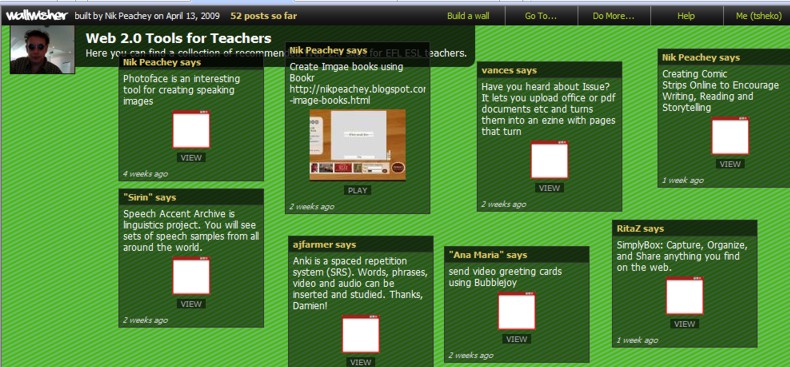

Wallwisher

I discovered Wallwisher when I came across Wallwishers created by Nik Peachey and Ackygirl through Ackygirl’s link.

Wallwisher

Looking through the FAQs, I discovered the following information about Wallwisher:

Wallwisher is an Internet application that allows people to express their thoughts on a common topic easily.

A wall is basically the ‘web page’ where people actually post messages.

You don’t need to sign up to use the Wallwisher, but you do need to provide an email address. A temporary account will be created for you using your email address so that you can come back and make changes to the wall.

Have a look at FAQs for more information about how to use Wallwisher.

You can also share the Wall, embed it in a website or organise an RSS feed for Wallwisher.

I like the collaborative aspect the best,  the fact that it looks better than a list, it links to things easily, and you can even embed a video.

It would be an excellent way to brainstorm ideas and collaborate for students and teachers alike.

What are your ideas on the potential of Wallwisher?

Vision of the future – Are you ready?

Have you given nanotechnology any serious thought?  Have a look at this video by Karsten Staack, The 21st Century: What will it look like?


[youtube=http://www.youtube.com/watch?v=c1KEFgD6Dtg&feature=player_embedded]

What are your thoughts? Are you excited/afraid of the future? Don’t be. It’s not for you, it’s for the next generation.

Best online collaboration tools 2009

Robin Good has published Best online collaboration tools 2009.  It’s an enormous mindmap, difficult to read even if you shrink it.  If you hover over the central title you get two links. The first is a note which says

Collaborative map idea by Robin Good of MasterNewMedia.org realised during the Learning Trends 2008 event with the cooperative contributions of over 150 people on November 16 2008 and during the following weeks. You can email Robin Robin.Good@masternewmedia.org if you want to add to it.

The second link takes you to Robin Good’s website.

In an attempt to get an overview, I looked at the mindmap as a linear text in a word document; it’s enormous.

Here are the headings:

event-scheduling; chat; instant messaging; audio-conferencing; screen-sharing; video-conferencing; large audience webinars; web conferencing; co-browsing; whiteboards; web presenting; multimedia presentations; work grouping; document-sharing wikis; file-sharing; mindmapping and diagramming; collaborative reviewing; collaborative writing; project management.

The tools for each of these headings are hyperlinked. I’m overwhelmed by the number of tool here. Still, only one way to explore them – one at a time.

Here’s one of the many tools under the heading of Workgrouping. I wasn’t sure what that was when I read it, but the first tool listed is a ning, and I know what that is – an online platform for the creation of a social network. I chose randomly, and here’s what I found out about Yammer.

Yammer is a private communication tool for a company in which you can control privacy settings (very much like a ning).  The formatting reminds me of Twitter and Facebook: there are status updates, information shared on a discussion board, groups formed, and members have profiles/bios with layers of background information. Its attraction to commercial companies? The same as what would (or should) attract nings to schools. It connects people within the company in one place, allowing this to be divided into the required spaces within that company. Members share news, information, questions, links; bios provide valuable background information, such as the information provided in Facebook and nings. You look up a person, and you can follow them, as on Twitter. That means, if you think someone is interesting, you can keep updated about what they’re working on or what they’re reading (as on Twitter, Facebook). This kind of knowledge sharing reduces redundant questions asked by people. I think it also gives a good measure of control to the individual member, allowing independent research into people or projects, and allowing them to take the initiative of forming public or private groups.

I wonder if commercial companies will embrace these online tools before schools do?  And if so, will schools finally sit up and take notice when they see that the world of work is taking them seriously? Or will schools become the innovators?

By the way, for a while now, when I mention a ning, I get some sort of guffaw as a response, and then the inevitable question: ‘Why is it called a ning?’ Well, I decided to look it up. According to Wikipedia, the word ‘ning’ is Chinese for peace.

Ning is an online platform for people to create their own social networks [2], launched in October 2005.[1] Ning was co-founded by Marc Andreessen and Gina Bianchini. Ning is Andreessen’s third company (after Netscape and Opsware).

The word “Ning” is Chinese for “peace” (simplified Chinese: ; traditional Chinese: ; pinyin: níng), as explained by Gina Bianchini on the company blog, and it is also a surname in Chinese.

Still, I think, to attract more credibility, they could have gone with a name which didn’t allude to a nonsense poem by Spike Milligan.

Tinkering as a mode of knowledge production

Listen to John Seely Brown’s talk where he addresses the Carnegie Foundation for the Advancement of Teaching, Stanford, CA, 2008.

[youtube=http://www.youtube.com/watch?v=9u-MczVpkUA&feature=player_embedded]

I am what I create is how John Seely Brown defines our new identity.

I’d like to paraphrase what John says in his talk ‘Tinkering as a mode of knowledge production’, and also to offer some of my own thoughts.

Here’s the gist: Since many of the skills that we learn today have become obsolete several years ago, we must find a way to get today’s kids to embrace change, to want to constantly learn new kinds of things, to find a way to play with creating knowledge on the fly by experimenting with things. Notice how different this is to the traditional learning of finite knowledge imparted by the omniscient teacher . How do we initiate this tinkering, this creating of knowledge? John Seely Brown says we need to look for ways to foster the imagination; if there’s no imagination, there’s no creativity. And he places the tinkering learners within a new culture of sharing, in peer-based learning communities, where kids learn from each other. The challenge, he says, is to find new learning environments. We need to go back in time, so to speak, to the comprehensive classroom that had students of all ages in it, where the teacher was the organiser, the facilitator, and where students’ learning was as much from other students as from the teacher. We need to construct an environment where we are constantly learning from and teaching each other. And now for the tinkering.

What is tinkering? John Seely Brown sees it as the creation of something concrete as opposed to abstract or theoretical learning out of context.

Let me take my imagination and build something from it. Build something concrete instead of decontextualised knowledge. Once we’ ve created this concrete thing, we can see if it hasn’t worked, why doesn’t it work, and ask questions: how to build it better. We expect this thing to do something.

Why do we need this new learning environment? We live in a different type of world, one of rapid change. We need to find ways to tinker with ideas, ask good questions, and be able to take criticism. We need to learn in this architectual studio, where all work in progress is made public .

This makes so much sense to me. Currently, as part of our project for the Powerful Learning Practice program in which our school is involved, we have decided to create a NING, a whole-school online learning network, in order to bring the members of our school together, learning from each other, sharing, and making all our processes and projects transparent. In the new learning environment Brown speaks of, we are all able to witness each other’s struggle, understanding the process each of us is going through. What a powerful way of learning with and from each other. As Brown says, when the design is finished, and you overhear the master critiquing another’s design, this has tremendous meaning to us as well because we’ve been part of the process of the each other’s constructing of design. In this distributed learning environment, you learn to accept criticism. You want to be critiqued, you appreciate criticism, you learn from it. Brown sees this as one of the key platforms for lifelong learning and in embracing change.

Today’s networked technology allows us to build distributed communities of practice. Instead of us physically working shoulder to shoulder with others, our avatar is working shoulder to shoulder with others. We have infinitely more powerful tools to craft things, to mash this up. Creativity takes on new possibilties through tinkering – our tools not only allow us to create but also remix. In a short space of time, we can take what we see from others, rework it and recreate it, then give it back to the community for further reworking. How much better is this than isolated learning and creating?

The second message in John Seely Brown’s talk is something I’m very excited about. It’s a positive statement about young people today, and I urge everyone to think about it seriously, because it counters the many negative statements that are thrown out about young people in the age of technology. We are on the cusp of the creation of a new identity. In prior decades a lot of kids grew up thinking ‘I am what I wear’, or what my parents own, or how much money we have. Identity came from material possessions. I’d like to add to that by saying that identity also came from what we did for a living. Our occupation was who we were. It was the name of the occupation that was important, not the internal workings and processes of these occupations.

Here is the most exciting part of Brown’s talk for me : JUST MAYBE, he says, just maybe we are entering into a world now where our own identity gets defined by what we’ve created and what others have added to it.

This is a sense of identity constructed for myself. I passed something onto others, and they have been able to do wondrous things with this as well.

I can relate to this so well. When my children were younger and I was unable to teach full-time for several reasons, I was a ‘housewife’. I was not a teacher, I was not a thinker, I was not someone with creative talents, I was defined by my title. Now that I’m a teacher once again, I’m pushing beyond this title too. In my writing (which is really a remashing of my reading of others’ thinking with my own thinking) in my blogs and personal learning networks, I’m stretching my identity to include much more of my potential, and I’m doing this shoulder to shoulder with many others around the world. Technology is allowing me to recreate myself along with others – unlimited by my geographic location, unlimited by time zones. I’m creating my own identity within a new learning community. I’m a teacher, but what’s most satisfying and comfortable for me, I’m a learner.

As John Seely Brown says THIS IS A DIFFERENT WORLD.

Web 4.0 thanks to GE

One thing leads to another. That happened to me today as it happens so often. The pathways within social networks are as mysterious as they are surprising. I was checking my Twitter updates, and I did what I often do – check out who else is interesting through my own network. So I was checking out @art4change who was conversing with @hrheingold, and I followed a link she had tweeted. I was hoping it would be good, because she had promised: ‘Watch this NOW. Dead serious. It will blow your mind. Thanks @JohnStauffer http://tinyurl.com/cydomk’.

This comes from GE. As John Stauffer says in his post ‘Hangin with Mr Cooper’,

Sit back and prepare to be amazed. No video editing was done to create this, just a flipcam and some Friday afternoon brainstorming with our Creative Director, Robert Cooper….

[youtube=http://www.youtube.com/watch?v=DkqtklABgGQ&eurl=http://blog.ogilvypr.com/2009/02/hangin-with-mr-cooper/comment-page-1/#comment-35235&feature=player_embedded]

Siftables – the toy blocks that think

[youtube=http://www.youtube.com/watch?v=JP0w9lZoLwU]

David Merrill is the creative inventor of Siftables, small computer blocks that interact with each other, offering a myriad of learning possibilities using physical manipulation and play.

I’m so inspired by people like David, and by the way he talks just as much as what he does. His passionate explanation of his new discovery reveals  creative and innovative thinking. He says “I started to wonder… what if…?” And that’s the point where you  know something great is going to happen. ‘What if…?’ is something I think we should do more often.

So he thinks ‘What if, when we use computers, instead of having a single mouse cursor, we could reach with both hands and grasp information physically, arranging it the way we wanted it?’

David’s idea came from watching kids play with blocks, and understanding that through this physical play they were learning how to think and solve problems by understanding and manipulating spatial relationships.  He argues that spatial reasoning is deeply linked with how we understand the world around us.

From this idea, David, the computer scientist, came up with a concept and developed a new tool – Siftables; you could grab information physically and arrange it the way you wanted to. Siftables, according to David, are an example of a new ecosystem of tools for manipulating information, for exploring new and fun interaction styles. The blocks are somehow aware of each other, aware of the nuances of how we move them, and respond accordingly. The examples he showed were language and maths games, as well as musical composition, but he hinted that there were many more applications.

The game aspect is appealing. As David says, you don’t have to give kids many instructions – they work it out for themselves by playing around with the blocks. Discovery.

The music was my favourite example, and I immediately wanted to have a go.  The Siftables enabled you to inject sounds into a sequence that you could assemble into the pattern you wanted.

David says, ‘My passion is to make new human computer interfaces that are a better match to ways our brains and bodies work… we are on the cusp of a new generation of tools for interacting with digital media that is going to bring information into our world on our terms.’

A powerful statement.

I like the way he’s thinking about matching digital tools with our brains AND bodies. I often think about how traditional education, with its expectation that students sit still and listen for prolonged periods of time, or work on teacher-prescribed work which focuses on text, doesn’t match the way adolescents function, and definitely doesn’t take into account their need for physical activity.

Siftables may have been created for young children but I think there is much potential for adolescents too. This is an excellent example to underline something I’ve been saying for a while: technology is not an end in itself. Technological tools are just tools, but they can enhance learning, and with the learner in mind, and particularly with the learning aims in mind, they can enable creative and innovative activity.

 Thanks to @marciamarcia for this link.

Rethinking young people, rethinking ourselves

schoolkids

Photo taken by Chris Suderman

In his book Through the children’s gate, Adam Gopnik said this about children:

Children reconnect us to romance. For children, … every day is the first day of love: The passions that for us grown-ups rise and fall only in exceptional circumstances, unexpected storms on the dull normal beach where the tide breaks unchangingly, rise every day for them. Shock, hatred, infatuation: “I hate you,” they cry, slamming the door, and they mean it; and then the door opens fifteen minutes later for dessert. They compel us to see the world as an unusual place again. Sharing a life with them is like sharing a life with lovers, explorers, scientists, pirates, poets. It makes for interesting mornings.

I like this quotation for a few reasons. Firstly, to remind me of the passionate and immediate nature of young people. If at school they seem indifferent, apathetic, unengaged, then we need to ask ourselves why. We look to ourselves and what we are doing as teachers to make them behave in a way which is actually contrary to their nature.

Secondly, this passage tells me what we can gain from being with young people, what we can learn from them. Our role as teachers is not to ‘teach’ them in the sense of pouring into them what we know better, it is to listen, to bring out, to – with time, the time it takes to know a person – understand where their interests lie, what their passions are, how we can harness their dreams to educational opportunities. We provide the environment, teach skills, encourage and guide, but we work with the unknown – the unknown possibilities of what each young person is yet to create, to achieve.

As I think about returning to school soon, starting along that well worn cyclical path again, I’m gathering together the technology tools that I look forward to using with students, but I’m not thinking about the technology – I’m thinking about the process, the learning and teaching process that will take place. This year I’d like to focus on providing learning experiences which are from people, from communities, learning not from static texts but from living, thinking people – some from other hemispheres – from conversations, comparisons, real discoveries. I’m hoping that this year’s learning will not come solely from one teacher. The net will be cast wide. What treasures will be collected in the net?

Sharing culture – Creative Commons video

George Siemens put a plug in for this Creative Commons video. Thought I’d share it.

[youtube=http://au.youtube.com/watch?v=1DKm96Ftfko]

Some of the thoughts I’ve taken out to give you an idea of the video:

What does it mean to be human if we don’t have a shared culture? What does a shared culture mean if you can’t share it?

We have all these new technologies that allow people to express themselves, take control of their creative impulses, but the law gets in the way.

Creative Commons wants us to be able to say ‘here’s the freedom that I want to run with any creative work’.

A Creative Commons license says give me credit for my work.

Creative Commons allows you to exercise your copyright more simply.

It’s really about creativity and connection, access and control

Creative Commons is a bridge to this future – thinking not about content but about communities

It’s the space for more speech, more expression.


What do you think about Creative Commons?

Library Odyssey : 2029 future projection

jetsons


There’s been talk about libraries and librarians becoming an endangered species and eventually dying out. Personally, I think that’s a lot of rubbish. Nothing could be further from the truth. Although, you could say that libraries and librarians are shedding their skins, evolving with changes that are taking place.

The DaVinci Institute does a good job of discussing this and projecting a future snapshot of libraries. Thomas Frey, Senior Futurist of the DaVinci Institute, rejects the predictions that technologies will make libraries defunct, and says this:

Ever since the people of ancient Nineveh began storing and classifying their books nearly 3,000 years ago, libraries have been hallowed and largely unchanging bastions of learning. But in the information age, libraries have been caste with a new identity, and the future is evolving into a very different place.

Ten years ago, as the Internet began to take off, many in the tech elite were predicting the death of the public library. What the critics failed to predict, however, was libraries’ stirring ability to reinvent themselves. Much like plants that flourish with good soil, water and sunshine, libraries have actually begun to thrive in our information-rich environment.
In the school library context, many libraries and teacher librarians are not only reinventing themselves in keeping with the fast-paced changes in the availability and management of information, but they are also often leaders in the future direction of education. Despite this, I still hear people say that libraries should be closed, and that librarians will soon be unemployed.
Here are some of the predictions for a 2029 library by the DaVinci Institute:
Traditional lending has been replaced with downloadable books, which are never out of stock, formatted for electronic tablets and readers. A bigger change, though, has come with the very concept of what a book is. Where once a customer would passively read and, hopefully, absorb a book, every volume now is more akin to an online forum, with authors, experts and other readers available to discuss and answer questions on almost every important book ever written.
I look forward to this change, especially having become hooked on interactive online communities. It would be satisfying to be able to respond to text on the spot, and receive others’ responses. Librarything has paved some of this way, but I think it could go even further.
Here are some more snippets from Thomas Frey’s article
With the Internet having put increasingly powerful business tools into the hands of individuals, more people are working and operating businesses from home. To such people, the library offers not just a refuge from the isolation of their house, it also provides temporary office space complete with podcast recording studios, conference rooms and editing stations.
And of course, predictions should always include a future which inspires the imagination:
With technology having improved so dramatically, a central feature of this library is the Search Command Center, where a team of experts, both real and virtual, assists with complex searches that now incorporate not just words, but sounds, textures and even smells.
What would your predictions be for schools of the future?