All posts by Tania Sheko

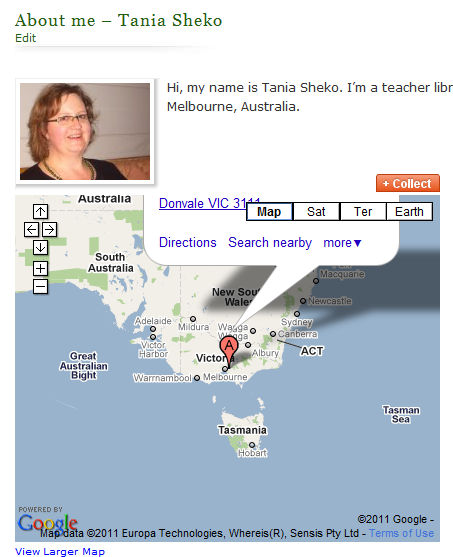
My name is Tania Sheko, and I am a teacher librarian at Melbourne High School, a selective secondary boys’ school 9-12 in Melbourne, Australia. ‘Teacher librarian’ usually requires a bit of an explanation. I think it’s a ‘School Librarian’ or ‘Library Media Specialist’ in the US and Canada. Often people are not sure what my role is, and it’s not easy to define. I like to think of it as the focus on ‘skills’ and ‘passion’ which exists in the spaces between the teaching of curriculum which is the domain of subject teachers. Some of my areas of focus include all sorts of literacies (information, digital, critical, network, etc.), collaboration with teachers as a kind of third hand (curating resources, differentiating learning, experimenting with blogs), and connecting people to ideas and an understanding of self and others through reading, discussion and debate. Most of our students go on to university, and we are always thinking about how we can best prepare them for the world of university and work. I’m interested in the educational environment, behaviours and directions of tertiary institutions, particularly as they move from traditional to innovative practices with connective courses. Connected learning makes sense to me, and I’m concerned that schools are often still envisioning learning as a passive consumption of content delivered by individual classroom teachers. With so much research-based evidence about student-centred, interest-driven and collaborative learning, and with the findings from the NMC Horizon Project, identifying and describing emerging technologies likely to have an impact on learning, teaching, and creative inquiry in education, I really think it’s time we woke up to ourselves about the anachronistic nature of our educational practices and took action. I learn from my colleagues, but also from my online network, reading their blogs, interacting with them on Twitter, exploring the wealth of their shared expertise online. This is what excites me about learning – connecting with people globally for a shared purpose.

New: Google Art Project

Google has developed a new project – The Google Art Project.

Explore museums from around the world, discover and view hundreds of artworks at incredible zoom levels, and even create and share your own collection of masterpieces.

Here’s a video showing you how to use the site:

[youtube=http://www.youtube.com/watch?v=GThNZH5Q1yY]

You can create your own art collection, add notes to  join a discussion about art, save closeups, share collections with people across networks, take a trip to different museums, and more.

Take a look at some of the art museums involved in this project

[youtube=http://www.youtube.com/watch?v=aYXdEUB0VgQ]

Google approached the museum partners without any curatorial direction, and each museum was able to chose the number of galleries, artwork and information they wanted to include, based on reasons specific to them. All content in the information panel pertaining to individual artworks was also provided by the museums.

At this stage, these are the museums involved:

  • Alte Nationalgalerie, Berlin – Germany
  • Freer Gallery of Art, Smithsonian, Washington DC – USA
  • The Frick Collection, NYC – USA
  • Gemäldegalerie, Berlin – Germany
  • The Metropolitan Museum of Art, NYC – USA
  • MoMA, The Museum of Modern Art, NYC – USA
  • Museo Reina Sofia, Madrid – Spain
  • Museo Thyssen – Bornemisza, Madrid – Spain
  • Museum Kampa, Prague – Czech Republic
  • National Gallery, London – UK
  • Palace of Versailles – France
  • Rijksmuseum, Amsterdam – The Netherlands
  • The State Hermitage Museum, St Petersburg – Russia
  • State Tretyakov Gallery, Moscow – Russia
  • Tate Britain, London – UK
  • Uffizi Gallery, Florence – Italy
  • Van Gogh Museum, Amsterdam – The Netherlands

I’m sure this list will grow. What an exciting project. I’m looking forward to browsing the art and also to what will develop here in the future.


Art still matters

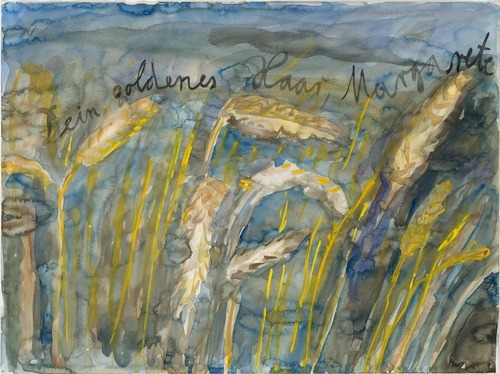
Your golden hair, Margarete by Anselm Kiefer. Title derived from Death Fugue by Romanian Jewish poet and WWII survivor Paul Celan. Read more here.

The school year is starting again and so I thought I should air out some of my blogs and other resources because they’ve been put away in the top cupboard during the long break.

Remember the art blog? Art does matter.  Remember how, towards the end of last year, I revised the look of the blog so that it came out all svelte and user-friendly?

Well, don’t think it’s been sitting there idly, it’s been hatching lots of new art to stun you. Students, teachers and art lovers, get ready to be inspired by the diverse talent which is about to unfold before your eyes. I snuck in three examples during January (couldn’t help myself), one of which you see above, and then two animations.

[vimeo http://vimeo.com/16262803]

This one would be great for a discussion about issues such as beauty, bullying, female exclusivity, perhaps.

Some of you will know that I’m a fan of Russian animation, so here’s a claymation example by Serge Merinov.

[youtube=http://www.youtube.com/watch?v=OqbyUuFmhig]

So bookmark this blog if you have any interest in art. I’ll do all the work and present you with visual delights throughout the year. What do you say?

PS  The wiki is a good accompaniment but you have to take time to browse.

Kick Start Activity 3 (Advanced) – Add Some Muscle to your Blog

Well, my participation in the Edublogs-supported blogging activities is erratic to say the least…
I wasn’t sure if I should skip to the latest activity number 6 or contribute belatedly to previous activities. As you can see I’ve gone for the latter option, and I’m glad I did because it’s given me a chance to take a broom to my About Me page and to think about what other pages I could create.
Here’s what I did to my About Me page:
  • I moved my photo to the top of the page
  • I added my name and teaching role at the beginning of the page. Seems obvious to do that, but somehow I had neglected it.
  • I introduced myself at the beginning and started with a more personal, conversational tone
  • I added my passion for art and animation and linked to my newish art blog, Art does matter.
  • To encourage conversation, I asked the readers to feel free to leave a comment or introduce themselves.
  • I wasn’t sure about naming my school, so I thought I might just say that I was in Melbourne, Australia. After all, my blog is personal, and not in any way representational of my school.
  • I added a Google Map of my location
  • This year I will have the added role at school as coordinator of learning enhancement. I added this information and invited people to share their knowledge with me.
  • I added my involvement with Powerful Learning Practice since this was seminal to my connection to other people and networks

I’d like to add a page which links directly to my wiki but I haven’t figured out how to do it yet, so any help would be appreciated. It makes sense to link everything you do to your blog. In that case, should I have pages for all my other blogs or is it enough to include them in the links on the side? Comments are welcome and appreciated.

Flashmob Moscow style

You’ve all seen the flashmob events made famous by Improv Everywhere, for example, Grand Central Station in New York. Here is a group doing the same thing  in a Moscow shopping mall singing a popular Christmas carol. The singers are from an Orthodox boarding school and include clergy (obviously the bearded ones).

[youtube=http://www.youtube.com/watch?v=JPlZTqc5z7o]

A bit late for Christmas, I know, but just came across it.

Going for Google Academy

I thought I was dreaming when I read a tweet about Google Teacher Academy running in Sydney, Australia this year.

The Google Teacher Academy is a FREE professional development experience designed to help primary and secondary educators from around the globe get the most from innovative technologies. Each Academy is an intensive, one-day event where participants get hands-on experience with Google’s free products and other technologies, learn about innovative instructional strategies, receive resources to share with colleagues, and immerse themselves in an innovative corporate environment

Only 50 educators Australia wide will be selected. Although my chances are small, thanks to Anne Mirtschin, I decided to have a go. Why not? The application process itself is valuable in its evaluative and reflective focus. An important part of the application is the creation of an original 60 second video on either  of the following topics: “Motivation and Learning” OR “Classroom Innovation.”  To me, they’re pretty much one and the same. I chose “Classroom Innovation” and included evidence of some of the learning which used new technologies to take learning out of the textbook and the classroom by creating interactive, collaborative and often global learning opportunities.

[youtube=http://www.youtube.com/watch?v=G3ot-bCDPgA]

What do you think? Not easy to cram a message into 60 seconds. The music is from Public Opinion Afro Orchestra, and I’m grateful that the manager of the band, Tristan Ludowyk, responded so quickly to my email request and gave me permission to use the band’s music.

If you’d like to apply, you’d better hurry up because applications close 27 January 2011. Click here for information.

Kick Start Activity 2 – Advanced – Posts! The heartbeat of the Blog.

First of all, how important is it for a blog post to be effective?

That may seem like a stupid question but I think that it’s reasonable considering many bloggers would say they’re not out to score points. At the same time, whether we like it or not, we write for an audience (even if we also write for ourselves). Who doesn’t like feedback and discussion? The question is, how to attract readers and consequently a network, however small, so that we can share our thoughts and have them challenged and extended by others.

One of the ways to do this is to think about how to write an effective post.

Hmmm….

from my Flickr photostream

1.  Even adults like looking at pictures

Although this has nothing to do with the writing, but a picture always enhances the blog post. After my initial rave, you may have been relieved to receive the visual distraction, and obviously the picture should be relevant to the post. You can be clever with the picture and use it either to illustrate the message using humour, metaphor, surprise, cryptic association or accompanied by a quotation. Either way, it breaks up the mass of text. I like to use more than one picture if I have enough time to find what I need.

2. The heading should not be too boring and preferably interesting

I’m not saying you have to knock people out with the heading but at least have a hook. When I read Joyce Valenza’s award winning post, Things I think teacher librarians should unlearn (20 and counting), I immediately zoomed in on ‘unlearn’. Not sure why, maybe because I get sick of reading about what we should learn, and unlearning seems a little subversive. I was very curious about what Joyce would consider unlearning.

3. Experience

A heading can be catchy but the content of the post is even more important. Going on to read Joyce’s list of what teacher librarians should unlearn, it was clear that Joyce’s experience enabled her to punch out so many excellent points. An blog post is effective when the author writes from experience.  Even though we might feel we are not saying anything new, there is always someone who will appreciate our perspective, for whom our experiences and observations are new and interesting.

4.  Generosity

People jump at a post which shares generously, such as Joyce Seitzinger’s Moodle tool guide for teachers post. In this case, Joyce adapted a social media cheat sheet with a business/marketing focus to one relevant to education. When you do the hard work and share a resource you’ve created in your post, it’s a winner.

5.  Honesty

Jeremy Harmer’s post, Why I walked out – but would you?, was shortlisted in the Edublogs influential blog post category. It’s a good example of an anecdotal post which I always enjoy reading and also writing. Jeremy writes honestly about walking out of Marc Prensky’s conference session – that in itself attracts the reader’s attention. I think the post works because it’s so reflective, and invites the reader to respond to a series of questions.

Which brings me to my last point:

6.  Conversation

An effective blog post invites readers to join the conversation. This is something I strive to do because there’s nothing more satisfying than engaging people in dialogue, and perhaps influencing them to come back to the blog regularly.

from my photostream

I hope that my post has given you enough to savour, something to chew on.

Teacher blogging challenge – Kick start activity 1: Down blog’s memory lane


Learning anything means moving forward one step at a time, although sometimes you leap ahead and skip steps, or other times, slip and have to get up again. The steps are not always smooth but that’s life.

This is the first post for the first teacherchallenge for advanced bloggers in the Kick Start Your Blog.

The advanced teacher blogging challenge is to encourage experienced bloggers to continue to post regularly, improve the quality of their blog, increase readership, allow further networking and importantly, to learn together. It offers a unique showcase reflecting individual knowledge, approaches, experience, wisdom and hindsight of experienced bloggers. When we write reflective and informative posts on similar themes to the beginners and share with each other, we build a rich community and supportive network.

So, memory lane for my blog…

  1. When did you start blogging and what instigated this?

It was May 2008. I decided to take on a Web 2.0 course run by the Yarra Plenty Regional Library.

2.  What did you start out blogging about?

My first post was just an introduction to the blog, and an explanation for the blog title. (My second post was a YouTube video of a shrimp on a treadmill! I think I was trying to be funny in both posts, and the reason was that I felt awkward writing and publishing, and was covering up with humour and hyperbole. By the way, the shrimp video was a metaphor for moving forward with technology. Really.

3. What did you enjoy about your early blogging?

I realised that I missed writing (from my school days), that I loved having a voice, and publishing in the hope that someone would read what I had to say and comment.

4. How much time did blogging take for you in the early days.

It actually ate up a lot of my time. The first time you do anything, it takes a while to figure things out. I’m not intuitive about technology, so it takes me longer to figure things out than usual. Just figuring out how to add pictures, videos, widgets, etc. – all these things come easily now, but not then.

5. What frustrated you about your early blogging efforts?

Well, in those days, my computer would crash pretty often, so I’d lose what seemed like hours of thinking and writing. I refused to write on a word doc first, and so I used to curse a lot when things disappeared.

6. What were the highlights of your early blogging?

Receiving a response from people is definitely a highlight. I suppose, in a way, writing a blog is like posting journal reflections, so you do it for yourself, but it’s great to get comments, particularly when these develop into a conversation, and even moreso when you get to know people through this exercise.

7. Is blogging a selfish, lonely, egotistical (you get the picture) exercise?

People would sometimes sneer at me blogging, and tell me to get a life. Writing a blog is actually the opposite of a self-centred exercise because it connects you with other bloggers, with people who share your professional and personal interests, who support you and extend your thinking, who challenge you, and who, most importantly, take you out of the walled garden of schools and teaching.

8. Have you changed your blogging style or subject matter over the years?

Yes and no. I suppose I used to feature new technologies in education more often, but since then I’ve become more reflective about my practice.

9. What would you say to teachers or students about blogging?

I would say, just start blogging! It’s a space that belongs to you, giving you a voice, and documenting your development and learning. You’ll be surprised by the variety and depth of your progress when you look back through you posts.

10. Where do you get your blogging ideas from?

From my classroom experiences, from reading others’ blogs, Twitter and Facebook. Although most of the blogs I read are educational, they focus on different areas, eg art, literature, animation, libraries, museums, psychology, gifted learning, technology, music, science, maths, etc.

 

Kids teach parents tech in their own way

This makes me laugh; I think my eldest son may have left home because of this.

[youtube=http://www.youtube.com/watch?v=rHa1Dj3JIFQ]

It’s true that many of the ‘parent’ generation are less than expert at tech. Embarrassing, yes, and something I can completely relate to. When I did my Master of Education online, I didn’t even (dare I say it) know where the ‘on’ switch on the computer was. So the line ‘have you tried switching it off and on?’ would have not helped me one little bit.

My son was about 12 then and helped me struggle through the whole thing so that I could complete the degree. It was painful for both of us. I used to think that, once I’d logged onto the Charles Sturt University site, if I made a mistake, the people at the other end would know, and it would be embarrassing. The same as when I was a very young and I thought the people on the TV could see me. I’m not very tech-savvy.

It’s ironic  because, as my friends know, I’m connected a lot of the time (still don’t have the phone, but contemplating). My role as teacher librarian in finding and setting up the most interesting, relevant and engaging resources is made possible only by the enormous amount of time I spend online connecting with people and organisations, asking questions, joining discussions, saving it all to Diigo and Vodpod, sharing it with people.

It’s interesting to note the emerging learning styles of young people, on the whole, demonstrate an independence we never had. Connected, they find what they need to do what they want. We get on their nerves because we are helpless and think we need someone to tell us how to do something. They google, youtube, and whatever else, or even create videos to teach us, just to get us off their backs.

As educators, it would be nice if we let go of the traditional teaching/preaching approach, gave our students some credit, trust and space, and allowed them to learn actively by taking charge of the research/learning process. Instead of us teaching them, they could create teaching videos for each other. I hope to try and turn around some of the learning and teaching in the classroom this year.

Holiday bloggy sluggishness. But wait! something… mathematical?

Apologies for my rare postings of late  to those who still take an occasional peek into this blog  – although I doubt the existence of these people very much because there has been an unmistakable lapse in eventful posting. This is due mainly to school holidays and family things, not all pleasant. Nevertheless, here I am, and even if nobody is here to witness my thoughts falling into this post, I will proceed undeterred because I haven’t got anything better to do. OR, I actually have something interesting to share with you.

Today a Facebook link shared by my dear online friend and PLP colleague, Hiram Cuevas (@cuevash on Twitter), gave me the pleasure of discovering a rare talent, Vi Hart, who is obviously a very gifted young lady. Vi is as passionate about maths as she is about music, art and other things.  Her website made my jaw drop. Often I’m astounded by how much of value very young people have achieved in their short lives; how much more do they have to offer.

Here’s the first video that caught my attention. Let me know what you think.

[youtube=http://www.youtube.com/watch?v=CfJzrmS9UfY]

I love the doodling videos; here’s another one

[youtube=http://www.youtube.com/watch?v=heKK95DAKms&feature=player_embedded]

What did you think?

I haven’t explored everything in Vi’s site but the music boxes are fascinating.

[youtube=http://www.youtube.com/watch?v=3iMI_uOM_fY]

The balloon page looks challenging. Not sure if the average party clown would be game for these.

A little about Vi from her own website:

I like most creative activities that involve making a lot of noise, mess, or both. Aside from composing, I love improvising on various instruments, drawing, sculpting, and other methods of making things. My main hobby is mathematics, with special interests in symmetry, polyhedra, and surreal complexity. This usually manifests as collaborative research in computational geometry and other areas of theoretical computer science, or as mathematical art. I think the human brain is incredible and strange, so I have developed a great interest in dreaming and consciousness. As a result, I am a trained hypnotist and a lucid dreamer. The human body is pretty neat as well, so I enjoy dancing and judo. I always love to learn new things—variety is the food of creativity!

It would be interesting to trace Vi’s learning history to peek at the environment which supports such an intelligent, creative and unique person. I will be taking on a new role at school next year, Coordinator of Learning Enhancement, and I’m mentally hovering over different mental images of how best to support and inspire those responding to learning enhancement opportunities. All suggestions and ideas are very welcome.

How Delicious it was

The words from Big yellow taxi come to mind

Don’t it always seem to go
That you don’t know what you’ve got
Till it’s gone

That’s how it’s suddenly hit me with the news about Yahoo terminating the popular social bookmarking  site, Delicious. I haven’t felt this disappointed since Ning stopped free service. Delicious was one of the first Web 2.0 tools I used and raved about to other people. Not only an extremely efficient way to save links and render them searchable via tagging, but also a very transparent way to follow what other people are reading and saving.

I’m slow off the mark with this post; so many people have already tweeted and blogged their despair but it’s taking a while to settle in. At first I thought, oh well, I still have Diigo. And actually, I’ve been sending my links to Delicious via Diigo for some time since it’s so easy to use Diigo’s bookmarklet for recording essential information, and since, like others, I’ve used the automatic Diigo to Delicious function.

But then today I decided to have a look at my Delicious and realised how easy it is to see what people in your network are reading and saving. The beauty of Delicious is in the Network. Not only can I see what someone in my network is reading and saving, I can see an alphabetical listing of their tags, their tag bundles and their lists. This means I have an insight into the way their thinking, what’s important to them, the direction they’re taking.

And now I’m lamenting not using Delicious as well as I should have. Why didn’t I use tag bundles or make lists? Typical that I’d want to start now that Delicious is on its last legs.

Seriously, many people have written about the demise of Delicious with informative alternatives. I like Anne Mirtschin’s post. Anne’s not a whinger like me; she’s a postive, forward thinking person who remains open to future possibilities.

Just the other day, when Anne read on Twitter that @ggrosseck and I were wondering if we could trust cloud applications, if we  should stop promoting Web 2.0 tools to colleagues, Anne responded with her characteristically unwavering conviction:

“Never any guarantee on the future of any Web 2.0 but will always be alternative”.

Wise words, Anne, very true.

Good luck, everyone, in exporting your Delicious bookmarks and finding alternatives.