All posts by Tania Sheko

My name is Tania Sheko, and I am a teacher librarian at Melbourne High School, a selective secondary boys’ school 9-12 in Melbourne, Australia. ‘Teacher librarian’ usually requires a bit of an explanation. I think it’s a ‘School Librarian’ or ‘Library Media Specialist’ in the US and Canada. Often people are not sure what my role is, and it’s not easy to define. I like to think of it as the focus on ‘skills’ and ‘passion’ which exists in the spaces between the teaching of curriculum which is the domain of subject teachers. Some of my areas of focus include all sorts of literacies (information, digital, critical, network, etc.), collaboration with teachers as a kind of third hand (curating resources, differentiating learning, experimenting with blogs), and connecting people to ideas and an understanding of self and others through reading, discussion and debate. Most of our students go on to university, and we are always thinking about how we can best prepare them for the world of university and work. I’m interested in the educational environment, behaviours and directions of tertiary institutions, particularly as they move from traditional to innovative practices with connective courses. Connected learning makes sense to me, and I’m concerned that schools are often still envisioning learning as a passive consumption of content delivered by individual classroom teachers. With so much research-based evidence about student-centred, interest-driven and collaborative learning, and with the findings from the NMC Horizon Project, identifying and describing emerging technologies likely to have an impact on learning, teaching, and creative inquiry in education, I really think it’s time we woke up to ourselves about the anachronistic nature of our educational practices and took action. I learn from my colleagues, but also from my online network, reading their blogs, interacting with them on Twitter, exploring the wealth of their shared expertise online. This is what excites me about learning – connecting with people globally for a shared purpose.

The end of the year is nigh

Nigh? What kind of language do I think I’m speaking? I blame end of year debilitating virus for that.

Anyway….

…it’s a strange time of the year when you jump off the spinning School Wheel and onto the Christmas Shopping and Everything Else Wheel.

I love this time of year in Edublogland when the Edublog Award winners are announced in all the delectably diverse categories. It’s a time to revere winners, to rejoice with friends, to expand the old Google Reader with more blogs, to bookmark best podcasts, virtual worlds, social networks and PLNs. It’s a time when you wish you had more time to explore, and a magical way of keeping up with everything.

I’m proud that our Australian educators have made the Edublogs honours list: @brightideasblog @edtechcrew @mrrobbo. Congratulations!

The end of the school year, I think some would agree, is a bitter-sweet time of letting go and refocusing on the multi-faceted holiday period.

I try to balance the stresses of everyday life with things of beauty. I need things of beauty; I think we all do. Sometimes music, sometimes art, sometimes literature. Today I’m sharing a beautiful Russian animation, The Seasons, by Yuri Norstein. Despite all his awards for animation, he was fired from Soyuzmultfilm in 1985 for working too slowly on his latest film, a  feature-length adaptation of Gogol‘s Overcoat.

[youtube=http://www.youtube.com/watch?v=jnvuw29Tc28]

I was interested in reading about the technique which enables him to evoke such ‘magical’ landscapes:

Norshteyn uses a special technique in his animation, involving multiple glass planes to give his animation a three-dimensional look. The camera is placed at the top looking down on a series of glass planes about a meter deep (one every 25–30 cm). The individual glass planes can move horizontally as well as toward and away from the camera (to give the effect of a character moving closer or further away). (from Wikipedia)

Best wishes to everyone for the holiday period; stay healthy and productive, focus on what’s essential, and I’ll save my Christmas wishes closer to the date.

Edublog winners – looking in from the outside

The 2010 Edublog Awards have raised some excitement as well as some good natured jabbing on Twitter. I’m watching the whole spectacle from the outside and find it very entertaining. Meanwhile, I think my Summer holidays will be sucked up by frantic attempts to save nominated people and their blogs/wikis/whatever to my Google Reader, all the while wondering aloud and in a panicky internal voice, ‘How can I keep up with all these people?’ and ‘How can hope to emulate, even on some small scale, the work and reputation these people have built up?

I enjoyed reading this blog post, and can identify with the polarities warring within whenever any kind of acclaim is bestowed upon one. John Spencer, we have a lot in common.

Amplify’d from www.johntspencer.com
Last night I sent out a tweet mentioning being nominated for an Edublog Award.  I then erased the tweet, but it had already become public knowledge on those crazy ether tubes that fill up our make believe world.  I had pleaded publicly and I regretted it.  Then I added a badge and mentioned it at the bottom of two blog posts.  Then I felt like an arrogant fool and so I thought about erasing all of that. 

Here’s the deal: I want to win.  This feels oddly foreign, since I don’t tend to be all that competitive.  I chose individual sports in my youth (if running as hard as you can is considered a sport) so that I could compete against my own personal records. One of my greatest personal accomplishments involved finishing among the bottom of the pack in a marathon.

And yet . . .

Ego and the Edublog Awards

I want to spread some of my ideas and values to a larger audience.  I want people to get past the Waiting for Superman mythology and recognize that it’s about humility and transparency and authenticity.  (And all the while, I’ve got this ego thing that I can’t shake) On the darker side, this is the explicitly arrogant belief that I have the answers (even if the answer is that no one has all the answers).  On the positive side, I think I have something worth saying. I think I’ve been sharing a philosophy that counters much of the screaming in the mainstream media echo chambers about teachers and education reform.

Read more at www.johntspencer.com

My nominations for Edublogs Awards 2010

In the nick of time, my nominations for the Edublogs Awards 2010 are:

Best individual blog – Jenny Luca – Lucacept.

Jenny Luca has been posting regularly through rain, sleet and snow. Her enormous following can be sure that she finds the latest information and news and opens up discussion for pertinent and controversial educational issues. Jenny shares what she’s reading, thinking and doing in a very personal way. The blog reflects her warmth and support to others. Jenny’s blog fits into many categories, but I’ve put it into the personal category because the blog is all Jenny.

Best individual tweeter – @ggrosseck (Gabriela Grosseck)

First person I check out when I open Twitter. Gabriela has the knack of finding the best links, and not always just the ones everyone else finds.

Best resource sharing blog – Judy O’Connell – Heyjude

I can be very lazy and just fish Judy’s blog for resources if I want to. Judy does all the work and I’m grateful. Of course, this is no dry, resource-only blog; Judy’s blog keeps you up to date with the latest in education and latest technology for learning, teaching and networking. Also, having just bought an iPad, Judy has everything I need to work out what to do with it in her blog, on Facebook and Twitter.

Best teacher blog – On an e-journey with generation y (Anne Mirtschin)

Anne is my hero when it comes to setting an example for teachers who create engaging, relevant, real-life learning situations. Anne’s students’ classroom is the world. I’m jealous. And Anne doesn’t just talk about it – she does it.
Best librarian / library blog – Bright Ideas (Judith Way)

Bright Ideas is the absolute best teacher librarian/library blog. Judith sources best resources for teacher librarians/librarians to support learning and teaching, and networks madly with educators who share what they do. It’s a window into what’s happening in school libraries and a great place to connect to new people.

I wish I’d had the time and energy to think about the rest of the categories, and there are so many people I’d really like to nominate. My Google Reader is bursting at the seams and is testament to how many people I rely on for my own learning.

And every year I learn about new, amazing people who are making learning and teaching such an exciting business. Thanks to all and thanks to Jenny Luca who has made my jaw drop to the floor with her nomination of my blog.

Although I’ve left this quite late, you might still have time to squeeze in some nominations here.

Stop telling me I’m wasting my time on Facebook

I’m a little tired of people telling me I’m wasting my time on Facebook.

Yes, I do enjoy keeping an eye on what my friends and colleagues are up to, seeing photos of their weddings, new babies and celebrations, particularly when they don’t live close. But I also use Facebook professionally. I’m a teacher librarian – I resource the curriculum, and that means I need a constant stream of information coming to me. Facebook, my Twitter network, Google Reader, my Diigo and Delicious network, my Vodpod network – all connect me to what I need to do my job. The same goes for what I’m interested in.

Some read the newspaper, others do it differently.

I don’t know what you see on your Facebook page but this is a cross-section of what I see –

You get the idea…

Making learning personal and social – Presentation at SLAV conference

Last Friday I had the privilege of sharing some of what I’ve been doing with blogging at my schools at the SLAV conference, Celebrations! An eye for literacy. I believe SLAV hosts the most informative and inspiring conferences, deepening our understandings and broadening our horizons.

Unfortunately we were running late with this session, and at least half of my presentation had to be cut. I wasn’t able to fully develop my presentation of the topic:

Social networking: giving students an online voice. In this session you will explore the initiatives of threeschool libraries and the use of social networking to buildcommunities of readers. What worked – and why it’s worth having a go.

That’s why I’ve embedded my slideshow and accompanying text in case anyone is interested in the complete presentation.

[vodpod id=Video.4904357&w=425&h=350&fv=]

Here is the link to the accompanying text.

The educators in my session were inspiring in their presentations – Tricia Sweeney and Michael Jongen (Our Lady of Mercy College, Heidelberg) talked about Twitter and Facebook to engage students, and Rachel Fidock (Mooroopna Secondary College) talked about Google Lit Trips.

Thanks to SLAV for the opportunity to share some of my work with teachers and students. Like the others, I was incredibly nervous but ended up enjoying the experience. Sharing of ideas and experiences is very satisfying.

My slideshow is also embedded in my wiki.

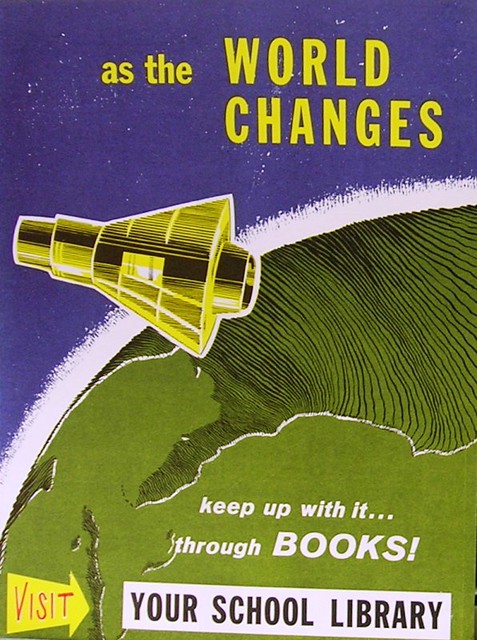
As the world changes, how do we keep up with it?


Photo from Enokson on Flickr

Books have been a source of information for some time now. But in libraries, the people have been important too. Librarians have been the personal link to information for some time too.

As the world of information has changed from being bound in books to becoming available to all on the net, people have become even more important because of their expertise. In schools, just as we are seeing a movement towards reducing funding to libraries, teacher librarians are skilling up in step with a fast-changing, online world, and are not only supporting the management an overwhelming outpouring of information, but are also able to support new digital skills in a globalised society.

Libraries are no longer prized for their hard-copy content as much as for their intellectual property. Resource centres, stage for events that bring people to ideas, gathering places – libraries have evolved and continue to do so.

If our libraries are recognised in these ways, we will never be redundant – on the contrary, we will be essential.

How do you see the emerging role of libraries and school libraries?

See other retro library posters here.

Control your identity online

This has been cross-posted from I get to say what’s culture.

Taken from Jenny Luca’s presentation

Kids these days are connected and mobile. Wherever they are, they have access to information and can communicate with their friends online.  Although I do believe that the media sensationalizes and demonizes social media, becoming informed about how to stay safe and behave responsibly online is crucial – for teachers and parents. Even for those of us on Facebook, it may come as a bit of a shock to realise how much we are unaware of in terms of privacy settings.

Do you know how much of what you or your kids post online is visible to others?

The Generation Yes Blog alerted me to the new A Parents’ Guide to Facebook by Connect Safely.  You can download the whole document as a pdf file here or take a look at an overview of recommended settings for young people here.

I like the recommended settings for young people as an alert to what Facebook users should be thinking about. Actually, I doubt whether most young people would be taking the time to fine-tune their settings, and Facebook doesn’t seem to be making it easy or intuitive to do so. That’s where kids need education. We all do, teachers and parents, so that we can recommend to our young ones what they should be taking control over.

I’ve included screen grabs of some of the information on the Recommended Privacy Settings for Teens here –

Jenny Luca has created some top quality slideshow presentations which I highly recommend. Take a look at them on her wiki.

You can also find good information on ACMA cybersafety website.

Finally, I’m sharing my ‘cybersafety’ Diigo links here.

I do think we need to be informed as teachers and parents because the issue of cybersafety and digital citizenship is not only relevant but crucial to our students’ lives.  Kids know how to work out technology but that doesn’t mean they’re going to be informed about consequences.

What do you think?

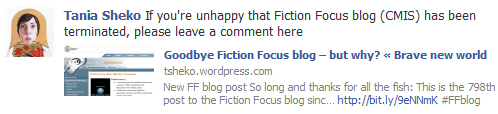
Goodbye Fiction Focus blog – but why?

This morning I read a tweet that left me in shock:

New FF blog post So long and thanks for all the fish: This is the 798th post to the Fiction Focus blog sinc… http://bit.ly/9eNNmK #FFblog

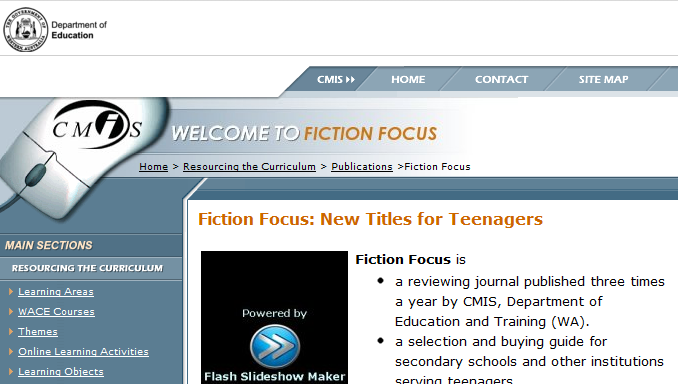
Following the link I discovered the bad news – Judi Jagger would no longer be writing the Fiction Focus blog:

This is the 798th post to the Fiction Focus blog since it began in early 2008. We didn’t quite make the 800. Unfortunately funding is no longer available for me to continue in this role, so my involvement has ended.

Whether or not my colleagues will have the time to maintain the blog will decide its fate. It certainly cannot be at the rate of posts that there have been in the past as they have an enormous workload.

Thanks for all the positive comments that come this way over the past nearly-three years.  I have enjoyed every minute. No, make that lovedevery minute.

I know that I speak for many people, teacher librarians in particular, for whom the Fiction Focus blog has been the first port of call for best quality YA fiction reviews and current information about books and reading.

The blog has been a wonderful extension of the CMIS Fiction Focus journal published three times a year by CMIS, Department of Education and Training (WA).  Although we’ve relied on the hard copy journal for a long time, the blog has been a welcome development at a time when social media transforms static publications into writing which has a personal voice and invites commentary and discussion.

I’m completely baffled as to why such an initiative would be terminated.

If you’ve enjoyed the Fiction Focus blog, please join me in expressing your gratitude to Judi and the team, and leave a comment on this blog or, better still, on Fiction Focus’ last blog post here.

What George Siemens knows and is sick of asking.

George Siemens’ recent post is to the point. He says we should stop asking useless questions about learning and just get on with it. The following convictions explain the kind of learning he’s talking about. His second last question has made me think: ‘Which questions are you no longer asking about the role of technology in learning?’ Definitely worth reading the whole post as well as the comments coming in.

Amplify’d from www.elearnspace.org

I’m firmly convinced of the following:
1. Learners should be in control of their own learning. Autonomy is key. Educators can initiate, curate, and guide. But meaningful learning requires learner-driven activity
2. Learners need to experience confusion and chaos in the learning process. Clarifying this chaos is the heart of learning.
3. Openness of content and interaction increases the prospect of the random connections that drive innovation
4. Learning requires time, depth of focus, critical thinking, and reflection. Ingesting new information requires time for digestion. Too many people digitally gorge without digestion time.
5. Learning is network formation. Knowledge is distributed.
6. Creation is vital. Learners have to create artifacts to share with others and to aid in re-centering exploration beyond the artifacts the educator has provided.
7. Making sense of complexity requires social and technological systems. We do the former better than the latter.

Read more at www.elearnspace.org


Prime Minister’s Literary Awards

Thanks, Fiction Focus, you are always ahead of the latest news in fiction; my first stop for reading news and well written YA reviews.

Sadly, due to funding issues, we will no longer have the pleasure of your blog posts. Thankyou and well done for 798 posts! Judi, you will be sorely missed!

Amplify’d from cmisevalff.edublogs.org

The Prime Minister’s Literary Awards

pmla-headThe waiting will soon be over for the authors and illustrators shortlisted for the 2010 Prime Minister’s Literary Awards. The word is that the announcement will be made next Monday, 8 November.

YA Fiction:

  • Stolen – Lucy Christopher
  • The Winds of Heaven – Judith Clarke
  • Confessions of a Liar, Thief and Failed Sex God – Bill Condon
  • The Museum of Mary Child – Cassandra Golds
  • Swerve – Phillip Gwynne
  • Jarvis 24 – David Metzenthen
  • Beatle meets Destiny – Gabrielle Williams

Read more at cmisevalff.edublogs.org