All posts by Tania Sheko

My name is Tania Sheko, and I am a teacher librarian at Melbourne High School, a selective secondary boys’ school 9-12 in Melbourne, Australia. ‘Teacher librarian’ usually requires a bit of an explanation. I think it’s a ‘School Librarian’ or ‘Library Media Specialist’ in the US and Canada. Often people are not sure what my role is, and it’s not easy to define. I like to think of it as the focus on ‘skills’ and ‘passion’ which exists in the spaces between the teaching of curriculum which is the domain of subject teachers. Some of my areas of focus include all sorts of literacies (information, digital, critical, network, etc.), collaboration with teachers as a kind of third hand (curating resources, differentiating learning, experimenting with blogs), and connecting people to ideas and an understanding of self and others through reading, discussion and debate. Most of our students go on to university, and we are always thinking about how we can best prepare them for the world of university and work. I’m interested in the educational environment, behaviours and directions of tertiary institutions, particularly as they move from traditional to innovative practices with connective courses. Connected learning makes sense to me, and I’m concerned that schools are often still envisioning learning as a passive consumption of content delivered by individual classroom teachers. With so much research-based evidence about student-centred, interest-driven and collaborative learning, and with the findings from the NMC Horizon Project, identifying and describing emerging technologies likely to have an impact on learning, teaching, and creative inquiry in education, I really think it’s time we woke up to ourselves about the anachronistic nature of our educational practices and took action. I learn from my colleagues, but also from my online network, reading their blogs, interacting with them on Twitter, exploring the wealth of their shared expertise online. This is what excites me about learning – connecting with people globally for a shared purpose.

Live stream from ELH09 Lorne – Jenny Luca’s talk

Steve Collis was kind enough to livestream (not sure if that’s a verb) Jenny Luca’s presentation at elh09 technology and learning conference at Lorne today. Brilliant for me for two reasons: firstly I couldn’t afford to go, and secondly it’s my day off so I could watch it. Well done, Jenny! As always, Jenny has presented an engaging, informative and inspiring talk about nings, social networking and participatory learning.

I’ve been lucky to get to know Jenny well since my involvement with Powerful Learning Practice, and anyone else who knows her will appreciate that Jenny speaks from experience, not hiding behind jargon or titles, but saying it how it is. As far as I’m concerned, that’s the way to reach a wider audience in the conversation about 21st century learning and teaching.

One of the most powerful messages Jenny transfers, both verbally and in terms of modelling, is that she is a learner first and foremost, and that this has given her the wings she needs to fly as an educator (I’m paraphrasing). Listen to Jenny. Read her blog.

Jenny Luca’s talk about ning

[vodpod id=Groupvideo.3221019&w=425&h=350&fv=id%3D21FC3FE2-3DEF-371F-3217-11EF739CE05F]


more about “Jenny Luca – Ning“, posted with vodpod


I’ve just listened to Jenny Luca’s presentation from the elh09 conference in Lorne. This is the slideshow that accompanied her talk. You’ll find it here on her personal wiki. I’ve had to put the live stream (well, it was at the time) of Jenny’s presentation into the next post; I couldn’t seem to send both at once from Vodpod. More about Jenny’s talk in the next post.

What would happen if maths and language arts teachers swapped jobs?

bobrobertasmith

Art21 blog has given me an interesting idea in their latest post:

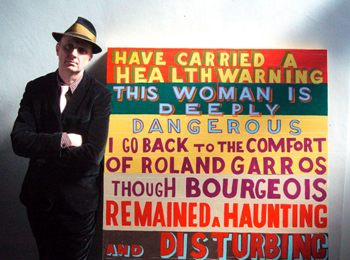
Last year the Guardian asked its sports and art writers to swap pieces for a day. Tennis correspondent Steve Bierley reviewed a Louise Bourgeois (Season 1) exhibition, which Bob and Roberta Smith fell in love with and subsequently made into a text-based painting.

Hmmm…

But how can we translate that into the school environment? I mean, the idea is something I’ve been playing with for a while – wouldn’t it be good if school didn’t separate learning into subjects?

Life isn’t like that, so why….?

In my job as teacher librarian I write a blog to encourage reading – I’ve mentioned it before – well, it’s not only about reading but all that goes with it. Thinking, discussing, idea-broadening, understanding – you know what I mean. Ideally, I’d love for the blog to create a reading (thinking, etc.) community, one that links people within the school through interests and discussion, but also links the school community with the wider community. I’ve also spoken about this before. Yes, I have so far included a couple of book recommendations/reviews by teachers who aren’t librarians. This is good, this gives the students the idea that people outside of the library read and enjoy reading. But …. they’re English teachers.

What I would really love is if sports teachers wrote about their reading. Yes, sports teachers. Maths teachers. Legal studies teachers.

So what kind of swap could I do? Do you think it would be easier for the maths/science teachers to talk books than the other way around? At first I thought yes. What’s left of my own maths/science knowledge, the little I gained in secondary school? I wouldn’t really like to go there. But then I remembered Sean Nash. He blends Science with the Arts. I was overwhelmed by his approach when I first discovered Sean’s blog, and I continue to be overwhelmed because it’s so inspiring, and I don’t see many educators do it.

Sean’s wife, Erin, shares his way of looking at a blended curriculum. Have a read of Erin’s profile on Sean’s biology ning where she says:

The best thing about the study of biology is:
The opportunity it provides for invoking curiosity and questioning in students and instructors alike. There are so many interesting topics in Biology that, ultimately, bring about questions that just aren’t currently answerable, and this provides so many awesome possibilities for critical thought and analysis. I could have taught English or Biology, and I was drawn to science because of that one big question, “WHY?”

 Isn’t this also the point of literature? The WHY and WHAT IF?  What if a character lived in a particular time/situation? How would that character live out his/her life? And WHAT IF this complication arose? WHY would he/she act in that way/make those choices? Personal choices, ethical choices, any choices.

I frequently reflect on what I’m trying to achieve in writing the fiction blog. Why is it important to stretch students’ – and for that matter, teachers’ – concept of what a reader is like, why we read, why books grab our attention, how books and films get our reactions and lead us into discussion or debate. It’s not a library thing, it’s not an English thing – and yet, it is literacy. The kind of literacy that is important for all of us across disciplines and beyond school. Sean Nash sums it up excellently when he talks about the connection between science and literacy in his comment to my post:

Science and literacy had certainly better go together. We are in a heap of trouble as a species as it is. We can’t afford to continue to create a scientifically-illiterate populace. Where science and literacy are separate, science is but mystery and mythology to even our brightest.

TED Q & A with Ken Robinson

KenRobinsonTED-reddit

The TED blog describes an interesting Q&A session with creativity expert, Sir Ken Robinson, author of The element. Reddit gave TED fans the opportunity to submit questions for Ken, with the 10 most voted questions being answered.

Here are the 10 questions Ken answered. Many of these are long, and I’ve tried to select the main part of the question, but you’ll have to go to the post to read the rest:

1. What specific actions do you recommend taking to overhaul, say, public education to maximize how we identify and nurture creativity? And what place do you think things like critical thinking and logic (also noticeably absent) have in basic education?

2. …why do we make these distinctions between “math”, “biology”, “history”, and “art”, when they are all linked, and when the interconnections so often make them meaningful? Is it OK if children are not “well-rounded,” as long as they are following their curiosities, or does a lack of “well-roundedness” mean we are not exposing them to enough bridges to new interests?

3. What do you think is the correct way to grade/rank/assess an individual’s academic performance? And what do you think should & should not be included in standardized entrance exams like SAT?

4. … some would advocate that video games are in fact best preparing kids for 21st century life. What’s your opinion on this, and of the place of video games in education?

5. There are so many individual teachers and librarians out there who GET IT, who want to help their students stop “playing school” and start having authentic learning experiences. How do they build critical mass to change our bureaucratic, cookie-cutter approach to educating children?

6. How do I get involved to make this change happen?

7. … What are your thoughts on the future of distance learning, and have you seen any signs of a breakthrough that will replace the status quo, while delivering interactive, powerful, social and visually simulating learning?

8. What is your opinion of the Summerhill School?

9.  I’m a maths teacher, in England, in a forward-thinking school (the head showed your TED talk to the whole school a couple of years ago at a staff meeting) and I believe in what you say about creativity passionately. So what three things should I do in September to foster creativity? I’m talking about definite, in-the-one-hour-lesson things I can do to my classes to change their experience.

10. … We all know you can find your element at any time in life but what more can I do to find out what MY element is?

 It’s definitely worth reading in full. I won’t summarise but I’ll pull out sections which resonated with me.

 The basis of my argument is: creativity isn’t a specific activity; it’s a quality of things we do. You can be creative in anything — in math, science, engineering, philosophy — as much as you can in music or in painting or in dance. And you can certainly be involved in the arts in ways that are especially creative. And so it’s important to emphasize that it’s not about creating some small space in schools where people can be creative, and particularly not if that means just tacking on some art programs on a Friday afternoon. It’s about the way we do things.

Ken talks about a ‘grammar of creativity’:

You can help them think productively, generate ideas effectively, help them to think of alternative approaches to issues and questions.

It’s a series of processes, not an event. And helping people understand how that works is an important part of being creative. You wouldn’t expect people to become literate just by hoping it’d happen.

And I think subjects is a poor idea, really, for the kind of work I’m interested to promote, because it suggests that the world is definable into entirely different sorts of content or subject matter…. So now, we live in an age where there are multiple variations of different disciplines — the merging of physics and chemistry and of engineering and genetics. And the problem is that schools and institutions are often slow to keep up with these changes.

It’s not that I am against standardized testing. What I’ve personally got a rant about is the extent to which standardized testing, firstly, has become a massive commercial industry which is detached, in most cases, from the real purpose of education. And secondly, the extent to which we’ve come to associate standardizing with raising standards. Now, everybody agrees we should raise standards in schools. Of course you should. But, the primary instrument that’s being used is standardized testing. And the problem with it is that it fails to do the one thing we know works if we want to improve standards in schools, which is to address personal development… It’s not there to identify what individuals can do. It’s there to look at things to which they conform.

So, my argument is that instead of standardizing everything in schools we should be going in the opposite direction…. I think we should be personalizing everything in schools. We should be looking at ways of making education relevant to each individual child. And there’s no other way of improving standards. Actually, there’s no other way of doing it on the grand scale.

 On the whole, people in education get this as much as anyone else. And they don’t like it. They know there’s a big problem in the system, and they want to change it…. 

The real place to focus, initially, is on the work you do yourself. I’m always keen to say this: Education doesn’t happen in the committee rooms of Washington, or London, or Paris or Berlin. It doesn’t happen in government buildings. It happens in the minds of students and learners. It happens in the classroom… So what I would say to teachers is: Change your own practice, today. The education your children are getting is a result of what you’re doing with them.

Don’t wait for the government to change things; get on and do it yourself. But also, if you’re in a position to do it, you should try and influence policy. There’s an opportunity to do that in many countries. It depends on your position.

Just dumping stuff online isn’t the answer to it. But there’s a massive thirst for ideas, for this sort of content, as illustrated by the mushrooming of social networking and user-generated content… Because we now have the ability to put the best thinking, materials, pedagogy, resources in front of everybody. This should be seen by schools as a massive opportunity to — not to replace what they do, not to replace their own teachers and curriculum, but to enrich and enhance it.

But there are some characteristics of good teaching which are concerned with promoting creativity. One of them is to engage children’s curiosity to get their imaginations fired up. I was saying earlier that the fundamental capacity is imagination. Well, what I mean by that is you can’t be creative if your imagination is not engaged.

If you want to promote creativity, you need, firstly, to stimulate kids minds with puzzles and questions which will intrigue them. Often that’s best done by giving them problems, rather than just solutions. What often happens in classrooms is, kids sit there trying to learn in a drone-like way things of not much interest that have already been figured out.

I talked about, in the All Our Futures report, two things, one of which was “teaching creatively”: teachers finding interesting ways into material. Presenting unusual points of entry or interesting angles or perspectives, and enjoying the process of finding them. So, that’s important. Teachers themselves should try to evolve their own creative capacities and enjoy what they do, creatively. Standardized testing has taken the joy of teaching away from them.

The second big part of this is asking open questions as much as we ask closed questions. Giving people questions they can explore, rather than ones to which they have to find answers that have already been given. That, to me, is the fundamental piece of all creative processes. Giving area for exploration.

One thing I didn’t touch on earlier is, the creative process is a bit like a DNA strand. There are a lot of things weaving through it. One task being creative is to hypothesize and think of possibilities and look at alternatives ideas — to speculate. To be imaginative. But an equally important part for every creative process is to act critically on the ideas you’re coming up with. To evaluate them.

… group work. An awful lot of creative work doesn’t happen individually. It happens with people interacting with other people. The most powerful engines of creative thinking are groups. And the reason that’s true is because a great group models the human mind: it’s diverse, it’s dynamic, it’s distinctive. So, knowing how to form groups, how to get groups to work, how long to leave them doing it is a core skill of good teachers.

So I think its three things: it’s stimulating imagination, it’s telling them problems with open questions, and knowing how to organize groups. And I think in there are the answers to things we can all start doing tomorrow.

Fertile ground for personal and professional discussion, don’t you think?

 

TED Q & A with Ken Robinson

KenRobinsonTED-reddit

The TED blog describes an interesting Q&A session with creativity expert, Sir Ken Robinson, author of The element. Reddit gave TED fans the opportunity to submit questions for Ken, with the 10 most voted questions being answered.

Here are the 10 questions Ken answered. Many of these are long, and I’ve tried to select the main part of the question, but you’ll have to go to the post to read the rest:

1. What specific actions do you recommend taking to overhaul, say, public education to maximize how we identify and nurture creativity? And what place do you think things like critical thinking and logic (also noticeably absent) have in basic education?

2. …why do we make these distinctions between “math”, “biology”, “history”, and “art”, when they are all linked, and when the interconnections so often make them meaningful? Is it OK if children are not “well-rounded,” as long as they are following their curiosities, or does a lack of “well-roundedness” mean we are not exposing them to enough bridges to new interests?

3. What do you think is the correct way to grade/rank/assess an individual’s academic performance? And what do you think should & should not be included in standardized entrance exams like SAT?

4. … some would advocate that video games are in fact best preparing kids for 21st century life. What’s your opinion on this, and of the place of video games in education?

5. There are so many individual teachers and librarians out there who GET IT, who want to help their students stop “playing school” and start having authentic learning experiences. How do they build critical mass to change our bureaucratic, cookie-cutter approach to educating children?

6. How do I get involved to make this change happen?

7. … What are your thoughts on the future of distance learning, and have you seen any signs of a breakthrough that will replace the status quo, while delivering interactive, powerful, social and visually simulating learning?

8. What is your opinion of the Summerhill School?

9.  I’m a maths teacher, in England, in a forward-thinking school (the head showed your TED talk to the whole school a couple of years ago at a staff meeting) and I believe in what you say about creativity passionately. So what three things should I do in September to foster creativity? I’m talking about definite, in-the-one-hour-lesson things I can do to my classes to change their experience.

10. … We all know you can find your element at any time in life but what more can I do to find out what MY element is?

 It’s definitely worth reading in full. I won’t summarise but I’ll pull out sections which resonated with me.

 The basis of my argument is: creativity isn’t a specific activity; it’s a quality of things we do. You can be creative in anything — in math, science, engineering, philosophy — as much as you can in music or in painting or in dance. And you can certainly be involved in the arts in ways that are especially creative. And so it’s important to emphasize that it’s not about creating some small space in schools where people can be creative, and particularly not if that means just tacking on some art programs on a Friday afternoon. It’s about the way we do things.

Ken talks about a ‘grammar of creativity’:

You can help them think productively, generate ideas effectively, help them to think of alternative approaches to issues and questions.

It’s a series of processes, not an event. And helping people understand how that works is an important part of being creative. You wouldn’t expect people to become literate just by hoping it’d happen.

And I think subjects is a poor idea, really, for the kind of work I’m interested to promote, because it suggests that the world is definable into entirely different sorts of content or subject matter…. So now, we live in an age where there are multiple variations of different disciplines — the merging of physics and chemistry and of engineering and genetics. And the problem is that schools and institutions are often slow to keep up with these changes.

It’s not that I am against standardized testing. What I’ve personally got a rant about is the extent to which standardized testing, firstly, has become a massive commercial industry which is detached, in most cases, from the real purpose of education. And secondly, the extent to which we’ve come to associate standardizing with raising standards. Now, everybody agrees we should raise standards in schools. Of course you should. But, the primary instrument that’s being used is standardized testing. And the problem with it is that it fails to do the one thing we know works if we want to improve standards in schools, which is to address personal development… It’s not there to identify what individuals can do. It’s there to look at things to which they conform.

So, my argument is that instead of standardizing everything in schools we should be going in the opposite direction…. I think we should be personalizing everything in schools. We should be looking at ways of making education relevant to each individual child. And there’s no other way of improving standards. Actually, there’s no other way of doing it on the grand scale.

 On the whole, people in education get this as much as anyone else. And they don’t like it. They know there’s a big problem in the system, and they want to change it…. 

The real place to focus, initially, is on the work you do yourself. I’m always keen to say this: Education doesn’t happen in the committee rooms of Washington, or London, or Paris or Berlin. It doesn’t happen in government buildings. It happens in the minds of students and learners. It happens in the classroom… So what I would say to teachers is: Change your own practice, today. The education your children are getting is a result of what you’re doing with them.

Don’t wait for the government to change things; get on and do it yourself. But also, if you’re in a position to do it, you should try and influence policy. There’s an opportunity to do that in many countries. It depends on your position.

Just dumping stuff online isn’t the answer to it. But there’s a massive thirst for ideas, for this sort of content, as illustrated by the mushrooming of social networking and user-generated content… Because we now have the ability to put the best thinking, materials, pedagogy, resources in front of everybody. This should be seen by schools as a massive opportunity to — not to replace what they do, not to replace their own teachers and curriculum, but to enrich and enhance it.

But there are some characteristics of good teaching which are concerned with promoting creativity. One of them is to engage children’s curiosity to get their imaginations fired up. I was saying earlier that the fundamental capacity is imagination. Well, what I mean by that is you can’t be creative if your imagination is not engaged.

If you want to promote creativity, you need, firstly, to stimulate kids minds with puzzles and questions which will intrigue them. Often that’s best done by giving them problems, rather than just solutions. What often happens in classrooms is, kids sit there trying to learn in a drone-like way things of not much interest that have already been figured out.

I talked about, in the All Our Futures report, two things, one of which was “teaching creatively”: teachers finding interesting ways into material. Presenting unusual points of entry or interesting angles or perspectives, and enjoying the process of finding them. So, that’s important. Teachers themselves should try to evolve their own creative capacities and enjoy what they do, creatively. Standardized testing has taken the joy of teaching away from them.

The second big part of this is asking open questions as much as we ask closed questions. Giving people questions they can explore, rather than ones to which they have to find answers that have already been given. That, to me, is the fundamental piece of all creative processes. Giving area for exploration.

One thing I didn’t touch on earlier is, the creative process is a bit like a DNA strand. There are a lot of things weaving through it. One task being creative is to hypothesize and think of possibilities and look at alternatives ideas — to speculate. To be imaginative. But an equally important part for every creative process is to act critically on the ideas you’re coming up with. To evaluate them.

… group work. An awful lot of creative work doesn’t happen individually. It happens with people interacting with other people. The most powerful engines of creative thinking are groups. And the reason that’s true is because a great group models the human mind: it’s diverse, it’s dynamic, it’s distinctive. So, knowing how to form groups, how to get groups to work, how long to leave them doing it is a core skill of good teachers.

So I think its three things: it’s stimulating imagination, it’s telling them problems with open questions, and knowing how to organize groups. And I think in there are the answers to things we can all start doing tomorrow.

Fertile ground for personal and professional discussion, don’t you think?
 

The research process is full of twists and turns

whichway

Photo courtesy of Hulalulatallulahoo p

My younger son, currently in Year 9, is taking part in an interesting research project outside of the school. His school has made a smart decision to run several programs which take the students out of the classroom and textbooks. This makes a lot of sense at a time when disengagement with normal classroom routine is possibly at its peak. Putting young people in a different learning environment, giving them a bigger-picture problem to solve, and a choice about how they are to present their findings, is a smart move. In his case, my son’s school has joined with La Trobe University and some of its lecturers, tutors and student teachers, in order to support a two-week research project.

What interests me as an educator and teacher librarian, is the affective aspect of the research process. After a week, my son is feeling overwhelmed and insecure; he feels he’s a failure because he hasn’t come very far. As I talk with him about how he’s feeling, I wish that a discussion of these feelings were part of the support given to the students.

It was a relief to me when I read Carol Kuhlthau’s research into the affective stages of research. I’ve written about this in a previous post. I discovered it was normal to feel confused and overwhelmed at the start of your research because you hadn’t defined what the question was. It was normal to feel the same way before you had found relevant information to support your research. It was normal to feel happier and more confident having found those resources, but also to plummet again when you faced the task of synthesizing this information into some sort of argument or presentation. And so, as each new stage of the process is faced, it would be so good to acknowledge that the way you’re feeling is to be expected.

Reflection is a good thing, and leads to self-awareness. The more you understand how you’re feeling, the less frustrated you’ll feel. Instead, you’ll be able to navigate these different stages of information seeking and synthesis, or any other learning process.

I wonder how we deal with this as educators. How can we identify how students feel and empathise with them, or provide context, if we don’t understand our own internal processes? I’m not sure that teachers’ busy schedules, with the ongoing face-to-face teaching of classes, interspersed with constant correction and preparation, allow them the time to stop and reflect. And that’s a great shame.

Blogs are an excellent way to routinely reflect on teaching practices, and document highs and lows, problems and celebrations. On the one hand, blogging has been embraced by so many people that there seems to be a hundred blogs for every topic imaginable. Blog writing is often made fun of, in the same way as superficial twittering. On the other hand, there are few educators in my school who blog, who see the point of blogging, or who regularly read blogs.

Recently, as I’ve mentioned before, I started a blog to record the progress of my collaborative teaching of a year 7 English class with Maria. It’s called English@wfc and it’s a space for me to write down what we do in class, how the students responded, how Maria and I felt, what worked and what didn’t, and what we learned from this. For me, this is a valuable exercise; it doesn’t take long, but it’s useful both for me and, I hope, for teachers if they would read it.

This blog also has a list of links to English-related blogs – all fantastic. Some of them are

As a teacher, I’m so much more comfortable and happier to function as a learner, continuing my own education and understanding, learning as I go, learning from others, with students – instead of just being the provider of information or the so-called expert. I appreciate looking into others’ teaching experiences, just as I enjoy writing out my own.

I hope that, as a parent, I’m able to support my son in his research agony through discussion, broadening his understanding and developing self-awareness. I hope that, as a teacher, I can provide the empathy and wisdom to go with the provision of information.


Green Pen Society – Gold Rush

quoteflections

Paul C. from Quoteflections has invited bloggers to a GPS group with a monthly theme. Not sure what GPS is? Find out on Paul’s blog.

Paul writes prolifically on his rich blog, and regularly drops in on me here with valuable comments. Against my better judgement – no, that doesn’t sound right – despite the fact that I might find it challenging to write a monthly post of substance, I decided to take up the offer.

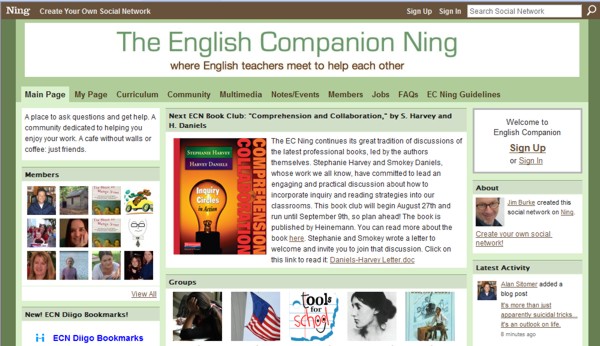
Gold Rush is the August GPS theme, which means I get to recommend a website which is valuable to me. I’ve chosen the ning, The English Companion. 

englishcompanion

Created by Jim Burke, the English Companion Ning is a rich learning environment for English teachers. The subtitle reads ‘where English teachers meet to help each other’.

The English Companion ning has 6,146 members – I think that’s a good indication of how valuable educators find it.

So far I’ve been busy and have only dipped in and out, but this ning has so much discussion and sharing of resources and ideas, that I don’t know where to start. Although I may not the best person to talk about The English Companion since I haven’t been involved in conversations yet,  I can definitely see how rich it is.

Just a quick tour through the tabs at the top:

Under Curriculum – there’s a whole variety of stuff on teaching: texts, writing, reading, through discussion, with technology, with blogs and wikis, and assessment, research, lit and language.

under multimedia: photos, videos and showcase

Events –  Poetry round table, Ning book club

Community: Forum, blogs, groups, Diigo bookmarks

There’s so much here, I’ll just give you a taste.

Looking around recently, I found some great Shakespeare resources which support our curriculum, and I added them to my English wiki.

Shakespeare Resource Centre.
50 best Shakespeare sites
Romeo and Juliet resources and activities from Teachit.co.uk (free registration)
Romeo and Juliet Enhanced e-text with modern translation
Discover Shakespeare on the Folger Shakespeare Library
Shakespeare teaching resources on the Folger Shakespeare Library
Romeo and Juliet Interactive folio and study guide

What I love the most about the ning is the plethora of discussions on every topic imaginable. It’s like the cornucopia of English teaching. Here’s an example:

Kate Messner started a conversation about using Twitter in the classroom:

I’m meeting with our ed-tech coordinator next week about creating a classroom Twitter feed that allows my ELA classes to share what they’re doing & reading with followers as well as connect with other classes & authors. Since it would be a classroom feed, only I would have access to it and could carefully screen conversations before sharing them.

All I can say is go in, have a look for yourself. It’s a rich community of educators, all with ideas, questions, practical suggestions. The English Companion is a giant staffroom with many and varied conversations.

Conversation with the author

THis is partially cross-posted from my English class blog, http://englishwfc.wordpress.com/     with the addition of what happened since the post was written.

I’m teaching collaboratively in a year 7 English class. Since we’re studying Allan Baillie’s Little Brother, I thought I’d muster up enough courage to email the author himself, in the hope that he’d join our ning and interact with the students. What better way to create an authentic learning situation?

Well, guess what!? Allan Baillie has joined! He is part of our ning! I tell you, a day that moves like any other day, when frustration mounts, as it has a habit of doing – receiving an email reply from the renowned Australian author himself really turned things around for Maria and me. We were so thrilled!

Not so thrilled were we when we couldn’t find a trace of any such excitement on the boys’ faces. What? Are you kidding? Here we are organising the author himself for your information and enjoyment, and you can’t even stretch your face into a half-smile? What’s going on? Besides typical adolescent disengagement with anything that isn’t a game or related to free time or sport or TV.

Still, today was productive. A few days ago, Maria prepared the boys for questions by developing what would have been for any other class (I’m sure) a rich discussion leading to rich questions. Only it was like squeezing water from a stone. Seriously. And yet, these boys are never as predictable as we think they are, and today they happily entered their questions into the ning, demonstrating thoughtful and responsible online behaviour. We were proud, and we told them so.

I think for us, as teachers, it’s a lesson about the fact that the boys will never be as excited or appreciative as we are. How can we expect them to be? And I think, as we look into the ning activity, we can see that so much has happened – not even looking at the invisible activity which goes on in the background in the form of brainstorming, discussion, etc. – and in the end the ning is a transparent receptacle of this development and these breakthroughs.

Well, last night, I received an email notification to say that Allan Baillie had answered one of the students’ questions. Then another, and another, and soon most of the boys had received a reply to their question. I was so pleased! I think the boys should be too.

It’s very special that our boys are receiving individual answers to their questions. Here is an example:

Dear Mr Baillie,
I have read the book, Little Brother and I really liked the book. When I read it I felt like I was in Cambodia! I have one question, how did you feel when you were in Cambodia at the time of the Khmer Rouge?

Allan’s response:

I was Cambodia in 1969 and I visited some Frenchmen running a rubber plantation.
They slapped a revolver in my hand and took me on a night hunt in the plantation. They warned me about careless shooting because we were going into an area controlled by a few bandits. Harmless, they said, and charming. The bandits were just sick and tired of the corruption of the government. Called themselves Khmer Rouge. We stopped and I shot four coconuts.

I hope that this little exercise will be a lightbulb learning moment for the boys. We’ve been discussion the thinking behind the writing and creation of characters, and now that they’ve had a conversation with the author himself, I hope they’ll understand the power of the story, and the man behind the story.

Dangerous new (cyber)world

I firmly believe that we should educate students for their world.

There’s no doubt that they will function in an online and networked world, even more than they are doing now.

Yesterday our staff listened to Susan McLean’s talk about the dangers of the cyberworld. I became increasingly uncomfortable as the horror stories unfolded at the expense of a more balanced view, or even in terms of focusing on how we could manage cybersafety education.

I want to share my letter to the principal in the hope of opening up a conversation which will fill in the gaps to create a balanced picture of what we should be doing to educate our students as citizens of their future world.

To balance out last night’s presentation on cyberbullying, I would like to suggest that you look at ACMA which provides excellent links to resources and free PD.

 For example, here is the page for teens with practical help

 Here is the school page. 

There is free professional development

You can browse the site – it is set out clearly, and very helpful.

 I hope that our staff have been discerning in understanding that Susan McLean has presented a very extreme picture, describing the worst case scenarios (many of them), which should be acknowledged for what they are – worst case scenarios. It was difficult not to be affected by her stories; I know I was starting to panic and my instinct to run and save myself kicked in.

 What was unmistakable – Susan only mentioned that online involvement could be positive at the beginning and end of the presentation – she didn’t give examples. Her language was emotionally charged, and her numerous horror stories were dramatic.

It would be a shame if staff who were already resistant to technology and strangers to online possibilities in education, were to run even further away from technology – especially as we are a laptop school. We have to remember that we are educating students for their technology-rich world, not our world or the world of our own schooling.

 Just yesterday I was moderating comments in my fiction blog – no comments will be published until I approve them. I’m encouraging comments to inspire discussion around books and reading, and I noticed a student had commented on a student review of the new Harry Potter movie. The comment was fine, but the last sentence inappropriately put down a boy who had received a scholarship. I found the boy, had a little chat with him about what was inappropriate in the comment (he understood), and asked him to resubmit the comment without the negative part. This is part of students’ ongoing education – who else will teach them how to behave online if we don’t?

 We need, more than ever, to understand the power of these technologies, and educate our students to use them responsibly. The only way we will understand these from the inside is if we play with them ourselves. I would be more than happy to show you my Facebook and Twitter involvement – they are an important part of my professional development and educational support.

 What is also imperative, is that we don’t mix up the problematic online activities of our students in their leisure time with the technology that can be used to support teaching and learning, eg. Blogs, nings, etc.

 When you have time, please have a look at the 7M ning – we are thrilled to have Allan Baillie, author of our literature study, ‘Little Brother’, as part of our ning, ready to join the students in discussion. What better way to learn about the book than have the author answer questions – this is authentic learning. The boys and Maria and I are excited that Allan has agreed to join us, and we spent yesterday’s lesson reading his life story on his website in preparation for our interaction with him.

 I hope you accept my email in the spirit it has been written. I believe that we need to educate our students for their world. We should not bury our heads in the sand, but accept the challenge, moving past our own discomfort with technology, and taking up our responsibility to educate responsible citizens.

Thanks to Lisa Dumicich for the link to ACMA on Twitter.

I would be extremely  interested in hearing what you think about this issue of cybersafety and the use of Web 2.0 technologies in education. Please enter into the conversation.

Science and fiction – The Human Genre Project

The Human Genre Project

is a collection of new writing in very short forms — short stories, flash fictions, reflections, poems — inspired by genes and genomics.

Starting with just a few pieces at its launch in July 2009, the collection will grow and develop over time.

The Human Genre Project is an initiative of the ESRC Genomics Policy and Research Forum, part of the ESRC Genomics Network, funded by the Economic and Social Research Council (ESRC) and based at The University of Edinburgh.

Wow. Creative writing inspired by science. I love the overlap in disciplines; it would be good to enable more of this at school, where subjects seem to live in separate worlds, as if life were cut up into mutually exclusive areas.

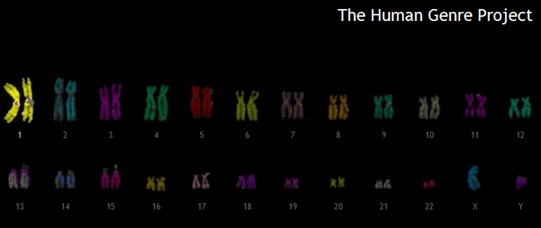
genome

The main page shows 24 different chromosomes: 22 autosomes, which are numbered, and two sex chromosomes, labelled as X and Y.

Here’s the unusual part – when you click on a chromosome, you get the title which takes you to the creative writing piece. This example links from chromosome #8:

The WRN gene on chromosome 8 is responsible for Werner syndrome, which causes premature ageing.

My hair goes grey and falls out, my teeth yellow and decay, brown spots bloom on my skin. I’m thirty-six years old. My world is a room, and a view of the sea beyond it.

I’ve been told that there’s something wrong with me. But I know my physics. I know that in this universe there has to be decay and disorder. I’m normal. I’m entropy.

I try to sip tea but my clawed fingers let the cup fall to the floor. Liquid spills out from its shattered remains and soaks into the carpet.

What I don’t understand is why the rest of them never change. My twin brother could be my son. His teeth are white and even, his hair is as glossy as ever. His skin always has a rosy blush. He comes here regularly to tell me about life outside my room. Life with other people, other women. There seem to be many women. Or perhaps it’s just tales.

But as I sit listening to him and his stories, I realise how they do it. While I stay here, they’re all travelling around. Einstein had a theory about twins; one sits in his small room, watching the sea, and the other zooms to the stars. As he accelerates to the speed of light, time slows down for him, so when he gets back he’s younger than his stay-at-home brother.

I ask my brother, “Where did you park your rocket ship?” I look outside, “I can’t see it.”

The rocket ship looked like a bicycle, but apparently it worked very well, and my brother frequently made trips to the centre of our galaxy.

“I got rid of it,” he replies, “I replaced it with a quantum teleporter. They’re all the rage now.”

All I can see out of the window is a little red car. “That’s it,” he says. “The women like it.” And sure enough a woman gets out of the car and waves at us.

This was written by Pippa Goldschmidt inspired by chromosome 8.

The WRN gene on chromosome 8 is responsible for Werner syndrome, which causes premature ageing.

My hair goes grey and falls out, my teeth yellow and decay, brown spots bloom on my skin. I’m thirty-six years old. My world is a room, and a view of the sea beyond it.

I’ve been told that there’s something wrong with me. But I know my physics. I know that in this universe there has to be decay and disorder. I’m normal. I’m entropy.

I try to sip tea but my clawed fingers let the cup fall to the floor. Liquid spills out from its shattered remains and soaks into the carpet.

What I don’t understand is why the rest of them never change. My twin brother could be my son. His teeth are white and even, his hair is as glossy as ever. His skin always has a rosy blush. He comes here regularly to tell me about life outside my room. Life with other people, other women. There seem to be many women. Or perhaps it’s just tales.

But as I sit listening to him and his stories, I realise how they do it. While I stay here, they’re all travelling around. Einstein had a theory about twins; one sits in his small room, watching the sea, and the other zooms to the stars. As he accelerates to the speed of light, time slows down for him, so when he gets back he’s younger than his stay-at-home brother.

I ask my brother, “Where did you park your rocket ship?” I look outside, “I can’t see it.”

The rocket ship looked like a bicycle, but apparently it worked very well, and my brother frequently made trips to the centre of our galaxy.

“I got rid of it,” he replies, “I replaced it with a quantum teleporter. They’re all the rage now.”

All I can see out of the window is a little red car. “That’s it,” he says. “The women like it.” And sure enough a woman gets out of the car and waves at us.

Pippa Goldschmidt is Writer in Residence at the Genomics Forum. I’ve mentioned Pippa in an earlier post; her writing is often inspired by science.

Chromosome 11 leads to a piece called Photophobia,

an eye disorder in which the iris is partially or completely missing. A person with aniridia frequently has photophobia (sensitivity to light). The mutation is in the PAX6 gene on chromosome 11.

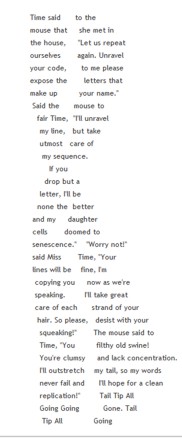
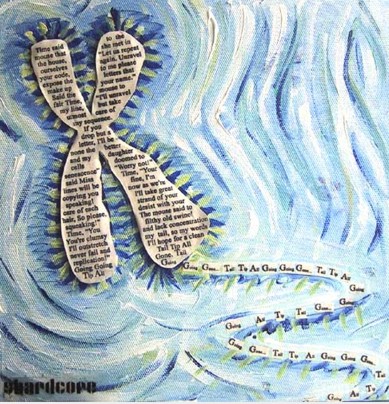
The telomeric tale of the mouse’s tail (chromosome X) is a shape poem.

chromosome

You can find the original painting/collage here and it looks like this:

mousetale

Still in progress, this is a fascinating project, demonstrating the possibilities in the union between science and art.

If you like this, have a look at what inspired it: Michael Swanwick’s Periodic Table of Science Fiction.