All posts by Tania Sheko

My name is Tania Sheko, and I am a teacher librarian at Melbourne High School, a selective secondary boys’ school 9-12 in Melbourne, Australia. ‘Teacher librarian’ usually requires a bit of an explanation. I think it’s a ‘School Librarian’ or ‘Library Media Specialist’ in the US and Canada. Often people are not sure what my role is, and it’s not easy to define. I like to think of it as the focus on ‘skills’ and ‘passion’ which exists in the spaces between the teaching of curriculum which is the domain of subject teachers. Some of my areas of focus include all sorts of literacies (information, digital, critical, network, etc.), collaboration with teachers as a kind of third hand (curating resources, differentiating learning, experimenting with blogs), and connecting people to ideas and an understanding of self and others through reading, discussion and debate. Most of our students go on to university, and we are always thinking about how we can best prepare them for the world of university and work. I’m interested in the educational environment, behaviours and directions of tertiary institutions, particularly as they move from traditional to innovative practices with connective courses. Connected learning makes sense to me, and I’m concerned that schools are often still envisioning learning as a passive consumption of content delivered by individual classroom teachers. With so much research-based evidence about student-centred, interest-driven and collaborative learning, and with the findings from the NMC Horizon Project, identifying and describing emerging technologies likely to have an impact on learning, teaching, and creative inquiry in education, I really think it’s time we woke up to ourselves about the anachronistic nature of our educational practices and took action. I learn from my colleagues, but also from my online network, reading their blogs, interacting with them on Twitter, exploring the wealth of their shared expertise online. This is what excites me about learning – connecting with people globally for a shared purpose.

Alice in Wonderland trailer

This is cross-posted from my other blog, Fiction is like a box of chocolates.

[youtube=http://www.youtube.com/watch?v=b7j7b-iLPU4&feature=player_embedded]

Directed by Tim Burton (famous for Edward Scissorhands, The Nightmare before Christmas, and Charlie and the chocolate factory) and starring Johnny Depp as the Mad Hatter, Alice in Wonderland, due out early 2010 (March 5), has already sparked interest from film-goers who have enjoyed a recent spate of fantasy films, such as Harry Potter, Lord of the Rings, the Narnia series, to mention a few.

Out of all these, Alice in Wonderland is arguably the strangest story, playing around with logic, celebrating nonsense and absurb characters, many of them animals. But how many people know that the original story, Alice’s adventures in Wonderland, was written in 1865 by Charles Lutwidge Dodgson, the author better known as Lewis Carroll.

 Arthur Rackham’s illustration250px-Rackham_Alice
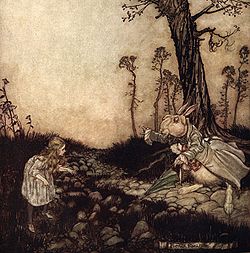
What child (or adult) can resist a story which allows the reader to escape the boredom of daily life by escaping down a rabbit hole, and enter into a world of crazy characters. Did you know that early Alice fans included Queen Victoria and the young Oscar Wilde?

Proof of the popularity of Alice’s adventures in Wonderland  is the fact that it has never been out of print, with over a hundred editions, as well as different theatre and film versions.

The film versions of Alice often mix the original story of The adventures of Alice in Wonderland with the sequel Alice through the looking glass. Characters like Twiddledee and Twiddledum, Humpty Dumpty and Jabberwock are actually from the sequel, but are often included in the original story in films.

The setting, Wonderland, has inspired the imagination of many. One of the novels written after the TV series, Dr Who, was called Wonderland. There are many songs called Wonderland, including the one by Simply Red. There are numerous amusement parks called Wonderland, including the one in Sydney which my family used to enjoy, and which is now, unfortunately, closed (sob).

Did you know that Alice has also been used in the field of medicine? There is a neurological condition called Alice in Wonderland syndrome, also known as Todd’s syndrome, in which things seem larger or smaller than they really are.

Comics have also been influenced by Alice. The supervillain of the Batman comics, The Mad Hatter, for example. And on TV, the seventh season of The Simpsons included references to the Alice story.

There are many phrases from Alice that have been used in popular culture. How many times has the phrase ‘Off with her head!’ been repeated? And what about ‘we’re all mad here’ spoken by the Cheshire Cat? Another often repeated phrase is the one uttered by Alice when she started growing after trying the cake labelled ‘Eat me’ – ‘curiouser and curiouser’.

Not everybody liked the book. Fantasy writer, Terry Pratchett, didn’t like it at all. And in 1931, it was banned in Hunan, China, because it put animals and humans on the same level, and especially because animals used human language, which was apparently unacceptable!

And who hasn’t read and enjoyed the nonsense poem, Jabberwocky, found in Alice through the looking glass, considered by some to be the greatest nonsense poem in the English language?

‘Twas brillig, and the slithy toves

Did gyre and gimble in the wabe;
All mimsy were the borogoves,
And the mome raths outgrabe.

“Beware the Jabberwock, my son!
The jaws that bite, the claws that catch!
Beware the Jubjub bird, and shun
The frumious Bandersnatch!”

He took his vorpal sword in hand:
Long time the manxome foe he sought—
So rested he by the Tumtum tree,
And stood awhile in thought.

And as in uffish thought he stood,
The Jabberwock, with eyes of flame,
Came whiffling through the tulgey wood,
And burbled as it came!

One, two! One, two! and through and through
The vorpal blade went snicker-snack!
He left it dead, and with its head
He went galumphing back.

“And hast thou slain the Jabberwock?
Come to my arms, my beamish boy!
O frabjous day! Callooh! Callay!”
He chortled in his joy.

‘Twas brillig, and the slithy toves
Did gyre and gimble in the wabe;
All mimsy were the borogoves,
And the mome raths outgrabe.

If you’d like to read Alice’s adventures in Wonderland online, click here.

Have a look at the Disney website for Alice in Wonderland.

Or why don’t you just read the book?
Power of photography: Prix Pictet

I stumbled across this website and have been moved and absorbed by these images, as well as the artists’ thinking behind their works. The information in this post has been selectively copied from the Prix Pictet website.

Sponsored by the Geneva private bank Pictet & Cie, the Prix Pictet is the world’s first prize dedicated to photography and sustainability

Prix Pictet’s vision

Food riots. Loss of forest cover. Desertification. The ecosystems we depend on appear to face resource demands already beyond their capacity. As governments try urgently to stimulate growth, a central question remains. Can the earth’s complex living systems sustain the future consumption patterns of another three billion people in the world’s population by 2050?

Or are we making the transition, as the Nobel laureate Paul Crutzen has suggested, to a point where the face of the earth – its soil, its waters, its groves, its hollows – is no longer natural, but bears the terminal scars of man’s intervention.

I was looking through the shortlisted artists, I thought I’d share some of my favourite ones.

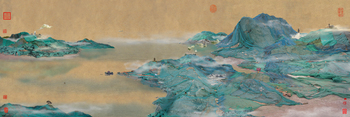
Yao Lu : Dwelling in the Mount Fuchun

YaoLu

Photography can be understood in traditional ways: It can ‘record’ many histories long before our own time, and it can take people back to times and situations many years ago. But photography is also very contemporary. It can re-assemble and re-edit the things that we actually see in order to produce illusions that people see when they are in front of such photographic works. In these works, you see images that are both real and fictional.

Darren Almond: Shan Shui fullmoon

DarrenAlmond

 Since 1998, Almond has been making a series of landscape photographs called the Fullmoons. Taken during a full moon with an exposure time of 15 minutes or more, these images of remote geographical locations appear ghostly, bathed in an unexpectedly brilliant light where night seems to have turned into day.

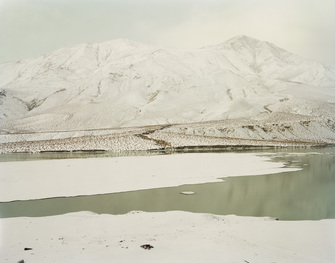
Nadav Kander : Frozen River, Qinghai

frozenYangtze

China is a nation that appears to be severing its roots by destroying its past in the wake of the sheer force of its moving “forward” at such an astounding and unnatural pace. A people scarring their country and a country scarring its people.

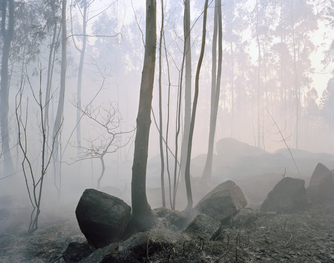
Edgar Martins: Untitled from the series ‘The diminishing present’.

EdgarMartins

For all their historical evocation and appeal to the sublime, these images reflect on both the physical death of the landscape and the death of the landscape as a pictorial ‘theme’.

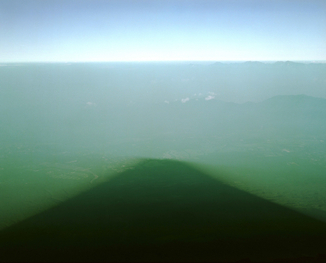
Chris Steele-Perkins: Early morning shadow of Mt Fuji from summit

MtFuji

Nowadays, Mount Fuji is a national park but it is covered in, or surrounded by, theme parks, golf courses, resorts, cities and scrap yards as well as being used as a military testing ground by both the Japanese and American armed forces. At the same time there are still magical areas of great tranquillity, but they are increasingly being eroded.

The Prix Pictet is born of a flicker of hope — that photographs … have the power, as Gro Harlem Brundtland put it in her remarks at the launch of the inaugural Prix Pictet in 2008 , “to move us and shake us”. To take the sustainability statistic, validated, econometrically correct, but devoid of emotional force, and make it something that moves us to action.

Sponsored by the Geneva private bank Pictet & Cie, the Prix Pictet is the world’s first prize dedicated to photography and sustainability. It has a unique mandate – to use the power of photography to communicate crucial messages to a global audience; and it has a unique goal – art of the highest order, applied to the immense social and environmental threats of the new millennium.

So much talent…

Powerful Learning Practice presentation is finished!

Well, when I say finished, I mean that the first layer of our presentation is complete. Whitefriars College Powerful Learning Practice cohort has documented their PLP journey on a blog which is the platform for all the projects, experimentation and reflection during the course of this year.

Marie Salinger and I have spent long hours pulling the presentation together, and at the end of it we feel deeply satisfied. As I was saying to Marie earlier today, the experience reminds me of the ‘Stone soup’ story:

a tale in which strangers trick a starving town into giving them some food. It is usually told as a lesson in cooperation, especially amid scarcity. In varying traditions, the stone has been replaced with other common inedible objects, and therefore the fable is also known as button soup, wood soup, nail soup, and axe soup (from Wikipedia).

It really was exactly like that – at first we thought we didn’t have enough for the presentation but gradually we gathered things from here and there, pooling our resources and forcing reflection and evaluation, until we surprised ourselves with the result.

So we have the first layer. And as Marie Salinger has said,

It has been a very positive and affirming experience to take the time to do this. Evaluating, reflecting on , summing up and consolidating the work we have been doing for the past nine months has been a very worthwhile endeavour.

Now that we have the blog as a space for sharing, we can continue to add to it as we go. I’m going to link to a new blog which follows the progress of 7M Ning, and I hope other team members will do the same. What would be even more encouraging – if the blogs inspired other members of the school community to have a go. It would be fantastic to see blogs for each faculty, documenting progress, reflecting, evaluating and celebrating.

Here is a short audiovisual reflection and summary of our journey.

[youtube=http://www.youtube.com/watch?v=zwH16mU2oYY&feature=player_embedded]

Here is a link to the blog.

Still kicking.

Forty years ago astronaut Neil Armstrong did something no one had ever done before. On July 20, 1969, he set foot on the moon. We all know what he said when he stepped onto the moon’s surface and looked at the Earth above him: “That’s one small step for a man, one giant leap for mankind.”

Meanwhile, back on Earth 40 years later, some of us are still struggling with less cosmic achievements, like the Recurring External Blog Saga which you  may have read about here and here. Unlike Armstrong, and more like Prometheus, unable to move forward, having been chained to a rock by Zeus, my way forward with technology in my own school is often just too hard.

Jacob Jordaens, Der gefesselte Prometheus, c. 1640 Rheinisches Bildarchiv

This morning I received yet another email criticising my move to an external blog for reading promotion. Yes, I know you’ve heard all this before, but imagine how I feel then. I’m definitely over it. Nevertheless, for every attempt to drag me back, to find fault with what I do, there are encouraging moments.

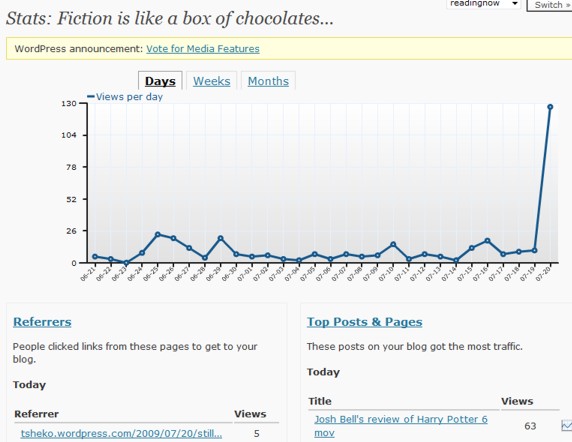
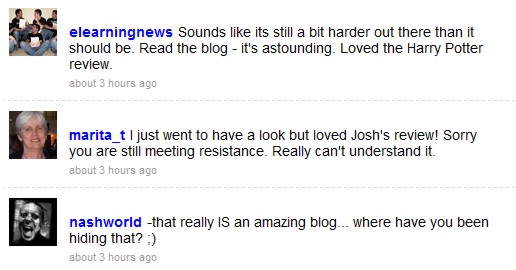
Today several things happened that demonstrated the advantages of the Web 2.o platform for things like reading promotion. Firstly, a student had posted a passionate review of the recent Harry Potter movie. I had only just posted that late last night, and already this morning there was an encouraging comment from Marita Thomson, a teacher librarian from The Kings, Parramatta. I know I was pleased to receive positive feedback, so I imagine the student was even more pleased. But wait, there’s more. Two more encouraging comments – one from Sean Nash and another from Paul Stewart. Here, let me show you.

fictionblogcomments

I’ve said it before, and I’ll say it again – sharing online opens up communication and possibilities. It’s encouraging and enriching. I really don’t get why people don’t get it.

So, while my Web 2.0 colleagues and I are moving forward slowly, I hope our small steps are paving the way for a more comprehensive change of mindset in the future, in which case I could also say,

“That’s one small step for a man, one giant leap for mankind.”

Reflecting again (still)

Last post I wrote a reflection for the culmination of my participation in the  Powerful Learning Practice program. Still, I felt I hadn’t drilled down to what was essential for me.

Listening to Howard Rheingold this morning, and rethinking things, I wrote another reflection.

My participation in PLP has been life changing. I know it smacks of evangelical fervour, and I’ve often written about this in my blog, but PLP came just at the point that I was ready for it. I’d just completed SLAV 23 things, and started a blog. Everything was new to me. Nothing was easy, I wasn’t a natural, probably more of a technophobe than anything, but something pulled me in. Jenny Luca must have read my blog somehow, and emailed me about joining the PLP cohort of Australian schools. It all avalanched from there. Soon I was blogging, wikiing, ninging, twittering, flickering, and having a great time.

Thinking about it more seriously, I realize there’s a big discrepancy between my personal awakening to online participation and what I’ve been able to do in convincing other educators at my school or anywhere else about what I see as a crucial path we must take in order to make learning relevant and engaging for students. Yes, I’ve made steps, and for me, these steps have been significant. I’ve been reflecting and sharing knowledge and resources in this blog, I’ve explored the literacy possibilities with Flickr’s image sharing, I’ve supported English and Art faculties with wikis, I’ve created a blog to inspire reading in the community, I’ve been working on a ning as a platform for learning, collaborating with a wonderful English teacher, I’ve sent countless links and resources to teachers as a result of my own connection to my online network. But it’s not enough. It hasn’t moved a significant portion of my school, it hasn’t changed the way my principal thinks, or other the way faculty heads function. Although, I suppose I shouldn’t underestimate small victories, such as the approval for an external fiction blog (read here and here).  On the whole, though, it’s often resulted in friends, family, colleagues casting a critical eye or making derogatory comments, telling me to get off the computerand get a life. Basically, I haven’t convinced many people that what I’ve spent an enormous amount of my own time on is worth anything.

It has, however, connected me to a network of people who are my lifeline. People I otherwise wouldn’t have met or known about. People who are experts in different fields, who are brilliant, engaged, supportive. It has crossed borders, transcended nationality, age-group, ignored physical apprearance and status – it’s been fantastic. I agree with many great speakers I’ve listened to: it’s not about the technology tools, it’s about literacies. Our students need critical thinking to navigate the flood of information and media that comes their way. They are learning outside of the classroom – and social media and technologies such as Youtube and Facebook provide a platform for communication, collaboration and collective action which is more important to them than their textbooks. One day it’s about organizing a large gathering through Facebook, and next thing, it’s organizing political action. None of it comes from teachers or parents; it wouldn’t spark that level of engagement.

I’m seeing the power of collective response to disaster. Why aren’t we thinking in terms of social capital? Why aren’t we thinking about how to mobilize people to do things using social media? What are we doing at school? How can we spark this level of engagement? Should we rethink the ways we are teaching, the content?

You can see that this isn’t about technology tools, although all of this is made possible through technology. These are the things that drive me today – as an educator, parent, citizen. I don’t have the answers but the questions are driving me forward, connecting me to others who find the conversation valuable. This is what my PLP experience has been about. Life is a series of new starts. That’s why we feel we never reach our destination. We’re always starting out with new questions and new problems to solve. That’s why it’s a journey.

Spider’s web

Photo courtesy of moonjazz.

The Powerful Learning Practice experience is coming to an end, and it’s time for us to gather our thoughts and share what we’ve done.

I’ve been putting off my reflection because, frankly, the thought of gathering my thoughts about this relatively short, but intense, period of PLP participation, is overwhelming. Scouting around in blogs and Twitter links, I came across something which describes what I consider to be the focus of what is most valuable from my PLP experience: connectedness. 

I love the way Lisa Huff compares the spider’s web-weaving in Walt Whitman’s A Noiseless Patient Spider  with our reaching out to connect with others through technology.

Whitman, writing in the 1800’s, observes how a spider ceaselessly launches forth filament to explore his surroundings, to travel from one place to another, to bridge his world. Whitman notes mankind’s similarity to the spider. We too ceaselessly seek to connect, to make sense of the world, to reach out to others.

 Technology of the 21st century is connecting us like never before. We blog, we podcast, we collaborate via wikis, webcams, e-mails, discussion boards. We explore endless information easily summoned with a few clicks. We are living in the midst of sweeping technological changes that are reinventing the way we live, learn, laugh. At the heart of this change, however, is the basic spirit of exploration–that same spirit Whitman captured some two hundred years ago.

This is what I have learned since joining the PLP team – how much richer my life has become through connections with people globally via technology. I’m connected through people’s blogs, wikis, through Twitter, and other Web 2.0 applications, to a limitless network of resources, ideas, discussions and creativity. At the risk of sounding evangelical (once again), this is a life-changing experience. It’s not just a matter of acquiring some technological skills with tools, it’s what we have in common with Whitman’s spider as we ‘ceaselessly seek to connect, to make sense of the world, to reach out to others.’

Coming down to earth a little, I must say that my fervour about 21st century learning, and that of my team members, is shared by few in our school community, and I hear it’s the same everywhere. At times it’s lonely, other times frustrating, to be convinced that networked learning and teaching are in step with our fast-paced, global world, and to know that our current education system supports an outdated society. Trying to take tiny steps in convincing others is perhaps the only way to move forward, taking care not to alienate others, but to support them, model new ways of teaching, and to celebrate small successes.

What have I enjoyed the most?

  • writing my personal and fiction blogs
  • reading others’ blogs, wikis; commenting; taking part in discussion
  • creating and supporting nings, joining others’ nings
  • the support of my personal learning networks on Twitter, Facebook, Friendfeed, etc.
  • sharing information and ideas
  • ‘converting’ others to the networks
  • discovering amazing people with great talents and wonderful minds
  • seeing engagement and joy in students, especially after the new ways of teaching have been a struggle to implement
  • being able to participate in professional development opportunities online at many different times
  • lifting up the minds of young people, seeing the spark in their eyes, hearing excitement in their voices
  • collaborating with others towards common goals
  • discovering unexpected and wonderful links to links to links
  • feeling energized by the depth of what’s out there
  • loving the learning

What have we learned, and what have we achieved? We’ve learned so much, and at the same time, we have so much more to learn. We’ve achieved a great deal, and yet we’ve only just begun.

What I’m sure of is that there are people I can rely on for help, ideas, support, resources, inspiration. These are the people I connect to as a teacher. I can never be bored, will never feel isolated, will always look forward to more.

4 Rs meme: favourite posts

I almost forgot to say this, so I’m editing postscript. Paul C. tagged me in a meme in his blog post. I have to admit that while some people find memes annoying, I love them, as long as they contain something worth reading. Memes are a great way to pool people, their views and resources. This one about favourite posts is like getting people to skim the cream of their thinking and writing. I hope you’ll enjoy mine and go on to read others, including Paul’s.

‘Meme rules:1. Scan your posts for your own personal favorites.
2. Choose one post in any/each of the four categories:

  • Rants
  • Resources
  • Reflections
  • Revelations

I leave it to you folks to define these terms, but my instinct is that we could treat these loosely. You are welcome to suggest new categories if these don’t fit.

3. In a blog post, list those posts and very briefly describe

  • why it was important,
  • why it had lasting value or impact,
  • how you would update it for today.

4. Select five (or so) other bloggers to tap with this meme.

5. Tag all of your post with #postsofthepast ‘

Rants – Don’t bag technology – ask what it means first –  I rave quite a lot. In fact, most of my posts are raves. In this post I express my frustration with the negativity with the wall you sometimes come face to face with when you talk to people about technology in education. The conclusion of this post centres on what I think is the transforming aspect of Web 2.0 tools, and that is the conversation and connection with a larger audience. As frustrating as it is to believe so much in what Web 2.0 platforms offer for engaged and connected learning and teaching, and to feel like Sisyphus pushing the massive boulder up the impossibly steep mountain, I have gained so much from my own connection with a personal learning network, and I intend to keep offering and suggesting, sharing and collaborating, even if that means moving small steps with few people. I live in hope.

Resources – Shift into overdrive – As I say in the post, Web 2.0 technologies have opened up new ways of opening up and creating new experiences for teachers. This post is a fairly comprehensive collection of Web 2.0 resources – not so much a collection of resources as a list of the amazing people who have created them.

Reflections – How have you changed as a writer because of online spaces? – It seems that my posts have a dominant theme: one of connections with people. I realised at the outset of the post that I have become a writer since starting a blog, and how much I missed writing since finishing secondary school. I’m convinced that having readers and commenters gives me a supportive, rich community to feed from and into.

Revelations – Teach the child – Sometimes the most powerful revelations are the ones which manifest themselves beyond words. This video of children singing moved me deeply and reminded me what is wonderful and sometimes hidden in each child. I like to come back to this video to remind myself that children are not just empty vessels to pour curriculum into.

I tag:

Steve Shann- Birds fly, fish swim; Susan Carter Morgan scmorgan ; Jennifer Clark Evans – My continuing education; Sean Nash – Nashworld; Marie Salinger – Just in time; Paul Stewart – Contemporary learning.

Melbourne Writers’ Festival

The Melbourne Writers’ Festival 2009 has something for everyone. Here is the line-up for under 18s.

Randa Abdel-Fattah | Tony Birch | Ezra Bix | John Boyne | Isobelle Carmody | Paul Collins | Kate De Goldi 

Briohny Doyle | Anthony Eaton | Elizabeth Fensham | Archie Fusillo | Raimond Gaita | Morris Gleitzman | Andy Griffiths

Jack Heath | Lia Hills | Simmone Howell | Michael Hyde | Danny Katz | Paul Kelly | Kon Karapanagiotidis | Chrissie Keighery

Joey Kurtschenko | Margo Lanagan | Justine Larbalestier | Julia Lawrinson | John Long | Geoff Lemon | Melina Marchetta

Andrew McDonald | Mischa Merz | David Metzenthen | China Mieville | Kirsty Murray | Joanna Murray-Smith

Richard Newsome | Mandy Ord | Maria Pallotta-Chiarolli | Bruce Pascoe | Alice Pung | Hannie Rayson | Gary Simmons

Alicia Sometimes | Shaun Tan | Penny Tangey | Tony Thompson | Urthboy | Scott Westerfeld | Chris Wheat | Gabrielle Wang

Read about more details here.

This is an excellent opportunity for schools and school librarians to engage and extend young readers.

We hope the program will assist to enrich your own reading experience, and promote the ways in which writing and reading are engaged in our schools.


Here is an opportunity to learn more about your favourite authors, as well as discover new talents:

We have an array of talent for your enjoyment and edification, and I hope you’ll spend some time with both our better-known authors, as well as with those who are on the rise. As in past years we’ve mixed the new with the established so that you can tell your friends and colleagues that you saw them here first!

Go to the website for more detailed information.

This is great timing for Book Week, August 22 – 28. There’s a good reason why Melbourne is the City of Literature. An excellent opportunity to take books and reading out of the library and amongst the people.

Just discovered that there is a Melbourne Writers’ Festival blog. You may be interested in the possibility of being among the first to see Neil Gaiman’s Coraline on film.

Join us for a very special Melbourne Writers Festival fundraising event, which will be –

  • Introduced by Shaun Tan (award-winning creator of The Arrival)
  • Screened at Cinema Nova, 380 Lygon St, Carlton on Tuesday 21 July 2009 at 6.30pm sharp
  • Raising money for the MWF Schools’ Program  

Coraline is created by cult author Neil Gaiman, directed by famed stop-motion animation expert Henry Selick, and voiced by the talents of Dakota Fanning, Teri Hatcher, Jennifer Saunders and Dawn French.


Problem-solving is for the birds

Problem-solving is not limited to the world of humans. It’s interesting to watch other species use thinking to solve a problem. Crows and ravens are, for me, associated with Grimms’ fairy tales and tales of dark forces, but here, thanks to Britannica Blog, we see a very practical crow persisting in reaching its goal.

[youtube=http://www.youtube.com/watch?v=TtmLVP0HvDg&feature=player_embedded]