All posts by Tania Sheko

My name is Tania Sheko, and I am a teacher librarian at Melbourne High School, a selective secondary boys’ school 9-12 in Melbourne, Australia. ‘Teacher librarian’ usually requires a bit of an explanation. I think it’s a ‘School Librarian’ or ‘Library Media Specialist’ in the US and Canada. Often people are not sure what my role is, and it’s not easy to define. I like to think of it as the focus on ‘skills’ and ‘passion’ which exists in the spaces between the teaching of curriculum which is the domain of subject teachers. Some of my areas of focus include all sorts of literacies (information, digital, critical, network, etc.), collaboration with teachers as a kind of third hand (curating resources, differentiating learning, experimenting with blogs), and connecting people to ideas and an understanding of self and others through reading, discussion and debate. Most of our students go on to university, and we are always thinking about how we can best prepare them for the world of university and work. I’m interested in the educational environment, behaviours and directions of tertiary institutions, particularly as they move from traditional to innovative practices with connective courses. Connected learning makes sense to me, and I’m concerned that schools are often still envisioning learning as a passive consumption of content delivered by individual classroom teachers. With so much research-based evidence about student-centred, interest-driven and collaborative learning, and with the findings from the NMC Horizon Project, identifying and describing emerging technologies likely to have an impact on learning, teaching, and creative inquiry in education, I really think it’s time we woke up to ourselves about the anachronistic nature of our educational practices and took action. I learn from my colleagues, but also from my online network, reading their blogs, interacting with them on Twitter, exploring the wealth of their shared expertise online. This is what excites me about learning – connecting with people globally for a shared purpose.

Moving forward and pulling back

Well, hello. Haven’t been around the blog lately. Mid-year holidays and taking time out of my head for a change. And, to tell you the truth, I’ve needed the break. No blog ideas put up their hands in their usual impatient manner. Nothing was hammering inside my head, clamouring to come out. No clear thoughts were forming, no ideas were sprouting. For a while there, I thought I’d dried out for good. Until I realised that I was looking back, only I’m not sure if I’m having second thoughts, or if I’m giving things a second look over.

Our PLP presentation is very close now. I can’t deny feeling unprepared. How have we, as a team, moved forward in changing teaching and learning in our school? How far have we come, if at all?

The answer is simultaneously a great deal and hardly at all. Taking part in the PLP ning, connecting to a rich network of educators, great minds, variety of personalities and viewpoints, forming a personal learning network that I don’t feel I could do without  – this is a new dimension that has changed my life as a teacher and a learner. The Art and English wikis, the personal and reading blogs, the ning I created to support students and teachers at my school are initial experiments, attempts to engage students in new ways, to share resources, to present different types of media as possibilities for discussion or creativity, to use technology for the purpose of re-envisaging education.

But how far does this go in making any difference to the way teaching and learning occur at my school? How many eductors have seen these things, and if they do, how many are convinced that I’m offering them something valuable, something worth trying out? The answer is – not many.

Dean Shareski’s post has resonated with me today. He describes the architecture of learning as transformative where there’s no going back.

The landscape of learning is changing. Rethinking what control means, understranding the power of sharing and transparency all work to topple many of the foundations our schools are built upon.

His post strikes a chord with me at this stage of my journey:

I know this, you know this but after spending 3 days amongst 18,000 in the educational technology field, I still say very few else know this. I made this observation (jump down to #4) last year at NECC and while the number may have increased slightly, those who really have any sense of the changes that are possilbe and perhaps inevitable in education is strikingly small. Yet sometimes the conversations amongst them would indicate they think everyone understands. A good example took place in the last session I attended on a panel discussion on Web 2.0. The panel was made up of all people that I and many in the audience knew very well either because we’ve spent time with them or know them from varoius online circles. The panel and audience were calling them by their first names and having a good discussion One lady stood up and felt frustrated since she didn’t know these people, these terms and most of the content of the conversation. That wasn’t her fault that’s ours. The assumption amongst folks who live and breath social media is that most teachers know about but they just don’t understand social media. We jump in with disucssion about Web 2.0 when they aren’t ready for that discussion since they have absolutely no prior knowledge. I”m not against having these kinds of discussions but it’s a bit like Christopher Columbus and crew arguing over how they would organize and structure the new world when most of the old world didn’t even know it existed and if they did, had no idea why or how they would get over to see it, let alone settle there. It’s not a totally useless discussion but perspective is important.

This is what I’m finding unsettling at this stage –  Dean’s analogy with Columbus. Should I feel unsettled knowing that I’m trying to populate a new world with people who deny its existence? Am I going about this the wrong way? Should I be happy to go slowly with a minority of takers? Am I being naive and unrealistic? Is trying to change teaching and learning in a school insane or egotistical? Am I unrealistically trying to change society itself? Can individuals make this change or is it only possible for politicians?

But then again, I’m pulled back by a comment on Dean’s blog by a teacher who attended NECC:

I paid my own way, as did many of the classroom teachers and a few of the administrators I met, because we are hungry to learn and starving for people who have the knowledge and experience to teach us. Of course, there were sessions and conversations at NECC that were way over my head, but hearing them and trying to understand gives me guideposts and goals for my future development.

If my new, recent direction in learning and teaching came ‘out of the blue’, then why shouldn’t other people make that transition? If a teacher cares about students and thinks about the best ways to inspire students to learn, then who’s to say my little steps, and those steps of my fellow PLP members, or anyone else who is struggling through relevant and engaging teaching and learning – who’s to say these things won’t make a difference?

Should we despair that our efforts are mere drops in the ocean, or should we appreciate our small steps?  So many rhetorical questions…

Dean points us to Tom Carroll’s article, If we didn’t have the schools we have today, would we create the schools we have today? written 8 years ago and still very pertinent:

If we continue to prepare teachers as we have always prepared them, we are going to continue to recreate the schools we have always had. We have to start preparing teachers differently. If we are going to continue preparing educators to work as solo, stand-alone teachers in self-contained, isolated classrooms, we are going to perpetuate the schools we have today.   If we want schools to be different, we must start today to prepare teachers differently… significantly differently.

Yes, I do feel a few can make a difference, but it’s a slow and laborious process. Why isn’t teacher training aligned with the educational needs of students today? Who should we be influencing in order to revise teacher training, in order to go to the source of the problem?

I might stop before another flood of questions is unleashed. Please come in and help stop the flood.

Ukraine has talent (and creativity)

Occasionally I see something creative in an unexpected way.  I wanted to share this video of a contestant on ‘The Ukraine has talent” who expresses her creativity in an unusual way. Frankly, I was surprised to see such a performance amongst the usual entertainment, and also surprised how long it lasted.

[youtube=http://www.youtube.com/watch?v=Z1JZ9O15280]

This ‘performance’ demonstrates the power of human creativity and original thought. I love seeing the story come to life through real-time art, and its transitory nature. Thanks to Nadya Ignatievsky for posting this on Facebook.

Wisdom from the periphery

As always, I’m amazed by the wisdom of the people who form my online network. My last post was written out of the frustration I was feeling when I was temporarily overwhelmed by a sense of isolation – it seemed to me that I was speaking a foreign language amongst many of those around me. It wasn’t long before I started to receive comments from other educators – intelligent, diverse and encouraging comments. My sense of isolation was short-lived. These people have become colleagues regardless of their geographical location. They have become valuable friends and colleagues, sharing their views based on experience and reflection. I feel inspired and supported by these people; thankyou to all of you.

I would recommend you read all the comments, and I’d like to take the opportunity to feature the last comment I’ve received so far, because it would be a shame to leave it buried. I admire Paul Stewart’s deep thinking, and I think he eloquently expresses what many of us can relate to:

A wonderful post. It’s a reminder that we’re not all on the same page. Teachers are an eclectic bunch, and this should be a good thing – I abhor homogeneity, as do kids – but I can appreciate your frustration that our differences result in division. Ironically, it is our diversity that should unite us – it’s what makes us interesting to our students.

That said, I find it difficult to understand how educators – people charged with the responsibility of extending our youth, could be so reluctant to understand the context in which today’s youth develop. These teachers often see school as separate to the world outside, rather than an essential part of it.

Now I don’t buy into the whole digital natives nonsense (now there’s a flawed concept that has got more mileage than it deserved) but I do believe it is the role of any educator to constantly seek out new ways to engage, stimulate and challenge their students. Educators should be provocative. They should be unsettling (but in a good way).

And students? Well, students should be constantly shedding their skin in a classroom. They should be pushed to embrace change by experiencing it.

Now of course, you don’t need to use technology every minute of a lesson to achieve such outcomes, but it puzzles me that some teachers can so easily dismiss the opportunities that lie in technology: the chance to produce rather than consume, the chance to collaborate across time and space, the chance to make a mark upon society without using a spray can. Technology gives students so many tools to analyse, design, produce and investigate and these should not be denied to kids simply because a teacher is unfamilar with such tools.

I added dumplings to a chicken curry I made the other day and one of my progeny stuck out his bottom lip and refused to eat. After much coaxing, he tried one, then two… Ten minutes later he stuck out his bowl for seconds. I was pleased but I wish it didn’t have to be so hard. It’s sometimes like that with teachers (and they do not have the defence of youth to excuse their reactions to new experiences).

Your post really made me think of how different people are. As I get older, I am increasingly aware that I am approaching a time when there will be fewer days in front of me than there are behind me, and that makes me want to pack in as many new experiences as possible. The thought of doing something the same way twice kind of depresses me. The thought of teaching the same lesson that I taught five years ago, ignoring all the incredible changes that have happened in the world, now that would lead to ennui so crippling, I wouldn’t get out of bed.

I don’t think you’re alone in getting frustrated in having to justify your position, but that’s the lot of innovative people. By pushing the boundaries, you (by definition) place yourself on the periphery. There will always be a need to supply justifications to employers (they have a right to ask) but I hope we can move to a place in education where the innovative and bold are not subject to the sort of scepticism you allude to in your post.

Thankyou for taking the time to reply so thoughtfully, Paul. This line made me sit up and take notice:

These teachers often see school as separate to the world outside, rather than an essential part of it.

How many of us have thought about whether what we do at school has anything to do with the outside world? That would make an interesting survey, don’t you think?

Don’t bag technology – ask what it means first

I’ve been feeling discouraged lately in my conversations with people about education. Maybe I’ve been talking to a small sample of people, but I’m feeling really peeved at the moment (and it may be because of lack of sleep).

I’m not sure if the endless circular conversation – between those who see the value of technology in education and those who dont’ – is even worth the effort. Yes, I’m not in a very positive frame of mind currently. I don’t find I have the energy or patience to continue, but I still want to reflect on what the problem is.

It’s not a problem that centres on technology at all. It’s a problem that centres around the very human aspect of dialogue. Dialogue which depends on two (or more) people listening to each other and making a real effort to understand what the other person is saying.

I’m sick and tired of entering into a conversation where I’m asked to justify my belief that technology is an important aspect of transformed learning, learning that has to change with the times in order to prepare us all for the way the world works and the way it will work in our students’ future. Most of the time I find that I’m cornered into petty justification because the other person is coming from a personal conviction and will, at all costs, aim to knock me off my beliefs to prove an ultimately negative point. This is not a dialogue. Cornering someone so that they desperately try to stick up for their beliefs while ignoring the larger argument is not dialogue. It radically narrows the scope of information which would otherwise offer a larger, more informative picture.

An example:

Me: I believe that technology offers new possibilities in learning (*very aware that this is a broad and ambiguous statement which needs comprehensive explanation*)

Other: What’s all the hype about technology? Does it really teach ‘them’ anything? Or is it a just a gadget, the latest fad?

Me: Technology offers possibilities for creating and connecting with others.

Other: I know all about that. It’s been proven that kids no longer have personal skills because they are using technology too much.

Me: They are learning the skills of online interaction

Other: I read/saw on TV how dangerous online involvement is, and how it isolates kids, how it takes them into dangerous zones which their parents don’t know about, how bad it is.

Me: You have to look at the real evidence. The media is often one-sided and sensationalises a small part of the picture

Other: But I heard an interview about it and these people are reliable; this information is authoritative.

Me: There are many wonderful connections kids can make to the real world and real people outside the classroom to make learning relevant

Other: (confused look) What are they learning by talking to each other? Is there any academic value?

And then the conversation reverts back to All Things Negative in terms of Any Kind of Change with regard to What Is Considered Sacred about Education, and it’s Sacred because That’s The Way It Was, and That’s The Way It’s Always Been, so all of this new stuff is Bad. We should probably go back to Grammar and stay safe teaching Facts. Numbers, Dates. Like my own education where I studied the Victorian Year Book and copied out fascinating information about how much rainfall and wheat we had in Victoria in  a certain year (the one that had passed). Fascinating facts about sheep and sewerage, I’ll never forget that (except for the facts themselves).

Ok, so now you’ve fully realised how down I am about this argument. I just have to point out that the worst thing about that kind of ‘discussion’ is that you never end up saying what you want to say, but you end up sounding like a crazed evangelist, ready to die for your cause – and I hate that. I’m not a crazed evangelist, I have much more to say and show you if only you would listen. The problem is about listening and wanting to hear, not about technology itself. It’s an age-old problem of failure to listen.

If I had a chance to talk to the ‘other person’ without being pushed into a corner, I would question their negative association with the word ‘technology’. I think this is a wide-reaching association. Technology = computers, dangerous  online involvement, unhealthy focus on what is not real, and therefore what takes you away from real, people-to-people contact.

But technology is also TV. Do you watch TV? Does it stop you from going out of the house? (If so, then it’s your personal problem) Or does it offer a window into the world?

Do you use a telephone? Does it stop you from seeing your friends and family in person? Or does it offer you an opportunity to chat more often in between visits?

All technology!

Yes, it changes the way we live. Some of us held off getting a mobile phone in the early days (we didn’t need it? we’d lived without it), but now we can’t imagine going out without it? Good or bad? It’s something worth investigating more deeply. But it’s here to stay, and it’s technological capacities are growing fast. Change is difficult; some of us jump on the bandwagon and others yell insults at the bandwagon from afar. What we need to remember is that, like it or not, the way we function in the world is changing, and we would be wise to jump on so that we know what we’re dealing with. So that we know what kind of support and education we need to give our kids. So that they’re ready for their world. Are we thinking about this? Are we looking forward or backward?

This morning I followed a link posted by @scmorgan on Twitter which led me to an article on the Edutopia website:

Kids create and critique on social networks.

The first couple of paragraphs grabbed my attention.

In the common conception, kids plus social networking equals an online popularity contest conducted in grammar-free instant-messaging lingo — not exactly an educator’s dream world. But the Chicago-based Digital Youth Network, a digital-literacy program funded by the John D. and Catherine T. MacArthur Foundation, has tapped into the networking phenomenon to encourage creativity and learning.

The Digital Youth Network runs a private Web site called Remix World, which is modeled on popular online social networks such as Facebook and MySpace.

This ning works like Facebook where students can create a space (their page) which is their own style, and where they can post their work and receive feedback from their peers, take part in discussion, and give and receive constructive criticism. Sharing with the class (or other classes) is more engaging because they care more about what their peers have to say than what their teacher has to say, and they want to show what they can do. They develop confidence in themselves when they realise they can help out or contribute to a discussion. It’s all there for the class to see; their contribution amongst everyone else’s. They don’t remain invisible or unheard. They have a place, a voice, a unique style.

When students are motivated to create work that they share online, it ignites an independent learning cycle driven by their ideas and energized by responses from peers.

That’s the theory, but let’s hear it from the kids

Twelve-year-old Jalen (also the subject of an Edutopia video profile) is among those who’ve taken their work to a larger audience on YouTube and elsewhere. “I post online because I don’t want it to just be on my computer, where nobody can see it,” Jalen says of his work, which includes graphic art, videos (both remixed mash-ups and some using original footage), and computer games. “I get positive and negative feedback, but it helps me get better and better,” he says.

“One guy on YouTube told me it was a good video, but the timing was off,” he remembers of one project that got mixed feedback. “So I went back and edited it.”

The article also talks about another student who created his own social network. He didn’t follow a prescriptive set of teacher-created instructions.

“I didn’t learn from anywhere particularly,” Mosea says about creating his network. “I just experimented.”

Experts say that, even more than the digital world in general, collaborative Web 2.0 tools in particular can motivate self-directed learning.

Students creating and publishing online within their own community is the first step to compelling learning, but the deepest learning takes place in the commenting and conversation which follows:

“While the ability to publish and to share is powerful in and of itself, most of the learning occurs in the connections and conversation that occur after we publish,” argues education blogger Will Richardson

Of couse, this kind of learning is not automatic or without its problems. But this is where the teaching part of it comes in. Teacher support is more important than ever for these new experiences to be successful. It’s not a matter of handing over to technology, stepping back and expecting self-directed learning to naturally take place. Nothing could be further from the truth, as teachers who have worked with online networks have discovered.

Researcher Christine Greenhow cautions that the virtual world can also present its own barriers to independent learning. “Students can get easily distracted,” she observes. “There are so many nonlearning paths, so we need to help them stay focused.”

And there’s the rub. If those against technology think that kids just jump in and need no supervision, they’re wrong. Wherever kids are and whatever they do, they need supervision and support. As parents, we shouldn’t leave them to their online activities without taking a real interest in what’s going on – and I don’t mean looking over their shoulders with a critical eye. I mean engaging in conversation where we learn what they’re doing, and why they like doing it. Or even trying some of these things out ourselves. As teachers, we shouldn’t leave them with the laptop and Google, and expect them to navigate a positive and successful learning experience.

To finish, I apologize for my rave – I think it’s something I needed to get off my chest to reduce mounting frustration.

Finally, technology is about the people who use it. Let’s demystify it, let’s try to understand it before we judge it, let’s acknowledge that it’s increasingly the way the world functions, and learn how to make the most of it.

Michael Jackson 1958-2009

michaeljackson

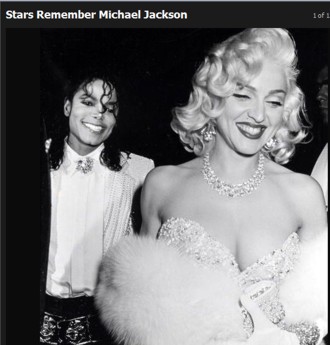
Today the world was saddened by the news of the two celebrity deaths – Farrah Fawcett and Michael Jackson. Celebrity popularity is a fact of life, and in this instance Michael Jackson stole the limelight, if you can call it that.  Sometimes the best way to remember a life and career is through pictures. LIFE Magazine is a good place to revisit Michael Jackson’s life.

Stars remember Michael Jackson is an interesting visual record.

Equally as interesting is the album of Michael Jackson covers.

mj

Equally as interesting is the album of Michael Jackson covers.

MJcovers

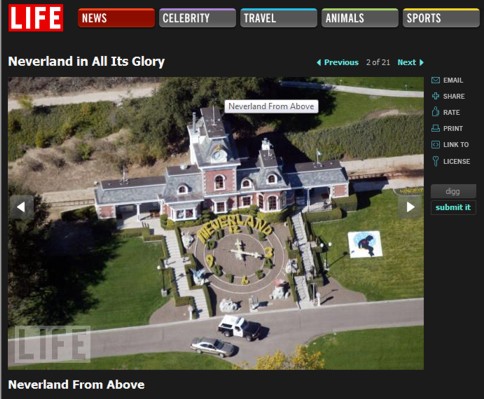
Then there’s Neverland in all its glory

Neverland

Michael Jackson live – best pics

moreMJ

And, to be fair, have why don’t you stroll down Memory Lane with Farrah Fawcett?

farrah

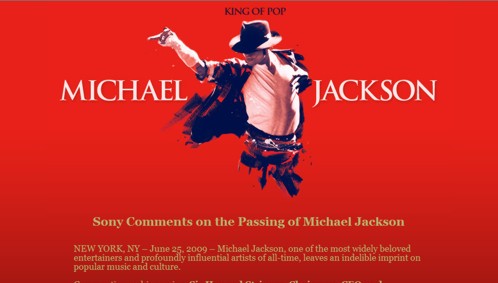
Since I was on a roll, I decided to check out Michael Jackson’s website.

mjwebsite

 The New York Times has a long post of updates on Michael Jackson and the world’s reaction to his death.

 YouTube has its own tribute to Michael Jackson’s talent.

Given the recent interest in all things Vampire at a time when books like Twilight are more popular than sliced bread, I think it’s time to revisit Thriller.

[youtube=http://www.youtube.com/watch?v=AtyJbIOZjS8]


The old and the new

SCN_20090624140218_017-1

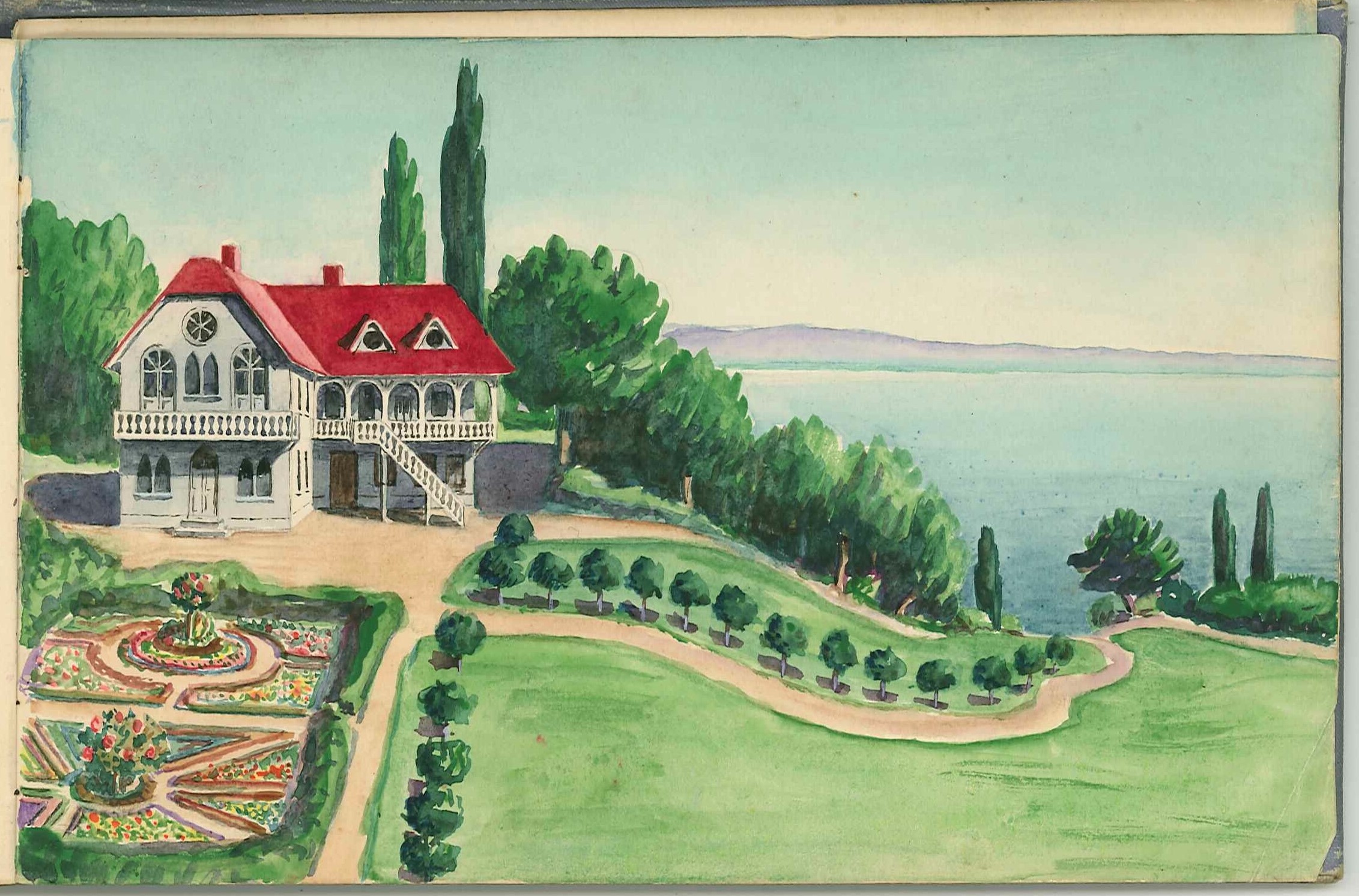
I’ve been meaning to scan some old photos and pictures for a long time, and today I finally did. This picture lives inside one of two autograph books which belonged to my maternal grandmother. I love these books because they’re full of hand-drawn pictures and poetry. Some of the poetry is the typical verse which would have been popular as choices for autographs, and other poetry has been written especially for my grandmother. My grandmother was German but born in Russia, and lived there until she and her family fled to Germany during WWII. And so the entries are in Russian, German or Ukrainian.

The pages of these books contain history – dates, names, warm wishes and sincere words from people who were once young and are now long gone – but they are precious to me also for their lost art of handiwork.  There’s a thrill in being able to feel the paint on the page, to see the brushwork or ink, and think that somehow the traces of people long gone are kept alive within these pages.

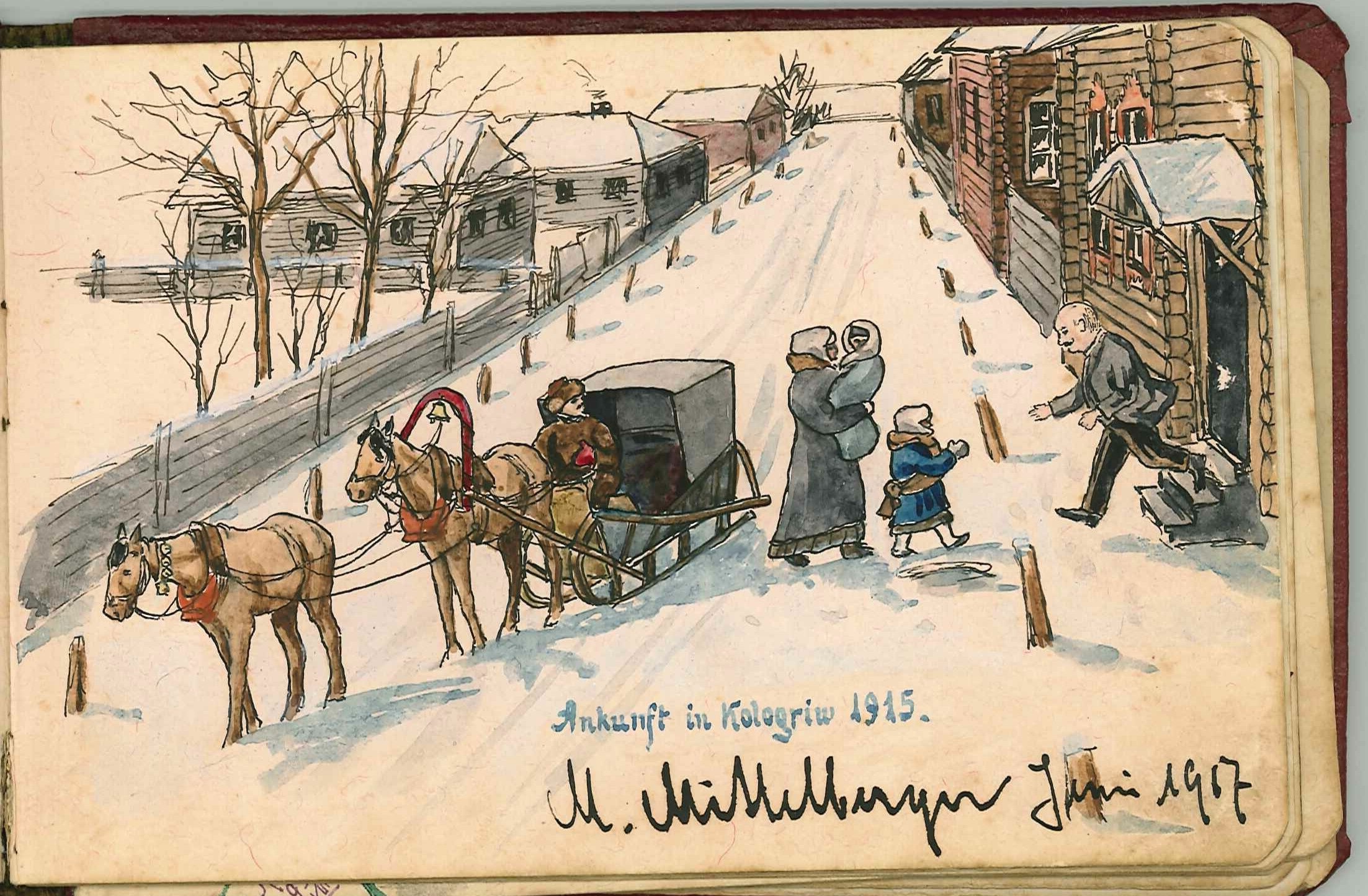
Here’s a page from an illustrated poem written about a time when my grandmother’s father was separated from the family when he was working in Siberia. In this picture you can see my grandmother as a young girl, her mother holding her baby brother and her father rushing out to meet his family, happy to see them. And the whole story is written as poetry.  How special is this!

SCN_20090624140218_001-1

Things have really changed since the times of these autograph books. Even the fact that I can scan, crop, save and upload these pictures demonstrates how technology has created possibilities. We may lament the fact that people don’t have the fine motor skills to draw as well as they used to, or the time or inclination to write poetry by hand, but we have different options for creativity. If students can’t draw, this doesn’t stop them from being able to create computer-generated art or animation. I love the fact that this generation is revisiting things from the past – art and music – and are remixing, reorganising, reinterpreting these in a new way. 

Here’s a Second Life animation take on Yeats’ poem, The Stolen Child, by Lainy Voom. Andy Fisher found this for me; thanks!

[youtube=http://www.youtube.com/watch?v=g9hnUYV06t4]

The autograph book demonstrates a lovely collection of shared sentiments, but at the same time, this generation is collaborating in newly found ways to create.

And remember, it’s about the kids

A little while ago I included a post with a video of a heart-warming song sung by 5th graders in New York.

Here’s another one you’ll enjoy

[youtube=http://www.youtube.com/watch?v=h0FPZolbYns]

This choir is testament to one man’s relationship with a regular class of 5th graders in New York, it’s not a music school or selective school:

The PS22 Chorus was formed in the year 2000. We are an ever-changing group of 5th graders from a public elementary school in New York City, NOT a school for the arts or a magnet program.

Read about this teacher/musician and view more videos on his YouTube page.

The PS22 Chorus has a blog documenting their activities with lots more videos to watch.

Watching this video reminded me that it’s really all about the kids. At a time when teachers have been swamped with corrections and report writing, labouring over sentence structure and punctuation, categorising students into cleanly definable spaces, it’s good to remember that it’s really just about the kids themselves. When I look at what this teacher has brought out in these kids, I do a double-take and step back to reflect. How can I keep that important focus without getting side-tracked by the structures. I’d like to remember that the structures are there to support the kids, and not the kids to support the structures.

PS22choir

Don’t drop the Internet!

Well, we’re winding down at school with this week being the last in term 2. I’m thinking about all the things I’d like to explore in depth online, but at the same time, I’m hoping to enjoy interests that get shoved aside during the term.

It’s Sunday night and I thought I’d indulge in a light-hearted post, in anticipation of the term holidays. Here are two videos parodying the internet.

Web crash 2007 is a humorous parody of the causes and consequences of a major internet crash (which I can’t embed, unfortunately)

The IT Crowd is a favourite comedy show in our house. Here’s the episode when the IT guys manage to convince Jen that they’re handing over ‘The Internet’ to her.

[youtube=http://www.youtube.com/watch?v=iDbyYGrswtg]

The humour of these two videos rests in the mystery and awe which used to surround the internet. A little like how the old TV shows used to depict computers – either as robots or massive machines with flickering lights. I think that Web 2.0 technology is still viewed with varying degrees of mystery, although it’s usually not awe but a kind of negative or fearful reaction that is demonstrated. I suppose that it’s part of human nature to resist change, but I think that approaching something new with caution is a good thing, while criticising it without looking into it at all is not a good thing.

Timelines and Twitter

Yesterday I was at a SLAV professional development session with the dynamic duo, Ross Todd and Carol Gordon – something I might write about in a later post (although I might not, considering Judith Way has taken copious notes and will no doubt do a brilliant write up in Bright Ideas – and she has). I was uncertain whether to take comprehensive notes or not, so that I could sit back and enjoy listening to and watching the speakers. I ended up splitting myself three ways – a solution to my indecision – and jotting down some things on paper, some in a word document and tweeting out interesting one-liners and links on Twitter.

Twitter is always so satisfying during conferences because while you’re sharing information and links, you’re getting immediate feedback from your network who are either retweeting or responding in some way.

At one point during the afternoon session while we were working on transforming an enquiry unit,  I tweeted out a request for online timelines, and unsurprisingly received 3 replies, so I thought I’d share them with you.

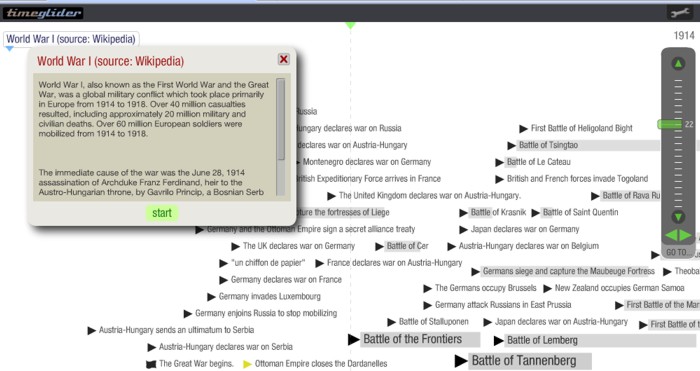
Paul Stewart shared a link to his blog post about Timeglider which used to be called Mnemograph. Interesting, the name change. The former does sound more ‘futuristic’ while the latter sounds like some kind of wondrous ancient machine housed in a museum.  Paul describes Timeglider in his post:

Mnemograph is a web-based timeline application. It can be used for a range of purposes. I attempted to chart the growth of Web 2.0 technologies. After a few minutes of initial confusion, I quickly found my way around and was throwing in images, text and hyperlinks with gay abandon. My first effort in Mnemograph is below. Additional information can be accessed by double-clicking items on the timeline. In this particular case, I have included links to original pages via the incredible Wayback Machine, a web archive of 85 billion webpages). I thought it appropriate to complement a timeline with the web’s most significant piece of temporal devotion.

I can’t seem to embed Paul’s example, so here’s the link. 

And here’s one of the examples given on the site:

timeglider

Martin Jorgensen shared this link to a post about Our Story, stories built with interactive timelines. Martin writes:

OurStory allows users to design a timeline using images and text. Stories built using this tool most often appear as sequences of events that lead to a conclusion. Some of the examples I’ve seen are simply one event leading to another, but others are more subtle.

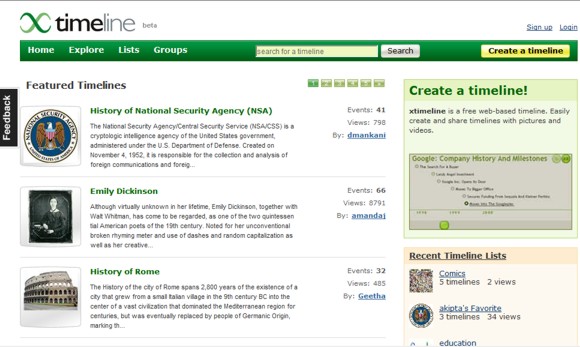
Allison Kipta shared a link to Timeline. You can create a timeline or browse existing timelines which have been featured on the site.

timeline

What I love about shared resources which are housed in blogs is the opportunity to explore the blog and discover all the other resources and ideas by the authors. In this way, I’ve found Twitter an invaluable resource and opportunity to discover and connect with amazing people and their work.

What does teaching well mean to you?

I was reading Allanah King’s blog, and she had posted a slideshow about ‘Teaching well’ which had been created collaboratively by some of our PLP people. Darren Kuropatwa initiated and coordinated the project in Google Docs.  Here is how he explained it:

WANNA PLAY?
I’m thinking of something that has legs to grow but has a low participation threshold. Something along the lines of
Presentation Tennis. I’ll serve the first ball in the next couple of days. Would anyone be willing to be part of my “seed team” to get the ball rolling? I’m looking for a few good people to help me get the ball rolling. Your commitment to this is very small: 1 slide. Details below …

WHAT WE’LL DO
We will collaboratively create a 20 slide presentation (not counting the title slide) called “Teaching Well”. 20 slides in 10 pairs of contrasts: “Teaching well is more like < slide 1 > than it is like < slide 2 >.” or however else you want to create contrast.

Each day one slide is added to the deck that builds on those that came before. The final 4-6 slides must bring the presentation to some sort of close.

For me, it was a truly satisfying experience which demonstrated the richness of collaboration.  The end result is much greater than each person’s individual contribution.  Here is my slide

teachingwell

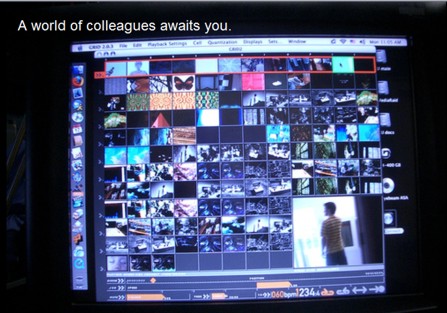
And this is the complimentary slide by Susanne Nobles

worldcolleagues

Have a look at the slideshow here. This would be a great collaborative project for both students and teachers, used as a slideshow or even printed off as posters.