Category Archives: 21st century learning

Conversation with the author

THis is partially cross-posted from my English class blog, http://englishwfc.wordpress.com/     with the addition of what happened since the post was written.

I’m teaching collaboratively in a year 7 English class. Since we’re studying Allan Baillie’s Little Brother, I thought I’d muster up enough courage to email the author himself, in the hope that he’d join our ning and interact with the students. What better way to create an authentic learning situation?

Well, guess what!? Allan Baillie has joined! He is part of our ning! I tell you, a day that moves like any other day, when frustration mounts, as it has a habit of doing – receiving an email reply from the renowned Australian author himself really turned things around for Maria and me. We were so thrilled!

Not so thrilled were we when we couldn’t find a trace of any such excitement on the boys’ faces. What? Are you kidding? Here we are organising the author himself for your information and enjoyment, and you can’t even stretch your face into a half-smile? What’s going on? Besides typical adolescent disengagement with anything that isn’t a game or related to free time or sport or TV.

Still, today was productive. A few days ago, Maria prepared the boys for questions by developing what would have been for any other class (I’m sure) a rich discussion leading to rich questions. Only it was like squeezing water from a stone. Seriously. And yet, these boys are never as predictable as we think they are, and today they happily entered their questions into the ning, demonstrating thoughtful and responsible online behaviour. We were proud, and we told them so.

I think for us, as teachers, it’s a lesson about the fact that the boys will never be as excited or appreciative as we are. How can we expect them to be? And I think, as we look into the ning activity, we can see that so much has happened – not even looking at the invisible activity which goes on in the background in the form of brainstorming, discussion, etc. – and in the end the ning is a transparent receptacle of this development and these breakthroughs.

Well, last night, I received an email notification to say that Allan Baillie had answered one of the students’ questions. Then another, and another, and soon most of the boys had received a reply to their question. I was so pleased! I think the boys should be too.

It’s very special that our boys are receiving individual answers to their questions. Here is an example:

Dear Mr Baillie,
I have read the book, Little Brother and I really liked the book. When I read it I felt like I was in Cambodia! I have one question, how did you feel when you were in Cambodia at the time of the Khmer Rouge?

Allan’s response:

I was Cambodia in 1969 and I visited some Frenchmen running a rubber plantation.
They slapped a revolver in my hand and took me on a night hunt in the plantation. They warned me about careless shooting because we were going into an area controlled by a few bandits. Harmless, they said, and charming. The bandits were just sick and tired of the corruption of the government. Called themselves Khmer Rouge. We stopped and I shot four coconuts.

I hope that this little exercise will be a lightbulb learning moment for the boys. We’ve been discussion the thinking behind the writing and creation of characters, and now that they’ve had a conversation with the author himself, I hope they’ll understand the power of the story, and the man behind the story.
Dangerous new (cyber)world

I firmly believe that we should educate students for their world.

There’s no doubt that they will function in an online and networked world, even more than they are doing now.

Yesterday our staff listened to Susan McLean’s talk about the dangers of the cyberworld. I became increasingly uncomfortable as the horror stories unfolded at the expense of a more balanced view, or even in terms of focusing on how we could manage cybersafety education.

I want to share my letter to the principal in the hope of opening up a conversation which will fill in the gaps to create a balanced picture of what we should be doing to educate our students as citizens of their future world.

To balance out last night’s presentation on cyberbullying, I would like to suggest that you look at ACMA which provides excellent links to resources and free PD.

 For example, here is the page for teens with practical help

 Here is the school page

There is free professional development

You can browse the site – it is set out clearly, and very helpful.

 I hope that our staff have been discerning in understanding that Susan McLean has presented a very extreme picture, describing the worst case scenarios (many of them), which should be acknowledged for what they are – worst case scenarios. It was difficult not to be affected by her stories; I know I was starting to panic and my instinct to run and save myself kicked in.

 What was unmistakable – Susan only mentioned that online involvement could be positive at the beginning and end of the presentation – she didn’t give examples. Her language was emotionally charged, and her numerous horror stories were dramatic.

It would be a shame if staff who were already resistant to technology and strangers to online possibilities in education, were to run even further away from technology – especially as we are a laptop school. We have to remember that we are educating students for their technology-rich world, not our world or the world of our own schooling.

 Just yesterday I was moderating comments in my fiction blog – no comments will be published until I approve them. I’m encouraging comments to inspire discussion around books and reading, and I noticed a student had commented on a student review of the new Harry Potter movie. The comment was fine, but the last sentence inappropriately put down a boy who had received a scholarship. I found the boy, had a little chat with him about what was inappropriate in the comment (he understood), and asked him to resubmit the comment without the negative part. This is part of students’ ongoing education – who else will teach them how to behave online if we don’t?

 We need, more than ever, to understand the power of these technologies, and educate our students to use them responsibly. The only way we will understand these from the inside is if we play with them ourselves. I would be more than happy to show you my Facebook and Twitter involvement – they are an important part of my professional development and educational support.

 What is also imperative, is that we don’t mix up the problematic online activities of our students in their leisure time with the technology that can be used to support teaching and learning, eg. Blogs, nings, etc.

 When you have time, please have a look at the 7M ning – we are thrilled to have Allan Baillie, author of our literature study, ‘Little Brother’, as part of our ning, ready to join the students in discussion. What better way to learn about the book than have the author answer questions – this is authentic learning. The boys and Maria and I are excited that Allan has agreed to join us, and we spent yesterday’s lesson reading his life story on his website in preparation for our interaction with him.

 I hope you accept my email in the spirit it has been written. I believe that we need to educate our students for their world. We should not bury our heads in the sand, but accept the challenge, moving past our own discomfort with technology, and taking up our responsibility to educate responsible citizens.

Thanks to Lisa Dumicich for the link to ACMA on Twitter.

I would be extremely  interested in hearing what you think about this issue of cybersafety and the use of Web 2.0 technologies in education. Please enter into the conversation.

Science and fiction – The Human Genre Project

The Human Genre Project

is a collection of new writing in very short forms — short stories, flash fictions, reflections, poems — inspired by genes and genomics.

Starting with just a few pieces at its launch in July 2009, the collection will grow and develop over time.

The Human Genre Project is an initiative of the ESRC Genomics Policy and Research Forum, part of the ESRC Genomics Network, funded by the Economic and Social Research Council (ESRC) and based at The University of Edinburgh.

Wow. Creative writing inspired by science. I love the overlap in disciplines; it would be good to enable more of this at school, where subjects seem to live in separate worlds, as if life were cut up into mutually exclusive areas.

genome

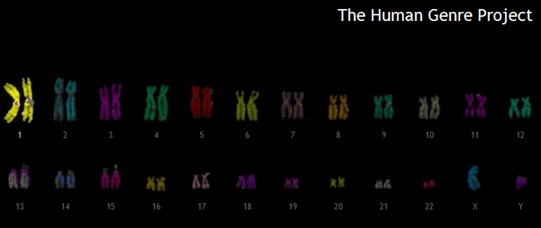
The main page shows 24 different chromosomes: 22 autosomes, which are numbered, and two sex chromosomes, labelled as X and Y.

Here’s the unusual part – when you click on a chromosome, you get the title which takes you to the creative writing piece. This example links from chromosome #8:

The WRN gene on chromosome 8 is responsible for Werner syndrome, which causes premature ageing.

My hair goes grey and falls out, my teeth yellow and decay, brown spots bloom on my skin. I’m thirty-six years old. My world is a room, and a view of the sea beyond it.

I’ve been told that there’s something wrong with me. But I know my physics. I know that in this universe there has to be decay and disorder. I’m normal. I’m entropy.

I try to sip tea but my clawed fingers let the cup fall to the floor. Liquid spills out from its shattered remains and soaks into the carpet.

What I don’t understand is why the rest of them never change. My twin brother could be my son. His teeth are white and even, his hair is as glossy as ever. His skin always has a rosy blush. He comes here regularly to tell me about life outside my room. Life with other people, other women. There seem to be many women. Or perhaps it’s just tales.

But as I sit listening to him and his stories, I realise how they do it. While I stay here, they’re all travelling around. Einstein had a theory about twins; one sits in his small room, watching the sea, and the other zooms to the stars. As he accelerates to the speed of light, time slows down for him, so when he gets back he’s younger than his stay-at-home brother.

I ask my brother, “Where did you park your rocket ship?” I look outside, “I can’t see it.”

The rocket ship looked like a bicycle, but apparently it worked very well, and my brother frequently made trips to the centre of our galaxy.

“I got rid of it,” he replies, “I replaced it with a quantum teleporter. They’re all the rage now.”

All I can see out of the window is a little red car. “That’s it,” he says. “The women like it.” And sure enough a woman gets out of the car and waves at us.

This was written by Pippa Goldschmidt inspired by chromosome 8.

The WRN gene on chromosome 8 is responsible for Werner syndrome, which causes premature ageing.

My hair goes grey and falls out, my teeth yellow and decay, brown spots bloom on my skin. I’m thirty-six years old. My world is a room, and a view of the sea beyond it.

I’ve been told that there’s something wrong with me. But I know my physics. I know that in this universe there has to be decay and disorder. I’m normal. I’m entropy.

I try to sip tea but my clawed fingers let the cup fall to the floor. Liquid spills out from its shattered remains and soaks into the carpet.

What I don’t understand is why the rest of them never change. My twin brother could be my son. His teeth are white and even, his hair is as glossy as ever. His skin always has a rosy blush. He comes here regularly to tell me about life outside my room. Life with other people, other women. There seem to be many women. Or perhaps it’s just tales.

But as I sit listening to him and his stories, I realise how they do it. While I stay here, they’re all travelling around. Einstein had a theory about twins; one sits in his small room, watching the sea, and the other zooms to the stars. As he accelerates to the speed of light, time slows down for him, so when he gets back he’s younger than his stay-at-home brother.

I ask my brother, “Where did you park your rocket ship?” I look outside, “I can’t see it.”

The rocket ship looked like a bicycle, but apparently it worked very well, and my brother frequently made trips to the centre of our galaxy.

“I got rid of it,” he replies, “I replaced it with a quantum teleporter. They’re all the rage now.”

All I can see out of the window is a little red car. “That’s it,” he says. “The women like it.” And sure enough a woman gets out of the car and waves at us.

Pippa Goldschmidt is Writer in Residence at the Genomics Forum. I’ve mentioned Pippa in an earlier post; her writing is often inspired by science.

Chromosome 11 leads to a piece called Photophobia,

an eye disorder in which the iris is partially or completely missing. A person with aniridia frequently has photophobia (sensitivity to light). The mutation is in the PAX6 gene on chromosome 11.

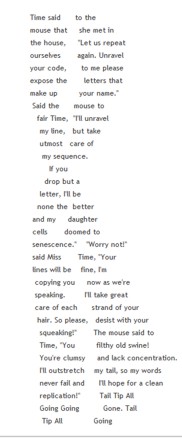
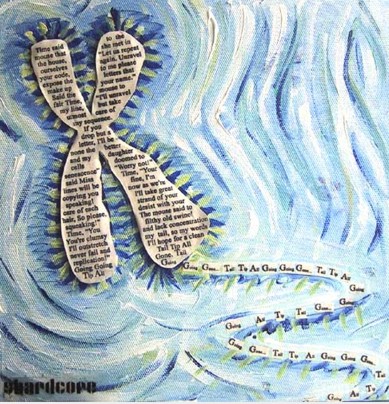
The telomeric tale of the mouse’s tail (chromosome X) is a shape poem.

chromosome

You can find the original painting/collage here and it looks like this:

mousetale

Still in progress, this is a fascinating project, demonstrating the possibilities in the union between science and art.

If you like this, have a look at what inspired it: Michael Swanwick’s Periodic Table of Science Fiction.

Powerful Learning Practice presentation is finished!

Well, when I say finished, I mean that the first layer of our presentation is complete. Whitefriars College Powerful Learning Practice cohort has documented their PLP journey on a blog which is the platform for all the projects, experimentation and reflection during the course of this year.

Marie Salinger and I have spent long hours pulling the presentation together, and at the end of it we feel deeply satisfied. As I was saying to Marie earlier today, the experience reminds me of the ‘Stone soup’ story:

a tale in which strangers trick a starving town into giving them some food. It is usually told as a lesson in cooperation, especially amid scarcity. In varying traditions, the stone has been replaced with other common inedible objects, and therefore the fable is also known as button soup, wood soup, nail soup, and axe soup (from Wikipedia).

It really was exactly like that – at first we thought we didn’t have enough for the presentation but gradually we gathered things from here and there, pooling our resources and forcing reflection and evaluation, until we surprised ourselves with the result.

So we have the first layer. And as Marie Salinger has said,

It has been a very positive and affirming experience to take the time to do this. Evaluating, reflecting on , summing up and consolidating the work we have been doing for the past nine months has been a very worthwhile endeavour.

Now that we have the blog as a space for sharing, we can continue to add to it as we go. I’m going to link to a new blog which follows the progress of 7M Ning, and I hope other team members will do the same. What would be even more encouraging – if the blogs inspired other members of the school community to have a go. It would be fantastic to see blogs for each faculty, documenting progress, reflecting, evaluating and celebrating.

Here is a short audiovisual reflection and summary of our journey.

[youtube=http://www.youtube.com/watch?v=zwH16mU2oYY&feature=player_embedded]

Here is a link to the blog.

Still kicking.

Forty years ago astronaut Neil Armstrong did something no one had ever done before. On July 20, 1969, he set foot on the moon. We all know what he said when he stepped onto the moon’s surface and looked at the Earth above him: “That’s one small step for a man, one giant leap for mankind.”

Meanwhile, back on Earth 40 years later, some of us are still struggling with less cosmic achievements, like the Recurring External Blog Saga which you  may have read about here and here. Unlike Armstrong, and more like Prometheus, unable to move forward, having been chained to a rock by Zeus, my way forward with technology in my own school is often just too hard.

Jacob Jordaens, Der gefesselte Prometheus, c. 1640 Rheinisches Bildarchiv

This morning I received yet another email criticising my move to an external blog for reading promotion. Yes, I know you’ve heard all this before, but imagine how I feel then. I’m definitely over it. Nevertheless, for every attempt to drag me back, to find fault with what I do, there are encouraging moments.

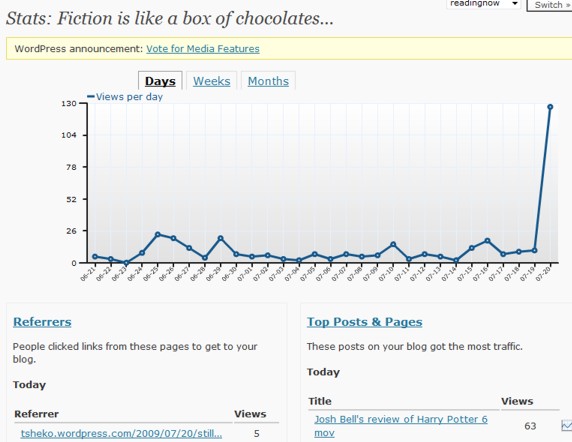
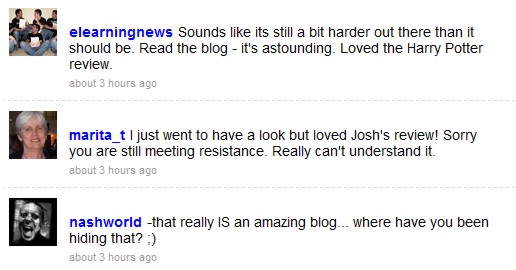
Today several things happened that demonstrated the advantages of the Web 2.o platform for things like reading promotion. Firstly, a student had posted a passionate review of the recent Harry Potter movie. I had only just posted that late last night, and already this morning there was an encouraging comment from Marita Thomson, a teacher librarian from The Kings, Parramatta. I know I was pleased to receive positive feedback, so I imagine the student was even more pleased. But wait, there’s more. Two more encouraging comments – one from Sean Nash and another from Paul Stewart. Here, let me show you.

fictionblogcomments

I’ve said it before, and I’ll say it again – sharing online opens up communication and possibilities. It’s encouraging and enriching. I really don’t get why people don’t get it.

So, while my Web 2.0 colleagues and I are moving forward slowly, I hope our small steps are paving the way for a more comprehensive change of mindset in the future, in which case I could also say,

“That’s one small step for a man, one giant leap for mankind.”

Reflecting again (still)

Last post I wrote a reflection for the culmination of my participation in the  Powerful Learning Practice program. Still, I felt I hadn’t drilled down to what was essential for me.

Listening to Howard Rheingold this morning, and rethinking things, I wrote another reflection.

My participation in PLP has been life changing. I know it smacks of evangelical fervour, and I’ve often written about this in my blog, but PLP came just at the point that I was ready for it. I’d just completed SLAV 23 things, and started a blog. Everything was new to me. Nothing was easy, I wasn’t a natural, probably more of a technophobe than anything, but something pulled me in. Jenny Luca must have read my blog somehow, and emailed me about joining the PLP cohort of Australian schools. It all avalanched from there. Soon I was blogging, wikiing, ninging, twittering, flickering, and having a great time.

Thinking about it more seriously, I realize there’s a big discrepancy between my personal awakening to online participation and what I’ve been able to do in convincing other educators at my school or anywhere else about what I see as a crucial path we must take in order to make learning relevant and engaging for students. Yes, I’ve made steps, and for me, these steps have been significant. I’ve been reflecting and sharing knowledge and resources in this blog, I’ve explored the literacy possibilities with Flickr’s image sharing, I’ve supported English and Art faculties with wikis, I’ve created a blog to inspire reading in the community, I’ve been working on a ning as a platform for learning, collaborating with a wonderful English teacher, I’ve sent countless links and resources to teachers as a result of my own connection to my online network. But it’s not enough. It hasn’t moved a significant portion of my school, it hasn’t changed the way my principal thinks, or other the way faculty heads function. Although, I suppose I shouldn’t underestimate small victories, such as the approval for an external fiction blog (read here and here).  On the whole, though, it’s often resulted in friends, family, colleagues casting a critical eye or making derogatory comments, telling me to get off the computerand get a life. Basically, I haven’t convinced many people that what I’ve spent an enormous amount of my own time on is worth anything.

It has, however, connected me to a network of people who are my lifeline. People I otherwise wouldn’t have met or known about. People who are experts in different fields, who are brilliant, engaged, supportive. It has crossed borders, transcended nationality, age-group, ignored physical apprearance and status – it’s been fantastic. I agree with many great speakers I’ve listened to: it’s not about the technology tools, it’s about literacies. Our students need critical thinking to navigate the flood of information and media that comes their way. They are learning outside of the classroom – and social media and technologies such as Youtube and Facebook provide a platform for communication, collaboration and collective action which is more important to them than their textbooks. One day it’s about organizing a large gathering through Facebook, and next thing, it’s organizing political action. None of it comes from teachers or parents; it wouldn’t spark that level of engagement.

I’m seeing the power of collective response to disaster. Why aren’t we thinking in terms of social capital? Why aren’t we thinking about how to mobilize people to do things using social media? What are we doing at school? How can we spark this level of engagement? Should we rethink the ways we are teaching, the content?

You can see that this isn’t about technology tools, although all of this is made possible through technology. These are the things that drive me today – as an educator, parent, citizen. I don’t have the answers but the questions are driving me forward, connecting me to others who find the conversation valuable. This is what my PLP experience has been about. Life is a series of new starts. That’s why we feel we never reach our destination. We’re always starting out with new questions and new problems to solve. That’s why it’s a journey.

Spider’s web

Photo courtesy of moonjazz.

The Powerful Learning Practice experience is coming to an end, and it’s time for us to gather our thoughts and share what we’ve done.

I’ve been putting off my reflection because, frankly, the thought of gathering my thoughts about this relatively short, but intense, period of PLP participation, is overwhelming. Scouting around in blogs and Twitter links, I came across something which describes what I consider to be the focus of what is most valuable from my PLP experience: connectedness. 

I love the way Lisa Huff compares the spider’s web-weaving in Walt Whitman’s A Noiseless Patient Spider  with our reaching out to connect with others through technology.

Whitman, writing in the 1800’s, observes how a spider ceaselessly launches forth filament to explore his surroundings, to travel from one place to another, to bridge his world. Whitman notes mankind’s similarity to the spider. We too ceaselessly seek to connect, to make sense of the world, to reach out to others.

 Technology of the 21st century is connecting us like never before. We blog, we podcast, we collaborate via wikis, webcams, e-mails, discussion boards. We explore endless information easily summoned with a few clicks. We are living in the midst of sweeping technological changes that are reinventing the way we live, learn, laugh. At the heart of this change, however, is the basic spirit of exploration–that same spirit Whitman captured some two hundred years ago.

This is what I have learned since joining the PLP team – how much richer my life has become through connections with people globally via technology. I’m connected through people’s blogs, wikis, through Twitter, and other Web 2.0 applications, to a limitless network of resources, ideas, discussions and creativity. At the risk of sounding evangelical (once again), this is a life-changing experience. It’s not just a matter of acquiring some technological skills with tools, it’s what we have in common with Whitman’s spider as we ‘ceaselessly seek to connect, to make sense of the world, to reach out to others.’

Coming down to earth a little, I must say that my fervour about 21st century learning, and that of my team members, is shared by few in our school community, and I hear it’s the same everywhere. At times it’s lonely, other times frustrating, to be convinced that networked learning and teaching are in step with our fast-paced, global world, and to know that our current education system supports an outdated society. Trying to take tiny steps in convincing others is perhaps the only way to move forward, taking care not to alienate others, but to support them, model new ways of teaching, and to celebrate small successes.

What have I enjoyed the most?

  • writing my personal and fiction blogs
  • reading others’ blogs, wikis; commenting; taking part in discussion
  • creating and supporting nings, joining others’ nings
  • the support of my personal learning networks on Twitter, Facebook, Friendfeed, etc.
  • sharing information and ideas
  • ‘converting’ others to the networks
  • discovering amazing people with great talents and wonderful minds
  • seeing engagement and joy in students, especially after the new ways of teaching have been a struggle to implement
  • being able to participate in professional development opportunities online at many different times
  • lifting up the minds of young people, seeing the spark in their eyes, hearing excitement in their voices
  • collaborating with others towards common goals
  • discovering unexpected and wonderful links to links to links
  • feeling energized by the depth of what’s out there
  • loving the learning

What have we learned, and what have we achieved? We’ve learned so much, and at the same time, we have so much more to learn. We’ve achieved a great deal, and yet we’ve only just begun.

What I’m sure of is that there are people I can rely on for help, ideas, support, resources, inspiration. These are the people I connect to as a teacher. I can never be bored, will never feel isolated, will always look forward to more.

4 Rs meme: favourite posts

I almost forgot to say this, so I’m editing postscript. Paul C. tagged me in a meme in his blog post. I have to admit that while some people find memes annoying, I love them, as long as they contain something worth reading. Memes are a great way to pool people, their views and resources. This one about favourite posts is like getting people to skim the cream of their thinking and writing. I hope you’ll enjoy mine and go on to read others, including Paul’s.

‘Meme rules:1. Scan your posts for your own personal favorites.
2. Choose one post in any/each of the four categories:

  • Rants
  • Resources
  • Reflections
  • Revelations

I leave it to you folks to define these terms, but my instinct is that we could treat these loosely. You are welcome to suggest new categories if these don’t fit.

3. In a blog post, list those posts and very briefly describe

  • why it was important,
  • why it had lasting value or impact,
  • how you would update it for today.

4. Select five (or so) other bloggers to tap with this meme.

5. Tag all of your post with #postsofthepast ‘

Rants – Don’t bag technology – ask what it means first –  I rave quite a lot. In fact, most of my posts are raves. In this post I express my frustration with the negativity with the wall you sometimes come face to face with when you talk to people about technology in education. The conclusion of this post centres on what I think is the transforming aspect of Web 2.0 tools, and that is the conversation and connection with a larger audience. As frustrating as it is to believe so much in what Web 2.0 platforms offer for engaged and connected learning and teaching, and to feel like Sisyphus pushing the massive boulder up the impossibly steep mountain, I have gained so much from my own connection with a personal learning network, and I intend to keep offering and suggesting, sharing and collaborating, even if that means moving small steps with few people. I live in hope.

Resources – Shift into overdrive – As I say in the post, Web 2.0 technologies have opened up new ways of opening up and creating new experiences for teachers. This post is a fairly comprehensive collection of Web 2.0 resources – not so much a collection of resources as a list of the amazing people who have created them.

Reflections – How have you changed as a writer because of online spaces? – It seems that my posts have a dominant theme: one of connections with people. I realised at the outset of the post that I have become a writer since starting a blog, and how much I missed writing since finishing secondary school. I’m convinced that having readers and commenters gives me a supportive, rich community to feed from and into.

Revelations – Teach the child – Sometimes the most powerful revelations are the ones which manifest themselves beyond words. This video of children singing moved me deeply and reminded me what is wonderful and sometimes hidden in each child. I like to come back to this video to remind myself that children are not just empty vessels to pour curriculum into.

I tag:

Steve Shann- Birds fly, fish swim; Susan Carter Morgan scmorgan ; Jennifer Clark Evans – My continuing education; Sean Nash – Nashworld; Marie Salinger – Just in time; Paul Stewart – Contemporary learning.

Moving forward and pulling back

Well, hello. Haven’t been around the blog lately. Mid-year holidays and taking time out of my head for a change. And, to tell you the truth, I’ve needed the break. No blog ideas put up their hands in their usual impatient manner. Nothing was hammering inside my head, clamouring to come out. No clear thoughts were forming, no ideas were sprouting. For a while there, I thought I’d dried out for good. Until I realised that I was looking back, only I’m not sure if I’m having second thoughts, or if I’m giving things a second look over.

Our PLP presentation is very close now. I can’t deny feeling unprepared. How have we, as a team, moved forward in changing teaching and learning in our school? How far have we come, if at all?

The answer is simultaneously a great deal and hardly at all. Taking part in the PLP ning, connecting to a rich network of educators, great minds, variety of personalities and viewpoints, forming a personal learning network that I don’t feel I could do without  – this is a new dimension that has changed my life as a teacher and a learner. The Art and English wikis, the personal and reading blogs, the ning I created to support students and teachers at my school are initial experiments, attempts to engage students in new ways, to share resources, to present different types of media as possibilities for discussion or creativity, to use technology for the purpose of re-envisaging education.

But how far does this go in making any difference to the way teaching and learning occur at my school? How many eductors have seen these things, and if they do, how many are convinced that I’m offering them something valuable, something worth trying out? The answer is – not many.

Dean Shareski’s post has resonated with me today. He describes the architecture of learning as transformative where there’s no going back.

The landscape of learning is changing. Rethinking what control means, understranding the power of sharing and transparency all work to topple many of the foundations our schools are built upon.

His post strikes a chord with me at this stage of my journey:

I know this, you know this but after spending 3 days amongst 18,000 in the educational technology field, I still say very few else know this. I made this observation (jump down to #4) last year at NECC and while the number may have increased slightly, those who really have any sense of the changes that are possilbe and perhaps inevitable in education is strikingly small. Yet sometimes the conversations amongst them would indicate they think everyone understands. A good example took place in the last session I attended on a panel discussion on Web 2.0. The panel was made up of all people that I and many in the audience knew very well either because we’ve spent time with them or know them from varoius online circles. The panel and audience were calling them by their first names and having a good discussion One lady stood up and felt frustrated since she didn’t know these people, these terms and most of the content of the conversation. That wasn’t her fault that’s ours. The assumption amongst folks who live and breath social media is that most teachers know about but they just don’t understand social media. We jump in with disucssion about Web 2.0 when they aren’t ready for that discussion since they have absolutely no prior knowledge. I”m not against having these kinds of discussions but it’s a bit like Christopher Columbus and crew arguing over how they would organize and structure the new world when most of the old world didn’t even know it existed and if they did, had no idea why or how they would get over to see it, let alone settle there. It’s not a totally useless discussion but perspective is important.

This is what I’m finding unsettling at this stage –  Dean’s analogy with Columbus. Should I feel unsettled knowing that I’m trying to populate a new world with people who deny its existence? Am I going about this the wrong way? Should I be happy to go slowly with a minority of takers? Am I being naive and unrealistic? Is trying to change teaching and learning in a school insane or egotistical? Am I unrealistically trying to change society itself? Can individuals make this change or is it only possible for politicians?

But then again, I’m pulled back by a comment on Dean’s blog by a teacher who attended NECC:

I paid my own way, as did many of the classroom teachers and a few of the administrators I met, because we are hungry to learn and starving for people who have the knowledge and experience to teach us. Of course, there were sessions and conversations at NECC that were way over my head, but hearing them and trying to understand gives me guideposts and goals for my future development.

If my new, recent direction in learning and teaching came ‘out of the blue’, then why shouldn’t other people make that transition? If a teacher cares about students and thinks about the best ways to inspire students to learn, then who’s to say my little steps, and those steps of my fellow PLP members, or anyone else who is struggling through relevant and engaging teaching and learning – who’s to say these things won’t make a difference?

Should we despair that our efforts are mere drops in the ocean, or should we appreciate our small steps?  So many rhetorical questions…

Dean points us to Tom Carroll’s article, If we didn’t have the schools we have today, would we create the schools we have today? written 8 years ago and still very pertinent:

If we continue to prepare teachers as we have always prepared them, we are going to continue to recreate the schools we have always had. We have to start preparing teachers differently. If we are going to continue preparing educators to work as solo, stand-alone teachers in self-contained, isolated classrooms, we are going to perpetuate the schools we have today.   If we want schools to be different, we must start today to prepare teachers differently… significantly differently.

Yes, I do feel a few can make a difference, but it’s a slow and laborious process. Why isn’t teacher training aligned with the educational needs of students today? Who should we be influencing in order to revise teacher training, in order to go to the source of the problem?

I might stop before another flood of questions is unleashed. Please come in and help stop the flood.