Category Archives: Education

Creativity, a sense of purpose and belonging

In his latest post (6 May), Will Richardson asks this question:

So when I read Jay Cross’s latest piece in CLO magazine, I wondered how many schools could point to someone, anyone, who is in charge of learning. By that I mean someone who manages the culture of the school by focusing not on outcomes as much as how learning is writ large in the system.

Learning is occurring at my school this week. Learning with a capital L. We are coming to the end of a pilot project where the entire Year 8 cohort, along with its teachers, has been involved in researching a big picture question culminating in a multimedia presentation of their choice.  Normal classes have been suspended, and each teacher has stepped into the continuum at different points, providing the support needed at that time. Teachers have been in a unique situation, supporting not content, but skills; and this often meant that they were learning alongside the students, at times from the students. The process seems to have taken on a life of its own, and teachers have reported being surprised that students’ projects are taking shape, and that they are on task and engaged, even excited.  Trust in the students’ abilities and creativity has been growing.

This is the part of the project that gets me going – the learning process of both students and teachers. This is what I hope we can record, make transparent, discuss collaboratively, reflect upon, project into the future with. I’ve been enjoying discussions with teachers at different stages of the project: the initial feeling of not knowing how to begin, being overwhelmed by the enormity of something new and big, the joy and relief with the first successful day, the surprise when students took the task and ran with it, in all different directions, in a variety of ways, the excitement upon seeing things take shape, and the anticipation of the final presentation.

I’d like to record all of this. I think that this discussion is the guts of the learning. It’s exciting to see shared discussion in a shared project, and I wish it would happen more often. For a change, the teachers are not in charge, they are facilitators, they are not in control, but are taking one step at a time, and trusting in the students, they are not keepers of the content, but observers of the process.

This is learning. I hope we can capture this for reflection and evaluation. We can base next year’s project on what we have observed, what we’ve learned. I hope we can come together for discussion, reflection and evaluation, modifying the assessment rubric from experience of what the process has involved. Teachers have been talking excitedly not of perfect products or best products, but of the learning leaps for individual students.

I read Will Richardson’s latest post (6 May) and he says

I wonder how many of us can look at our colleagues and answer the question “How does that person learn?” And think of the leaders in our schools in that light as well.

This week, Year 8 teachers have seen with new eyes how their students learn. I think they’ve had an insight into their own learning process. Learning has been shared by teachers and students alike.What does Will Richardson say about teachers’ learning? In discussing Jay Cross’s latest piece in CLO magazine, Will wonders if any schools have one person

 ‘who is in charge of learning. By that I mean someone who manages the culture of the school by focusing not on outcomes as much as how learning is writ large in the system. Someone who also understands the ways in which social Web technologies accentuate the need for the learning skills we’ve desired all along: creativity, critical thinking, independent thought, collaboration, etc…

And it really is about a culture that supports, celebrates and shares learning.

The Year 8 immersive project has given those involved a taste of the learning culture which supports, celebrates and shares learning.

In the article about Chief Learning Officers in companies, Jay recommends looking at the workplace through different lenses: from the point of view of the anthropologist, the Web 2.0 specialist, the informal learner.

Some of the questions posed through these lenses are:

From the anthropologist:

Are people sharing the information or are they just hoarding?

Are people taking time for reflection, or are they so busy they only live in the moment?

Are they experimenting and taking risks, or are they doggedly following the rules?

Are people working collaboratively or are they in isolation?

Through the Web 2.0 lens:

Are people using instant messaging, social networks, search engines and multimedia resources that are as good as or superior to those they are accustomed to in their homes?

Are discoveries recorded and shared with one another and documented for future use?

Do workers have blogs or other means to express themselves?

The informal learning lens:

Are there comfortable places for people to talk?

Are workers intrinsically motivated to learn and increase their professionalism, or are they waiting for their next class?

Is informal collaboration encouraged?

Are people learning from observing others… and reflecting on experience?

These are questions I’ve chosen which are most pertinent to the school situation. As Will says, do we or should we have a CLO in our schools,

 … people to lead that work, …  who understand deeply the passion-based, self-directed potentials for learning in a connected world, and the importance of a vision for true learner-centered classrooms and curricula for everyone in the building.

Do you have such leaders in your school?

(Now, I’m not sure about this, but it seems that the Chief Learning Officer is like our Training (or Learning) and Development Manager in Australia).
What’s it worth? A teacher’s beliefs.

Yesterday I unexpectedly leaped into a heated argument with a very close friend who had come to visit from interstate. It was one of those fires that flare up suddenly from a small spark, blazing fiercely long enough for onlookers to look alarmed and consider calling for help, and then burn down gradually, leaving those involved in a slightly shaky state, surveying the damage.

The offending spark was a question about why my friend’s daughter didn’t have Facebook, and if she did I’d be able to view her photos from the Ball she was attending that night. Remember, these friends live interstate.

Now, you can imagine, with a blazing argument, most of what goes on is reactive, and each person becomes locked in to a mainly defensive position, taking each comment personally and wanting to come back strongly enough to defend their position. There isn’t any room for thought or even fair appraisal of what the opponent has said. Luckily, the latter occurred as the fire burned down; concession and reconciliation was possible in the smouldering stage.

I can only speak for myself in this argument, and I will.

I reacted to my friend’s initial painting of Facebook and MySpace as bad places (which, I think, he must have said unconsciously, because he later denied it), places where, at best, young people wasted their time with inane conversations, and, at worst, young people exposed themselves graphically involved in the worst behaviour.

If I hadn’t been so defensive, I would have said that I’d been there not so long ago. I was initially against my older son interacting online, either msn or Facebook/MySpace. I gave many reasons, but one I pushed the strongest was that online interaction was not real, it was virtual. It was unnatural, it took away from the time spent with people face to face, it was potentially dangerous because it increased solitary time with virtual friends, etc. Why didn’t he use the phone if he wanted to talk to someone? How could he be ‘friends’ with all those people? That wasn’t friendship.

Funnily enough, these were some of the points my friend expressed, in between dodging my line of fire. I wonder (always wonder) when I’ll learn that the conversation ends when the other person feels attacked.

What has happened from the time I held my friend’s convictions and now? Several things. Instead of making conclusions about social networking and online environments from the outside, based on what I’d read, on media reports (which are mainly negative and engender fear in parents and teachers), I decided to play around with these things myself. What happened? I connected with people I hadn’t talked to for years (even decades), I saw photos of where they lived, saw status updates of what they were up to – no, not just what they had for breakfast –  they were about to become parents, or they were travelling overseas, etc. No, I didn’t have deep relationships with all of these people, but I did appreciate suddenly having a general view of what my ‘friends’ were up to, and many of these are scattered all around the world.

I also saw a different side to young people, definitely different to the picture that is often painted in the media, or even in conversations held by people who have little to do with adolescents or university-age students. I saw these people supporting each other with positive comments, engaging in humorous and often witty dialogue, planning events and meetings, putting out interesting links to things they had read or music they listened to, venturing to express opinions they might not in real life.

One of my main points in the aftermath of the argument was that social networking supports real-life interaction. The young people I observe are less isolated than I used to be at their age, not only because they can chat to a group of friends at home in between homework, but because they use these connections to meet up and do something together. They inititate interest groups, they gather friends for events, they learn to function as social beings – important skills for life and work. They do this because these spaces belong to them. They’re not forced to create a group and contribute to discussion; they choose to because of personal interest.

Which brings me to my next point. How much of this initiative and cooperation do we see in schools, in the classroom? Do we see discussion, do we see young  people sharing their interests and passions? Or do we see disengagement, boredom, solitary struggle in place of collaborative effort? Is there room for students to take initiative, pursue interests, work together to solve problems, get involved in real-world research and enquiry.

Are we getting the best out of our young people at school?

To finish my rave, yes! I agree with my friend that there is potential danger in online involvement. And I believe we should discuss these dangers. We should take every opportunity to educate our young people about the irreversible nature of what they put out the web. But we could also create a safe, online environment for them to use at home when they need help with homework, or when they want to share ideas for a project. A place they could become teachers as well as learners. An exciting place where they are enriched by the diverse contribution of others. Where they learn to respect each other. Where they are not afraid to ask questions.

As an educator, I’ve been pushing my boundaries, often painfully, against what I felt comfortable with. But I want to keep my eyes open, and I’m trying to re-evaluate constantly, and I know that I must do that if I’m to have any part in educating young people for their future. No, not going with all the latest fads, not embracing new things without thought, but thinking deeply, and listening to the dialogue in my own online network, asking the deep questions….

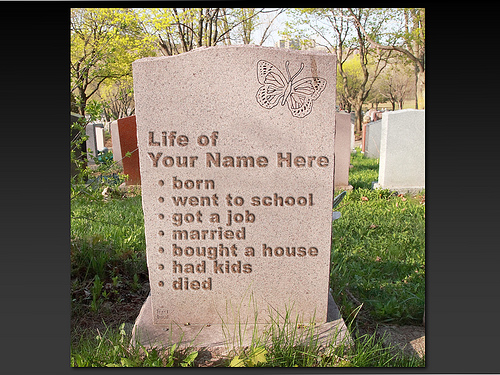
We want dot-points

dotpointgrave

Thanks to cogdogblog for the photo.

My older son has started university this year. His core subjects are Psychology and Politics, and Logic is one of his breadth subjects. Today he was telling me that some of the students in one of his Psychology classes were complaining about a particular lecturer. They thought he was too vague. What did they mean by ‘too vague’? The lecturer gave them material to read, but he didn’t specify what exactly they were supposed to learn, he didn’t give them dot points, and he didn’t make it clear what they needed for the assessment task or exam.

In other words, he expected them to read and think for themselves, to learn instead of just memorising dot points to satisfy exam criteria. According to my son, his lectures were more about making students think about things. eg. in a lecture about sensation and perception he might present an example that encouraged students to reconsider the way they perceived things, to deconstruct how they perceived reality.

What is going on in our education system that produces such an attitude to learning ?

Of course, this is a complex question which cannot be answered simply but, in my opinion, this is the result of teaching to the test, of putting all the pressure onto a final mark, an ENTER, which will allow access into a university course, which, in turn, will provide students with a job. Nothing wrong with employment. Nothing wrong with wanting further education. What is wrong, then?

The lamentable thing here is that academic success is based on performance which is made up of mastering discrete chunks of information. Why? In order to pass the assessment task or test. What is missing here is the desire to learn something because it’s interesting, because a deeper understanding enriches your life. What is also missing is the thinking behind the learning, the ability to independently read and understand, construct meaning, evaluate information, solve problems and construct creative solutions.

If students at tertiary level claim they cannot learn without the summaries or the dot points, then shouldn’t we reassess what we are teaching them? Shouldn’t we consider which skills are most important to them in their lives?

These students compared two lecturers: the one who frustrated them with the open-ended teaching method, and the one they preferred, who provided dot-point summaries, and provided notes, telling them that this was all they needed to know for the exam, and anything else they didn’t need to worry about.

My son liked the unpopular lecturer’s teaching style because it was more philosophical, more interesting because it required higher order thinking.  He said that it wasn’t the case that this lecturer would include in the exam things they hadn’t covered, it’s just that he didn’t present his information in pre-digested chunks.

What do other educators think about this? Do you see this as an isolated or general problem? What do you think are the most important skills students should leave school with? Are we preparing our students for their future world?

Reblog this post [with Zemanta]

Teaching – what’s it all about?


I’ve been reflecting about teaching – you know, the existential part – what’s it all about, what are our essential aims as teachers, how do we connect to students individually and as a group to engage and stimulate meaningful and creative learning? The usual.

Often I think about how I learn. I imagine myself as the student sitting in the classroom listening to the teacher and participating in the lesson. It’s easy for me to do this when I’m teaching collaboratively, and I can do that as a teacher librarian. The beauty of coming into a class as a teacher librarian is that I’m not the principal driver, and so I have a certain distance conducive to reflection which can be very satisfying. It’s not unusual to experience a cloud of ideas during the lesson, although these are not always fully formed ideas as much as reactions and hunches. More challenging is taking the time to record these ideas, reflect on them, and come up with planned solutions.

The one class that I teach collaboratively on a regular basis is an English class with possibly one of the best teachers I have met. This teacher’s leitmotif and driving conviction is ‘It’s not about what you teach them, it’s the connections you make’. Absolutely. If you don’t connect to the student, they haven’t picked up. If they haven’t picked up, they’re not going to hear anything you say. And once they pick up, they need to want to stay on that line. And that’s all about a personal connection. The teacher I’m referring to makes the positive connection with each individual student, and then goes on to create the group connection. This really is the best learning scenario – a student who’s happy with the relationship with his/her teacher, feeling accepted, acknowledged, liked, respected, and also confident as an accepted member of the class. This is where learning can take place. If you look into a classroom you can immediately see where this is happpening and where it is not. We’ve all seen it before: the class where students look distracted, bored, all looking in different directions, eyes switched off, and the class where facial expressions are turned on, students are bursting to contribute, focussed discussion or activity is taking place.

It is the affective domain that may be overlooked in teaching. It’s easily done; you have the curriculum content to cover, and you focus on delivering the material while keeping the class in order. It would be good to take a look at Blooms affective taxonomy, and I’m going to re-blog Kent Manning’s excellent post for this purpose.

Most educators are familiar with the traditional Bloom’s Taxonomy, but what I didn’t know, or had forgotten from my EDUC 101 days is that Mr. Bloom developed a taxonomy for the affective domain as well.

Let me explain.

Our school district has a “Growing with Character” system goal so when I happened upon Bloom’s Taxonomy of Affective “Transformation” it caught my eye.

It goes like this:

Level 5: Internalizing Values

Character acts on value systems as an individual, rather than in response to group expectations; uses teamwork effectively, values others for their intrinsic merit rather than external qualities.

Level 4: Organization

Character prioritizes values, resolves conflicts, develops personalized value system; balances freedom and responsibility and accepts standards of moral behavior.

Level 3: Valuing

Character demonstrates belief in a value system that manifests itself in solving problems for others and in valuing cultural and individual differences.

Level 2: Responding to Phenomena

Character participates in solutions, works with a team, helps others.

Level 1: Receiving Phenomena

Character listens to others respectfully.

Source: Bloom, Krathwohl, & Masia, 1964.


The dominant words in Bloom’s affective taxonomy are ‘values’ and ‘valuing’. With citizenship as the focus, the real learning takes place not within the facts and information themselves, but in the evaluation of these facts. We’re teaching the students as people and future citizens of the adult world, more than we are teaching information.

As always, I value people’s comments and look forward to hearing from you.

Vision of the future – Are you ready?

Have you given nanotechnology any serious thought?  Have a look at this video by Karsten Staack, The 21st Century: What will it look like?


[youtube=http://www.youtube.com/watch?v=c1KEFgD6Dtg&feature=player_embedded]

What are your thoughts? Are you excited/afraid of the future? Don’t be. It’s not for you, it’s for the next generation.

Teaching 21st century literacies

Howard Rheingold  has written an article for City Brights on 21st century literacies.  His opening paragraph asks essential questions for the future (and present) of education:

Will our grandchildren century grow up knowing how to pluck the answer to any question out of the air, summon their social networks to assist them personally or professionally, organize political movements and markets online? Will they collaborate to solve problems, participate in online discussions as a form of civic engagement, share and teach and learn to their benefit and that of everyone else? Or will they grow up knowing that the online world is a bewildering puzzle to which they have few clues, a dangerous neighborhood where their identities can be stolen, a morass of spam and porn, misinformation and disinformation, urban legends, hoaxes, and scams?

And here in a nutshell is the definition for 21st century literacies in plain English. What concerns me, and many others, is that the shift from traditional literacy to these 21st century literacies is not occurring in schools on any significant scale. An understanding of the critical need for a focus on these literacies isn’t happening from the top down, nor from the bottom up. And it’s not going to happen unless we, educators, step out of our teaching role and immerse ourselves in the 21st world as learners.

As far as I know, on the whole Australian schools still view online involvement for students as ‘a dangerous neighborhood where their identities can be stolen, a morass of spam and porn, misinformation and disinformation, urban legends, hoaxes, and scams?’ This is part of the reason for inaccessibility and filtering; for the rules prohibiting the use of online games and mobile phones at school. We talk about integrating technologies into the curriculum, but we still view these technologies as the enemy.

Perhaps many of us are uncomfortable about using new technology. We figure our students are naturals, that they’ll figure out the technology thing by themselves, better without us. Howard Rheingold questions the term ‘digital natives’ applied to our students:

Just because your teens Facebook, IM, and Youtube, don’t assume they know the rhetoric of blogging, collective knowledge gathering techniques of taggers and social bookmarkers, collaborative norms of wiki work, how to tune and feed a Twitter network, the art of multimedia argumentation – and, by far most importantly, online crap detection.

Rheingold makes it very clear how urgent it is for our students to be educated in 21st century literacies:

If you think that forgetting to teach your kids the facts of life is dangerous, wait until you witness the collision of a global superempowered infrastructure with a population of illiterate users.

There’s no mincing of words. According to Rheingold, our students will be illiterate if we don’t redefine our concept of literacy. What literacies are we teaching our students at present? Are these in line with the world in which they will live and work? We may not like digital media as much as our students, but isn’t our job as educators preparing them for their future? Their future is digital, global and networked. Digital literacy is not so much about the mechanics of digital tools; it is much more than that:

The most important critical uncertainty today is how many of us learn to use digital media and networks effectively, reasonably, credibly, collaboratively, civilly, humanely.

One of the commenters identifies the importance of teaching critical reading skills. Howard adds that ‘some, perhaps many, view critical thinking as a frivolous distraction from “the basics”… Others say that there is nothing new about this requirement’.  For teacher librarians, teaching critical reading and critical thinking has been part of their role for some time. As a teacher librarian,I find this problematic –  not the fact that we are delegated this teaching role, since we are ‘information specialists’, and our role must evolve in line with developments in the world of information – but that this teaching is seen as somehow separate from ‘the real curriculum’, that we come in for one lesson or two at most, and teach ‘information skills’ as discrete skills. We all know that this doesn’t work, that the integration of critical, digital literacies must be integrated fully in everyday teaching, and that curricular material must be selected with this teaching aim in mind. Our choice of medium must support the teaching of these literacies. If we use blogs, wikis or nings, it is not because we are ticking off our use of Web 2.0 technologies for the sake of being recognised as Web 2.0 savvy, it’s because we recognise that a networked learning  environment is the best way to prepare our students for their future. If we teach our senior students to critically evaluate newspaper articles and advertisements, shouldn’t we finally take the leap to teaching them the skills they need to navigate the deluge of online information?  They’re not reading editorials as much as they’re watching YouTube videos. Will they continue to get their news from newspapers? Or will they prefer real-time, real-people news reports on Twitter?

What are your thoughts? Let’s have a discussion.

Reblog this post [with Zemanta]

Student bloggers speak out eloquently

On the blog Free resources from the net for special education Paul Hamilton has written a very interesting post sharing his views on student blogging in Jan Smith’s grade 6 class, and a video where he interviews his students about their blogging. If you have any doubts about the value of student blogging, then watch this video. You’ll meet students with different capabilities and interests, explaining what they have learned from blogging. They’re very expressive and specific about how their writing has improved with blogging – and not all of these students like writing. You’ll also notice that they’re able to focus on their special interests and passions in their blog writing, and you’ll see how much work they’ve put in with research and visual presentation, and how proud they are of their efforts. It confirms for me what I’ve been raving about of late – that learning occurs when it’s student-driven, passion-driven, and authentic, with an audience consisting not only of the teacher, but of peers and even people all over the world.

When I listened to the kids on this video talk about their blogging experiences, I was amazed at their ability to reflect and evaluate their learning since taking up blogs. They have become experts in their area of interest. Their passion has driven their depth of research, and they’re more likely to learn from each other than from information presented to them by their teacher out of context and unattached to people they know.

Listen to the girl who loves blogging. She describes blogging as ‘another part of me’.  She blogs outside of school hours because she loves it. When asked to explain why blogging is better than normal classroom writing, she lists the feedback (‘The whole world sees my writing’); the fact that she can speak out and let people know what she has to say, that she can write. What does she write about? What has happened. She writes about what she has read, what has happened in her life, and in the rest of the world.

Take a look at the video. If you jotted down the advantages of blogging as these kids speak, you’d have a decent presentation for principals or staff in general in defence of student blogging.

[googlevideo=http://video.google.ca/videoplay?docid=-5516786120599905125&hl=en]

Best online collaboration tools 2009

Robin Good has published Best online collaboration tools 2009.  It’s an enormous mindmap, difficult to read even if you shrink it.  If you hover over the central title you get two links. The first is a note which says

Collaborative map idea by Robin Good of MasterNewMedia.org realised during the Learning Trends 2008 event with the cooperative contributions of over 150 people on November 16 2008 and during the following weeks. You can email Robin Robin.Good@masternewmedia.org if you want to add to it.

The second link takes you to Robin Good’s website.

In an attempt to get an overview, I looked at the mindmap as a linear text in a word document; it’s enormous.

Here are the headings:

event-scheduling; chat; instant messaging; audio-conferencing; screen-sharing; video-conferencing; large audience webinars; web conferencing; co-browsing; whiteboards; web presenting; multimedia presentations; work grouping; document-sharing wikis; file-sharing; mindmapping and diagramming; collaborative reviewing; collaborative writing; project management.

The tools for each of these headings are hyperlinked. I’m overwhelmed by the number of tool here. Still, only one way to explore them – one at a time.

Here’s one of the many tools under the heading of Workgrouping. I wasn’t sure what that was when I read it, but the first tool listed is a ning, and I know what that is – an online platform for the creation of a social network. I chose randomly, and here’s what I found out about Yammer.

Yammer is a private communication tool for a company in which you can control privacy settings (very much like a ning).  The formatting reminds me of Twitter and Facebook: there are status updates, information shared on a discussion board, groups formed, and members have profiles/bios with layers of background information. Its attraction to commercial companies? The same as what would (or should) attract nings to schools. It connects people within the company in one place, allowing this to be divided into the required spaces within that company. Members share news, information, questions, links; bios provide valuable background information, such as the information provided in Facebook and nings. You look up a person, and you can follow them, as on Twitter. That means, if you think someone is interesting, you can keep updated about what they’re working on or what they’re reading (as on Twitter, Facebook). This kind of knowledge sharing reduces redundant questions asked by people. I think it also gives a good measure of control to the individual member, allowing independent research into people or projects, and allowing them to take the initiative of forming public or private groups.

I wonder if commercial companies will embrace these online tools before schools do?  And if so, will schools finally sit up and take notice when they see that the world of work is taking them seriously? Or will schools become the innovators?

By the way, for a while now, when I mention a ning, I get some sort of guffaw as a response, and then the inevitable question: ‘Why is it called a ning?’ Well, I decided to look it up. According to Wikipedia, the word ‘ning’ is Chinese for peace.

Ning is an online platform for people to create their own social networks [2], launched in October 2005.[1] Ning was co-founded by Marc Andreessen and Gina Bianchini. Ning is Andreessen’s third company (after Netscape and Opsware).

The word “Ning” is Chinese for “peace” (simplified Chinese: ; traditional Chinese: ; pinyin: níng), as explained by Gina Bianchini on the company blog, and it is also a surname in Chinese.

Still, I think, to attract more credibility, they could have gone with a name which didn’t allude to a nonsense poem by Spike Milligan.

Finding your passion

Of course, I’m referring to Sir Ken Robinson’s book The Element which I’m not going to summarise here because I’ve only just been dipping in and out, chewing bits and gazing out, pondering. What I have taken out with joy, the joy that comes from connecting your life context with the book’s message, is that you have to find your passion. You. You have to find your passion. Yes, your students have to find their passion in order for true learning to happen, but – and now I’m taking over here, so you’re hearing my own rave, not Ken’s – YOU, the teacher, must put yourself before the student, and find YOUR passion. Because if you will, you’ll take off and become a better teacher, and if you don’t, you may never know the teacher you could have been.

For me, finding your passion is synonymous with finding your inner strength. We’re all different, you knew that, I didn’t have to tell you, obviously. When we find what we’re passionate about, and we connect it to what we do and how we do it, then we’ve found an eternal spring. We don’t force things, we don’t find it difficult, we don’t find it boring. We need to trust ourselves.

I’ve had the privilege of working with teachers who have done just that. They love teaching – which doesn’t mean they’re forever stuck in an evangelistic fervour, no, they have their days – and they love the kids they’re teaching (moments, again). They’ve found their passion, and it’s in connecting with students and making a difference in their lives.  Yes, for the English teacher, it’s about the grammar at times, the punctuation, the ability to write a coherent introductory paragraph, but actually, no, it’s about the relationship with the students, a relationship that builds trust, admits to liking the student, develops confidence, unleashes the often hidden talent that is unique to that student.

And I just want to say one more thing – as a teacher you can’ t do any of that unless you’re in touch with your own passion. You need to unlock yourself before you try unlocking anyone else. If you’re bored, you’ll burn out. It’s yourself you need to reignite. You start burning, you’ll heat up those around you.

I apologize for my fervent bombast. I blame Ken Robinson for getting me fired up. Read the book: The element. How finding your passion changes everything.

Or watch this video where Sir Ken Robinson talks about aspects of his book

[youtube=http://www.youtube.com/watch?v=2UooOCbBrj8]

Houston,we have conversation!

new-1

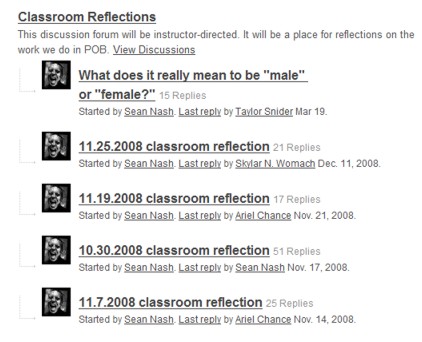
A couple of posts ago I wrote about Thinking and writing about biology, and featured a NING called ‘Principles of biology: bringing life and living things into focus’ created by Sean Nash.  I wanted to show off Sean’s NING because I love the way he teaches biology, incorporating Web 2.0 technologies, critical thinking, creativity, reflection and even poetry. The NING, of course, is perfect for collaborative learning, and brilliant for discussion.

It was a thrill to have Sean comment on my blog, not just as a polite hi, but sharing information about his students and his teaching. It’s worth going back to the post and reading what he says.

What I found most interesting was our little conversation. I had pointed out that Sean’s teaching combined literacy with science.  He commented back:

Science and literacy had certainly better go together. We are in a heap of trouble as a species as it is. We can’t afford to continue to create a scientifically-illiterate populace. Where science and literacy are separate, science is but mystery and mythology to even our brightest.

What happened next really made my day. Two students left comments for me here on my blog.  These comments blew me away; they revealed a love for their learning experiences in Sean’s classes and NING, and an ability to reflect and analyse that our teachers would kill for.

I wanted to post these comments in full because I think they’re worth reading.

Here is what Tori Scott wrote (the bold type is my emphasis)

This is my classes website! I’ve always loved science, but this year was a whole new experience for me. In our class Mr. Nash gives us multiple ways too look at science. There are so many new things to learn that it’s truly fun to experience it in different ways. I came into this class thinking it was going to be him lecturing and us taking notes. This year was the first year that it’s all been so hands on.

This class really makes us think. Mr. Nash will just give us something, for instances a visual, and ask us to write about it. Like what we think it represents and our thoughts and opinions on it. I really enjoy doing this. It allows us as students to share what were thinking. That’s one of my favorite things about the website. Were able discuss and blog about the things we do in class. We each get to share as individuals, which is pretty amazing because each one of us think differently. This also allows us to learn on a completely different level.

I’d have to say that if there is one thing i’ve learned this year would be that science is not black and white. Thats a big misconception i’ve had. Through the year though i’ve began to learn and realize that there is always a gray area. The site gives us the opportunity to talk about it and understand more.

Rachel Huntsman wrote:

I am a student in the dual-credit biology class that uses the blog you have been discussing. I just wanted to let you know my thoughts on our use of the blog.

I really think it is a beneficial way of learning, and would recommend it to any teacher in order to get their students to actually think about learning.

I will admit I was one of the students who took the class just to get this major required science class out of the way before college. However, this coming from a person who really doesn’t enjoy science at all, I have found that I enjoy this class. I feel like I can analyze what I learn and discuss things with other students rather than simply fill out a work sheet and answer test questions.

I honestly think I will retain things from taking this class, and I can say I have benefited a great deal from it.

I also like the idea that other people, such as yourselves, are actually reading this blog and looking at what we are learning and how we are learning. It makes me think about what I will post because I know someone from the other side of the world might read it.

Now, you might have noticed that I’ve recently heard Will Richardson talking about network literacy, passion-based learning, and an authentic readership. Well here it is – an inspiring example of the best kind of learning. It makes a difference when it’s real writing to real people, not just writing what you think your teacher wants and what will get a good mark. As Rachel says, analysing, discussing, learning collectively – not filling out worksheets.

I wish more educators, parents and students could see  how good this kind of learning is. Thankyou Tori and Rachel for sharing and inspiring us.