Category Archives: Education

Don’t bag technology – ask what it means first

I’ve been feeling discouraged lately in my conversations with people about education. Maybe I’ve been talking to a small sample of people, but I’m feeling really peeved at the moment (and it may be because of lack of sleep).

I’m not sure if the endless circular conversation – between those who see the value of technology in education and those who dont’ – is even worth the effort. Yes, I’m not in a very positive frame of mind currently. I don’t find I have the energy or patience to continue, but I still want to reflect on what the problem is.

It’s not a problem that centres on technology at all. It’s a problem that centres around the very human aspect of dialogue. Dialogue which depends on two (or more) people listening to each other and making a real effort to understand what the other person is saying.

I’m sick and tired of entering into a conversation where I’m asked to justify my belief that technology is an important aspect of transformed learning, learning that has to change with the times in order to prepare us all for the way the world works and the way it will work in our students’ future. Most of the time I find that I’m cornered into petty justification because the other person is coming from a personal conviction and will, at all costs, aim to knock me off my beliefs to prove an ultimately negative point. This is not a dialogue. Cornering someone so that they desperately try to stick up for their beliefs while ignoring the larger argument is not dialogue. It radically narrows the scope of information which would otherwise offer a larger, more informative picture.

An example:

Me: I believe that technology offers new possibilities in learning (*very aware that this is a broad and ambiguous statement which needs comprehensive explanation*)

Other: What’s all the hype about technology? Does it really teach ‘them’ anything? Or is it a just a gadget, the latest fad?

Me: Technology offers possibilities for creating and connecting with others.

Other: I know all about that. It’s been proven that kids no longer have personal skills because they are using technology too much.

Me: They are learning the skills of online interaction

Other: I read/saw on TV how dangerous online involvement is, and how it isolates kids, how it takes them into dangerous zones which their parents don’t know about, how bad it is.

Me: You have to look at the real evidence. The media is often one-sided and sensationalises a small part of the picture

Other: But I heard an interview about it and these people are reliable; this information is authoritative.

Me: There are many wonderful connections kids can make to the real world and real people outside the classroom to make learning relevant

Other: (confused look) What are they learning by talking to each other? Is there any academic value?

And then the conversation reverts back to All Things Negative in terms of Any Kind of Change with regard to What Is Considered Sacred about Education, and it’s Sacred because That’s The Way It Was, and That’s The Way It’s Always Been, so all of this new stuff is Bad. We should probably go back to Grammar and stay safe teaching Facts. Numbers, Dates. Like my own education where I studied the Victorian Year Book and copied out fascinating information about how much rainfall and wheat we had in Victoria in  a certain year (the one that had passed). Fascinating facts about sheep and sewerage, I’ll never forget that (except for the facts themselves).

Ok, so now you’ve fully realised how down I am about this argument. I just have to point out that the worst thing about that kind of ‘discussion’ is that you never end up saying what you want to say, but you end up sounding like a crazed evangelist, ready to die for your cause – and I hate that. I’m not a crazed evangelist, I have much more to say and show you if only you would listen. The problem is about listening and wanting to hear, not about technology itself. It’s an age-old problem of failure to listen.

If I had a chance to talk to the ‘other person’ without being pushed into a corner, I would question their negative association with the word ‘technology’. I think this is a wide-reaching association. Technology = computers, dangerous  online involvement, unhealthy focus on what is not real, and therefore what takes you away from real, people-to-people contact.

But technology is also TV. Do you watch TV? Does it stop you from going out of the house? (If so, then it’s your personal problem) Or does it offer a window into the world?

Do you use a telephone? Does it stop you from seeing your friends and family in person? Or does it offer you an opportunity to chat more often in between visits?

All technology!

Yes, it changes the way we live. Some of us held off getting a mobile phone in the early days (we didn’t need it? we’d lived without it), but now we can’t imagine going out without it? Good or bad? It’s something worth investigating more deeply. But it’s here to stay, and it’s technological capacities are growing fast. Change is difficult; some of us jump on the bandwagon and others yell insults at the bandwagon from afar. What we need to remember is that, like it or not, the way we function in the world is changing, and we would be wise to jump on so that we know what we’re dealing with. So that we know what kind of support and education we need to give our kids. So that they’re ready for their world. Are we thinking about this? Are we looking forward or backward?

This morning I followed a link posted by @scmorgan on Twitter which led me to an article on the Edutopia website:

Kids create and critique on social networks.

The first couple of paragraphs grabbed my attention.

In the common conception, kids plus social networking equals an online popularity contest conducted in grammar-free instant-messaging lingo — not exactly an educator’s dream world. But the Chicago-based Digital Youth Network, a digital-literacy program funded by the John D. and Catherine T. MacArthur Foundation, has tapped into the networking phenomenon to encourage creativity and learning.

The Digital Youth Network runs a private Web site called Remix World, which is modeled on popular online social networks such as Facebook and MySpace.

This ning works like Facebook where students can create a space (their page) which is their own style, and where they can post their work and receive feedback from their peers, take part in discussion, and give and receive constructive criticism. Sharing with the class (or other classes) is more engaging because they care more about what their peers have to say than what their teacher has to say, and they want to show what they can do. They develop confidence in themselves when they realise they can help out or contribute to a discussion. It’s all there for the class to see; their contribution amongst everyone else’s. They don’t remain invisible or unheard. They have a place, a voice, a unique style.

When students are motivated to create work that they share online, it ignites an independent learning cycle driven by their ideas and energized by responses from peers.

That’s the theory, but let’s hear it from the kids

Twelve-year-old Jalen (also the subject of an Edutopia video profile) is among those who’ve taken their work to a larger audience on YouTube and elsewhere. “I post online because I don’t want it to just be on my computer, where nobody can see it,” Jalen says of his work, which includes graphic art, videos (both remixed mash-ups and some using original footage), and computer games. “I get positive and negative feedback, but it helps me get better and better,” he says.

“One guy on YouTube told me it was a good video, but the timing was off,” he remembers of one project that got mixed feedback. “So I went back and edited it.”

The article also talks about another student who created his own social network. He didn’t follow a prescriptive set of teacher-created instructions.

“I didn’t learn from anywhere particularly,” Mosea says about creating his network. “I just experimented.”

Experts say that, even more than the digital world in general, collaborative Web 2.0 tools in particular can motivate self-directed learning.

Students creating and publishing online within their own community is the first step to compelling learning, but the deepest learning takes place in the commenting and conversation which follows:

“While the ability to publish and to share is powerful in and of itself, most of the learning occurs in the connections and conversation that occur after we publish,” argues education blogger Will Richardson

Of couse, this kind of learning is not automatic or without its problems. But this is where the teaching part of it comes in. Teacher support is more important than ever for these new experiences to be successful. It’s not a matter of handing over to technology, stepping back and expecting self-directed learning to naturally take place. Nothing could be further from the truth, as teachers who have worked with online networks have discovered.

Researcher Christine Greenhow cautions that the virtual world can also present its own barriers to independent learning. “Students can get easily distracted,” she observes. “There are so many nonlearning paths, so we need to help them stay focused.”

And there’s the rub. If those against technology think that kids just jump in and need no supervision, they’re wrong. Wherever kids are and whatever they do, they need supervision and support. As parents, we shouldn’t leave them to their online activities without taking a real interest in what’s going on – and I don’t mean looking over their shoulders with a critical eye. I mean engaging in conversation where we learn what they’re doing, and why they like doing it. Or even trying some of these things out ourselves. As teachers, we shouldn’t leave them with the laptop and Google, and expect them to navigate a positive and successful learning experience.

To finish, I apologize for my rave – I think it’s something I needed to get off my chest to reduce mounting frustration.

Finally, technology is about the people who use it. Let’s demystify it, let’s try to understand it before we judge it, let’s acknowledge that it’s increasingly the way the world functions, and learn how to make the most of it.

And remember, it’s about the kids

A little while ago I included a post with a video of a heart-warming song sung by 5th graders in New York.

Here’s another one you’ll enjoy

[youtube=http://www.youtube.com/watch?v=h0FPZolbYns]

This choir is testament to one man’s relationship with a regular class of 5th graders in New York, it’s not a music school or selective school:

The PS22 Chorus was formed in the year 2000. We are an ever-changing group of 5th graders from a public elementary school in New York City, NOT a school for the arts or a magnet program.

Read about this teacher/musician and view more videos on his YouTube page.

The PS22 Chorus has a blog documenting their activities with lots more videos to watch.

Watching this video reminded me that it’s really all about the kids. At a time when teachers have been swamped with corrections and report writing, labouring over sentence structure and punctuation, categorising students into cleanly definable spaces, it’s good to remember that it’s really just about the kids themselves. When I look at what this teacher has brought out in these kids, I do a double-take and step back to reflect. How can I keep that important focus without getting side-tracked by the structures. I’d like to remember that the structures are there to support the kids, and not the kids to support the structures.

PS22choir

What does teaching well mean to you?

I was reading Allanah King’s blog, and she had posted a slideshow about ‘Teaching well’ which had been created collaboratively by some of our PLP people. Darren Kuropatwa initiated and coordinated the project in Google Docs.  Here is how he explained it:

WANNA PLAY?
I’m thinking of something that has legs to grow but has a low participation threshold. Something along the lines of
Presentation Tennis. I’ll serve the first ball in the next couple of days. Would anyone be willing to be part of my “seed team” to get the ball rolling? I’m looking for a few good people to help me get the ball rolling. Your commitment to this is very small: 1 slide. Details below …

WHAT WE’LL DO
We will collaboratively create a 20 slide presentation (not counting the title slide) called “Teaching Well”. 20 slides in 10 pairs of contrasts: “Teaching well is more like < slide 1 > than it is like < slide 2 >.” or however else you want to create contrast.

Each day one slide is added to the deck that builds on those that came before. The final 4-6 slides must bring the presentation to some sort of close.

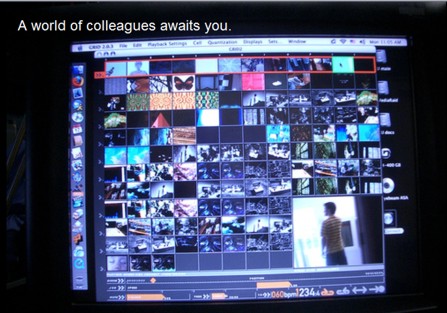
For me, it was a truly satisfying experience which demonstrated the richness of collaboration.  The end result is much greater than each person’s individual contribution.  Here is my slide

teachingwell

And this is the complimentary slide by Susanne Nobles

worldcolleagues

Have a look at the slideshow here. This would be a great collaborative project for both students and teachers, used as a slideshow or even printed off as posters.

Everything is amazing, nobody is happy

Here’s something that made me smile –  the comedian, Louis CK, talks about how we take technology for granted.

[youtube=http://www.youtube.com/watch?v=jETv3NURwLc]

As Louis CK says, ‘those were simpler times’ when we had little of the technological possibilities we have now. I think we’re all guilty of taking new technology for granted. I still remember the dial phone, and yes, the zeros took ages to come back. One of our phones had a dial that used to get stuck and you had to help it back. Bad luck if you wanted to phone in quickly to be first caller for something. There are so many things that have been developed since I was born, it’s embarrassing. My boys find it hard to believe that when I was their age there were no microwaves(at least not in my part of the world). Definitely no mobile phones. We used to think we were lucky that a friend worked for the telephone company and gave us a couple of phones so we could have them in different rooms. When I was in primary school, we were one of the first families in our circle of friends to have a remote control for the TV. Some people would say, why do you need a remote? Why can’t you just get up and change the channel? Who would say that now? I used to think that mobile phones were an unnecessary luxury, and now I have a fit if I’m out without my phone. How happy I was when I used an electric typewriter with a corrector ribbon! How frustrated I am when my webpage takes too long to load.

But, as Louis CK says, we’re quick to get frustrated with technology without giving a thought to how incredible it is. I think that’s human nature. We get used to new technologies so quickly, and we complain about what’s not working, but we don’t often extol the virtues of our machines. Are we basically negative in our perceptions and reactions?

It’s funny to read Top 30 failed technology predictions.  Some of my favourites are:

“There is no reason anyone would want a computer in their home.” — Ken Olson, president, chairman and founder of Digital Equipment Corp. (DEC), maker of big business mainframe computers, arguing against the PC in 1977.

“A rocket will never be able to leave the Earth’s atmosphere.” — New York Times, 1936.

“Flight by machines heavier than air is unpractical (sic) and insignificant, if not utterly impossible.” – Simon Newcomb; The Wright Brothers flew at Kittyhawk 18 months later.

“The energy produced by the breaking down of the atom is a very poor kind of thing. Anyone who expects a source of power from the transformation of these atoms is talking moonshine.” — Ernest Rutherford, shortly after splitting the atom for the first time.

“The cinema is little more than a fad. It’s canned drama. What audiences really want to see is flesh and blood on the stage.” -– Charlie Chaplin, actor, producer, director, and studio founder, 1916

“The Americans have need of the telephone, but we do not. We have plenty of messenger boys.” — Sir William Preece, Chief Engineer, British Post Office, 1878.

“Home Taping Is Killing Music” — A 1980s campaign by the BPI, claiming that people recording music off the radio onto cassette would destroy the music industry.

“Television won’t last. It’s a flash in the pan.” — Mary Somerville, pioneer of radio educational broadcasts, 1948.

Here’s a funny one:

“Rail travel at high speed is not possible because passengers, unable to breathe, would die of asphyxia.” — Dr Dionysys Larder (1793-1859), professor of Natural Philosophy and Astronomy, University College London.

It’s easy for us to laugh at these in retrospect, but what kinds of things are we saying today? I’m particularly interested in critical or sceptical things we say about technology in education. I’m hearing things like

  • we have the intranet so we don’t need to ‘go out’
  • mobile phones have no educational use and should be banned
  • computer games are a waste of time and should be banned
  • social networking, like Facebook, is a waste of time and has no educational value
  • I do all my professional reading in peer-reviewed journals; why would I want to read blogs?
  • Twitter is used by people to say superficial and unnecessary things

When we say these things we are making a major mistake, and that mistake is based on the fact that we are thinking in terms of our world, not the world of  our students, and definitely not the world of the future. Currently in education there is a significant pull away from Web 2.0 technologies. We can’t stop these things by banning them or criticizing them. We can try to understand what draws our students into these applications. What motivates them to create online games, get involved in Second Life, join Flickr groups, write blogs – become engrossed in things outside of school in a way we didn’t think was possible in school. I think that we, as educators, should seriously think about what kind of world our students will be living in once they leave school. Whatever the answer to that is, it won’t be our world.

We should be interested in what young people are doing outside of school because it may help us understand how to engage them at school.

[youtube=http://www.youtube.com/watch?v=0fu4vmiXxwc&feature=player_embedded]

Teach the child

Today I read Steve Shann’s recent blog post which I won’t try and fail to summarise.  I welcomed the introspective, quiet depth of his post. After my recent focus on the promotion of technology – always as a way to enhance learning and teaching – Steve’s anecdotal reflection led me back to the business of teaching young people, which is always about relating to them, and understanding them, awakening their understanding and wonderment. Sometimes we might get lost in perfecting rubrics, we might get stuck on assessment, ticking off technology skills – and then I always feel like something isn’t right, until I come back to what is essential – the kids.

In his post, Steve mentions how he feels about

some of what goes on in our classrooms, with children being made to perform unchildlike tasks, often to please a teacher, parroting back information for which they can see no use and to which they feel no connection.

Then he shows this video

[youtube=http://www.youtube.com/watch?v=f2p5augniQA&feature=player_embedded]

I don’t know about you, but this was one of the most powerful things I’ve seen in a while.  Steve wrote:

I found it deeply moving. As I watched those little faces live the song, I was catapulted back in time over 55 years ago when, as a very young child, the world was a place of heart-quickening wonder.

It’s good to see something like that and be reminded that we are teaching young people, not curriculum, not to the test or the marks. I’d like to believe that if we hold onto that, and when we inspire learning in our students, that they’ll follow through with the rest.

Steve’s post was about much more than this, and I recommend you read the whole thing.

16 habits of highly creative people

Most people would deny being creative. Have you noticed that? People who display obvious creativity, but who say, ‘Who me? I’m not creative!’  It’s the strange fallacy that in order to be creative you have to be good at drawing or play an instrument like a prodigy.

Ken Robinson talks about creativity. I’ve written previously about his TED talk and his book, The element. He has also written a paper entitled Creativity in the classroom, innovation in the workplace. in response to the following question:

What should be the role of business and industry in the education of today’s youth, and what strategies can realistically be put in place by business now to foster innovation on the widest possible range of platforms?

Ken begins by saying the following:

Businesses everywhere have to compete in a world that’s changing faster than ever. To keep pace they need people who can consistently generate new ideas and adapt to constant change. Many companies say it’s getting harder to find these people. One of the major reasons is education. All over the world, formal education systematically suppresses creative thinking and flexibility. National strategies to raise standards in education are making matters worse because they’re rooted in an old model of economic development and a narrow view of intelligence. For economic, cultural and political reasons, creativity should be promoted systematically at all levels of education, alongside literacy and numeracy.

According to Ken, the problem in the workplace is not a shortage of graduates, but something entirely different:

Companies now face an unusual crisis in graduate recruitment. It’s not that there aren’t enough graduates to go around, it’s that too many of them can’t communicate, work in teams or think creatively.

 Shalu Wasu, a Singapore-based trainer and consultant,  conducts open programs on Creativity and Innovation and Blogging for Business at NUS extension. He offers 16 habits of highly creative people on the Tickled by life website.

1. Creative people are full of curiosity.

2. Creative people are problem-friendly.

3. Creative people value their ideas.

4. Creative people embrace challenges.

5. Creative people are full of enthusiasm.

6. Creative people are persistent.

7. Creative people are perennially dissatisfied.

8. Creative people are optimists.

9. Creative people make positive Judgment.

10. Creative people go for the big kill.

11. Creative people are prepared to stick it out.

12. Creative people do not fall in love with an idea.

13. Creative people recognize the environment in which they are most creative.

14. Creative people are good at reframing any situation.

15. Creative people are friends with the unexpected.

 16. Creative people are not afraid of failures.

Read the full article here.

If, as Ken Robinson says, creativity will be most sought after in work of our students’ future, then what implications does this have for education? Are the above habits of creative people skills that are teachable? One thing that is certain is that none of the habits are tied to measurable content, which is the weight of our present curriculum. Obviously, knowledge of content is necessary for any profession, but it may not be enough to succeed. If you want to be a driving force in any job, you may have to acquire some of the creative habits.

I like #14: Creative people are good at reframing any situation

Reframes are a different way of looking at things. Being able to reframe experiences and situations is a very powerful skill.

Reframing allows you to look at a situation from a different angle. It is like another camera angle in a football match. And a different view has the power to change your entire perception of the situation.

Reframing can breathe new life into dead situations. It can motivate demoralized teams. It helps you to spot opportunities that you would have otherwise missed.

If looking at things from different perspectives is an aspect of creativity, then in order to develop creativity in students, the method of teaching should allow for these different perspectives. There are teachers of English, Mathematics, Science, and other subjects, whose teaching is based on encouraging different perspectives. Do they realise how important this is? Or do they do it simply because it’s the way they think? Think on, we need more teachers like these!

 How would you design a curriculum that developed these habits of creativity?

I’ll finish this post with the quote at the conclusion of Ken Robinson’s paper:

It’s often said that education is the key to the future. It is. But a key can be turned in two directions. Turn it one way and you lock resources away: turn it another and you release them. In education as in business, it’s no longer enough to read, write and calculate. We won’t survive the future simply by doing better what we have done in the past. In the future, we must learn to be creative.

Learning is a waste of time?

A day of conversations.

Good to record these and then reflect and analyse.

Firstly, a conversation with a Year 7 student who was ‘unable’ to do any work during English class because his laptop wasn’t working (note: he managed to remain undetected for most of the writing session before we realised, and then his visit to the computer centre was uneventful because he forgot to take the obligatory note, and the second visit left him without a computer until the end of the day). During our conversation, I told him that he should put the session down to valuable life lessons – taking the initiative to solve the problems instead of sitting aimlessly and wasting time, etc. – and he said these lessons were irrelevant because he was going to change schools the following year anyway. (My eyebrows raised involuntarily). He continued: the new school didn’t have a laptop program until the senior  years, and all his problems would be gone. What problems? You know, internet not working, things disappearing. He would get more work done. So, after a respectful pause, I asked him what he thought his future life of work would be like, wouldn’t it include functioning with technology? With all its glitches? And he would have to continue to problem-solve because there would always be problems? Yes, he agreed, but in the meantime he’d get more work done at school without the technology. It would all be in the book; easy to find and keep. (Has he heard of the technicality of losing the book?)

Hmm…

Get more work done…

Funny he should say that. Later in the day we had a meeting of the teachers involved in the Year 8 immersive project (mentioned in previous posts). I was late to the meeting, and I came in at the point where  groups of teachers were doing a post mortem on the project. The group I veered towards was engaged in passionate discourse, expressing negative views. There were too many points to remember them all, but the gist of it was that the big picture week-long, student-driven project didn’t work and was a waste of time. A waste of time because it took time away from the real work that had to be taught.  If it weren’t for the project, they would have ‘got more work done’. Work that was valuable.

Hmmm…

I ventured to say (I never learn, do I?) that all the problems and difficulties expressed were part of the teachers’ learning process, and that a collective discussion of these would result in a very different project next time – properly scaffolded, rubric based not on theory but on specific skills and capabilities demonstrated (or not) during the course of the project. The need to provide consistency throughout the different classes, the need to maintain seamless transfer between teachers, to deconstruct the questions at the beginning, to check for understanding, to get feedback from students on each day’s progress, etc. – all these observations I thought were valuable reflections, driving the discussion towards collective analysis and future improvement. But what I viewed as positive, some viewed as evidence that the project was a waste of time. The project took valuable time away from real work.

Interesting….

Not entirely surprising, though. I think you have to expect the initial digging in of heels, the panic and confusion when things are not spelled out, when teachers are just as much learners as the students, when stepping out onto unchartered territory. I can’t say that I”m not uncomfortable in new situations – of course I am. But if at least half of the teachers see the positive elements of the project, the rationale behind passion-based, student-driven, enquiry-based learning, then I hope that the scales will tip in favour of trying this out a second time. View this as a first draft, and collaborate towards an improved second draft.

Hopefully…

And please, consider the definition of ‘work’. Think about what it means to ‘get something done’. Or maybe you’d rather refocus on ‘learning process’ and navigate your learning  instead of getting it done.

Any thoughts?

The rules of school, or what is worth knowing?

It’s a great day when I discover a great blog, or, should I say, a person whose writing reveals someone I would love to meet. Just yesterday I came across Steve Shann’s blog, Birds fly, fish swim, and I don’t think I’ll be able to read anything else until I finish reading his posts.

In his post today, Steve describes what happened when he blasted his Year 11 students for not taking their writing responsibilities seriously on the class ning. The responses that followed in the ning were surprising (to me, at least) and revelatory. Here’s what one student (eloquently) said in this post entitled ‘Play the game’:

…in Years 11 and 12, it’s barely even about the learning at all. … In most subjects, we learn how to pass the exams… how to structure an essay, how to deliver a speech the way they want it, etc. School is all about how you play the game these days. It’s all about doing what you can to get an A, regardless of what you’re learning. … And I guess it does teach you stuff about the real world. Teaches you to try to beat the system, that menial busywork sometimes is what you need to do to do well in life, and, most importantly, no matter how much you hate your job, the best revenge is success.
I don’t think this is what the people who planned this school system had in mind. I guess those guys at the Board of Studies think that the system as it stands is a genuine attempt to educate kids in the subjects they selected for us. Simply put, they’re wrong.
…The reason why we (I) am having trouble with this course at times is because I have been trained to think like that. I do what I can to do well in the HSC. And I think some others in the class (although they may not know it) think the same way. Blogs aren’t marked, so I don’t do them; projects require organised creativity as opposed to just knowing shit, and suddenly I’m confused; Dr. Shann asks for dedication to the course but he can’t put a date or a number on it, so we just don’t try, et cetera, et cetera. 

I’ve already vented my dislike of teaching to the test, so I won’t say it again. Instead I’ll pull the same paragraph out of Greg Thompson’s post on his blog, Constructing meaning, as Steve did. Only I’ll include a little more of it because I think it’s worth the read:

Standardized textbooks work nicely for standardized testing. However, they do not do much for the idea that life is a big picture. Integration of content into a whole is hard work. It is far easier to teach a fractured curriculum because the result demanded is a standardized test that seeks the ability to see myopically, one subject at a time. Dr. McLeod is correct. This fractured approach has long been the model for education. The assembly line reality of the industrial age required each worker to do one thing and to do it well. Employee A did not need to know what Employee B did to complete their task five feet further down the line. That worked. Today, standardized testing requires each student to know how to do each thing in exactly the same way in order to produce the same product. The world they live in however, requires them to see the integrated picture. The test does not fit with reality.

I really do think that we must keep in mind the integrated picture when we teach, but it’s not going to happen unless we move things around in our education system, and in the way our classes and curriculum are structured. I can’t blame Steve’s students for not doing anything that falls outside of what is required for the final testing in year 12. Sometimes, when I talk to teachers about changing the way they teach, trying something new or integrating technologies into their curriculum to promote engagement and creativity, they will take on the challenge in the middle years, but the final 2 years of school really are devoted solely to the teaching of content that will get students their final ENTER score. If I were teaching senior years, I’d be torn between feeling responsible for students’ final scores, and wanting to  teach skills relevant to the world they were just about to jump into. It’s no doubt possible to do a bit of both, but I don’t think it’s easy, especially when students have been so carefully prepared for the test-readiness game.

Steve closes his post on a positive note. He quotes a student’s reflection which gives hope to teachers looking for evidence of a yearning for learning beyond the test.

English Extension and Studies of Religion are the only classes that allow us to be creative and have a relaxed teaching style that is more about us becoming educated, reflective, well-rounded individuals (if you’ve seen ‘The History Boys’, that is exactly what I’m talking about).

So what I’m saying is, give us a prod every now and then like you did today, because we are trying to untrain ourselves from what we know, or at least I am.

I hope that most students, deep-down, will want their schooling to help them become ‘educated, reflective, well-rounded individuals’, and not only young people whose formative years are summarised and evaluated in the one final ENTER score.

Our own process

I’ve been talking a lot about process in the learning journey, so it’s a little surprising that process has flown out the window for me in my conception of what our team is doing for the PLP (Powerful Learning Practice) project.

Tonight the Australian teams had a live meeting with Sheryl Nussbaum-Beach, and I decided to cast aside the old familiar feeling of being seen as the idiot in asking a question, a question which I probably should not have been asking so far into the session, but one which I was certainly glad I asked.

21st century learning is the theme for schools involved in the PLP learning journey, and each school presents their 21st century project to the entire cohort. I must say, I’m a little apprehensive (so what’s new?) about our project, as I explained during our Elluminate meeting tonight. Yes, we’re creating a ning, and the ning will be testament to what we’ve done using Web 2.o technologies, and to ways we’ve enhanced teaching and learning in the school. As I said to Sheryl and others, I don’t know if that’s enough. Maybe we’re just putting up disjointed projects, and we need a unifying one. Is the ning this unification? Do we need connections outside of the school?

Sheryl’s answer was loud and clear (and I had trouble keeping up with my notetaking, but it doesn’t matter because the session was recorded). She said that the project was not the ning, and we should stop thinking about it as the ning. The project is about the learning. It’s about what we are trying to change and accomplish in our school community, whether that ‘s building community, creating an awareness of 21st century learning, helping start conversations, etc.

It’s about the big goal.  We need to look and see what others have done, then work on developing a comprehensive action plan. Our team should be having regular discussions about how to manage change, and we should be looking at strong evaluation at the end of the journey. Have we accomplished what we set out to do? The success or lack of success is not the aim of the project, it’s the evaluation. Haven’t I been saying this to students all this time? I need to remember that I’m a learner first, and teacher second.

How will we prove mastery? Will we use computer-mediated analysis? Could we, for example, look at blog posts for evidence of teacher discussion? Could we track/count how many times people have posted? How are we going to measure our big picture project?

We need evidence of change and successes in the way teaching and learning happens in our school. We need to be able to show the principal and school leaders evidence and examples of how we’ve grown, how much we’ve shifted, and what we still want to do.

At the moment, I feel that we are still treading water. Good things are happening around the school, but we are yet to come together and have a deeper conversation. We are yet to fuse. I’d like to have more discussions, not just with individuals, but with the whole team. This is part of the process. Realising what isn’t happening, what needs to happen, is part of it. Our last meeting was productive, and we need to do that more often. It’s not easy, but it should be a priority.

Having thought about this overnight, I think we should focus on what we always tell our students –  QUESTIONS.  Too quickly we run to embrace answers, to set things in stone, convince ourselves we’re there. Questioning broadens the scope of our vision, helps to unpack and redefine.

As for me, I’m hoping that my lack of clarity at this point is a good sign that I’m still on the way.

Ever felt you’re waiting for the click?

Design a teacher education program

Jayson Richardson, an assistant professor in the Department of Educational Leadership, University of North Carolina-Wilmington, wrote an interesting post, Rethinking teacher preparation, on the ‘Education Futures’ website.  He said:

Let your mind wonder for just a moment. As yourself this question: If I could redesign an entire teacher education program, what would it look like?

Here is my vision of a teacher education program. I imagine a teacher preparation program that:

  • Challenges the individual. No one in this program would say “But I thought getting an education degree was easy!”
  • Is rigorous enough to attract intellectual, innovative, thought-leaders
  • Robustly develops a student’s ability to solve problem, become a critical thinker, and work collaboratively.
  • Is packed with upper level courses in history, ethics, mathematics, law, economics, policy, research, engineering, biology, anatomy, chemistry, and computer sciences (just to name a few).
  • Is academically challenging so that becoming a educator is professionalized at the level of doctors, lawyers, MBAs, etc.
  • Stresses global, national, and local issues. Students would not only understand where Cambodia is, but have some understanding of its politics, culture, history, and relationship to the rest of the world.
  • Mandates each student study abroad.
  • Mandates the individual gain proficiency in a foreign language.
  • Forces the pre-teacher to act on the tenants of social justice and peace education. This individual would be a skilled conflict mediator.
  • Produces teachers who are intercultural leaders.

How many of these points would you agree with? I wonder how many of these points are currently taught in teacher education programs?

I like the point about student teachers developing the ‘ability to solve problems, become a critical thinker, and work collaboratively.’ If we consider these skills important for our students, then we ought to do the same as teachers. Ideally, school programs and timetables should support teachers getting together, brainstorming ideas, solving problems and pooling their skills, knowledge and talents. Yes, we have teacher meetings, but how much of this time is taken up by the practical aspects of our work, and how much is devoted to a discussion of ideas, even just reflection about teaching experiences, what worked and what didn’t?

Although I don’t think overseas travel could ever become mandatory unless it was subsidised (yeah, right…), I do think we should stretch out to the world as much as we can. It’s easy to become isolated in Australia, and with tools such as Skype, blogging, Twitter, etc., it’s easy to make global connections, both for our own professional development (hey, that sounds formal and boring – for our own enjoyment!) and for the extension of our students’ experiences.

Which of these points do you consider important for teacher education?

What else would you add to this list?