Category Archives: Education

Images4Education

I’ve joined the Images4Education group on flickr.
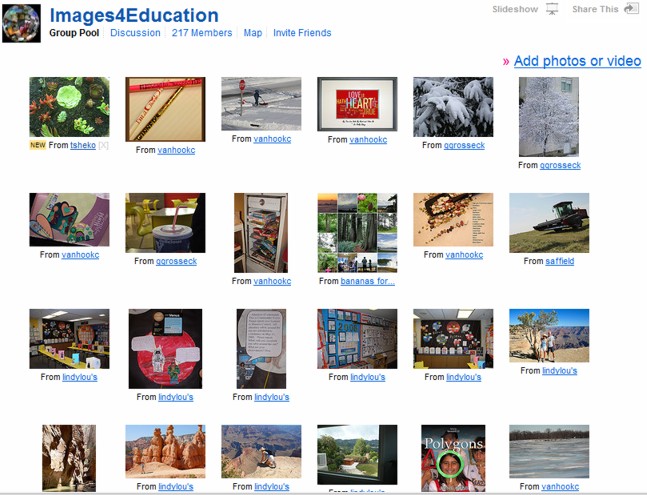
images4education


Like all photo groups, the collaboration and community is fantastic, but there’s the added focus on education. There’s something satisfying about using images that have a story or explanation, images that come from real people that we can communicate with. It’s easy to check permission and always possible to contact people for permission of use when you’ve added them as a flickr contact.

What’s even better is the NING supporting Images4Education.

One of the administators of this group, Carla Arena, offers 3 supportive offshoots:

a NING group

a wiki

a flickr-related discussion for the group

Shame that I’ve been too busy to participate in the 6-week online workshop focussing on using images in education.

In this six-week online workshop offered through the Electronic Village Online, participants will be introduced to various online image manipulation tools and will learn how to effectively incorporate these resources into their teaching practices. They will explore how images can be used in educational settings for photo sharing, storytelling, slideshows and comics creation, as well as understand how Creative Commons licensing can be beneficial for classroom use.  By the end of the workshop, participants will have the chance to develop a plan to begin incorporating digital production into their lesson plans.

All is not lost, as browsing through the NING will attest to. Blog posts, discussions, photos and videos are some of the treats in store for you here.

Currently the focus is on digital storytelling.  Members share their stories and links to their presentations. Sometimes a favourite book is recommended, for example, 99 ways to tell a story, and sometimes favourite tools will be reviewed or showcased, such as Capzles or other tools.

What may seem like a trivial theme always turns out to be a fascinating learning experience. A good example is ‘What’s on your table. A gastronomic view of our group’.  Scroll through this page and you’ll learn about cultures and customs through colourful photos of food and get-togethers.
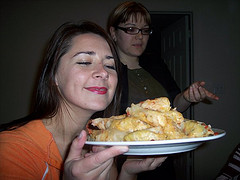
moldovancabbagerolls

 Some of the images are clickable and take you to a page with information about the picture.

Here’s a photo with everything on my plate (yes, I know! I’ll have to exercise the whole month after this gastronomic orgy!). We put the Feijoada over the white rice, eat the oranges and the collard greens. Some put the fried plantains with the rice and beans.On this photo, you cannot see the fried yuca and the cassava flour which are also very traditional side dishes to the Feijoada. You have to try it! It’s irresistible. Even better with cold beer or Caipirinhas, our national drink made of lime. 

The NING has excellent groups such as one dealing with everything you need to know about using flickr, or everything you need to know about Creative Commons.

There’s a slideshows group, a Moodle tools group (which I’m yet to investigate), and a lesson plans group.

I usually zoom in on the discussion forum for ideas and links.
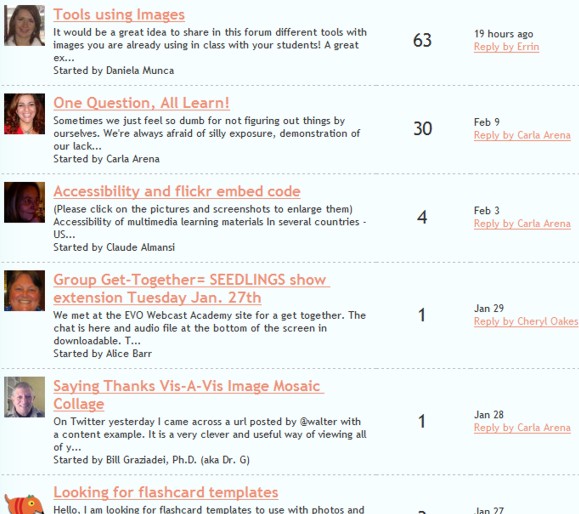
forumimages4

The best way to discover what else is available is to have a look for yourself. Images really are a wonderful way to engage learners and use creative teaching methods. There’s more to it than meets the eye!

I’m not good at maths but I could be

googleearthlessons


As I’ve said already, I’m not good at maths but I think I could be. I get the feeling that my learning style wasn’t catered for in the maths classroom. Something like Real World Math might have done the trick.

What a great way to take maths out of the textbook and into the real wide world. Google Earth’s satellite views of the earth and the interactive 3D environment allow users to add placemarks, annotations, photos and models, as well as measure distances and draw paths.

Within this site you will find lesson ideas, examples, and downloads for mathematics that embrace active learning, constructivism, and project-based learning while remaining true to the standards.  The initial focus will be for grades 5 and up, but teachers of younger students may be able to find some uses or inspiration from the site.  Higher level thinking skills, such as analysis, synthesis, and creativity are encouraged as well as technology skills and social learning.  The scope of this site is mathematics, but many lessons lend themselves to interdisciplinary activities also. 

 Higher level thinking skills, creativity, technology, social learning, and potential for interdisciplinary activities! Just what we need for our students today.

The site has separate areas: the Lessons page; the Community page; the Update page; and the Resource page.

The Lessons are grouped into 4 categories: Concept Lessons, Project-Based Learning, Exploratory, and Measurement.

The Community page is a strong point enabling collaboration and communication amongst users. In my opinion, that’s the drawcard of technology in education.

The other two pages are self-explanatory.

Thomas J. Petra, the author of the site, says this:

Math teachers are always searching for meaningful, practical math lessons that engage their students.  I hope this site is useful to you and that your students learn real world math.computingwithscientificnotation

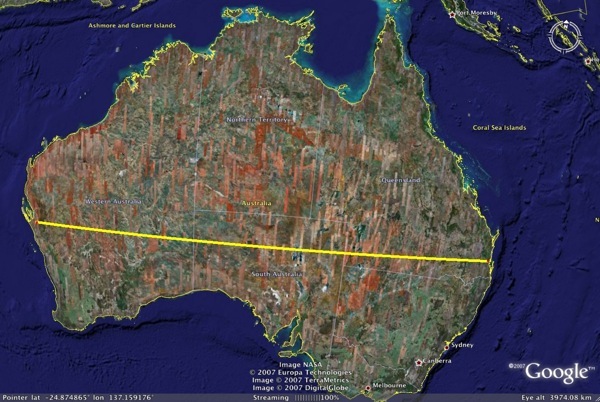
 An example of a lesson is ‘Computing with scientific notation’; here’s an extract of the instructions:


How long would it take to walk across Australia?  This lesson enables students to jump, walk, and crawl around the world without breaking a sweat.  The featured concept of this lesson is computing with scientific notation, but it also involves the distance formula, and measurement. 

In the left-hand navigation, you’ll see concepts used and grade level, eg.

Concepts used: Scientific Notation, Measurement, Rates, Algebra, Distance formula, Problem Solving

Grade level: Grades 7-9

When I clicked on the Community page I discovered it had been moved out onto a blog due to technical difficulties. The RealWorldMath Community blog provides a place for commenting, suggestions, feedback and lesson submissions.

I’m impressed with Real World Math and think it’s a rich educational resource for mathematics. If this was on the agenda in the Maths classroom, I might even give Maths another go.


Go underwater with Google Earth 5.0

Google Earth 5.0 has 2 new features. The first allows you to go back in time. You can go back in time to compare historical imagery of buildings, and you can compare historical photos of environmental features. observing changes to the landscape of our planet. The former will be of interest to history teachers, and the latter  to science teachers who will be able to use Google Earth to show students how climate change is affecting the Earth’s surface. What better way of learning than seeing for yourself.

This new application opens up exciting possibilities. When you click on the clock icon in the Google Earth 5.0 toolbar, the historical imagery time slider will appear and allow you to change your view to older imagery.

The Google Earth site includes a video which gives one of the examples of historic imagery, showing the  transformation of sports arenas in Philadelphia.

[youtube=http://www.youtube.com/watch?v=acKMplVeY6A&eurl=http://google-latlong.blogspot.com/&feature=player_embedded]


The Google Earth blog explains its exploration underwater:

But starting today we have a much more detailed bathymetric map (the ocean floor), so you can actually drop below the surface and explore the nooks and crannies of the seafloor in 3D. While you’re there you can explore thousands of data points including videos and images of ocean life, details on the best surf spots, logs of real ocean expeditions, and much more.

I believe this about learning…

‘map of Romania’ photo by ggrosseck on flickr


…students do not come in one-size-fits-all packages and should be treated as individuals who deserve to be stretched

…no matter what their level of learning, a student’s work is enhanced when their parents are involved in the learning process

…the experiences of students are important aspects of learning and should be incorporated in the classroom as possible

…students live up to the expectations given them by their parents, school and their community; if a student is expected to succeed he or she will

…every student has the capacity to reshape the world; they must be guided to making their impression a positive one

…students should learn by investigating the world and issues that surround them in fun and creative ways

…learning should be an  interesting and useful process

…what happens to students beyond the classroom is as important as what is contained in it

…every student deserves an opportunity to succeed

…the highest goal of education is to teach students to reason and think for themselves

...students should be taught and engaged in such a way that they fall in love with learning


Tonia Johnson posted her beliefs for learning on her wiki for Adams City High School. They gave me the opportunity to reflect on what initially may seem obvious and unoriginal, but at second glance are actually deep and essential aspects of learning. I started to think about how much of the teaching and learning at our school corresponds to these beliefs; how much my own practices support these beliefs.

Is there one introductory belief that forms a basis for further good teaching practices, or are they intertwined and shoot off each other?

I would really like some feedback from you about which of these beliefs you consider most important and why, and if you can add to this list.

Essential to good teaching practice, in my experience, is taking the time to reflect and critically evaluate what you are doing as an educator. Now that the new school year is starting, I can see how easy it will be to fall into the busy and relentless schedule of weeks and terms without taking time out to breathe or blink. I think we need to make a time to reflect, just as we deliberately schedule appointments to the dentist. Yes, it is sometimes an appointment we don’t feel like keeping.

Blogging (for those of you who continue to argue with me against it) is always a discipline that provides a regular time for reflection and evaluation. Amidst defensive cries of ‘haven’t got the time, too busy’, I stubbornly insist that time must be made. It’s worth it.


What does learning and teaching look like for me in 2009?

photo by aussiegall

Paul C of Quoteflections tagged me in a meme which goes a little like this:

What is the focus of learning for you in 2009?

What are the important new things you are teaching ?

In her meme, Joyce Valenza wrote

The landscape continues to shift and that means reinterpreting our standards for emerging tools, issues, and innovations. 

 The landscape is shifting and my own landscape is too.

 Here are 5 things I would like to focus on in teaching and learning this year.

1. Collaboration:

I’d like to focus on collaborative learning – encouraging students to learn from each other. I’m working on wikis for art and English, as well as a fiction blog, and this year I hope to bring the school community into it. I’d like these tools not to belong to me, but to be shaped by the whole community.

2. Global connections:

It would be good to break out of the metaphoric echo chamber this year. I’d like my learning and teaching to connect to people outside of the classroom, whether it be another class, another school, a different country or culture. I envisage using things like Voicethread to share ideas and opinions, commenting in blogs to build personal learning networks, and possibly Skype for author talks.

3. Picture it:

With the explosion of visual media, I’d like to think more visually and encourage students to do so. My teaching will expand the concept of literacy. I’m talking about focusing on visual literacy, learning to deconstruct images, creating visually, and exploring multiple layers of meaning in  images. Students are comfortable with imagery but  need to learn to use and manage visual images metacognitively.

I’d like to involve students in Flickr – putting pictures up, browsing the vast archive of flickr images, understanding Creative Commons, favouriting photos, connecting to others by commenting on their photos, participating in a photo project. I’d like to continue to show students visual search engines, such as Viewzi and SearchMe, and I’m pretty sure that similar search engines will continue to evolve.

4. Thinking!

In this changing landscape where learners need to be discerning and critical, there’s an ongoing need to focus on critical thinking. Not cramming content, memorising material or copying and pasting. Making kids think, question, debate, disagree, compare, synthesise, rethink.

5. The learning process

I’d like students to understand the learning process.

I will be constantly saying: don’t be afraid of making mistakes; that’s how you learn. Don’t be alarmed if something is difficult; it’s part of the process. Don’t give up, but push ahead. Don’t settle for what comes easily, take the challenge and go with what’s hard. Move out of your comfort zone. Know the fluctuation of emotions during the research process. Go with the flow. Learn something real.

That just about wraps it up. My learning and teaching goals for 2009. It’s good to make yourself write them down. Here they are, right in front of me, and I can come back to them at the end of the year to evaluate my progress.

Just realised (a day later) that I have to tag people for the meme. Ok, the following people are tagged; let me know if you’ve already done this and I’ll change my tag list.

Darren Kuropatwa

Frances Manning

Jenny Luca

Judy O’Connell

Jennifer Clark Evans

The world is talking; are you listening?

globalvoices

Global Voices aggregates, curates, and amplifies the global conversation online – shining light on places and people other media often ignore

At the moment the special coverage reports on Gaza strip bombings, Thailand protests 2008, Google street view arriving in Japan, and more.

I’m always looking to expand the often selective media coverage on mainstream news services.

A map at the top right of the screen changes its focus on different countries; you can click on the country to reveal how many news articles and links are available for the current day. Today in Kazakhstan there are 3 articles and 11 links available.

There are offshoots of this website including Rising Voices which

aims to extend the benefits and reach of citizen media by connecting online media activists around the world and supporting their best ideas.

This section includes project updates, Delicious links, videos and flickr photos;

Global Voices: Advocacy – Defending free speech online;

Voices without votes –

Voices without Votes opens a window on what non-Americans are saying in blogs and citizen media about US foreign policy and the 2008 presidential elections

 This site is easy to navigate with a search option or browsing option within countries, topics and authors.

I think this would be a valuable teaching resource. Worth noting is the Creative  Commons Attribution 2.5 License with ‘some rights reserved’ at the bottom of the page.

Please let me know what you think, and how you can envisage using this resource in the classroom.

Rethinking young people, rethinking ourselves

schoolkids

Photo taken by Chris Suderman

In his book Through the children’s gate, Adam Gopnik said this about children:

Children reconnect us to romance. For children, … every day is the first day of love: The passions that for us grown-ups rise and fall only in exceptional circumstances, unexpected storms on the dull normal beach where the tide breaks unchangingly, rise every day for them. Shock, hatred, infatuation: “I hate you,” they cry, slamming the door, and they mean it; and then the door opens fifteen minutes later for dessert. They compel us to see the world as an unusual place again. Sharing a life with them is like sharing a life with lovers, explorers, scientists, pirates, poets. It makes for interesting mornings.

I like this quotation for a few reasons. Firstly, to remind me of the passionate and immediate nature of young people. If at school they seem indifferent, apathetic, unengaged, then we need to ask ourselves why. We look to ourselves and what we are doing as teachers to make them behave in a way which is actually contrary to their nature.

Secondly, this passage tells me what we can gain from being with young people, what we can learn from them. Our role as teachers is not to ‘teach’ them in the sense of pouring into them what we know better, it is to listen, to bring out, to – with time, the time it takes to know a person – understand where their interests lie, what their passions are, how we can harness their dreams to educational opportunities. We provide the environment, teach skills, encourage and guide, but we work with the unknown – the unknown possibilities of what each young person is yet to create, to achieve.

As I think about returning to school soon, starting along that well worn cyclical path again, I’m gathering together the technology tools that I look forward to using with students, but I’m not thinking about the technology – I’m thinking about the process, the learning and teaching process that will take place. This year I’d like to focus on providing learning experiences which are from people, from communities, learning not from static texts but from living, thinking people – some from other hemispheres – from conversations, comparisons, real discoveries. I’m hoping that this year’s learning will not come solely from one teacher. The net will be cast wide. What treasures will be collected in the net?

The 365 photos challenge

cimg5757


Seems people are taking up the 365 photos challenge on flickr – committing to posting one photo per day for a whole year. Why, you ask? Well, that’s what I asked myself too. Why would you want to commit to more tasks on top of the already toppling mountain of daily tasks?  In my usual contradictory way (contradicting myself usually) I found myself joining 3 of these groups which just means I upload the same photo a day to each of these groups. Just in case I miss out on the interesting photos, since different people will be found in each of the groups. The 3 groups are Twitter 365 project; 2009/365photos; 365/2009.

Just today I followed Jo McLeay’s lead and decided to give my 365 photostream a home, so here’s the link to my new blog. If you look at the twelve days of photos, you’ll realise why I’ve been absent from blogging for so long – lots of things to do in the physical world.

Just a few thoughts. As usual. Apart from the fun factor, I think this kind of project has some promising educational possibilties.  Getting to know people in your personal learning network through photos and others’ comments is different to knowing them through text comments only. It adds a personal dimension, and the comments don’t have to be cerebral. I imagine the end result will be an interesting testament to my year – memories I may have otherwise forgotten.

I can imagine this as a class project, can’t you? Maybe one which includes teachers, and gives students an insight into teachers outside of the classroom.

A limerick for all occasions, but in a dictionary?

spaceodyssey

In the spirit of holidays, I thought I’d tone down the intensity of my posts – seriousness interfering with the holiday spirit…

Reading through Articulate, I found The Omnificent English Dictionary In Limerick Form (OEDILF).

The goal of The OEDILF, our online limerictionary, is to write at least one limerick for each and every meaning of each and every word in the English language. Our best limericks will clearly define their words in a humorous or interesting way, although some may provide more entertainment than definition, or vice versa.

Look up a word, browse by author or topic/genre, or join the project to submit original limericks.

There’s an impressive list of topics/genres.

Here’s an example of what you’ll find:

If you look up the word anticlimactic, you find this limerick:

In picking up women, my tactic?

I promise adventures galactic

We watch Lost in space

When we’re back at my place

Which they find to be anticlimactic


Here is one result for genres: science fiction:  

asphyxiate by mephistopheles (Limerick #8004)

Though you’re weightless and moving with grace,

You’ll asphyxiate here, out in space.

Is your very best pal

a computer named Hal?

You could die here and leave not a trace.


And some background is included:  In Stanley Kubrick’s classic 1968 film, 2001, a Space Odyssey, an astronaut, Dave, was famously locked out of the spaceship by a malfunctioning computer named Hal. If Dave had not succeeded in getting back onto the ship, he would have died when he ran out of air.

Lots of possibilties with this dictionary, both educational and recreational. For the sake of holidays I’ll abstain from the usual heavy-handed instructions.

One more under ‘ballet’

Her willowy arms flutter slightly,
Her feathered white head drops down lightly.
Alas for Odette,
Men who love soon forget.
Thus, she’s dying in Swan Lake once nightly.
…Except on Mondays, and twice on matinees.

There.

Winding down

2487518879_ca2e8f3642

The school year is over for me. I know that many poor souls are still fronting up until the end of this week (is there a point?) but for me it’s the long stretch ahead, the one I’ve been waiting for. Time to wind down.

It’s been a strange end to the year for me in that I missed the last 4 days, and am now recovering from spectacular oral surgery, looking less like a hamster every day, and still turning sickly shades of yellow and blue (wish I had less yellow, more blue) down my face and neck. And now that the fear of losing feeling in the lip has been put to rest, I can think about the year, looking both back in time at events and learning, and forward to next year, planning new projects for 2009.

Funny how you don’t realise the extent of change until you stop to measure it. It was only May this year that I began this blog as part of a State Library of Victoria Web 2.0 PD initiative. During the course of the following 6 or so months I’ve learned many things – lots of how-tos and bits of technology – and I’ve acquired an online presence on Facebook, Twitter and NINGs.  Most  importantly, I’ve learned what it’s like to be part of a community of learners and educators, a community that never sleeps, always on the lookout for new ways of thinking, doing and sharing.


So, winding down…

Well, actually, it’s easier said than done. I know that I’m not as tired as many teachers, having escaped report writing (as a teacher librarian), and not having the exhausting face-to-face of constant classes, and that may be one of the reasons I’m not finding the winding down easy to do. Although, I think the main reason is the feeling of excitement which comes from new discoveries, possibilities and connections. Already I’m thinking about what I want to do next year (and I’m lucky to be co-teaching with two wonderful teachers), already I’m planning new ways of doing things in class, ways of engaging and challenging students, using technologies which will inspire creativity and authentic learning. And I’m reading, reading, reading other people’s ideas and experiences.

The best thing about holidays – if you still have any energy or brain capacity left, and amongst all the Christmas and New Year bustle – is the unregimented  time for exploration. The joy of investigating new blogs,  discovering people, and making connections, branching out and connecting those connections around the world, until gradually the world starts to shrink as your map is filled with people you know  and relationships amongst these. How can you wind down when people ‘out there’ are posting great links, new ideas and articles which inspire and challenge?

Yesterday, I started looking at the Edublogs Awards 2008, and here are the categories for nomination:

1. Best individual blog

2. Best group blog

3. Best new blog

4. Best resource sharing blog

5. Most influential blog post

6. Best teacher blog

7. Best librarian / library blog

8. Best educational tech support blog

9. Best elearning / corporate education blog

10. Best educational use of audio

11. Best educational use of video / visual

12. Best educational wiki

13. Best educational use of a social networking service

14. Best educational use of a virtual world

15. Best class blog

16. Lifetime achievement

As you  browse those 16 categories, you’ll come to know a group of people you’ll admire and want to keep in touch with. These people have spent the time making transparent their learning journeys and acquired skills, not keeping these things to themselves but sharing with the world. I’m having difficulty in unwinding because there’s so much to read and enjoy!

Merry Christmas to all. Happy, safe holidays, good family and friend times, and take the time to do what nourishes you.