What does teaching well mean to you?

I was reading Allanah King’s blog, and she had posted a slideshow about ‘Teaching well’ which had been created collaboratively by some of our PLP people. Darren Kuropatwa initiated and coordinated the project in Google Docs.  Here is how he explained it:

WANNA PLAY?
I’m thinking of something that has legs to grow but has a low participation threshold. Something along the lines of
Presentation Tennis. I’ll serve the first ball in the next couple of days. Would anyone be willing to be part of my “seed team” to get the ball rolling? I’m looking for a few good people to help me get the ball rolling. Your commitment to this is very small: 1 slide. Details below …

WHAT WE’LL DO
We will collaboratively create a 20 slide presentation (not counting the title slide) called “Teaching Well”. 20 slides in 10 pairs of contrasts: “Teaching well is more like < slide 1 > than it is like < slide 2 >.” or however else you want to create contrast.

Each day one slide is added to the deck that builds on those that came before. The final 4-6 slides must bring the presentation to some sort of close.

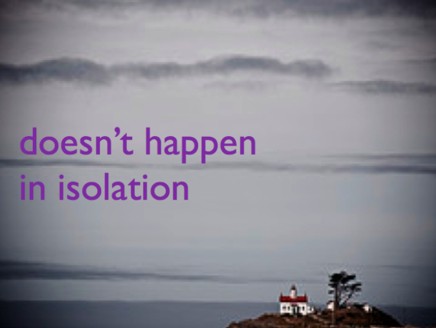
For me, it was a truly satisfying experience which demonstrated the richness of collaboration.  The end result is much greater than each person’s individual contribution.  Here is my slide

teachingwell

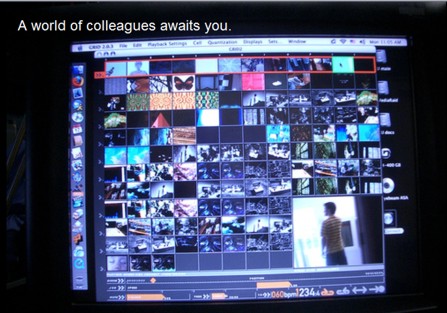
And this is the complimentary slide by Susanne Nobles

worldcolleagues

Have a look at the slideshow here. This would be a great collaborative project for both students and teachers, used as a slideshow or even printed off as posters.

What blogging means to Iran

Further to my last post, I’m adding a video posted by @Zadi on Twitter,

[youtube=http://www.youtube.com/watch?v=_TW7BzkuUKg]

The video tells us that Iran is the third largest nation of bloggers. For Iranians, a blog provides a safe place to write about forbidden topics and speak out with eloquence and anger against repression of the current regime and the need for change. The narrator of the video defines the blog as the true voice of the next generation.

A powerful example of the changing face of communication using Web 2.0 technologies.

You may also want to have a look at these images of recent happenings in Iran.

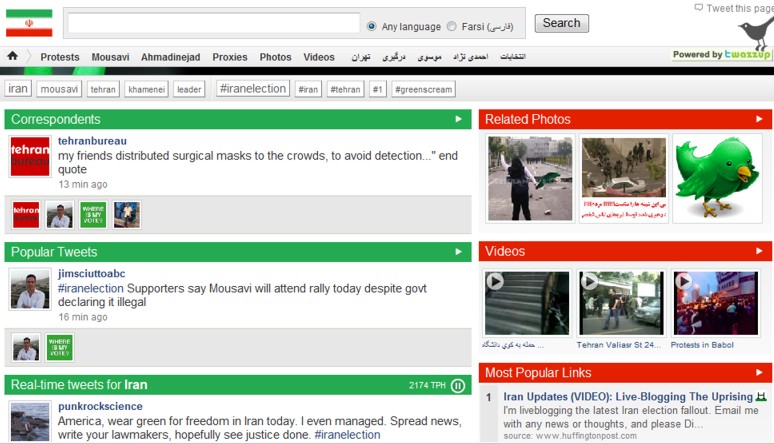
Iran uses Twitter to shout out

Today on FriendFeed I read Howard Rheingold’s message:

Smartmobbery moves to the core of world events more and more frequently

and this link to Smartmobs, a Website and Weblog about Topics and Issues discussed in the book Smart Mobs: The Next Social Revolution by Howard Rheingold.  Here you can read Twitter: Following the Aftermath of the Iranian Election

Twitter appears to be one of the most reliable channels to receive a first-person account of what is happening in the aftermath of the 2009 Iranian “election”.  Tor Henning Ueland is actively compiling a a list of Iranians using Twitter.  Also, you can follow the realtime results for the #iranelection here.

The power of microblogging is obvious here. Twitter has moved to a crucial role in communicating news when other forms of communication, such as official news, mobile phones, sms chat, and websites are no longer functioning. Twitterer @Persiankiwi is being followed by many, many people – 4,916 when I last checked. These are the sorts of things he has tweeted:

websites being shut down fast. having trouble accessing tweeters. #Iranelection20 minutes ago from web

students arrested last night at tehran uni: Mansoor Mousavi, Vahid Sarfi, Amir Afzali, Kazem Rahimi. #Iranelection23 minutes ago from web

advice to people joing march. tavel toether with friends. do not travel alone. keep track of friends. #Iranelection26 minutes ago from web

 I’ve selected other tweets which give current updates on the situation in Iran, as well as the urgency of the people.

nR: RT @persiankiwi My twitter was hacked. am back in again. they are shutting down all internet services. #Iranelection
 
@NorwAnon They insist to take exam to show e.th is normal. No news about our exams but if I’ll tweet it!about 3 hours ago from Twitstat Mobile

It’s 4th day that SMS service is down. #IranElectionabout 3 hours ago from mobile web

I’m calling my friends to get some fresh news but they don’t answerabout 3 hours ago from mobile web

I have an exam @ 14 (At national time). I’m a little worried, ppl are going to street again tomorrow morning and afternoon!about 10 hours ago from Twitstat Mobile

@mahdi: I use this to update my twitter account http://www.twit2d.comabout 13 hours ago from Twitstat Mobile

RT @mahdi @keyvan: Oh oh! Hearing that they have brought tanks to cities!about 13 hours ago from Twitstat Mobile

@_Sober : Rasht, 3 minibus security guards on Gaz square surrounding the square.about 15 hours ago from Twitstat Mobile

RT @StopAhmadi It’s getting rough in Rasht tonight. Armed forces waiting for ppl to make their move to beat them #IranElectionabout 15 hours ago from Twitstat Mobile

RT @HatefRad They arrested Guilan university students and took them to an unknown place! #IranElectionabout 16 hours ago from Twitstat Mobile

 I can’t find my friends on streets.about 17 hours ago from mobile web

 They attacked protestors students in Guilan university. Blood and violence here… #IranElectionabout 17 hours ago from mobile web

Police arrested 100+ protestors in Rasht. #IranElectionabout 18 hours ago from mobile web

It’s third day they disabled SMS service #IranElectionabout 18 hours ago from mobile web

Mousavi’s meeting with the Supreme Leader http://bit.ly/si7rq (via… http://ff.im/3ZxBNless than 5 seconds ago from FriendFeed

RT @reuterswire Ahmadinejad due in Russia on first trip since vote: YEKATERINBURG, Russia (Reuters). http://tinyurl.com/mt7bpkless than a minute ago from web

RT: @alirezasha: lost in lots of rumors and lies in news/چرا نمیشه به اخبار اعتماد کرد؟about 1 hour ago from TwitterFox

Twitter Users Put CNN to Shame on Iran Riot Coverage #iranelectionabout 1 hour ago from TwitterFox

RT: @Change_for_Iran: We’re trying to stop Masood from going outside! there is no way they will listen to us right now. #iranelectionabout 9 hours ago from TwitterFox

@Change_for_Iran what can we do? where are you? #iranelectionabout 9 hours ago from TwitterFox

RT: @Change_for_Iran:typing as fastest as I can in bth English&Farsi,Still we need outside help,I really don’t want to be captured by Ansarabout 9 hours ago from TwitterFox

@flashpolitique we are moving either toward a north korean style dictatorship or a more open and democratic societyabout 9 hours ago from TwitterFox in reply to flashpolitique

URGENT GET THIS OUT TO IRANIANS: ghalamnews confirms mousavi & karroubi WILL BE AT MARCH IT IS ON 100% AS OF NOW #iranelection2 minutes ago from web

RT @persiankiwi please tell all – march is NOT CANCELLED today. Mousavi is in danger of being killed. #Iranelectionabout 1 hour ago from web

Many roads are blocked in Tehran right now, it is like martial law out there right now. Government is panicking #iranelectionabout 1 hour ago from web

RT @persiankiwi I am online for few minutes. total communication blackout here. gov panicking. very dangerous. #Iranelectionabout 1 hour ago from web

intrepidteacher No matter what happens nothing will be the same in Iran again. I have been waiting for this my whole life. #iranelection

Irannews

Many pictures have been posted. Here are a couple:

http://twitpic.com/7fmr0 

 http://twitpic.com/7fmo8

Here are more videos and pictures of demonstrations in Iran 

http://tehranlive.org/

[youtube=http://www.youtube.com/watch?v=EyssJGHsGyw&feature=player_embedded]

I’m following developments on Twitter about the situation in Iran with interest – regular updates and personal information from people who are in the thick of these riots make this kind of news more dynamic than news from a traditional source. This is the new journalism.

This is very disturbing. I could read the updates all night, but I’m going to stop. Here is the last tweet I’ve read:

RT @drewb : #Iranelection web blocks via @IranPishi : “cant update topics on twitter anymore.cant open any webpage. hope you can see this.
You would have to be shortsighted to have read these developments and not recognised the role Twitter has played in new communication possibilities.

Everything is amazing, nobody is happy

Here’s something that made me smile –  the comedian, Louis CK, talks about how we take technology for granted.

[youtube=http://www.youtube.com/watch?v=jETv3NURwLc]

As Louis CK says, ‘those were simpler times’ when we had little of the technological possibilities we have now. I think we’re all guilty of taking new technology for granted. I still remember the dial phone, and yes, the zeros took ages to come back. One of our phones had a dial that used to get stuck and you had to help it back. Bad luck if you wanted to phone in quickly to be first caller for something. There are so many things that have been developed since I was born, it’s embarrassing. My boys find it hard to believe that when I was their age there were no microwaves(at least not in my part of the world). Definitely no mobile phones. We used to think we were lucky that a friend worked for the telephone company and gave us a couple of phones so we could have them in different rooms. When I was in primary school, we were one of the first families in our circle of friends to have a remote control for the TV. Some people would say, why do you need a remote? Why can’t you just get up and change the channel? Who would say that now? I used to think that mobile phones were an unnecessary luxury, and now I have a fit if I’m out without my phone. How happy I was when I used an electric typewriter with a corrector ribbon! How frustrated I am when my webpage takes too long to load.

But, as Louis CK says, we’re quick to get frustrated with technology without giving a thought to how incredible it is. I think that’s human nature. We get used to new technologies so quickly, and we complain about what’s not working, but we don’t often extol the virtues of our machines. Are we basically negative in our perceptions and reactions?

It’s funny to read Top 30 failed technology predictions.  Some of my favourites are:

“There is no reason anyone would want a computer in their home.” — Ken Olson, president, chairman and founder of Digital Equipment Corp. (DEC), maker of big business mainframe computers, arguing against the PC in 1977.

“A rocket will never be able to leave the Earth’s atmosphere.” — New York Times, 1936.

“Flight by machines heavier than air is unpractical (sic) and insignificant, if not utterly impossible.” – Simon Newcomb; The Wright Brothers flew at Kittyhawk 18 months later.

“The energy produced by the breaking down of the atom is a very poor kind of thing. Anyone who expects a source of power from the transformation of these atoms is talking moonshine.” — Ernest Rutherford, shortly after splitting the atom for the first time.

“The cinema is little more than a fad. It’s canned drama. What audiences really want to see is flesh and blood on the stage.” -– Charlie Chaplin, actor, producer, director, and studio founder, 1916

“The Americans have need of the telephone, but we do not. We have plenty of messenger boys.” — Sir William Preece, Chief Engineer, British Post Office, 1878.

“Home Taping Is Killing Music” — A 1980s campaign by the BPI, claiming that people recording music off the radio onto cassette would destroy the music industry.

“Television won’t last. It’s a flash in the pan.” — Mary Somerville, pioneer of radio educational broadcasts, 1948.

Here’s a funny one:

“Rail travel at high speed is not possible because passengers, unable to breathe, would die of asphyxia.” — Dr Dionysys Larder (1793-1859), professor of Natural Philosophy and Astronomy, University College London.

It’s easy for us to laugh at these in retrospect, but what kinds of things are we saying today? I’m particularly interested in critical or sceptical things we say about technology in education. I’m hearing things like

  • we have the intranet so we don’t need to ‘go out’
  • mobile phones have no educational use and should be banned
  • computer games are a waste of time and should be banned
  • social networking, like Facebook, is a waste of time and has no educational value
  • I do all my professional reading in peer-reviewed journals; why would I want to read blogs?
  • Twitter is used by people to say superficial and unnecessary things

When we say these things we are making a major mistake, and that mistake is based on the fact that we are thinking in terms of our world, not the world of  our students, and definitely not the world of the future. Currently in education there is a significant pull away from Web 2.0 technologies. We can’t stop these things by banning them or criticizing them. We can try to understand what draws our students into these applications. What motivates them to create online games, get involved in Second Life, join Flickr groups, write blogs – become engrossed in things outside of school in a way we didn’t think was possible in school. I think that we, as educators, should seriously think about what kind of world our students will be living in once they leave school. Whatever the answer to that is, it won’t be our world.

We should be interested in what young people are doing outside of school because it may help us understand how to engage them at school.

[youtube=http://www.youtube.com/watch?v=0fu4vmiXxwc&feature=player_embedded]

Shift into overdrive

Sean Nash said on Twitter:

But only when my professional life hit a point where I was empowered to really innovate and create new experiences for students did I shift into overdrive in many ways.

When I was in primary school, I always hated tracing. Tracing meant laboriously following someone else’s lines, and it was was boring. Even following my own lines that I had previously drawn was boring. Soul destroying.  I feel the same about prescriptive teaching – handing out worksheets, using someone else’s lessons in parrot fashion, repeating my own lessons – boring. That’s not to say I don’t do the same lesson, I just don’t do it the same way each time.

Susan Carter Morgan said something I can relate to in her blog post:

Using another teacher’s lesson plans does not make things easier! My colleague, Susanne, had taught this course for a number of years. In her organized, inimitable fashion, she handed me (virtually) her daily plans, quizzes, projects,and tests to use. Sounds great, but we teach differently, and I can’t tell you how many times I would be halfway through a lesson, wondering why I was doing it that way and then having to re-group for the next day. Susanne is one of the best, most creative teachers I know. But I should have just created the lessons myself.

Oscar Wilde said, “Be yourself. Everyone else is already taken”.

You may not know that my husband is a Russian Orthodox priest. When we were both 26 years old, he was ordained a priest, and I was left trying on masks in order to take up my new position as ‘matushka’ (as the Russians call a priest’s wife). I felt that I was in no way suitable for this new calling , so I started to emulate some of the other matushki. Of course, I don’t have to tell you, this plan failed miserably, and I was forced to return to myself. Only then could I function sincerely and convincingly, warts and all.

The same goes for teaching. When I recently changed careers in a minor way by moving from teacher of English and LOTE to teacher librarianship, being new to the job, I lacked the confidence that years of experience bring, and considered putting on borrowed hats in order to survive job interviews. I’m talking about  manner or terminology more than anything else. That definitely didn’t work, because more than anything else, I didn’t even convince myself. Over a fairly short space of time, letting to of preconceived ideas of what a teacher librarian might be like, I’ve connected with what I see as most important for this exciting role.

Today at lunch, chatting with teachers at my school, I explained my switch in roles to teachers who didn’t know me very well. We were joking about the teacher librarians not having to mark work or write reports (me, anyway), and I wondered what they thought I did, up in the library, without the regular face-to-face with classes. I didn’t want to bore them, but I’m often left wondering how I would adequately describe the teacher librarian’s role description, because it actually is quite broad, and depending on the school, it can be open to interpretation. That’s what I love about my job. It allows me to define my own role, to some extent. Unrestrained by adherence to one or two subject areas, a teacher librarian is, in a sense, a purer educator, looking after the learning of students across the curriculum. A teacher librarian inspires connection with ideas and  people through literature, teaches information skills (so important all through school and life), and supports best pedagogy.

So, back to my opening quote from Sean. To be empowered to innovate and create new experiences for students means, for me,  connecting with my authentic self, my way of doing things, my passion, taking the relevant curriculum and running with it. To make it absorbing for me and therefore the students, it should be a new experience each time. Teachers will know that this happens automatically because the dynamics are different for each class, but it’s good to build on the experience each time and present it in a slightly different way.

Web 2.0 technologies have opened up new ways of opening up and creating new experiences for teachers. Let’s take English teaching, for example. There are many ways to ‘renew’ your lessons by looking at what others have shared online.

I’d like to share some of my favourite networks which are a constant source of inspiration to me.

Ning

OZ/NZ Educators

Classroom 2.0

Educators’ guide to innovation

English Companion

Art Education 2.0

Independent School Educators’ Network

Mexico English Teachers’ Alliance

Voicethread for Educators

iConnect iLearn in the 21st century

TeacherLibrarianNetwork

Images 4 Education

Flat Classrooms

Discussing Current Events

Wikis

Classroom 2.0

School 2.0

Voicethread 4 Education

educational origami

21st century collaborative

Cool tools for schools

Visual Blooms

Web tools 4 U 2 use

Blogs

Geography blog Mr Robbo, the PE geek

2008 Edublogs winners (best education blogs)

Darren Kuropatwa’s Maths blog

Langwitches (Silvia Tolisano)

Art teaching blog : The  teaching palette

Global Teacher Blog directory and Web 3.0 community

School Library of Victoria blog: Bright Ideas (by Judith Way)

Angela Maiers: Educational Services

Susanne Nobles’ blog (English) Virginia, US

Susan Carter Morgan

Hey Jude (Judy O’Connell, Sydney)

Jenny Luca

On an e-journey with generation Y – Anne Mirtschin

Andrew Douch

Allanah King

Sheryl Nussbaum-Beach

Will Richardson

Rhonda Powling (Web 2.0 resources)

Have a look at my Twitter network here.

Here I am on Delicious and you can see my network here.

Here I am on Diigo.

Flickr (great way to share, discover and use images)

Although long, this is only a selection.

Nobody wants to regurgitate the same lesson again and again. That’s soul-destroying. If you’re inspired by what you’re teaching, then it’s likely to be an inspiring learning experience for students. Regularly connecting with networks of people who are teaching the same subjects is like securing your roots  into fertile ground. Combine that with the excitement you feel with all these ideas and resources at your fingertips, you can’t help going into overdrive.  You don’t mind (or can’t stop yourself) working after hours, into the night, during your breaks, because there is no longer just you and your subject material, there is you connected to a limitless number of people, ideas and resources, able to discuss and question, ask for help, co-create resources – you name it. Shifting into overdrive occurs naturally. Watch yourself take off.

How have you changed as a writer because of online spaces?

On Twitter I read that Will Richardson was doing a day-long workshop on ‘How have you changed as a writer because of online spaces and communities?’

Considering the deliberate and concentrated direction ‘out’ I’ve been following in the last year, when blogging through a Web 2.0 learning process took me out of the library and into the world, I thought it would be a good idea for me to ponder this question:

‘How have you changed as a writer because of online spaces and communities?’

Well, the short and simple answer is easy: I never was a writer until I started a personal blog, and so that simple step in setting up a blog, like so many people did before me, has given me the gift of a space I can personalise with my thoughts. Over 30 years ago, when I finished secondary school, I lost my excuse for writing. Having enjoyed writing in English classes more than anything else at school, there was no reason or opportunity to do it anymore. So when I started my blog, tentatively at first, it was a joyful reunion with a process I had long missed.

And so, back to the question, ‘how have I changed as a writer because of online spaces and communities’? Blogging has not only given me the chance to write, but it has given me an audience, and it has connected me to people. When I say audience, it’s not a big one, but I’m not talking to the air either. If I have something to say or share or ask, it’s great when I get a response, a thrill when I start a conversation, and brilliant if it involves people from different parts of the world. If I’m thinking or doing the same thing as someone in another country, then the world is brought closer, the unknown seems more familiar, what was foreign becomes more friendly.

The online communities I’ve joined since – Twitter, wikis, nings, etc., have taken my writing into the interactive zone. I’ve responded, supported, elaborated, argued, bounced off others, shared people’s successes, empathised, and generally had a great time with people I didn’t know, or hardly knew, and now with whom I share a great affinity. To describe this affinity, I will just say that if I’m ever in need of anything – moral support, information, advice – then the people in my network will instantly respond.

And back to the question again – my writing has changed even in its sincerity, its authenticity; I think it has thrown off its carefully constructed facade, its attempt to impress, to sound correct, to please, to conform to the status quo. It’s become transparent and unselfconscious, playful and casual, flexible and possibly courageous.

If my writing has changed in these ways because of online spaces and networks, then it must be clear to all that it is a human, and not technological, development. It’s about me, not my technology skills. The technology has provided the medium, the connections, but it has centred on human interaction.

These are the reasons why I’m exploring and pushing Web 2.0 platforms for learning and teaching at school. Using online spaces and communities for writing will connect students to each other and to others outside the classroom. Writing will become meaningful, and learning enjoyable.

Fun and games?

Before I say anything, I’m going to ask you to watch a video of a British game show called Split or steal.

[youtube=http://www.youtube.com/watch?v=p3Uos2fzIJ0&feature=player_embedded]

Am I alone in thinking that game shows are not all fun and games, that they contain more than a small portion of insidiousness? We like to watch people compete to win, and we may enjoy living vicariously through the contestants, imagining we were just about to win an incredible amount of money. But shows like this one seem to go beyond the harmless. But despite the fact that this game show is more like torture than fun, it’s interesting to observe our own motivations as observers. I was watching with my eyes popping out; I think my hands were on my face, perhaps in disbelief. Although I had a feeling there was going to be betrayal, I couldn’t believe that a person would actually lie so coldly, and then leave the other person so shattered. It’s an interesting study in human nature. If there was a war or state of emergency, I’d hate to have my life depend on the good will of the woman in this video. And shows like Big brother mess around with people in such a bad way, it makes you wonder how this form of psychological torture is permitted.

Does anyone else feel that way, or am I just overreacting?

Thanks to Howard Rheingold for the link to the video.

1000 Awesome Things

I haven’t written a post for 6 days. Too many things have been happening, and it would take too long to fill you all in. And besides, I’m tired.

So, for your enjoyment, I will share a fun blog, 1000 awesome things.

Here’s an example of the type of thing deemed awesome.

door

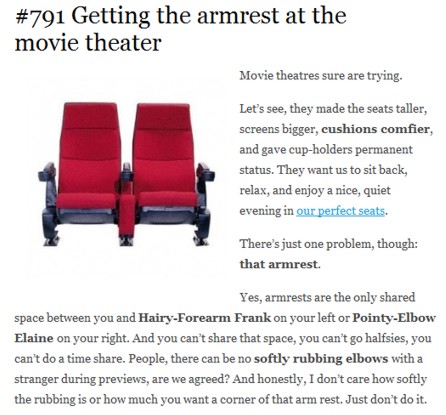
Or #791 Getting the armrest at the movie theatre

armrest

Or #797 Seeing a cop on the side of the road and realizing you’re going the speed limit anyway

#818 When the dentist says you have no cavities

#838 The smell of freshly cut grass

#844 Celebrities on Sesame Street

Celebrities tell you how to get, how to get to Sesame Street.

Some of the videos

[youtube=http://www.youtube.com/watch?v=5121VjLwqZM&feature=player_embedded]

[youtube=http://www.youtube.com/watch?v=-c3fvqNlFvc&feature=player_embedded]

[youtube=http://www.youtube.com/watch?v=zqHfser_9_s&feature=player_embedded]

[youtube=http://www.youtube.com/watch?v=3XpHZsTcuos&feature=player_embedded]

[youtube=http://www.youtube.com/watch?v=lv38j4lPzd0&feature=player_embedded]

There are more videos, and they’re all adorable.

Have a look through the site. There’s something for everyone. 1000 awesome things has won a 2009 Webby award.

John Green at the State Library of Victoria

CIMG7754

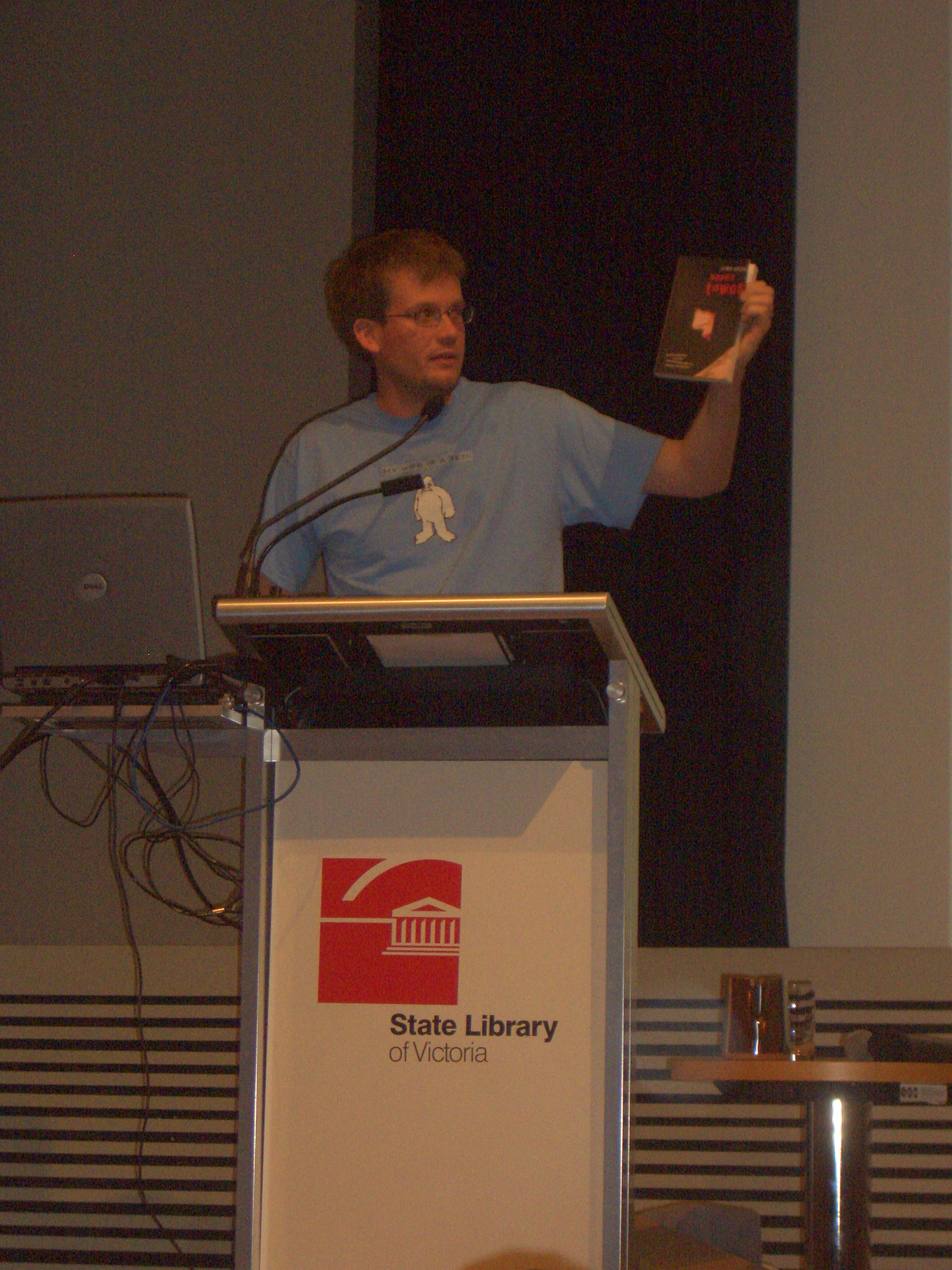
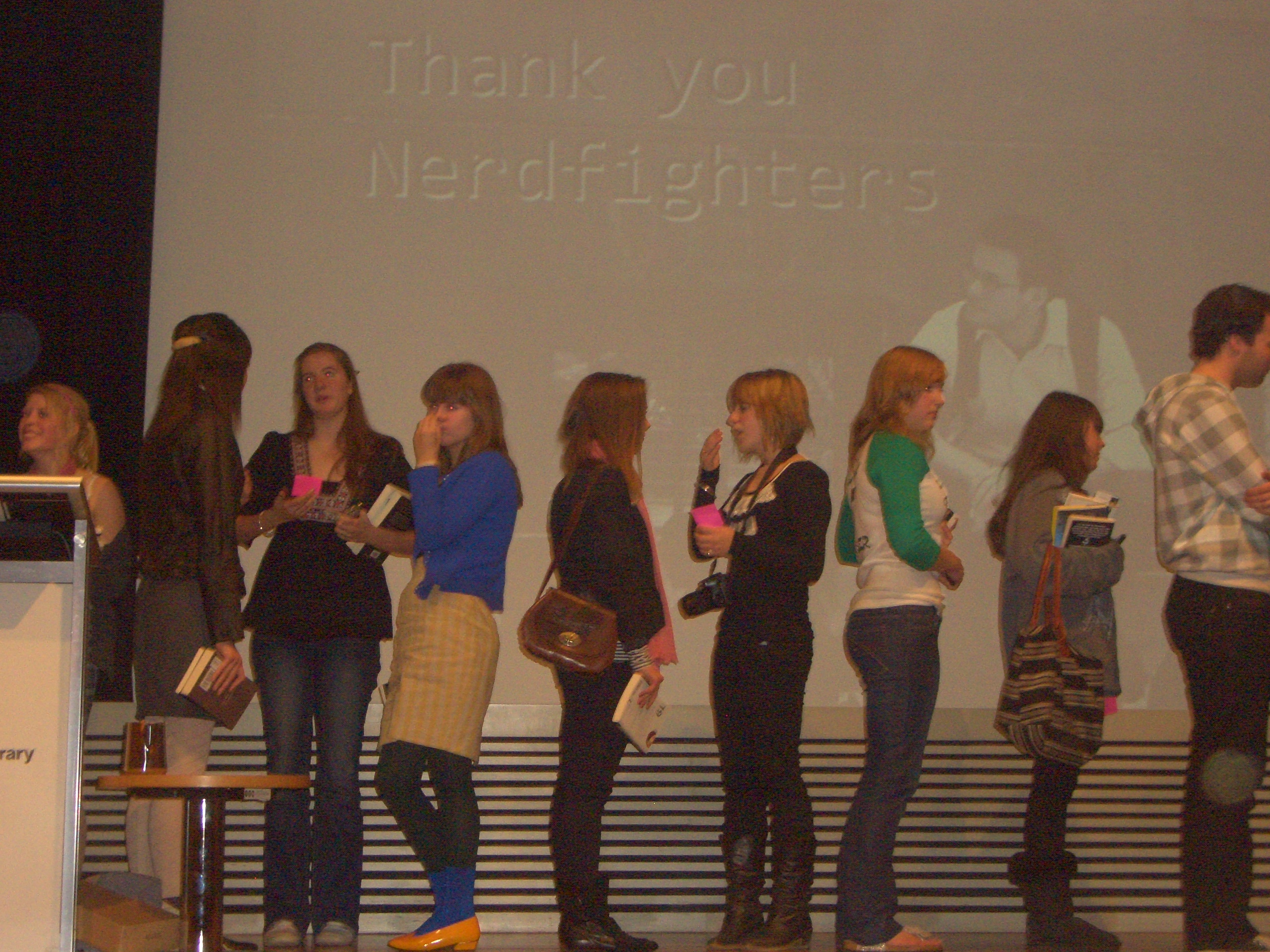
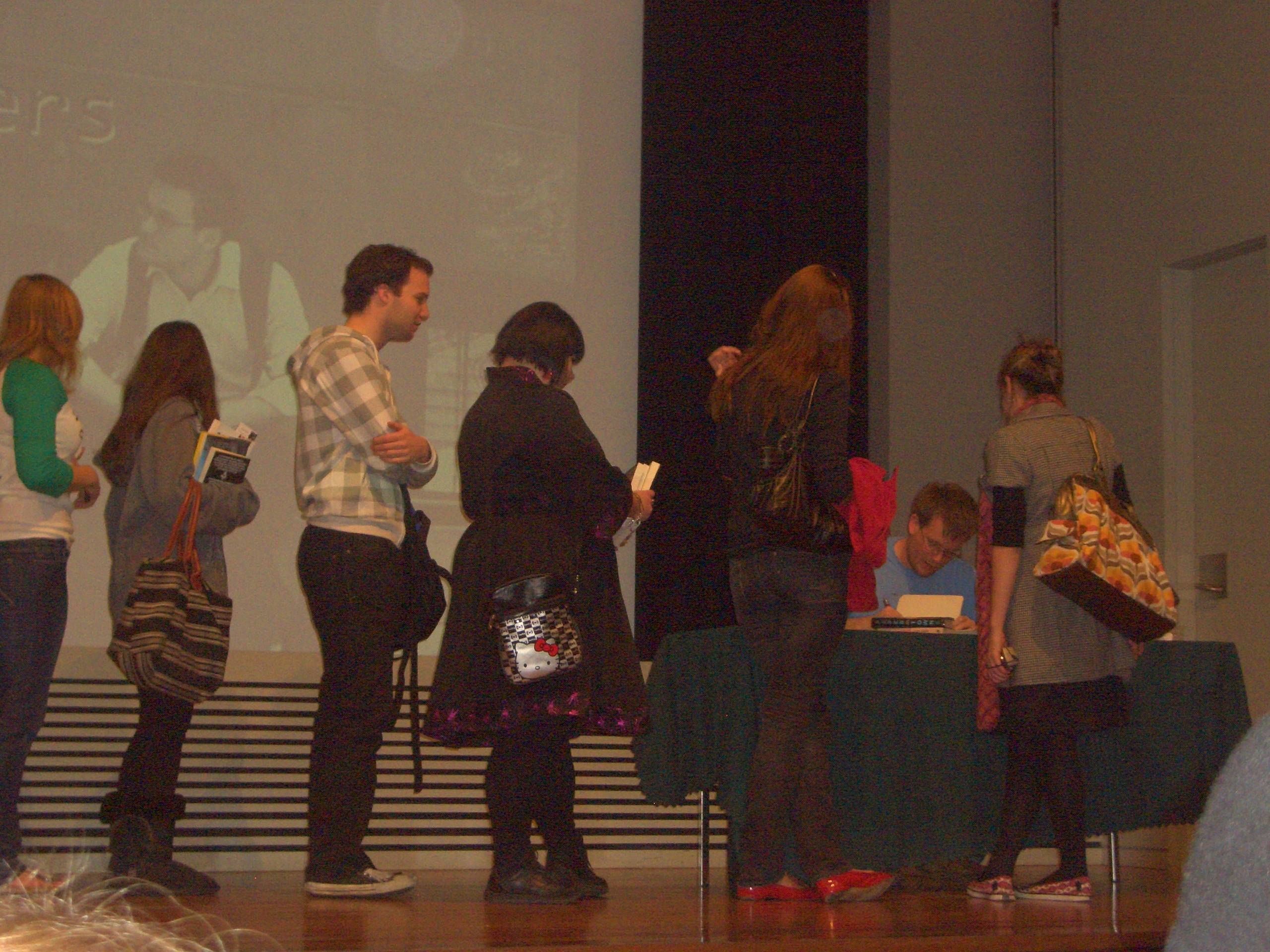
Amazed is how I would describe how I felt at today’s author talk. I kept thinking, the response from the audience is more like what you would expect for a rock star or a popular comedian.  John Green, author of YA books such as Looking for Alaska and Paper towns,  bounded into the Village Roadshow Theatrette at the State Library with the energy and enthusiasm that his online followers would know, and was greeted by an impressive and prolonged cheering.

And this is where he is perhaps more like the rock star, or at least the comedian, because John Green doesn’t just write books, he relates to his readers as a person, and he does this through a number of online exploits – a blog and videos, amongst other things.

CIMG7763

As a teacher librarian, I’m always thinking about how to engage students in reading, so I started writing a blog which would hopefully seem less like an academic, teachery (just made up the word – still fresh from John Green’s way of talking) thing, and more like something from popular culture that young people would read. When using the blog to talk to students about what’s worth reading and why, the best thing has been the availability of John Green’s nerdfighters.com videos on his Vlogbrothers YouTube channel. They’re very funny, extremely entertaining, quirky, witty and intelligent. Very popular was the video where he filmed himself carrying out a challenge to climb onto a table. John is incredibly afraid of heights, and Justine Larbalestier had dared him (publicly) to stand up on a table for money that would go to a charity of his choice. He did this at home and filmed himself. Now that’s putting yourself out there. And this is, in my opinion, John’s secret. He puts himself out there – through his blog, ning, videos, etc. He doesn’t present an author persona, he actually extends what he writes about by having discussions with his readers about what he thinks, what he believes, and why he does that. And it helps, of course, to be so dynamic, so genial, and so funny.

[youtube=http://www.youtube.com/watch?v=GWjYcWoaSbI&feature=player_embedded]

As a last-minute thing, I asked my 15 year old son if he wanted to come with me. I was really expecting most of the audience to be made up of librarians, so it was surprising to see that most were adolescents.

Today is food for thought. I’d like to incorporate more of what John Green does on my reading blog. He brings to authors a fresh, personal face, not the usual brief biography readers usually get.

Here’s what he says about what makes a good book. My camera isn’t flash, so you’ll have to excuse the poor quality. John says that a book doesn’t belong to the writer, it belongs to the reader. The reader decides the value. He says it’s a good book, in his opinion, if it makes him think, wonder about, and feel; if it has emotional complexity; if it makes him re-examine the map he’s drawn of his world. Good books, he says, have real and lasting value.

[youtube=http://www.youtube.com/watch?v=ntuQUe9TYI8]

What I think makes John Green a successful writer, is that he doesn’t underestimate his readers’ intelligence and maturity. He says that you can’t write a book that is too smart or complex for teenagers, because they are capable of reading critically and thoughtfully. He gives the example of the popularity of The book thief, by Markus Zusak , which maintains high sales.

[youtube=http://www.youtube.com/watch?v=JCpQ6JRqUf8]

I’m happy that I managed to get a ticket to the second of two sold-out meetings with John Green in Melbourne. There were many people in the audience from outside of Melbourne, one even who had travelled from New Zealand. John seemed sincerely thrilled that so many had come to see him.

 CIMG7762

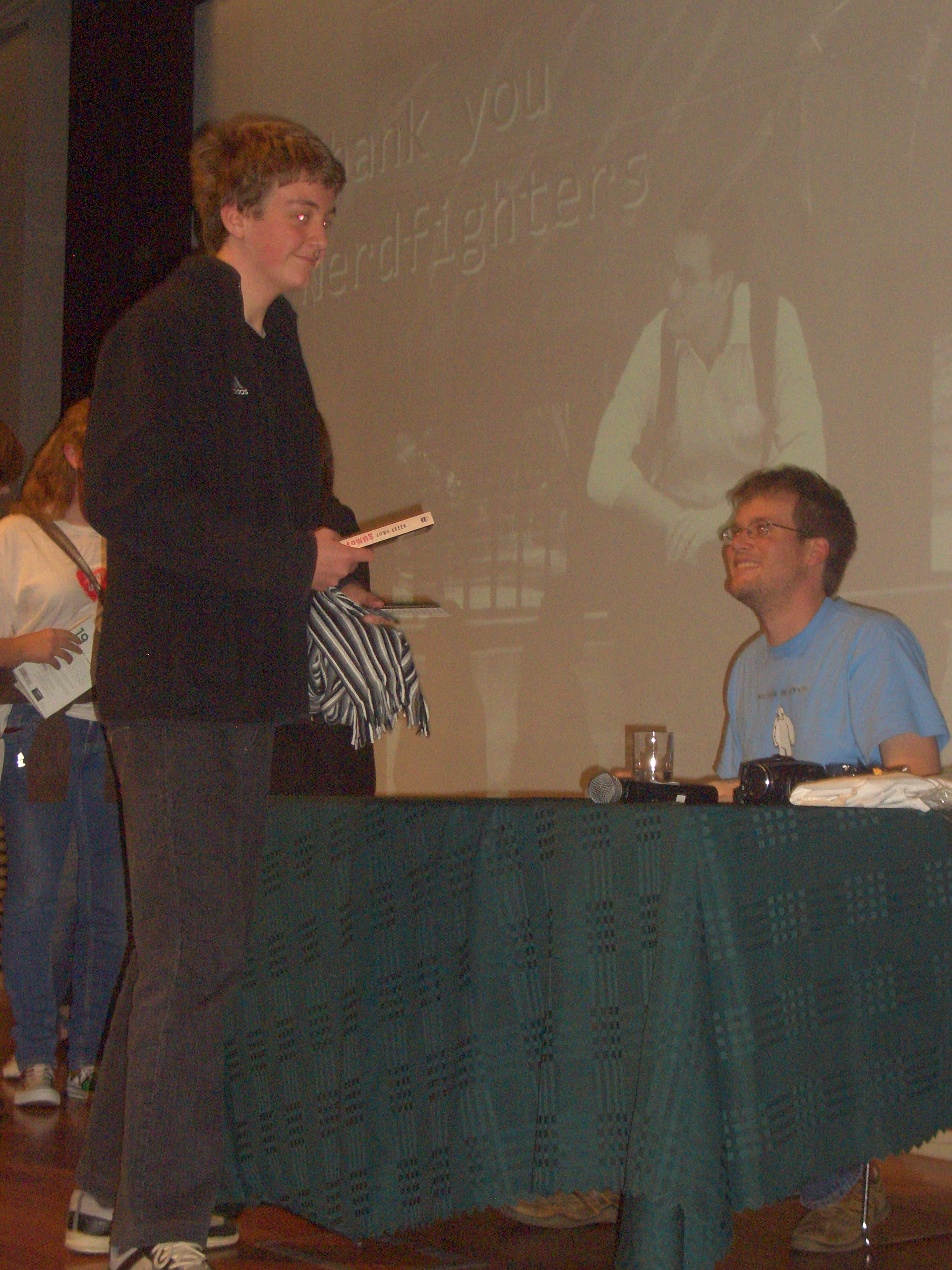
My son isn’t an avid reader, but he wanted to buy Paper towns after hearing John talk about the book, and not only the book, but his thoughts and ideas that went into the book. We bought the book, and when Maxim went to get it signed, John made him laugh by saying that he wanted to trade names with him. Good on you, John, for doing such a great job in relating to young people in such a real way.

CIMG7766

If you’re interested, have a look at John’s ning, and the videos that he and his brother, Hank, regularly create.

Tweeting from space – NASA on Twitter


 Some time ago, when talking about Twitter, I mentioned an astronaut using Twitter to share his journey to space – @Astro_mike, or Mike Massimino, a NASA astronaut, mission specialist for STS-125. You can see Mike along with the rest of the team on the NASA website.   Receiving real-time tweets as he prepared for launch, as he described his experiences in space, and in his readjustment to gravity on earth, he offered a unique perspective, much different to a newspaper article or even interview.

Although not as thrilling as the real-time follow, I decided to share selected tweets throughout his journey. Since the latest tweet is on top, you’ll have to start at the bottom.

  Finished a physical exam with the doctors, all is good, I am cleared to resume driving a car, flying, and light exercise3:34 AM May 28th from TwitterBerry

Going to our crew return ceremony, watch it live at 4PM central at www.ustream.tv/nasa2explore6:34 AM May 27th from TwitterBerry

Woke up with slightly sore back and lower legs, my muscles are re-adjusting to gravity11:24 PM May 26th from web

Getting re-adjusted to gravity, let go of a small bag of groceries and must have expected it to float, luckily no damage1:26 PM May 26th from web

On day 12 on a night pass over India I say 2 shooting stars entering the atmosphere below me, streaks of light below, I made 2 wishes11:41 PM May 25th from web

favorite moment on last full day was night pass over Australia with thunderstorms and city lights below and universe above, a heavenly view11:37 PM May 25th from web

Could not land for 2 days so spent most time looking out windows – this was a gift – listening to music looking at Earth and stars for hours11:34 PM May 25th from web

From orbit: got a call from President Obama, it was a great event for our crew and very thoughtful of the President11:49 PM May 21st from web

From orbit: Just saw Orion’s nebula in the night sky – the sights make all the hard work and risk worthwhile for me7:35 AM May 21st from web

From orbit: Night pass over Australia, the city lights give stunning signs of life on our planet within the darkness of nighttime7:34 AM May 21st from web

From orbit: Just a video conference with my family, it was great to see them7:33 AM May 21st from web

From orbit: As I closed my eyes to sleep last night I thought “these eyes have seen some beautiful sights today”12:39 AM May 21st from web

From orbit: Flying over the Pacific Ocean at night there were some thunder storms, it is so cool to see lightning go off below the clouds10:33 PM May 20th from web

From orbit: The stars at night in space do not twinkle, they look like perfect points of light and I can clearly see the milky way galaxy10:33 PM May 20th from web

From orbit: Viewing the Earth is a study of contrasts, beautiful colors of the planet, thin blue line of atmosphere, pure blackness of space8:08 AM May 20th from web

From orbit: We see 16 sunrises and sunsets in 24 hrs, each one spectacular as the sun lights up the atmosphere in a spectrum of colors8:06 AM May 20th from web

From orbit: The Earth is so beautiful, it is like looking into paradise8:04 AM May 20th from web

From orbit: Getting ready for bed, sleeping in space is cool, tie down your sleeping bag and float inside of it, very relaxing6:27 PM May 19th from web

From orbit: Eating chocolates in space, floating then in front of me then floating and eating them like I am a fish6:26 PM May 19th from web

From orbit: At the end of my spacewalk, I had time to just look at the Earth, the most awesome sight my eyes have seen, undescribable10:43 PM May 18th from web

From orbit: Getting more accustomed to living in space today and getting ready for our big rendezvous with hubble12:16 AM May 14th from web

I’m going to put my spacesuit on, next stop: Earth Orbit!!11:11 PM May 11th from TwitterBerry

Final check with the doctors, getting ready for breakfast. We launch today!!8:52 PM May 11th from TwitterBerry

I’ll tweet when I can from orbit, but it might not be much, follow us after the launch 24/7 on NASA TV, www.nasa.gov/ntv and NASA twitter9:59 AM May 11th from web

Just got up, met with the doctors for a routine checkup, now will start a final review of the spacewalks with my crew – 2 DAYS FROM LAUNCH8:34 PM May 9th from web

Just finished dinner with my crew and our spouses, this is our first night in quarantine in florida after 5 quarantine days in houston10:26 AM May 9th from TwitterBerry

I don’t know about you, but I got enormous satisfaction out of the succinct, personal tweeting by @Astro_Mike.

 You can read Mike’s journal on the NASA site. You can also read the crew profiles and interviews on the site.

I think it would be a unique way to teach about space, don’t you? Do you know any other real-time Twitter-documented journeys that could be used for learning?

Button up, we’re out in the open

css.php