All posts by Tania Sheko

My name is Tania Sheko, and I am a teacher librarian at Melbourne High School, a selective secondary boys’ school 9-12 in Melbourne, Australia. ‘Teacher librarian’ usually requires a bit of an explanation. I think it’s a ‘School Librarian’ or ‘Library Media Specialist’ in the US and Canada. Often people are not sure what my role is, and it’s not easy to define. I like to think of it as the focus on ‘skills’ and ‘passion’ which exists in the spaces between the teaching of curriculum which is the domain of subject teachers. Some of my areas of focus include all sorts of literacies (information, digital, critical, network, etc.), collaboration with teachers as a kind of third hand (curating resources, differentiating learning, experimenting with blogs), and connecting people to ideas and an understanding of self and others through reading, discussion and debate. Most of our students go on to university, and we are always thinking about how we can best prepare them for the world of university and work. I’m interested in the educational environment, behaviours and directions of tertiary institutions, particularly as they move from traditional to innovative practices with connective courses. Connected learning makes sense to me, and I’m concerned that schools are often still envisioning learning as a passive consumption of content delivered by individual classroom teachers. With so much research-based evidence about student-centred, interest-driven and collaborative learning, and with the findings from the NMC Horizon Project, identifying and describing emerging technologies likely to have an impact on learning, teaching, and creative inquiry in education, I really think it’s time we woke up to ourselves about the anachronistic nature of our educational practices and took action. I learn from my colleagues, but also from my online network, reading their blogs, interacting with them on Twitter, exploring the wealth of their shared expertise online. This is what excites me about learning – connecting with people globally for a shared purpose.

I don’t like New Year resolutions

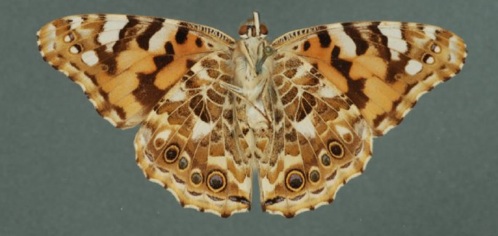
butterfly

As the title says, I don’t like New Year resolutions. I don’t like any resolutions. I’m not in the habit of making promises either. I don’t make promises because I’m not sure I’m going to keep them. What I prefer to do is say nothing, resolve secretly – allowing room for backing off – and only say yes when I’ve already succeeded. I don’t like to raise hopes, I don’t like to disappoint.  Not even myself.

The blogosphere has been changing its timbre for the Christmas and New Year period. Serious educational posts have given way to reflective, stocktaking and thanksgiving ones; posts summing up 2008 and looking ahead to 2009.

I started thinking… if I were to consider new year resolutions, what would they be?

There’s no reason for my resolutions to be any different to anyone else’s – after all, we have the same needs and aspirations. If I ever did make resolutions – and I’m not saying I will – they might be the following:

1.  Act my age – Since I’m turning 50 this year I’m thinking more about mortality. Not meaning to sound morbid, but we don’t live forever. Time is becoming precious and it would be reckless of me not to notice my downhill inclination. I need to make a conscious decision to stay healthy. Even as I say this I know that exercise will not be on my agenda, but a little self control wouldn’t go astray in looking after my body; it doesn’t seem as invincible as it used to be.

2.  Community – I’ve always been an introverted person, happy with my own company and a few close others. Maybe it takes me that long to charge, to figure out who I am and what I want from life. Now is the time to connect, appreciate what others have to offer, give something back.

3.  Creativity – I’m ready to be more creative, to realise how creativity is a life-force I can’t live without (without sounding too dramatic). Creativity can be expressed in many different ways, all of them worthwhile.

4.  Letting go of old fears – There’s nothing to fear but fear itself. One by one I hope to let go of fears that paralyse. The fear of making mistakes, of looking stupid, of being different, of being rejected, of not being good enough, of the unknown. What a waste of time.

5.  Time is precious – that means learning to say no, not wasting time moping, being lazy, procrasting, following an unthinking routine. It means appreciating what is good, people who matter, enriching experiences. Not taking things for granted, saying thankyou, saying sorry, organising people events.

Only a little more than half a year ago did I start this blog, then gradually make  connections with people around the world online through blog reading and commenting, through Twitter and PLNs. Thankyou to everyone for enriching my life, for conversations, advice and help, humour, and making me realise that we have so much in common wherever we are. I wish everyone and their families a blessed new year, and look forward to our conversations in 2009.

Think about what you wish for – you might get it.

For where your treasure is, there will your heart be also – Luke 12:34.
The Herd 2020 and Mike Daly – power of creative media

I found this on Boing Boing, and enjoyed it so much on so many levels that I had to share it with you. Try not to dance to this. Inspirational as political message, visual feast, creative production, political springboard for discussion, power of media.

It’s a music video of the song 2020 by the Australia-based band, The Herd,  and it’s directed by Mike Daly.  Mike recently won the award ‘Australian Music Video of the Year’ at the 2008 J Awards for this video.

[youtube=http://au.youtube.com/watch?v=n65x_cSHSHE]

7 things

Jenny Luca tagged me to participate in a meme.  The idea of this meme is to share seven things that your readers might not know about you.

Here are my seven things:

1.  My grandmother’s cousin was the well known pianist, Sviatoslav Richter. My grandmother held a childhood grudge against him since the time that he told her that people who weren’t musical shouldn’t exist.

2.  I worked temporarily for a pneumatic tool company, translating engineering texts from German into English and vice versa. I had no idea about engineering jargon – not in German or English.

3.  English is my second language. My first language was Russian. I went to preschool (Kindergarten in those days in Melbourne) with only a few words of English: please, thankyou, yes, no and toilet.

4.  In primary school, I made my best friend act out Brere Rabbit with me every Monday for 4 years. I was always Brere Rabbit, she was always Brere Fox and my sister had to be Tar Baby.

5.  I used to think if I concentrated hard enough I could go through the mirror into another world. I still wish I believed that.

6.  I really love things that sparkle. This is embarrassing so you won’t see any evidence of this around the house or on my person. Hang on, let me check…

7.  I have some sort of spatial disability. I lose all sense of direction when I go backwards from somewhere. If I come out of a shop, I always end up going back the way I came.

I tag the following people and apologize in advance if they’ve been tagged by someone already:

Nirvana Rose Watkins

Pam Thompson

Carey Pohanka

Cristina Costa

Keisa Williams

Hiram Cuevas

Susanne Nobles

Have a go if you have the urge…

Teens reading critically

I often wonder if I’m suited to my role as teacher librarian. From the point of view of my own taste in particular. My library ‘superior’ (who will remain nameless in case what I’m about to say will incriminate her – I’m joking), has said in half  jest a few times that I’m a reading snob. And I am. My tastes are often on the edge of out there.  I mean, my undergraduate thesis was on Max Frisch’s Graf Oderland – a play about a lawyer who put an axe into his briefcase and joined the underground movement. My point is, my reading tastes do not often coincide with the general population of students. This bothers me since, obviously, I need to be able to inspire the students (in my school, boys) to read. I should be reading action and adventure, fantasy, sports fiction, and crime. But it ends up that the books I read and recommend sit neatly on the shelf and remain so.

This was the case when I read Looking for Alaska by John Green. I was convinced that teenage boys would love this book but it didn’t happen. Well, obviously, I knew that not too many would rush to read it, but I didn’t expect almost nobody. And so I’m often pondering my role in this situation. Should I give in and read and talk about the popular books, authors and series that have their due date slip stamped all over, or should I stay true to my conviction that teenagers’ fiction menu needs to be expanded  to include those books they would normally not touch. I don’t mean cater to the reading minority, I mean somehow inspire the majority to read outside of their comfort zone.

Reading John Green’s blog, I recently came across a post that gave me hope. In this post John talks about a comment he received from a (presumably) teenager who sees in Paper Towns references to Orpheus. Having read this comment, John questions whether we should presume that most teenagers are incapable of critical reading. In fact, he actually questions whether we should exclude more challenging writing from teenagers or presume that they haven’t read widely.  Here’s a little of what he says:

I would argue that when we think about teens as readers, we need to stop thinking about the teens we know. Like, around us, teens can be awkward and intellectually unimpressive. But they often aren’t showing us their best selves, precisely because they feel the intellectual distance between us and them. I’d argue that the ONLY way to bridge that distance is to deny its existence.

And here is an extract of the student’s comment where he sees connections between John Green’s novel and Orpheus.

I was so blown away by Paper Towns I reread it right away. And the second time, I was really struck by the scene where Margo gets bit by the snake. It reminded me of the story of Orpheus and Eurydice, which I especially love Rilke’s version of. I realized that the whole book could be loosely seen as within that framework. She is taken from him – not through fate but through her own will – just when they begin to redevelop some sort of a relationship. And she is, from his point of view, lost in the underworld; he actually thinks she is dead. She has gone to the world of the paper towns, and he is willing to follow her despite all the dangers and obstacles.

The comment is longer than that and I recommend you reading the rest of it.

So what’s my point? Well, the first point is that we shouldn’t assume that readers like this one don’t exist. They may be hiding. There may be more of them than you think.

My second and more important (for me) point is that if we don’t expand teenagers’ reading tastes we do them a disservice. Yes, they should read what they enjoy. Yes, most boys will still read Matthew Reilly – but in between I’m going to come out of left field and surprise them with something different. That’s how I functioned as an English teacher – not suppressing what I considered thought-provoking, not keeping silent if I thought that something was worth pointing out. Shock them a little, confuse them a lot, and they’ll gradually get used to it. Their world view will expand. They’ll surprise you.

As for me, I think I might consider staying true to myself in my role as teacher librarian.

Playful, seductive, digressive, literate…

sketch

More on the differences between reading a book and reading on the internet…

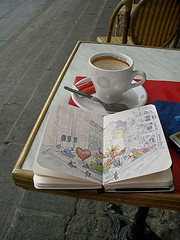
I was reflecting about what it is I like about reading blogs. Something I hadn’t thought of before – a blog post is like a sketch – incomplete, open, promising ideas, suggestive, an impression to be used for further thought. It doesn’t replace a published book, nor should it. Books are wonderful, complete, well-thought out, often definitive writings. I have books on my must-read list, and look forward to devoting  myself to them completely. Sometimes, though, I feel pressured after I’ve bought a book; I feel obliged to read it, from start to finish, obliged to give my full attention to it out of respect for the author, or at least because I’ve paid for it. Occasionally this detracts from my enjoyment, particularly when guilt creeps in.

Blog reading is like dipping here and there, like enjoying tapas as opposed to sitting down to the main meal. Blog posts in themselves are snippets of thought and opinion, allowing for impromptu reflection, without the pressures of serious writing. My Google Reader is bulging ridiculously, but it allows me to dip here and there, unpressured, enjoying every moment.

I was reading Jonathan Jones’ blog at guardian.co.uk, Art and design. In his latest post he talks about the science writer, Richard Fortey. Here’s what he says about Fortey’s talent as a writer, and I think this could easily apply to good blog writing:

The strength of Fortey as a popular science writer is that he is a real writer. His prose is playful, seductive, digressive and literate.

The blogs I enjoy reading the most – not for their information, but for their writing – demonstrate these qualities. And I’m beginning to realise that being digressive in blog writing is not a bad thing – it’s sharing more of your ongoing interests and changing focus, and therefore more of yourself, with the reader. The blogs I love to read are those whose authors generously share of themselves, and so reading the blog is synonymous with reading the person.

What do you like about blog writing?

Doorways around the world

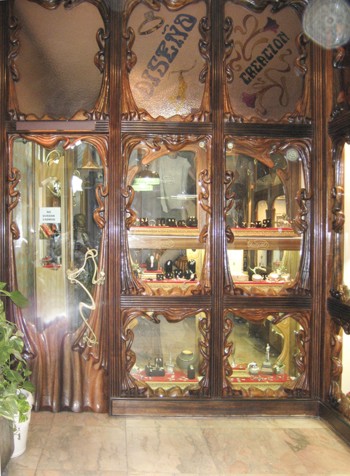
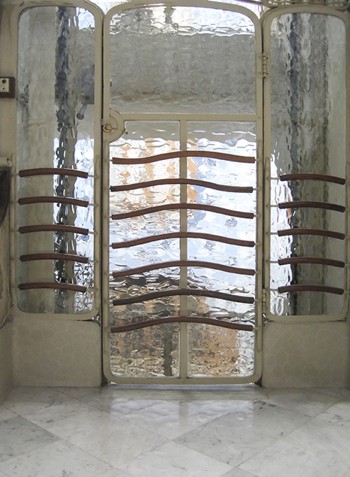
I’ve always loved doors and doorways. Imagine my delight when I came across this blog, Doorways around the world.

Here are a couple of my favourite doorways:

doorwayspainresampled

The Art Nouveau entrance to a jeweler’s shop in Montblanc, a medieval walled town in Catalunya, Spain.

doorwaybarcelonagaudiresampled

Elevator door in an apartment building in the Casa Batlló, Barcelona (Antoni Gaudí, 1907). 

If you are even remotely interested in doors, doorways or architecture, check out this blog.

Do you turn to Twitter when you’ve escaped death?

planecrash-22-december-2008-009

Photo from The Guardian UK

Interesting to read this article in The Guardian news blog.

Plane crash survivor texts Twitter updates

What’s the first thing you’d do after narrowly avoiding disaster

The first thing Mike Wilson did after surviving the Continental Airlines 737 crash when his plane slid off the runway in Denver was use his mobile phone to update his Twitter community.

A dedicated microblogger or …? Whatever he is, he has now made history as the first person to tweet a plane crash directly after an accident. Twitter might be the up and coming way to communicate after trauma. I think psychologists may eventually decide that sharing directly after a traumatic experience decreases shock or at least somehow alleviates stress. What do you think?

Guggenheim 2.0

The Guggenheim Museum in NY has a great little online event going which encourages interaction and collective thought around some of its collection. 

Catherine Opie is an American artist specialising in issues around documentary photography.

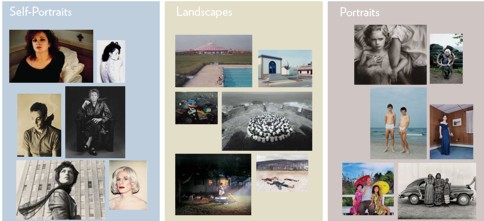
For this exhibition, Catherine Opie has selected images from the Guggenheim Museum’s photography collection and organized them into three sections: Self-Portraits, Landscapes, and Portraits. Visitors can write responses to the questions Opie poses about them and read other people’s responses.

Here are some more details from the Guggenheim Museum website:

September 26, 2008–January 7, 2009
While celebrated for her role behind the camera, Catherine Opie remains acutely aware of the voices of her subjects, and the diverse readings all images engender. Exploring this circuit of interpretation, Opie has selected images from the Guggenheim Museum’s photography collection to present alongside questions about the works’ themes and meanings, inviting museum visitors to respond with stories of their own.

People can participate online by writing about a photograph or reading other people’s comments.

guggenheimThe

I clicked on one of the portraits.

3infrontofcar

 These are the questions asked about the portraits:

What do you think makes a portrait interesting?

  • How do the titles of these photographs make you think differently about the people they portray?
  • Some of these images are made spontaneously while others are carefully staged by the artist. How does this difference in approach affect your response?

Here is one of the responses:

An interesting portrait to me is one that represents people honestly. Not only is it usually aesthetically pleasing, but it also is educational and interesting. In Keita’s photo of 3 women, she presents them in their usual daily clothing, telling the viewer something about their environment and status, and then the juxtaposition of the car brings to mind a completely different world or environment. The two together represent a very real albeit somewhat staged composition that’s intriguing and interesting.

I was excited to find this, and I’d like to keep up with the many innovative programs and ideas coming out of cultural institutions such as museums. The idea of  an artist selecting images from the collection is a creative way to bring out to more people what would normally remain within the walls of the museum, and perhaps not be accessed by as many otherwise. The addition of the questions and options to comment is added value,  inviting interaction and the sharing of opinions. I also like the fact that, whereas people would normally just look at the photos at an exhibition, maybe read a little about them, in this case the public is invited to express their impressions and opinions.

I was a little disappointed that only one or two responses were accessible, unless I’m missing something. I was looking forward to a real discussion and debate around the photos.

Nevertheless, an inspiring concept. This would be an excellent way to initiate discussion and reflection in the art classroom.