


Thought this was cool – a mosaic of my Twitter followers. This is a visualisation of the community I rely on – for the latest information, help, discourse, banter, and much more.
If you’re a Twitter user, you can also get this follower mosaic.

Thought this was cool – a mosaic of my Twitter followers. This is a visualisation of the community I rely on – for the latest information, help, discourse, banter, and much more.
If you’re a Twitter user, you can also get this follower mosaic.
It would be remiss of me not to post something about Barack Obama’s inauguration. Not for the first time, I’ve shirked a difficult synopsis of a complex event by opting for a video.
[youtube=http://www.youtube.com/watch?v=QYrZZ68zhSs&eurl=http://www.google.com/reader/view/?utm_campaign=en&utm_source=en-ha-ww-ww-bk&utm_medium=ha&utm_term=google+r&feature=player_embedded]
Theresa McGee posted this video in her post on the The Teaching Palette. It’s an interesting visual journey through the line of American presidents.
There is a similar morphing video in one of my earlier posts.
I’ve been involved in a discussion lately about different types of reading. Most people have agreed that reading a novel is very different to reading a website or anything else online. Some people think that deep thinking and understanding are becoming extinct since reading online has distracted a large part of the population. People are concerned that online reading is superficial, and that commenting revolves around less than challenging subject matter.
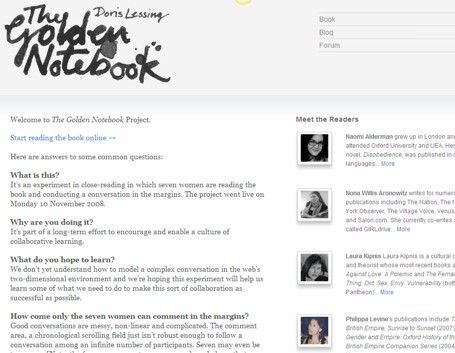
Well, today I discovered a very interesting project which combines serious literature with the trappings of online interaction. It’s called The Golden Notebook project.
Doris Lessing’s The golden notebook was digitised by HarperCollins. The book was allowed to be reproduced in digital form in its entirety without any cost.
Here is some information from the website:
What is this?
It’s an experiment in close-reading in which seven women are reading the book and conducting a conversation in the margins. The project went live on Monday 10 November 2008.
Why are you doing it?
It’s part of a long-term effort to encourage and enable a culture of collaborative learning.
What do you hope to learn?
We don’t yet understand how to model a complex conversation in the web’s two-dimensional environment and we’re hoping this experiment will help us learn some of what we need to do to make this sort of collaboration as successful as possible.
How come only the seven women can comment in the margins?
Good conversations are messy, non-linear and complicated. The comment area, a chronological scrolling field just isn’t robust enough to follow a conversation among an infinite number of participants. Seven may even be too many. [Note: the forums are open to everyone and we do hope that readers beyond the initial seven will join the fray there both as regards the text and the process. We really want to know what you think works and what doesn’t.
The seven women authors are profiled on the homepage. Towards the bottom of the page you can see recent comments, pages with the most comments, and recent discussions.
A reading schedule is included
We’ve developed a reading schedule; so for the next six weeks, you can follow along with the readers and discuss the same passages that they’re dissecting.
The blog, a collaborative one amongst the women, is fascinating. Here’s part of a post on reading by Nona Willis Aronowitz
For me, what is inspiring and magnificent about reading is the sense of communion with one single other human mind. No other artform, I think, is so direct, so unmediated, so simple. There’s no need for lighting, makeup artists, camera operators or directors. There’s no studio or network calling the shots. No orchestra or actors have to interpret the work. I don’t even have to be in the presence of the artist’s personal handiwork. A scattering of printed characters on a page or a screen and I am in the presence of another person’s creation.
Here’s a short section from Naomi Alderman’s post
A recent story in The NY Times asked if stories have a future. If we’re blogging, texting, doing rapid response communicating, who cares about the narrative, tortoise slow and painfully digressive? Naomi’s comment that she needs to come up for air now and then from TGN to overcome the characters’ depressive tendencies makes me wonder WHY DO WE READ? What do we get from books; what are we getting from Lessing? I have just moved from NY to Portland, Oregon with 140 book boxes, the collected treasures of a life spent in books. In each box I am finding approximately one book per 30 worth saving. Looking at them all with fresh west coast eyes, I’m not sure what these books have given me. I can tell you what they’ve taken away: an ability to live a good life OUTSIDE of books.
I’m thinking about the possibilities of a pared down project for students. How would this look?
Fascinating… fascinating….
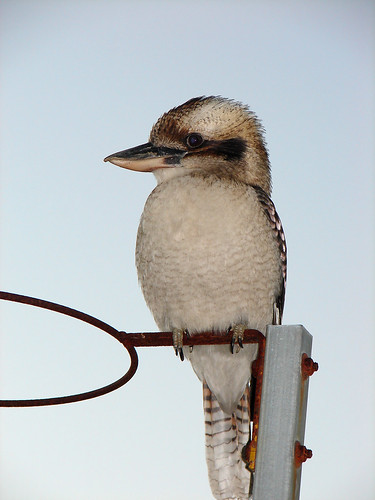
photo by aussiegall
Paul C of Quoteflections tagged me in a meme which goes a little like this:
What is the focus of learning for you in 2009?
What are the important new things you are teaching ?
In her meme, Joyce Valenza wrote
The landscape continues to shift and that means reinterpreting our standards for emerging tools, issues, and innovations.
The landscape is shifting and my own landscape is too.
Here are 5 things I would like to focus on in teaching and learning this year.
1. Collaboration:
I’d like to focus on collaborative learning – encouraging students to learn from each other. I’m working on wikis for art and English, as well as a fiction blog, and this year I hope to bring the school community into it. I’d like these tools not to belong to me, but to be shaped by the whole community.
2. Global connections:
It would be good to break out of the metaphoric echo chamber this year. I’d like my learning and teaching to connect to people outside of the classroom, whether it be another class, another school, a different country or culture. I envisage using things like Voicethread to share ideas and opinions, commenting in blogs to build personal learning networks, and possibly Skype for author talks.
3. Picture it:
With the explosion of visual media, I’d like to think more visually and encourage students to do so. My teaching will expand the concept of literacy. I’m talking about focusing on visual literacy, learning to deconstruct images, creating visually, and exploring multiple layers of meaning in images. Students are comfortable with imagery but need to learn to use and manage visual images metacognitively.
I’d like to involve students in Flickr – putting pictures up, browsing the vast archive of flickr images, understanding Creative Commons, favouriting photos, connecting to others by commenting on their photos, participating in a photo project. I’d like to continue to show students visual search engines, such as Viewzi and SearchMe, and I’m pretty sure that similar search engines will continue to evolve.
4. Thinking!
In this changing landscape where learners need to be discerning and critical, there’s an ongoing need to focus on critical thinking. Not cramming content, memorising material or copying and pasting. Making kids think, question, debate, disagree, compare, synthesise, rethink.
5. The learning process
I’d like students to understand the learning process.
I will be constantly saying: don’t be afraid of making mistakes; that’s how you learn. Don’t be alarmed if something is difficult; it’s part of the process. Don’t give up, but push ahead. Don’t settle for what comes easily, take the challenge and go with what’s hard. Move out of your comfort zone. Know the fluctuation of emotions during the research process. Go with the flow. Learn something real.
That just about wraps it up. My learning and teaching goals for 2009. It’s good to make yourself write them down. Here they are, right in front of me, and I can come back to them at the end of the year to evaluate my progress.
Just realised (a day later) that I have to tag people for the meme. Ok, the following people are tagged; let me know if you’ve already done this and I’ll change my tag list.
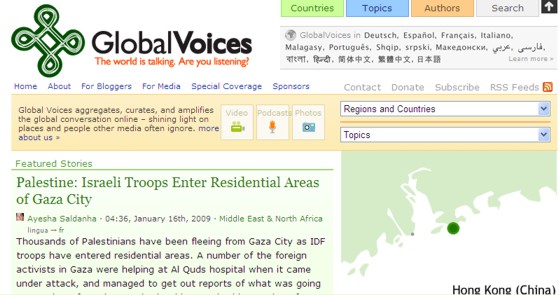
Global Voices aggregates, curates, and amplifies the global conversation online – shining light on places and people other media often ignore
At the moment the special coverage reports on Gaza strip bombings, Thailand protests 2008, Google street view arriving in Japan, and more.
I’m always looking to expand the often selective media coverage on mainstream news services.
A map at the top right of the screen changes its focus on different countries; you can click on the country to reveal how many news articles and links are available for the current day. Today in Kazakhstan there are 3 articles and 11 links available.
There are offshoots of this website including Rising Voices which
aims to extend the benefits and reach of citizen media by connecting online media activists around the world and supporting their best ideas.
This section includes project updates, Delicious links, videos and flickr photos;
Global Voices: Advocacy – Defending free speech online;
Voices without Votes opens a window on what non-Americans are saying in blogs and citizen media about US foreign policy and the 2008 presidential elections
This site is easy to navigate with a search option or browsing option within countries, topics and authors.
I think this would be a valuable teaching resource. Worth noting is the Creative Commons Attribution 2.5 License with ‘some rights reserved’ at the bottom of the page.
Please let me know what you think, and how you can envisage using this resource in the classroom.
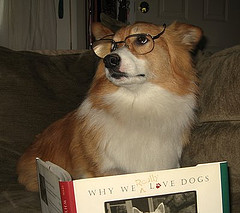
Photo by Sansanparrots on Flickr
Another article about whether reading – in the way we have known it – has changed forever; and is reading books becoming extinct as we are lured by online offerings.
People of the screen by Christine Rosen in the online journal The New Atlantis: a journey of technology and society is certainly worth reading. It tackles this subject with a wide net, and even though you may not agree with everything that is stated, it is an excellent basis for discussion.
The article deals with many aspects of the reading issue. Here it talks about the decline of reading for pleasure:
In 2007, the National Endowment for the Arts (NEA) published a report, To Read or Not To Read: A Question of National Consequence, which provided ample evidence of the decline of reading for pleasure, particularly among the young. To wit: Nearly half of Americans ages 18 to 24 read no books for pleasure; Americans ages 15 to 24 spend only between 7 and 10 minutes per day reading voluntarily; and two thirds of college freshmen read for pleasure for less than an hour per week or not at all. As Sunil Iyengar, director of the NEA’s Office of Research and Analysis and the lead author of the report, told me, “We can no longer take the presence of books in the home for granted. Reading on one’s own—not in a required sense, but doing it because you want to read—that skill has to be cultivated at an early age.” The NEA report also found that regular reading is strongly correlated with civic engagement, patronage of the arts, and charity work. People who read regularly for pleasure are more likely to be employed, and more likely to vote, exercise, visit museums, and volunteer in their communities; in short, they are more engaged citizens.
Here is an interesting take on the type of personality apparently suited to online reading:
For centuries, print literacy has been one of the building blocks in the formation of the modern sense of self. By contrast, screen reading, a historically recent arrival, encourages a different kind of self-conception, one based on interaction and dependent on the feedback of others. It rewards participation and performance, not contemplation. It is, to borrow a characterization from sociologist David Riesman, a kind of literacy more comfortable for the “outer-directed” personality who takes his cues from others and constantly reinvents himself than for the “inner-directed” personality whose values are less flexible but also less susceptible to outside pressures. How does a culture of digitally literate, outer-directed personalities “read”?
I disagree with the contention that screen reading discourages contemplation; in fact, the commenting in blogs, for instance, creates a string of contemplative replies. That this type of contemplation is interactive is surely a positive outcome.
There is too much in this article for me to cover it in a short post. The advantages and disadvantages of the Kindle are discussed, the attention span of young people, the changing nature of libraries, research and librarians’ roles, as well as the future of literature with the advent of hand-held devices that save books as iPods do with music, creating mashups of the paragraphs within different books.
Have a read. Tell me what you think.
[youtube=http://au.youtube.com/watch?v=D1EOJr11bvo]
Viewing a Velasquez or a Rembrandt in a place like Spain’s Prado museum is a unique experience. Now you can use Google Earth technology to navigate reproductions of the Prado’s masterpieces, delving even deeper into the Prado’s collection. In Google Earth, you can get close enough to examine a painter’s brushstrokes or the craquelure on the varnish of a painting. The images of these works are about 14,000 million pixels, 1,400 times more detailled than the image a 10 megapixel digital camera would take. In addition, you’ll be able to see a spectacular 3D reproduction of the museum.
You can have this exquisite experience in Google Maps. There are 3 paintings you can currently view here, with a new painting a day after that for the next two weeks. I zoomed into Bosch’s ‘The garden of earthly delights’ and saw some very strange things happening in detail.
If you visit the Prado museum in Spain through Google Earth like I did, you’ll be able to view paintings in high resolution, as I did when I clicked on Goya’s ‘The 3rd of may’. Here’s what it says once you get there:
We present a virtual tour of fourteen masterpieces from the Museo Nacional del Prado, displayed in ultra high resolution, enabling you to see details of the paintings that have never been seen before. Thanks to the high resolution of the digital images, you can view the whole painting or zoom in on a small fragment. Given the plethora of masterpieces housed at the Museum, choosing which works to include was no easy task but this selection represents the best of the collection.
What a way to learn; you can zoom into these works of art from wherever you are.
Jonathan Jones has a great art blog on guardian.co.uk has an interesting post with the pros and cons of this virtual art gallery.
I’ll get off now so you can get on with the virtual trip. Have fun.
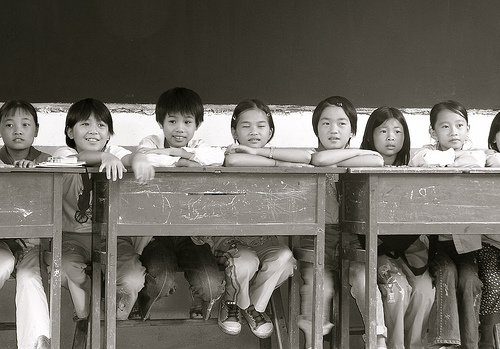
Photo taken by Chris Suderman
In his book Through the children’s gate, Adam Gopnik said this about children:
Children reconnect us to romance. For children, … every day is the first day of love: The passions that for us grown-ups rise and fall only in exceptional circumstances, unexpected storms on the dull normal beach where the tide breaks unchangingly, rise every day for them. Shock, hatred, infatuation: “I hate you,” they cry, slamming the door, and they mean it; and then the door opens fifteen minutes later for dessert. They compel us to see the world as an unusual place again. Sharing a life with them is like sharing a life with lovers, explorers, scientists, pirates, poets. It makes for interesting mornings.
I like this quotation for a few reasons. Firstly, to remind me of the passionate and immediate nature of young people. If at school they seem indifferent, apathetic, unengaged, then we need to ask ourselves why. We look to ourselves and what we are doing as teachers to make them behave in a way which is actually contrary to their nature.
Secondly, this passage tells me what we can gain from being with young people, what we can learn from them. Our role as teachers is not to ‘teach’ them in the sense of pouring into them what we know better, it is to listen, to bring out, to – with time, the time it takes to know a person – understand where their interests lie, what their passions are, how we can harness their dreams to educational opportunities. We provide the environment, teach skills, encourage and guide, but we work with the unknown – the unknown possibilities of what each young person is yet to create, to achieve.
As I think about returning to school soon, starting along that well worn cyclical path again, I’m gathering together the technology tools that I look forward to using with students, but I’m not thinking about the technology – I’m thinking about the process, the learning and teaching process that will take place. This year I’d like to focus on providing learning experiences which are from people, from communities, learning not from static texts but from living, thinking people – some from other hemispheres – from conversations, comparisons, real discoveries. I’m hoping that this year’s learning will not come solely from one teacher. The net will be cast wide. What treasures will be collected in the net?
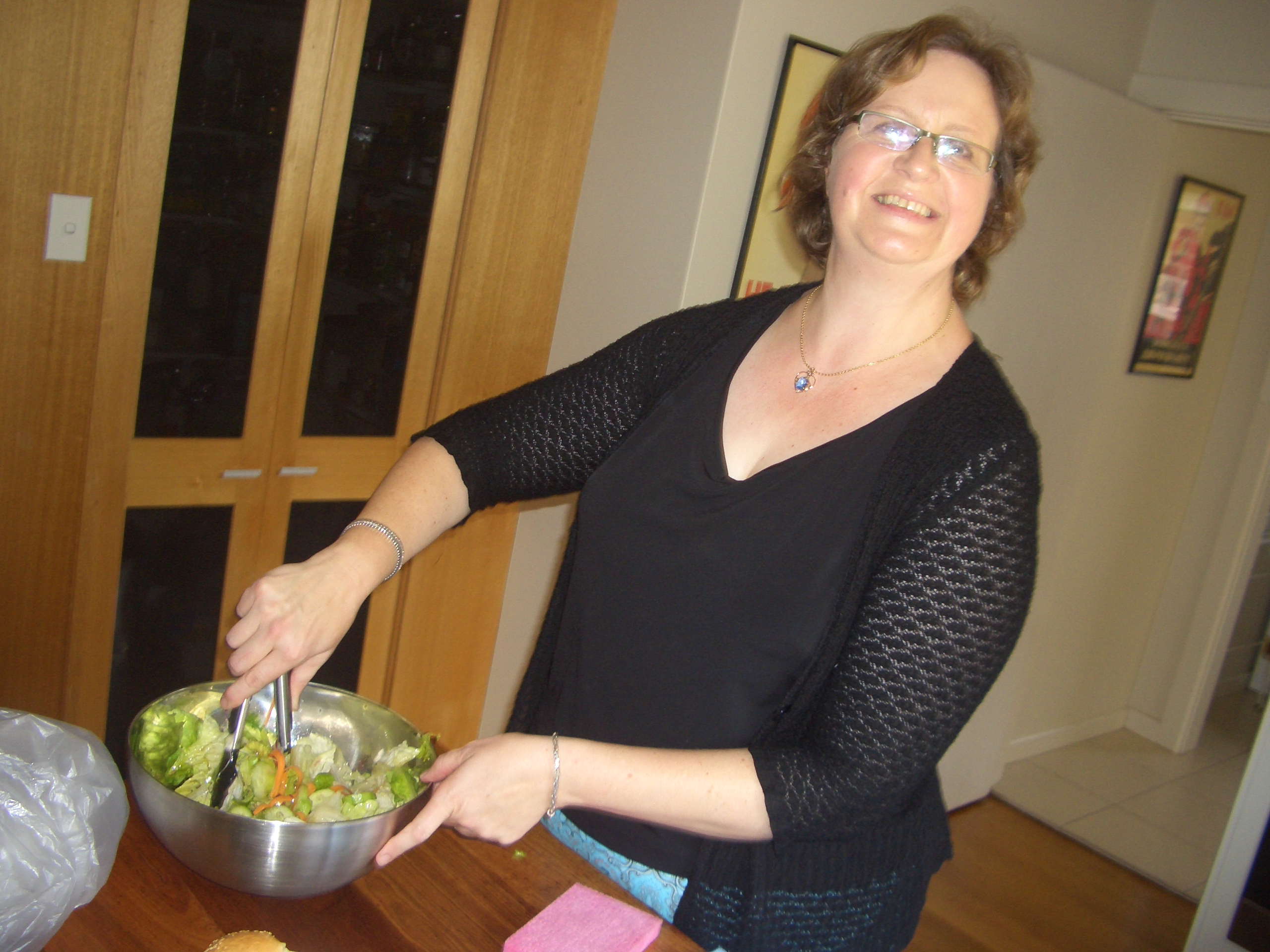
Seems people are taking up the 365 photos challenge on flickr – committing to posting one photo per day for a whole year. Why, you ask? Well, that’s what I asked myself too. Why would you want to commit to more tasks on top of the already toppling mountain of daily tasks? In my usual contradictory way (contradicting myself usually) I found myself joining 3 of these groups which just means I upload the same photo a day to each of these groups. Just in case I miss out on the interesting photos, since different people will be found in each of the groups. The 3 groups are Twitter 365 project; 2009/365photos; 365/2009.
Just today I followed Jo McLeay’s lead and decided to give my 365 photostream a home, so here’s the link to my new blog. If you look at the twelve days of photos, you’ll realise why I’ve been absent from blogging for so long – lots of things to do in the physical world.
Just a few thoughts. As usual. Apart from the fun factor, I think this kind of project has some promising educational possibilties. Getting to know people in your personal learning network through photos and others’ comments is different to knowing them through text comments only. It adds a personal dimension, and the comments don’t have to be cerebral. I imagine the end result will be an interesting testament to my year – memories I may have otherwise forgotten.
I can imagine this as a class project, can’t you? Maybe one which includes teachers, and gives students an insight into teachers outside of the classroom.
Photo by Sakurako Kitsa
You’ve heard me talk about my elder son (Mr 18 yo). He was inspired to write his own 7 things, and I thought I’d reblog them here for some amusement.
By the way, he has inherited bombast and hyperbole from someone in the family, so don’t believe him when he says his parents made him learn piano. No parent can make a child study piano until they get their AMUS certificate.
1. When I was in pre-school, I was convinced I was not a human being. The reason? We were read an environmental-themed book which showed “human beings destroying animals’ habitats”. Logic: human beings practise deforestation, I have never even thought about deforesting anything, ergo I am not a human being.
2. In the past week, I have been eaten by lift doors over a dozen times and almost lost my manhood to a scaffolding pole at a church clean-up
3. Russians don’t have middle names but rather patronymics so my full name is Alexander Petrovich Sheko (which is to say, “Alexander Sheko, son of Peter”). However, when I was young, I decided to rebel against the patriarchal system (you’re welcome, ladies) and called myself AlexanderTatianovich (Alexander, son of Tania).
4. At the age of three (or so), I had nightmares about a dragon chasing me around the backyard. Not just any dragon: the St George dragon. And I don’t mean the generic ectothermic creature of legend, but the dragon on the St George Bank logo. (Ironic twist: Last year I briefly worked for a sales company representing St George Bank)
5. I sing bass but because I have never had proper singing training, my range depends on the temperature, time of day and how long I have been singing. Usually the lowest note I can reach is D below the stave but it can go up to F if I’ve strained my voice. I once sang an A below the stave.
6. My parents made me learn the piano. At various points in time, I despised it and hated them for not letting me quit. I now have an Associate Diploma in piano, am being paid to play for a school musical (Cabaret) and enjoy playing every single day. I consider it a great blessing and one of the most rewarding aspects of my life.
7. A fundamental element of Russian culture is forcing children who have barely learned to speak to commit to memory large portions of poetry and recite them in front of large groups of people. At some point in my childhood, it was decided that it would be a good for my education (despite the fact I spoke very little Russian) for me to participate in this cultural treat and I learned some verses of a poem to recite at the annual Russian Culture Day. Unfortunately, I was sent on stage with a girl (half my age and height) who recited her poetry first. It never occured to me to adjust the microphone stand and I could not understand why several dozen Russians were laughing raucously at my attempt to combine poetry recitation with limbo.
These 7 things were originally posted in his blog under the pseudonym of Phillip Sandwich.
