Category Archives: technology

What’s it worth? A teacher’s beliefs.

Yesterday I unexpectedly leaped into a heated argument with a very close friend who had come to visit from interstate. It was one of those fires that flare up suddenly from a small spark, blazing fiercely long enough for onlookers to look alarmed and consider calling for help, and then burn down gradually, leaving those involved in a slightly shaky state, surveying the damage.

The offending spark was a question about why my friend’s daughter didn’t have Facebook, and if she did I’d be able to view her photos from the Ball she was attending that night. Remember, these friends live interstate.

Now, you can imagine, with a blazing argument, most of what goes on is reactive, and each person becomes locked in to a mainly defensive position, taking each comment personally and wanting to come back strongly enough to defend their position. There isn’t any room for thought or even fair appraisal of what the opponent has said. Luckily, the latter occurred as the fire burned down; concession and reconciliation was possible in the smouldering stage.

I can only speak for myself in this argument, and I will.

I reacted to my friend’s initial painting of Facebook and MySpace as bad places (which, I think, he must have said unconsciously, because he later denied it), places where, at best, young people wasted their time with inane conversations, and, at worst, young people exposed themselves graphically involved in the worst behaviour.

If I hadn’t been so defensive, I would have said that I’d been there not so long ago. I was initially against my older son interacting online, either msn or Facebook/MySpace. I gave many reasons, but one I pushed the strongest was that online interaction was not real, it was virtual. It was unnatural, it took away from the time spent with people face to face, it was potentially dangerous because it increased solitary time with virtual friends, etc. Why didn’t he use the phone if he wanted to talk to someone? How could he be ‘friends’ with all those people? That wasn’t friendship.

Funnily enough, these were some of the points my friend expressed, in between dodging my line of fire. I wonder (always wonder) when I’ll learn that the conversation ends when the other person feels attacked.

What has happened from the time I held my friend’s convictions and now? Several things. Instead of making conclusions about social networking and online environments from the outside, based on what I’d read, on media reports (which are mainly negative and engender fear in parents and teachers), I decided to play around with these things myself. What happened? I connected with people I hadn’t talked to for years (even decades), I saw photos of where they lived, saw status updates of what they were up to – no, not just what they had for breakfast –  they were about to become parents, or they were travelling overseas, etc. No, I didn’t have deep relationships with all of these people, but I did appreciate suddenly having a general view of what my ‘friends’ were up to, and many of these are scattered all around the world.

I also saw a different side to young people, definitely different to the picture that is often painted in the media, or even in conversations held by people who have little to do with adolescents or university-age students. I saw these people supporting each other with positive comments, engaging in humorous and often witty dialogue, planning events and meetings, putting out interesting links to things they had read or music they listened to, venturing to express opinions they might not in real life.

One of my main points in the aftermath of the argument was that social networking supports real-life interaction. The young people I observe are less isolated than I used to be at their age, not only because they can chat to a group of friends at home in between homework, but because they use these connections to meet up and do something together. They inititate interest groups, they gather friends for events, they learn to function as social beings – important skills for life and work. They do this because these spaces belong to them. They’re not forced to create a group and contribute to discussion; they choose to because of personal interest.

Which brings me to my next point. How much of this initiative and cooperation do we see in schools, in the classroom? Do we see discussion, do we see young  people sharing their interests and passions? Or do we see disengagement, boredom, solitary struggle in place of collaborative effort? Is there room for students to take initiative, pursue interests, work together to solve problems, get involved in real-world research and enquiry.

Are we getting the best out of our young people at school?

To finish my rave, yes! I agree with my friend that there is potential danger in online involvement. And I believe we should discuss these dangers. We should take every opportunity to educate our young people about the irreversible nature of what they put out the web. But we could also create a safe, online environment for them to use at home when they need help with homework, or when they want to share ideas for a project. A place they could become teachers as well as learners. An exciting place where they are enriched by the diverse contribution of others. Where they learn to respect each other. Where they are not afraid to ask questions.

As an educator, I’ve been pushing my boundaries, often painfully, against what I felt comfortable with. But I want to keep my eyes open, and I’m trying to re-evaluate constantly, and I know that I must do that if I’m to have any part in educating young people for their future. No, not going with all the latest fads, not embracing new things without thought, but thinking deeply, and listening to the dialogue in my own online network, asking the deep questions….
Google image search on the fly

Google’s new experimental Similar Images feature in Google Labs has improved image searching with the addition of ‘similar images’, allowing you to narrow your search and change your mind on the fly. Have a look here. It’s in its experimental stages.

[youtube=http://www.youtube.com/watch?v=6fD2t4d2Ln4&feature=player_embedded]

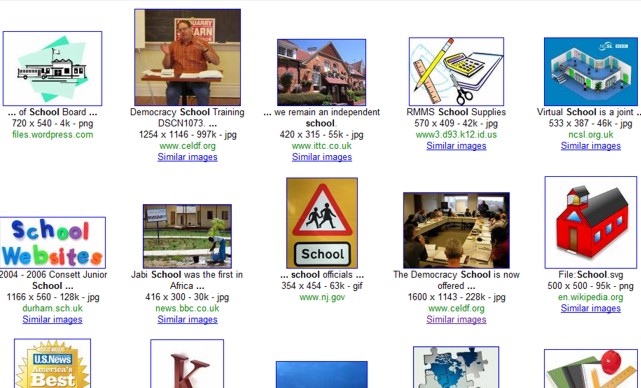
I searched ‘school’ and, predictably, got all types of ‘school’ images.

googleimagesearch1


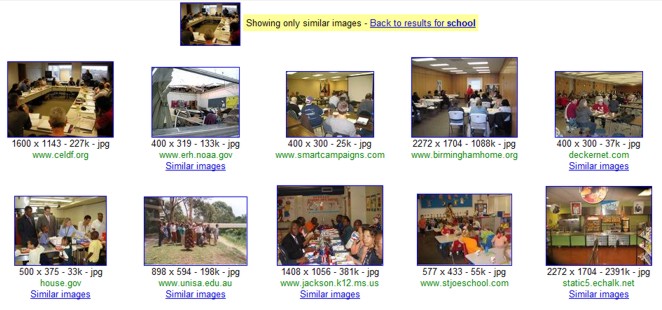
What I specifically wanted was images of classroom interiors so I clicked on ‘similar images’ under the one result.

googleimageschool

I think this is an easy way to get rid of unwanted results and refine your search.

What do you think?

Teaching 21st century literacies

Howard Rheingold  has written an article for City Brights on 21st century literacies.  His opening paragraph asks essential questions for the future (and present) of education:

Will our grandchildren century grow up knowing how to pluck the answer to any question out of the air, summon their social networks to assist them personally or professionally, organize political movements and markets online? Will they collaborate to solve problems, participate in online discussions as a form of civic engagement, share and teach and learn to their benefit and that of everyone else? Or will they grow up knowing that the online world is a bewildering puzzle to which they have few clues, a dangerous neighborhood where their identities can be stolen, a morass of spam and porn, misinformation and disinformation, urban legends, hoaxes, and scams?

And here in a nutshell is the definition for 21st century literacies in plain English. What concerns me, and many others, is that the shift from traditional literacy to these 21st century literacies is not occurring in schools on any significant scale. An understanding of the critical need for a focus on these literacies isn’t happening from the top down, nor from the bottom up. And it’s not going to happen unless we, educators, step out of our teaching role and immerse ourselves in the 21st world as learners.

As far as I know, on the whole Australian schools still view online involvement for students as ‘a dangerous neighborhood where their identities can be stolen, a morass of spam and porn, misinformation and disinformation, urban legends, hoaxes, and scams?’ This is part of the reason for inaccessibility and filtering; for the rules prohibiting the use of online games and mobile phones at school. We talk about integrating technologies into the curriculum, but we still view these technologies as the enemy.

Perhaps many of us are uncomfortable about using new technology. We figure our students are naturals, that they’ll figure out the technology thing by themselves, better without us. Howard Rheingold questions the term ‘digital natives’ applied to our students:

Just because your teens Facebook, IM, and Youtube, don’t assume they know the rhetoric of blogging, collective knowledge gathering techniques of taggers and social bookmarkers, collaborative norms of wiki work, how to tune and feed a Twitter network, the art of multimedia argumentation – and, by far most importantly, online crap detection.

Rheingold makes it very clear how urgent it is for our students to be educated in 21st century literacies:

If you think that forgetting to teach your kids the facts of life is dangerous, wait until you witness the collision of a global superempowered infrastructure with a population of illiterate users.

There’s no mincing of words. According to Rheingold, our students will be illiterate if we don’t redefine our concept of literacy. What literacies are we teaching our students at present? Are these in line with the world in which they will live and work? We may not like digital media as much as our students, but isn’t our job as educators preparing them for their future? Their future is digital, global and networked. Digital literacy is not so much about the mechanics of digital tools; it is much more than that:

The most important critical uncertainty today is how many of us learn to use digital media and networks effectively, reasonably, credibly, collaboratively, civilly, humanely.

One of the commenters identifies the importance of teaching critical reading skills. Howard adds that ‘some, perhaps many, view critical thinking as a frivolous distraction from “the basics”… Others say that there is nothing new about this requirement’.  For teacher librarians, teaching critical reading and critical thinking has been part of their role for some time. As a teacher librarian,I find this problematic –  not the fact that we are delegated this teaching role, since we are ‘information specialists’, and our role must evolve in line with developments in the world of information – but that this teaching is seen as somehow separate from ‘the real curriculum’, that we come in for one lesson or two at most, and teach ‘information skills’ as discrete skills. We all know that this doesn’t work, that the integration of critical, digital literacies must be integrated fully in everyday teaching, and that curricular material must be selected with this teaching aim in mind. Our choice of medium must support the teaching of these literacies. If we use blogs, wikis or nings, it is not because we are ticking off our use of Web 2.0 technologies for the sake of being recognised as Web 2.0 savvy, it’s because we recognise that a networked learning  environment is the best way to prepare our students for their future. If we teach our senior students to critically evaluate newspaper articles and advertisements, shouldn’t we finally take the leap to teaching them the skills they need to navigate the deluge of online information?  They’re not reading editorials as much as they’re watching YouTube videos. Will they continue to get their news from newspapers? Or will they prefer real-time, real-people news reports on Twitter?

What are your thoughts? Let’s have a discussion.

Reblog this post [with Zemanta]

Stephen Downes in Melbourne

cimg68631

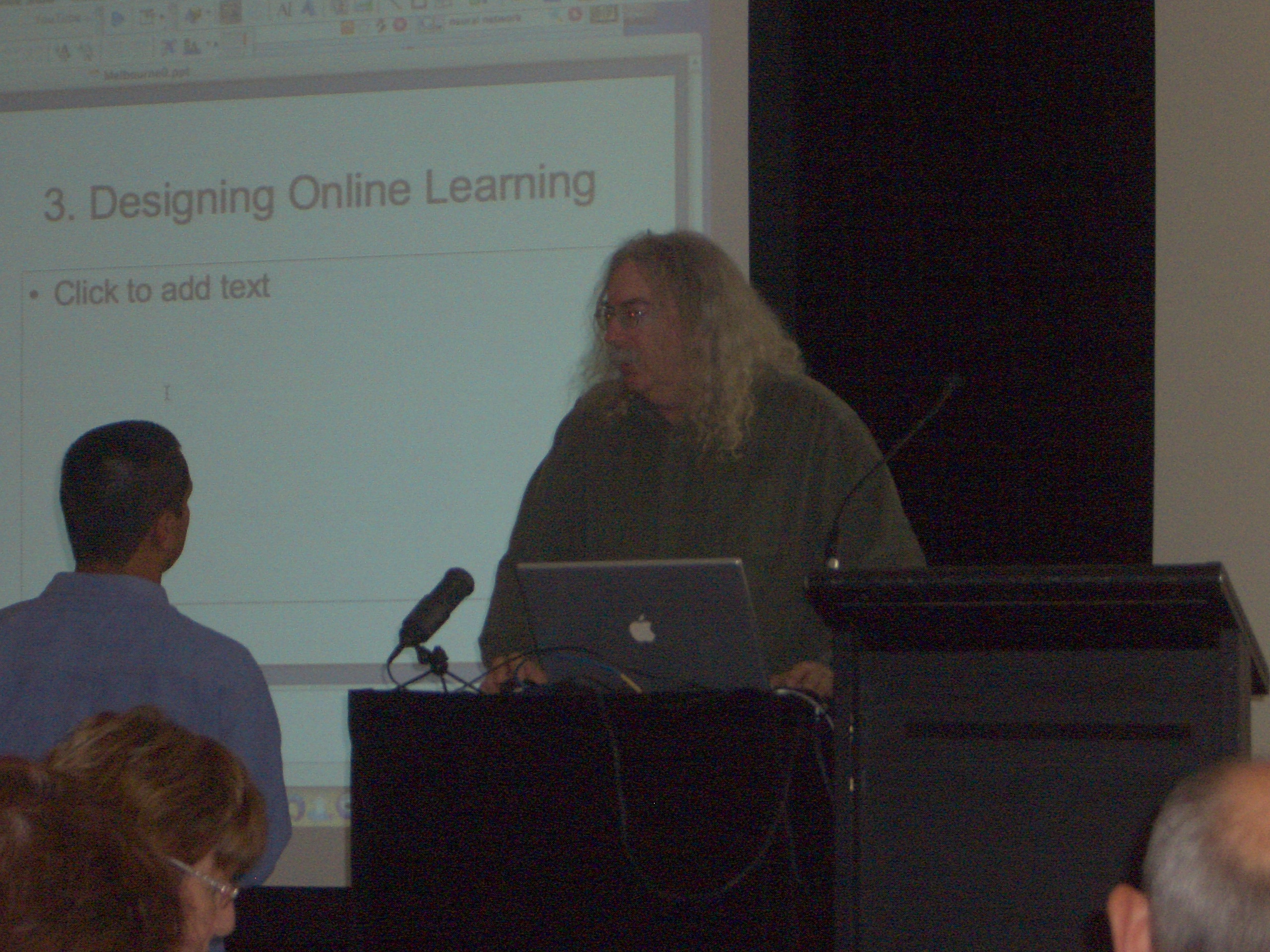
Why did I go to a professional event on the first day of my Easter holidays? Two words: Stephen Downes.

Stephen started by prompting reflection:

Reflect on how you learn in your job today?
How do you learn to use new technology and keep up with events and announcements? How do you learn new policies and procedures?

Then he made an interesting, perhaps controversial, comment. He said
there’s a distinction between the way we learn and the way learning is taking place in universities, etc.

What does that mean?

As I’ve mentioned earlier, my first-year uni son has confirmed for me that he learns in the same way that I did 30 years ago. Lectures and tutorials. Online forum? No. Sharing notes in Google docs? No. Creation of personal learning network using RSS, Delicious or Diigo, or Twitter. Absolutely not.

I know that some tertiary institutions are more progressive with online learning, but these are not the established, traditional ones so sure of their reputation that they forfeit self-assessment. Maybe I’m being unkind. After all, they provide experts. One expert per subject. Are the students learning how to learn in a global context where experts are scattered?

Stephen says we need interactivity in our learning; we need to learn from people. Instead of relying on traditional models of learning, we need to build our own interaction network, placing ourselves, not the content, at the centre.

I’m thinking about secondary school students. A teacher picks the content which is the agenda for learning. What about the interests, the passion of the individual student that could drive authentic learning? Isn’t there room for passion-driven learning in our curriculum?

Stephen says to employ a wide range of technologies to build our network. We need to pick and choose the technologies that are most comfortable to us. Pull is better than push, we should be able to choose our sources. He tells us to speak in our own voice and listen for authenticity; share our knowledge and our experiences, opinions.
We need to make networked learning a habit and a priority. He said someone had coined the phrase ‘interaction is like breathing for the brain’. If interaction isn’t provided, we have to make it ourselves, for example, if we’re at a lecture like this, we should blog it. Hence this post.

Stephen sees information and knowledge as people-centred. That is, we should bring knowledge in, but also translate it into our own way of seeing the world, and then share it, creating a network for people to remix in their own way. This is one of my favourite new concepts of knowledge – it evolves depending on who does what with it; we’re all unique, and so is our take on knowledge.

But how do we control knowledge as we pull it in? We simplify it, and summarise it in our own words, using our own vocabulary. Make it relevant to us, take what’s important to us now. Shouldn’t students be taught to learn this way?

And then it really got interesting. Stephen said, it’s better to shun formal lectures (certain irony here) in favour of informal learning, eg. the Google Reader approach to learning; learning from people we’ve decided we want to speak to us.

And what about this: Do connect to your work at home and on vacation but feel free to sleep at the office; most work environments are dysfunctional;your learning takes place when it takes place. Your best time might not be 9 to 5; ideas and learning happen when they happen.

And here’s one for those of you who, like myself, often feel overwhelmed by the flood of knowledge they’ve pulled down on themselves. You don’t want to assimilate all that knowledge. Let go, it will come back if it’s important; information is a flow, not a collection of objects.

Self-directed learning is a theme with Stephen. You and nobody else is reponsible for your own learning. These principles ought to inform how we teach as well as how we learn, and that’s what connectivism and Learning 2.0 is all about. Self-directed learning rejects passivity, so get up and walk out if what you’re hearing doesn’t interest you. Be pro-active; take responsibility for learning.

There’s a lot more to Stephen’s talk than I’ve managed to outline here. This will do from me.

Have a look at the Connectivism and Connective Knowledge Online Course. created by Stephen and George Siemens.

If I had to say one thing that I came out thinking about today, it would have to be that learning is personal, and that we must be pro-active about finding, organising and creating our own knowledge, about what we learn and who we learn from. And in this way, if we learn transparently, we model learning for our students.

Student bloggers speak out eloquently

On the blog Free resources from the net for special education Paul Hamilton has written a very interesting post sharing his views on student blogging in Jan Smith’s grade 6 class, and a video where he interviews his students about their blogging. If you have any doubts about the value of student blogging, then watch this video. You’ll meet students with different capabilities and interests, explaining what they have learned from blogging. They’re very expressive and specific about how their writing has improved with blogging – and not all of these students like writing. You’ll also notice that they’re able to focus on their special interests and passions in their blog writing, and you’ll see how much work they’ve put in with research and visual presentation, and how proud they are of their efforts. It confirms for me what I’ve been raving about of late – that learning occurs when it’s student-driven, passion-driven, and authentic, with an audience consisting not only of the teacher, but of peers and even people all over the world.

When I listened to the kids on this video talk about their blogging experiences, I was amazed at their ability to reflect and evaluate their learning since taking up blogs. They have become experts in their area of interest. Their passion has driven their depth of research, and they’re more likely to learn from each other than from information presented to them by their teacher out of context and unattached to people they know.

Listen to the girl who loves blogging. She describes blogging as ‘another part of me’.  She blogs outside of school hours because she loves it. When asked to explain why blogging is better than normal classroom writing, she lists the feedback (‘The whole world sees my writing’); the fact that she can speak out and let people know what she has to say, that she can write. What does she write about? What has happened. She writes about what she has read, what has happened in her life, and in the rest of the world.

Take a look at the video. If you jotted down the advantages of blogging as these kids speak, you’d have a decent presentation for principals or staff in general in defence of student blogging.

[googlevideo=http://video.google.ca/videoplay?docid=-5516786120599905125&hl=en]

Powerful Learning Day

Today was the second face-to-face get-together of the Australian teams involved in Powerful Learning Practice. We had so much fun listening to Will Richardson, connecting with Sheryl Nussbaum-Beach, skyping Dean Shareski, having powerful conversations, problem-solving, making connections, deepening friendships.

Thanks so much to Will for being there, leading and inspiring us, and to Jenny for creating this opportunity, then organising everything. We are starting to make a difference.

You’ll find a few more photos here.

Will Richardson speaks in Melbourne

willnetwork

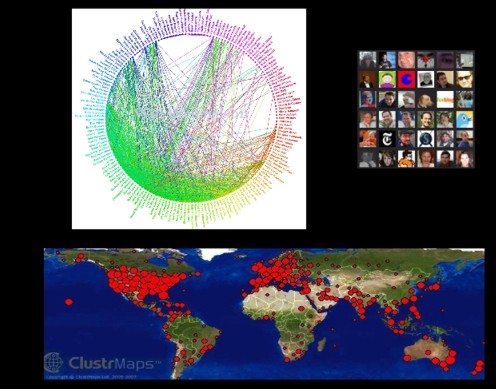
 Will  Richardson’s networks

I’m guessing there will be several blog posts about the SLAV conference, Perspectives on learning V2 today. I have considered whether to leave it to others, but a post always deconstructs my own thinking, and creates an archive for later reference.

Will Richardson was the keynote speaker, and he spoke about Network literacy: leveraging the potential of a hyperconnected world. There were concurrent sessions by Jenny Luca (Now you know Web 2.0, what next?), Adrian Camm (Why create a virtual learning community), and John Pearce (Projecting passionately with Web 2.0). The Plenary session was presented by Kerry Rowett and Judith Way (Web 2.0 and resources for you), who write the SLAV blog, Bright ideas.

SLAV is to be congratulated on providing cutting edge professional development, and also on providing links to the presentations on their Bright Ideas blog.

What I’m not going to do is summarise the talks. The slide presentations will give clues, and the podcasts to follow will provide the detail. What I’m going to do is pull out of Will’s keynote speech some of the main points that resonated with me.

Firstly, anyone who has read Will’s blog or looked through his Delicious tags, will know that network literacy is a leitmotif throughout his writings. If you compare the idea of network literacy with our traditional concept of literacy (at its most basic, reading and writing), then you have an idea of how Will stretches the idea of literacy, and also where his focus is. The hyperconnected world he speaks of is a connectedness which is made  possible by technology, but which is not focused on technology itself, but on a connectedness with people and people networks. And these networks are the source of information for Will. He doesn’t Google when he needs information, he goes to his Twitter or Delicious communities. When he wants to know what ‘s going on in the world, he doesn’t just read newspapers, he prefers to go to his personally designed sources in his Google Reader (RSS feeds), or to his favourite bloggers when he wants deep conversation. He connects with people who share his passions, with experts far and wide, and he urges us to do the same.

And so we shouldn’t be surprised when Will speaks of schools as places which need to change. He quotes Clay Shirky (Here comes everybody) who says we have to get outside of our physical spaces which define our schools and learning, and connect with people and networks globally. He reminds us that our students have already made it out to networked activity through social media sites like Facebook and MySpace. He pre-empts our concerns that Facebook is trivial and uneducational by pointing out that kids are already moving beyond the superficial and using social media to form interest-based groups, where their interaction is based purely on passion and transcends physical space, time zones and cultures. We are impressed when we realise that these experiences place kids in a position of being teachers as well as learners. We really get the point when we hear that this all happens outside of school, when it hits home that self-organised learning and teaching activities driven by pure passion are taking place outside of our learning institutions. While we have the problem of increasing disengagement in our classes. The point hits home with some discomfort.

Here are some points that came out of Will’s talk:

  • learning is an ongoing process, not something that fits neatly within a measured time frame
  • blogging allows us to rethink what it means to read and write; it becomes a connection, a conversation with an authentic audience
  • literacy is malleable and will evolve further in the next few years
  • multimedia texts expand literacy to include critical thinking and analysis
  • we need to create and navigate our own personal learning network, and teach our students to do the same
  • network literacy cannot be taught as a one-off course
  • we need to help our kids create a digital footprint, so that they have positive results when googled

Listen to the podcast when it comes onto the SLAV website for the rest of the talk.

Jenny Luca’s talk was a passionate account detailing her journey from Web 2.0 to making a difference to the lives of many people with the help of individuals and communities around the world. Amongst other projects, she spoke about Working together to make a difference which she is most proud of, since it is testimony to the best of people’s collabortive efforts.

I could go on; all the talks I attended were extremely interesting and relevant to educators. It’s the kind of resource and ideas list that could keep you going for a very long time. I’m already using most of the Web 2.o tools and applications that were mentioned, but I’m trying to integrate them into relevant and creative learning and teaching. What I have learned from hearing people like Will and Jenny speak, has not centred on new tools, but shifted me into a different direction, provided me with a new perspective.

What I’d love to find out now is how the audience received these talks, how people felt, what they thought, what resolutions, if any, did they make as they walked out of that conference. Did it make a difference? Please leave your honest comments here, and perhaps we can have a conversation. Did the talks effect a shift in your perspective and teaching direction, or did it just make you shift uncomfortably in your seat?

Tinkering as a mode of knowledge production

Listen to John Seely Brown’s talk where he addresses the Carnegie Foundation for the Advancement of Teaching, Stanford, CA, 2008.

[youtube=http://www.youtube.com/watch?v=9u-MczVpkUA&feature=player_embedded]

I am what I create is how John Seely Brown defines our new identity.

I’d like to paraphrase what John says in his talk ‘Tinkering as a mode of knowledge production’, and also to offer some of my own thoughts.

Here’s the gist: Since many of the skills that we learn today have become obsolete several years ago, we must find a way to get today’s kids to embrace change, to want to constantly learn new kinds of things, to find a way to play with creating knowledge on the fly by experimenting with things. Notice how different this is to the traditional learning of finite knowledge imparted by the omniscient teacher . How do we initiate this tinkering, this creating of knowledge? John Seely Brown says we need to look for ways to foster the imagination; if there’s no imagination, there’s no creativity. And he places the tinkering learners within a new culture of sharing, in peer-based learning communities, where kids learn from each other. The challenge, he says, is to find new learning environments. We need to go back in time, so to speak, to the comprehensive classroom that had students of all ages in it, where the teacher was the organiser, the facilitator, and where students’ learning was as much from other students as from the teacher. We need to construct an environment where we are constantly learning from and teaching each other. And now for the tinkering.

What is tinkering? John Seely Brown sees it as the creation of something concrete as opposed to abstract or theoretical learning out of context.

Let me take my imagination and build something from it. Build something concrete instead of decontextualised knowledge. Once we’ ve created this concrete thing, we can see if it hasn’t worked, why doesn’t it work, and ask questions: how to build it better. We expect this thing to do something.

Why do we need this new learning environment? We live in a different type of world, one of rapid change. We need to find ways to tinker with ideas, ask good questions, and be able to take criticism. We need to learn in this architectual studio, where all work in progress is made public .

This makes so much sense to me. Currently, as part of our project for the Powerful Learning Practice program in which our school is involved, we have decided to create a NING, a whole-school online learning network, in order to bring the members of our school together, learning from each other, sharing, and making all our processes and projects transparent. In the new learning environment Brown speaks of, we are all able to witness each other’s struggle, understanding the process each of us is going through. What a powerful way of learning with and from each other. As Brown says, when the design is finished, and you overhear the master critiquing another’s design, this has tremendous meaning to us as well because we’ve been part of the process of the each other’s constructing of design. In this distributed learning environment, you learn to accept criticism. You want to be critiqued, you appreciate criticism, you learn from it. Brown sees this as one of the key platforms for lifelong learning and in embracing change.

Today’s networked technology allows us to build distributed communities of practice. Instead of us physically working shoulder to shoulder with others, our avatar is working shoulder to shoulder with others. We have infinitely more powerful tools to craft things, to mash this up. Creativity takes on new possibilties through tinkering – our tools not only allow us to create but also remix. In a short space of time, we can take what we see from others, rework it and recreate it, then give it back to the community for further reworking. How much better is this than isolated learning and creating?

The second message in John Seely Brown’s talk is something I’m very excited about. It’s a positive statement about young people today, and I urge everyone to think about it seriously, because it counters the many negative statements that are thrown out about young people in the age of technology. We are on the cusp of the creation of a new identity. In prior decades a lot of kids grew up thinking ‘I am what I wear’, or what my parents own, or how much money we have. Identity came from material possessions. I’d like to add to that by saying that identity also came from what we did for a living. Our occupation was who we were. It was the name of the occupation that was important, not the internal workings and processes of these occupations.

Here is the most exciting part of Brown’s talk for me : JUST MAYBE, he says, just maybe we are entering into a world now where our own identity gets defined by what we’ve created and what others have added to it.

This is a sense of identity constructed for myself. I passed something onto others, and they have been able to do wondrous things with this as well.

I can relate to this so well. When my children were younger and I was unable to teach full-time for several reasons, I was a ‘housewife’. I was not a teacher, I was not a thinker, I was not someone with creative talents, I was defined by my title. Now that I’m a teacher once again, I’m pushing beyond this title too. In my writing (which is really a remashing of my reading of others’ thinking with my own thinking) in my blogs and personal learning networks, I’m stretching my identity to include much more of my potential, and I’m doing this shoulder to shoulder with many others around the world. Technology is allowing me to recreate myself along with others – unlimited by my geographic location, unlimited by time zones. I’m creating my own identity within a new learning community. I’m a teacher, but what’s most satisfying and comfortable for me, I’m a learner.

As John Seely Brown says THIS IS A DIFFERENT WORLD.

Teacher’s guide to Twitter

Still in Twitter mode, I’d like to share the teacher’s guide to Twitter by Kate Klingensmith on her blog Once a teacher.

Kate’s post answers those who question whether Twitter is worth the effort – and perhaps all of us have been there. I was certainly there not long ago, and am still expanding my Twitterverse.

Most people start off in a rocky relationship with Twitter.  It doesn’t seem to be as easy or as useful as everyone has said, it takes awhile before you find your niche, and there is an overwhelming amount of information to deal with.  But, just hang on – it’ll be worth it!!! 

Kate links to Mark Marshall’s post ‘Twitter: what is it , and why would I use it?’  Mark explores how to get started, why you would want to share stuff with strangers, and how to get followers in order to make  Twitter a meaningful experience. After all, there’s nothing sadder than a Twitter account with only a handful of followers.

Kate also posts useful information, such as how to manage your life on Twitter, how to control all that information, and favourite Twitter-related tools, and Twitter links.

Finding people to follow is initially problematic. Kate helps out by sharing directories of educators and professionals on Twitter, or suggesting that people use the Twitter Grader keyboard search, or Twitterholic.

I found Kate’s advice about keeping up with the everflowing or even overflowing Twitterstream very helpful (since at times it’s like trying to keep up with the treadmill without falling over

You’re standing on the bank, enjoying the stream as it passes, but you can’t worry about enjoyoing every drop of water that’s there.  Don’t worry about the tweets you missed – I promise that there are always, currently, very interesting things to read.  But – it is nice to catch up sometimes by browsing old tweets on peoples’ profile pages.

Also useful are the links to shorten urls, such as tinyurl  and fun symbols you can use in your tweets. It’s all part of the Twitter grammar and vocabulary.

My favourite section of Kate’s post, however, is the one that links to her favourite Twitter-related tools. Tweetdeck is a more attractive and organised way of receiving tweets; Retweetlist tells you who’s hot on Twitter; and my favourite for today – Twistori, where you can search tweets that start with ‘I love; hate; think; believe; feel; wish.

I wish that I could twitter about something other than food today, but I’m so hungry now;

I love the way the brain cell finally gets up when the body has already begun the day

I hate chasing the clock

Okay, that’s enough reblogging. Here’s where I discovered this fantastic post – on Top 100 Edu Tweeters, which has been revised recently, I’m sure.

Thanks to @Elizabeth Koh for the Top 100 link.