Category Archives: Uncategorized

How did my presentations go?

How did your presentations go?

People have been asking me this since last Friday when I faced two groups of people and talked about my experiences with nings, flickr (and briefly blogs) in the classroom, and how these things can create learning communities.

Well, I’m not sure how I went, to tell you the truth. I’m really not certain.

This is the first time I’ve presented at a whole-school professional development day – I did present with Maria Toomey last year, very briefly, about our Year 7 English ning at a staff meeting. And that’s it.

So here are my thoughts:

It was definitely a good experience for me. I had many moments during the session where I realised things, and this will contribute to my own learning and hopefully improve further presentations if they ever occur.

I realised that my Web 2.0 experiences have been predominantly within humanities areas, centering on discussion, reflection and sharing of ideas and viewpoints, construction of deeper understanding, and peer interaction. I haven’t had as much contact with maths, science, commerce teachers (apart from Nicole’s forensic science blogs), and haven’t seriously considered the fact that not every educator’s teaching depends on these things.

I’m usually hard on myself, and I will acknowledge the many supportive, positive comments I received from staff, but I think that I have a lot to learn about presenting in an engaging, relevant way. I intend thinking about this and perhaps paying attention to good speakers – our guest speaker, Travis Smith, being one, and the speakers who have just participated in the TEDxNYED talks which I missed because my notebook’s connectivity has been so sporadic.

Here is what I had in mind, and what I did for the presentation:

I wanted to show how rich the learning can be within collaborative Web 2.0 platforms, so I created a ning as a temporary sandbox for newbies. Within the ning, I created groups for some of the subject areas, and as more people joined my session, I expanded these groups, and tried to include a few resources and questions for discussion to give people an idea of how the ning could work for them. I created a collection of videos which provided either background to Web 2.0 technologies, or the future of education.

I had so much to share, and I knew that I wouldn’t have time for everything. The last thing I wanted to do was overwhelm everyone with theories and pedagogy, so I included a few of my blog posts which had already detailed the ning and flickr experiences. I added bits and pieces for discussion, including relevant and challenging quotations, a cool little flash demo about how high blog commenting rates in Blooms Taxonomy, and so on.

Photo courtesy of ecastro on Flickr in group ‘Great quotes about learning and change.’

My original plan was to start the session by acknowledging change, and how, as educators, we may feel overwhelmed or frustrated by it. I showed Karl Fisch’s video, What if?

This is what I showed the first session. I followed this up by asking the question, ‘How do you learn?’ I had set up a discussion for this within the ning, and included my own answer as a starting point.

I learn by writing things out, by making colour-coded charts and maps. Obviously now it’s much easier to locate information – I google instead of going to the library or consult an encyclopedia. In some respects, the way that I learn has changed over the years. I used to learn from one teacher, or by myself. Now I learn from and with people. I ask, I have discussion with others, I ask questions. I’ve built up an online personal learning network – people who are experts in different fields, educators mainly, but also people who push my thinking. I can ask these people for information, advice or their ideas any time and anywhere.

Teachers wrote their answer, read other teachers’ replies, and commented on these. The idea was to immerse them in a ning discussion, giving them an idea of how the threaded discussion worked, and how valuable this online discussion was in terms of collaborative peer unpacking of a topic.

That worked pretty well, without any dramas. Most of the staff wrote thoughtful replies,

I like to find things out for myself and discover new pieces of information. I like to take information or ideas from one field and apply them to another field. I like to see the possibilities of things and explore their extent.

others had a bit of fun,

We’ll try to make sure the office is a calm place for you to learn. Would you like us to bring some scented candles in???

and I think that’s a fair indication of what our students might do. So that’s cool.

It was interesting to see the beginnings of dialogue which extended the thinking through collaboration:

I learn through discussion with others. I find that discussion inspires me, and helps me to order my thinking. I tend to use this style of teaching in my classroom.

reply to this:

Do you think that how we learn and how we teach is different?

Originally, I had intended to follow that up with a video that showed how students learned, The digital generation. This was to be the lead-in to the whole point of the nings, etc. – as a connective learning platform within which our students felt comfortable, one which suits the way they are used to interacting with each other –  the point being that they learn best with and from each other instead of from the teacher, and writing for the teacher only.

I didn’t show this video in the end, either session. I don’t know if I just chickened out, but I got the feeling from my audience that they hadn’t come to think about the future of learning, pedagogy or anything like that. I felt from them that they’d come to consider whether nings and things were the way to go with their compulsory ICLT project. I made the decision on the spot to modify my approach and just supply practical and relevant information and instruction.

So from that point, I showed them a couple of nings which had been working very well – both within senior English classes. As I spoke about these, and later our flickr global photo project, I was aware that teachers who didn’t rely on the construction of knowledge and understanding in students from discussion and predominantly through writing, wouldn’t find my information relevant.

I have to say, it did affect my confidence and I felt that I withdrew in terms of dynamism. It’s not that I lost all enthusiasm, it’s just that I felt I hadn’t prepared sufficiently for all members of the audience. That had something to do with the fact that many of these had only joined my session very recently, in some cases that morning. Still, I think you do have to think on the spot and make spontaneous decisions after you get a feel for the audience.

As I mentioned earlier, many people were generous with their supportive feedback to the session. I would like to follow up with the rest, and find out whether they found the talk useful, and how I can provide answers to any questions they may have. I do feel I can do more through individual conversations.

It was disappointing that some teachers were not able to get into the ning – not sure why – and I’d like to try again, so that they can at least have a look around and see if there’s anything that interests them. The videos alone are a good resource, and I’m hoping that someone might take the time to look through these, as well as read some of the posts I’ve included.

I wonder if the ning will become a place I can continue to throw out interesting resources, links and videos. It may just die a natural death. I like the fact that it encompasses the whole school, and that I could potentially replace the separate emails to staff with ning group resourcing.

I wonder if the flickr project sparked any ideas in teachers other than those of English, foreign languages and English as a second language. I’m really keen to see what teachers can think of, where they can take some of these ideas. There’s no doubt that people will think of things that I haven’t, and I hope to gain from these perspectives.

Overall, it’s been a valuable learning experience for me, taking me out of my comfort zone, connecting me with teachers I would normally not see, and providing me with the challenge to synthesize my own experiences into an oral presentation to a broad audience.

If anyone has experiences or resources to share, I would be grateful.
Are we still learning? Global flickr project

This has been cross-posted from Through Global Lenses @wfc.

Photo courtesy of Flickr Creative Commons

Time to do a stocktake on what we’re learning here. Una and I smiled when the boys yelled out an enthusiastic ‘Yay!’ when she announced we’d devote the first half of the lesson to the Flickr project.

Looking around the room, I saw heads bent down to view photos and comments, unmistakable eagerness in reading, eyes darting about from comment to comment, fingers working at top speed to keep up with written responses.

Yes, but is this learning?

Just in case any of us started to think this was just chat – not that we would – I thought I’d take stock of the types of learning happening here.

First of all, I think it needs to be stated at the outset that engagement is a healthy precursor to any kind of learning. Although this project has clear guidelines and timeline with weekly themes and questions to answer, there are obvious reasons for the engagement we are seeing:

  • peer audience
  • global connections
  • familiar ‘chat’ platform for communication
  • ease of communication through Flickr comments setup
  • transparency of all activity
  • cultural curiosity
  • natural desire to socialise with other young people wherever they are

As I’ve said previously, it’s a far cry from writing on a prescribed topic for the teacher. The themes and questions have been chosen to encourage sharing of background, passions, hobbies, etc., and the students want to write about themselves and their lives because it’s part of a natural desire to share these things in order to make meaningful contact with others.

Cultural curiosity sparks questions like ‘What is AFL?’  or ‘What is that fluffy thing?’ (dreamcatcher). The desire to connect is clearly demonstrated too – ‘I also love watching crime investigation shows’; ‘my parents are also the most influential people in my life’, etc.

The positive comments and encouragement the students give each other is good to see, and much more meaningful to them than any comments from their teacher. I find this heart warming, actually, and cling to it when I read all the negative press in the media about young people being bullied and abused by their peers online. I think we could organise more of these types of learning environments to bring out the best in our young people.

There’s much still to be discovered in this learning process, some of it related to the options within Flickr itself. For example, for now we haven’t too fussed about tagging or organising photos into sets. That will come, and some students will learn that themselves just by browsing the site. Then there’s the photographic aspect – so much to learn about the potential of a picture. Even within Flickr there is an editing button above the photo which takes you to Picnik where you can play around with the image.  When students think about how they want to present their picture, what message they are trying to convey – this is visual literacy. I expect initially they will be focussing on satisfying the weekly theme, but later they may think about creative elements such as focus, colour, texture and so on. The potential for differentiated learning exists both visually and within the written text.

I followed a museum into the 21st century

 “America Face To Face With Itself”

This morning I received a Facebook update from The Museum of Modern Art (MOMA) suggesting I follow a museum a day on Twitter. The link took me to this page with a directory of countries which linked to a variety of museums. In less than half an hour, I’d discovered a range of diverse museums worldwide.

I followed the hashtag and came across the About page which unfolded the whole project:

Over one million people are following museums on Twitter.

What if each of these people told a friend about a museum that they enjoy following?

What if someone who hasn’t visited a museum for years was inspired to engage with art by Twitter?

What if more people used Twitter to tell museums what they think about their exhibitions?

Follow a museum day

On February 1st 2010 we want you to spread the word about museums on Twitter.

Just tell your followers about a museum you follow, or point them to our directory of museums on Twitter so that they can pick one for themselves.

I love museums and galleries but I don’t think about going on a museum discovery mission very often. It’s too much work – where would I start? What a brilliant idea!

Jim Richardson explains where the idea came from; I read that, then followed a link in Jim’s biography to MuseumNext where it became even more interesting:

We’re really excited about our next event. It’s about where museums, technology and audiences meet and we have an incredible line up of speakers from Europe and USA ready to share their experience.

This one day conference will share success stories from some of the world’s top museums and galleries. How are they using technology to keep up with audience expectations? How are they using the web to build deeper relationships? How are they using technology to meet their wider objectives?

You will be able to benefit from their experience to get practical advice on how to make the most of the web for your organisation and how to make your museum more web 2.0 savvy.

Here’s my favourite phrase: How are they using the web to build deeper relationships?

It turns out that there is a Museum 2.0.

What is Museum 2.0?

Museum 2.0 explores ways that web 2.0 philosophies can be applied in museum design. For more information, click here.  Nina Simone started the Museum 2.0 blog in November 2006

to explore the ways that the philosophies of Web 2.0 can be applied in museums to make them more engaging, community-based, vital elements of society.

I think Nina does a mean definitition of Web 2.0; she really nails it:

What do I mean by 2.0? “Web 2.0” is not just a buzzword; it’s a definition of web-based applications with an “architecture of participation,” that is, one in which users generate, share, and curate the content. The web started with sites (1.0) that are authoritative content distributors–like traditional museums. The user experience with web 1.0 is passive; you are a viewer, a consumer. Web 2.0 removes the authority from the content provider and places it in the hands of the user. Now, you are a participant. You determine what’s on the site, and you judge which content is most valuable.

Traditionally we’ve been passive viewers, consumers, in museums and galleries. If Web 2.0 removes the authority from the content provider and places it in the hands of the user, then I’m for it.

I’m for it in museums and galleries, and I’m for it in schools. What about you?

You see, Twitter isn’t the waste of time many people think it is. Twitter is very cool.

threesixtyfivephotos – daily photo challenge

This year I decided to take up the challenge of posting at least one photo a day as part of a Flickr group challenge. I ended up creating the blog, threesixtyfivephotos, so that the daily photos and small amount of written description would have somewhere to live. Now that I’ve almost finished, I realise that this exercise has proved to be surprisingly more than I expected.

Here are some of the themes:

My stuff, what I love and why Day 29 Toys     Day 232 Stuff

My garden and its seasonal transformation, how it responds to extremes in temperature in the summer (fellow bloggers in North America have documented how their natural surroundings have responded to extremes in temperature in the winter – interesting for me since we don’t have snow) Day 31 Heat damage in the garden  Day 242 First blossom   Day 225 Winter garden  Day 269  Rain rain  Day 256 The whole blooming lot

Good friends Day 13 Getting together with friends

Odd things around the place Day 20 The burning giraffe

Favourite Routines Day 17 Victoria Market

Traditions   Day 6 Christmas eve  Day 358  Christmas eve   Day 109  Orthodox Easter

Family Dramas     Day 5 Sasha doesn’t get his year 12 results  Day234  19th birthday saga  Day 302 Fencing

My City of Melbourne   Day 178 Federation Square  Day 164 Royal Arcade  Day 339  City sights

Food preparation   Day 212 Guest Photographer makes tarts  Day 348  Christmas baking

School events   Day 210  School Gala

Overseas visitors   Day 206  PLP and bloggers’ dinner at Southbank

Milestones and triumphs     Day 197  16th birthday  Day 187  He has wheels  Day 238  Namesday  Day 264 Day of Triumph  Day 246  Still smiling about yesterday  Day 338  Last day of school

Holidays   Day 185  Heaven  Day 318 Back to Barwon Heads

Special occasions    Day 312  Anna and Pat’s wedding   Babies Day 172 Baby’s first communion  Engagement Day 297

Self-fulfilling prophesies   Day 265 Once upon a time and Day 266 Lalo Symphony Espagnole

[youtube=http://www.youtube.com/watch?v=ZcwdppSunjs&feature=player_embedded]

Special things    Day 288 Russian carving

The photoblog has been a surprisingly rich journey without even trying to be. It’s like a time capsule of sorts. And best of all, it’s connected me in a personal way with people I would otherwise not communicate with.

This could work as an individual student or collaborative class project. Definitely. Just one photo and minimal written description a day.

Why don’t you try it?

Time to stop blogging – for good

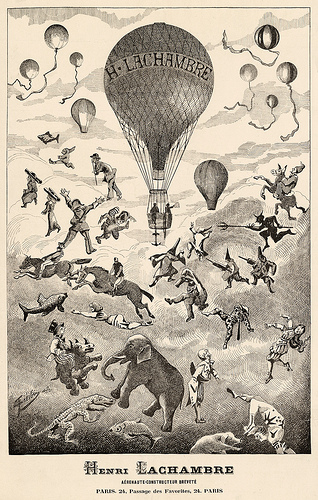
Henri Lachambre, aéronaute-constructeur breveté, ca. 1883 courtesy of trialsanderrors on Flickr.

The start of the long Summer holidays is something I have to grow into. Change of routine throws me out of wack, and I’m torn between the need to give in to the end-of-year exhaustion, frantically tackle household jobs which have been pressing down in a compulsive manner, or follow my online focus to see where it takes me.

Well, I’ve made a start on the last two of these options, although it takes a little while to move through dissipated interests and settle like dust on something satisfying.

Still, though I’ve squandered some time online, there’s been a significant pause in posting here, and I’ve been thinking my way through this, or trying to. Is it because I’m on holidays or is it simply that I have nothing to say?

That’s an interesting thought, and anybody who knows me well would laugh. I really do feel that, at the moment, I have nothing to say, and it could be a good thing. We all need a break, and if you look at my Diigo bookmarks from today, you’ll see (retrospectively) that my interests have refocussed from educational to predominantly gastronomical interests. Well,, not entirely. Actually, I’ve been saving odds and sods, for example, I’ve saved a chocolate praline tart, but I’ve also saved a bookcover archive blog, old Broadway theatre handbills, a fantastic blog which boasts a mean collection of animal illustrations, and then, even stranger things, like the frog museum. Amongst these bits and pieces, there are some educational gems, like Larry Ferlazzo’s “The Best of ‘The Best’ lists“, and a brilliant science blog called Science Blog, recommended by the fabulous Sean Nash (and I always take note of what he recommends, believe me).

One of my online discoveries this year, a jewel amongst art resources, Art 21,  is a PBS documentary series about contemporary visual artists in the United States, and for us not in the States, it’s still a rich resource for Art teaching. I recommend it, and if you join on Facebook, you get regular updates. It’s a rich resource of images and film for teachers and students of Art.

It’s through Art21 blog that I read ‘Nothing is new, but personal interpretation can often be so.
Alexander Girard, 1956′ and stumbled across the blog Nothing is new. Fascinating.

Apart from that, I’ve spent an inordinate amount of time on Flickr, indulging my passion for design and illustrations, and adding more and more contacts, people such as trialsanderrors whose sets include Early flight, with photographs of late 19th Century Paris from the Tissandier Collection, Finsbry’s set of Florence Upton’s vegetable people illustrations.

This diversion, the reason for my blogging absence, is the result of a release from the routine of school and school-related activities. It’s the direction I’ve taken with my newly found freedom. It’s pure pleasure; it feeds me.

I’ve also been struggling in the last days of my 365 day photo challenge blog, called (strangely enough) threesixtyfivephotos. Yes, the blog has been rewarding as a journal which records what would otherwise be lost to time, and in terms of connecting with others who read my blog and write theirs. But there comes a time when you just can’t find an interesting photo day after day. Time for a change. Will I continue? Maybe, in a different form. Maybe not.

I think holidays are a good opportunity to stop, have a break from the relentless reading and writing online, even miss good conferences, and not even have time to vote in all sections of the Edublogs Awards before the winners are announced. A time to think and evaluate what I’ve been doing, decide what worked and what didn’t, and why. Consider what I will do differently, goals, new challenges.

I haven’t stopped. I’m just processing…


The yeast to activate learning

Jabiz Raisdana, AKA @intrepidteacher, shared an interesting post a few days ago, which he entitled Singing Hearts, in which he wrote about how a group of eighth graders in Missouri connected with his 3 year old daughter in Qatar.

Like many stories of connections made across time zones, cultures, and age groups this one involved some risk taking, some curiosity, some opened minds, and I hope some learning.

After reading The last child in the woods , which spurred Jabiz to increase his daughter’s contact with nature, he and his daughter went outdoors with their cameras to explore their surroundings,

even if our immediate surroundings was an empty dry desert field covered in garbage and construction refuse. 

The result of this little expedition was a photo essay which Jabiz shared with his twitter network, and which then resulted in @wmchamberlain sharing the blog post with his class and receiving more than 40 comments which you can read on Kaia’s post.

[youtube=http://www.youtube.com/watch?v=KEY7raV7rH4&feature=player_embedded]

In this little expedition, Kaia not only connected with the outside world in a physical sense, but also the world of people beyond her immediate environment.

Hello from New Zealand.
Kaia
We really liked looking at the pictures of the backyard and the desert! Amazing stuff, you did a great job with the descriptions. We thought that it must be very hot in the desert, its been raining here in New Zealand today so the desert seems exciting and interesting. (Room 8 Melville Intermediate School, New Zealand)

Those pictures were awesome. You did a great job speaking in your first photo essay. You took ordinary things that everyone passes by and made them look wonderful. I like your blog and I will visit it more often. You can visit my blog at jacob-everybodysbog.blogspot.com Thanks and keep up the good work. (Jacob)

With her father as her guide, Kaia has connected with people in his learning network, people who are interested in learning from others, regardless of location, age or race. A simple photo story has been of interest to others who have contributed their thoughts and a little of themselves.

 Although, at such a tender age, Kaia would not fully understand the meaning of her experience, she has surely felt, to some extent, the power of connecting beyond her home and immediate family.

She is still too young to really grasp the connections that she is making, but in a few years these connections and this type of interaction will be ubiquitous in her life. I hope that her teachers are ready to help her continue on this journey.

Jabiz reflects on his feelings as a father who has shared his young daughter’s experiences with his online network:

… having Kaia exposed like this made me hyper aware of how vulnerable I am making her…

… I started to think about how much trust we ask that parents put in us as teachers. Kaia’s blog started as a way to share photos with family, it has quickly become a way that we are documenting her life. And now, it is becoming a way that she is connecting with people throughout the world. This is scary. Part of me wants to pull back and keep her our little secret. But if we want our students to feel comfortable and be cautious online, we must be able to do the same with our own children.

Jabiz’s blog reflection on the positive and negative potential consequences of his experiences ends in questions he poses directly to his readers:

What do you think? What is the value in this experience? Is the risk of exposing ourselves and our children online worth the connections that will be made and the lessons that will be learned?

I was amongst the commenters following Jabiz’s post, and so was John Strange, Professor of Professional Studies at The University of South Alabama.

John Strange says:

My response was you will not get the yeast to activate a closed system. They must engage the world. It is so important to energize learning through the techniques you, Mr. Chamberlain and others are using. I am not concerned about the issues of letting people into our lives. I think it is absolutely essential if we are to move forward with true learning, for all of us.

If I hesitate  when reading ‘ I am not concerned about the issues of letting people into our lives’, then I only do so momentarily, because the example of Jabiz supporting his little girl’s learning is an excellent model for us as educators and parent. If we hold the hands of our young and vulnerable students and our own children, and then still go outside of our private little worlds, then we learn to navigate the richness of connections with what is beyond our step.

For me, personally, every day spent reading what other people share online, in the form of blogs, Twitter posts or photos on Flickr, opens up a new window to the lives and experiences of others. There’s no way I could go back to what I had before. Could we even go back to pre-Google days?

I like John Strange’s concept of networking being the yeast to activate learning – it surely is.

Just in reading this one post, I’ve learned so much, and connected with so many people. It’s disappointing when someone contributes a comment and doesn’t provide a link. A blog, for example, provides knowledge of the author, and we can ‘know’ each other through our contributions in writing or pictures. We share what we think is appropriate, while preserving our privacy, and I think this is what we need to teach our students. Their digital footprint can be modelled on ours, and this not something we can do theoretically.

Apart from learning about Jabiz and his daughter, Gaia, I’m happy to have discovered John Strange who shares so much of himself online through blogs, points of contact and photos. Take a look at his page to see an excellent example of the richness of digital identity.

Where the wild things are

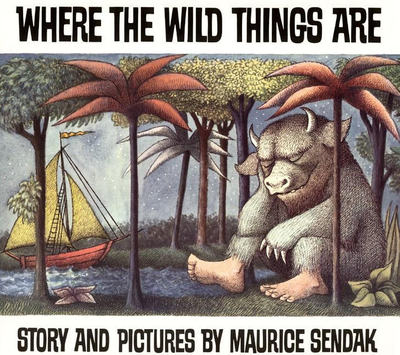
 Where the wild things are by Maurice Sendak has been a picture book favourite for children and adults since 1963.

The book is about the wild adventure of a boy named Max who is sent to his room without his supper by his mother as punishment for misbehaving. Max wears a distinctive wolf costume during his adventures and encounters various mythical creatures, the “wild things”. Although just ten sentences long, the book is generally regarded as a masterpiece of American illustrated children’s literature (Wikipedia).

wildthings

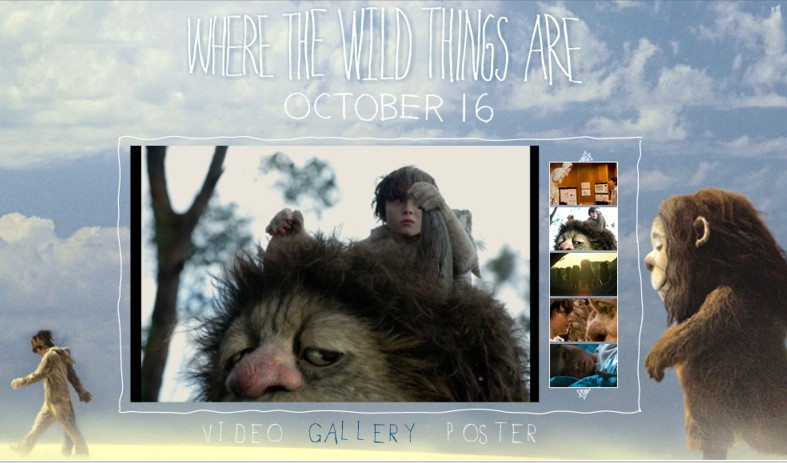
Particularly interesting is that this picture book has been made into a film. Picture book – film. How do you do that? Where the wild things are is directed by Spike Jonze, of Being John Malkovich fame.

Watch the trailer here.

 You can also view scenes from the film here (from USATODAY)

Max Records, 11, is the boy with anger issues who escapes to a land where giant beasts roam in Where the Wild Things Are, the film version of Maurice Sendak’s 1963 storybook classic.

Jonze describes Max as a special kid who loves books. Well, his mother is a librarian. His father is a photographer. Jonze says Max is ‘deep and thoughtful, sweet and sincere, wild and imaginative and caring’. The film, shot outside of Melbourne, Australia, is coming out 16 October in USA. I’m not sure when it’s coming out in Australia.

I agree with USA Today –

How do you take a storybook that sparks the imagination and touches the heart with a mere 338 words and expand it into a full-length movie?

Spike Jonze, a director whose off-kilter idiosyncrasies were on display in his first two features, Being John Malkovich (1999) and Adaptation (2002), has always been drawn to Maurice Sendak’s Where the Wild Things Are.  “As a kid, I just connected to it. I wanted to hear it over and over,” he says of the 1963 tale of Max, an angry boy who escapes to a mythical land of untamed giant beasts. “It’s like trying to explain why you love somebody. To me, the Wild Things are both cuddly and dangerous. I wanted to climb atop of them like Max.”

 Ten sentences have kept generations enthralled for decades, and have inspired a full-length film. Wouldn’t you like to be able to write ten such sentences?

Where_The_Wild_Things_Are


Shift into overdrive

Sean Nash said on Twitter:

But only when my professional life hit a point where I was empowered to really innovate and create new experiences for students did I shift into overdrive in many ways.

When I was in primary school, I always hated tracing. Tracing meant laboriously following someone else’s lines, and it was was boring. Even following my own lines that I had previously drawn was boring. Soul destroying.  I feel the same about prescriptive teaching – handing out worksheets, using someone else’s lessons in parrot fashion, repeating my own lessons – boring. That’s not to say I don’t do the same lesson, I just don’t do it the same way each time.

Susan Carter Morgan said something I can relate to in her blog post:

Using another teacher’s lesson plans does not make things easier! My colleague, Susanne, had taught this course for a number of years. In her organized, inimitable fashion, she handed me (virtually) her daily plans, quizzes, projects,and tests to use. Sounds great, but we teach differently, and I can’t tell you how many times I would be halfway through a lesson, wondering why I was doing it that way and then having to re-group for the next day. Susanne is one of the best, most creative teachers I know. But I should have just created the lessons myself.

Oscar Wilde said, “Be yourself. Everyone else is already taken”.

You may not know that my husband is a Russian Orthodox priest. When we were both 26 years old, he was ordained a priest, and I was left trying on masks in order to take up my new position as ‘matushka’ (as the Russians call a priest’s wife). I felt that I was in no way suitable for this new calling , so I started to emulate some of the other matushki. Of course, I don’t have to tell you, this plan failed miserably, and I was forced to return to myself. Only then could I function sincerely and convincingly, warts and all.

The same goes for teaching. When I recently changed careers in a minor way by moving from teacher of English and LOTE to teacher librarianship, being new to the job, I lacked the confidence that years of experience bring, and considered putting on borrowed hats in order to survive job interviews. I’m talking about  manner or terminology more than anything else. That definitely didn’t work, because more than anything else, I didn’t even convince myself. Over a fairly short space of time, letting to of preconceived ideas of what a teacher librarian might be like, I’ve connected with what I see as most important for this exciting role.

Today at lunch, chatting with teachers at my school, I explained my switch in roles to teachers who didn’t know me very well. We were joking about the teacher librarians not having to mark work or write reports (me, anyway), and I wondered what they thought I did, up in the library, without the regular face-to-face with classes. I didn’t want to bore them, but I’m often left wondering how I would adequately describe the teacher librarian’s role description, because it actually is quite broad, and depending on the school, it can be open to interpretation. That’s what I love about my job. It allows me to define my own role, to some extent. Unrestrained by adherence to one or two subject areas, a teacher librarian is, in a sense, a purer educator, looking after the learning of students across the curriculum. A teacher librarian inspires connection with ideas and  people through literature, teaches information skills (so important all through school and life), and supports best pedagogy.

So, back to my opening quote from Sean. To be empowered to innovate and create new experiences for students means, for me,  connecting with my authentic self, my way of doing things, my passion, taking the relevant curriculum and running with it. To make it absorbing for me and therefore the students, it should be a new experience each time. Teachers will know that this happens automatically because the dynamics are different for each class, but it’s good to build on the experience each time and present it in a slightly different way.

Web 2.0 technologies have opened up new ways of opening up and creating new experiences for teachers. Let’s take English teaching, for example. There are many ways to ‘renew’ your lessons by looking at what others have shared online.

I’d like to share some of my favourite networks which are a constant source of inspiration to me.

Ning

OZ/NZ Educators

Classroom 2.0

Educators’ guide to innovation

English Companion

Art Education 2.0

Independent School Educators’ Network

Mexico English Teachers’ Alliance

Voicethread for Educators

iConnect iLearn in the 21st century

TeacherLibrarianNetwork

Images 4 Education

Flat Classrooms

Discussing Current Events

Wikis

Classroom 2.0

School 2.0

Voicethread 4 Education

educational origami

21st century collaborative

Cool tools for schools

Visual Blooms

Web tools 4 U 2 use

Blogs

Geography blog Mr Robbo, the PE geek

2008 Edublogs winners (best education blogs)

Darren Kuropatwa’s Maths blog

Langwitches (Silvia Tolisano)

Art teaching blog : The  teaching palette

Global Teacher Blog directory and Web 3.0 community

School Library of Victoria blog: Bright Ideas (by Judith Way)

Angela Maiers: Educational Services

Susanne Nobles’ blog (English) Virginia, US

Susan Carter Morgan

Hey Jude (Judy O’Connell, Sydney)

Jenny Luca

On an e-journey with generation Y – Anne Mirtschin

Andrew Douch

Allanah King

Sheryl Nussbaum-Beach

Will Richardson

Rhonda Powling (Web 2.0 resources)

Have a look at my Twitter network here.

Here I am on Delicious and you can see my network here.

Here I am on Diigo.

Flickr (great way to share, discover and use images)

Although long, this is only a selection.

Nobody wants to regurgitate the same lesson again and again. That’s soul-destroying. If you’re inspired by what you’re teaching, then it’s likely to be an inspiring learning experience for students. Regularly connecting with networks of people who are teaching the same subjects is like securing your roots  into fertile ground. Combine that with the excitement you feel with all these ideas and resources at your fingertips, you can’t help going into overdrive.  You don’t mind (or can’t stop yourself) working after hours, into the night, during your breaks, because there is no longer just you and your subject material, there is you connected to a limitless number of people, ideas and resources, able to discuss and question, ask for help, co-create resources – you name it. Shifting into overdrive occurs naturally. Watch yourself take off.

Get tweets from space!

astronauts

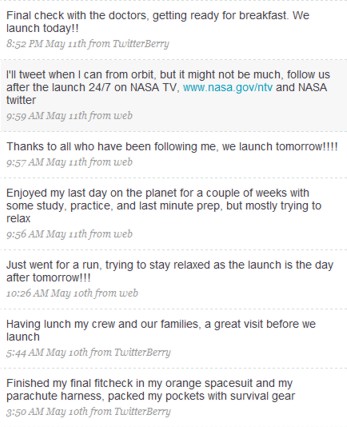
Tweets from space?  So, don’t tell me Twitter is just boring stuff about what people are having for breakfast. Follow NASA astronaut Michael Massimino (@Astro_Mike) on Twitter. You’d better hurry, he’s just launched into space.

From orbit: Launch was awesome!! I am feeling great, working hard, & enjoying the magnificent views, the adventure of a lifetime has begun!

And a little earlier

astromike

Thanks to @Zadi for the tip.

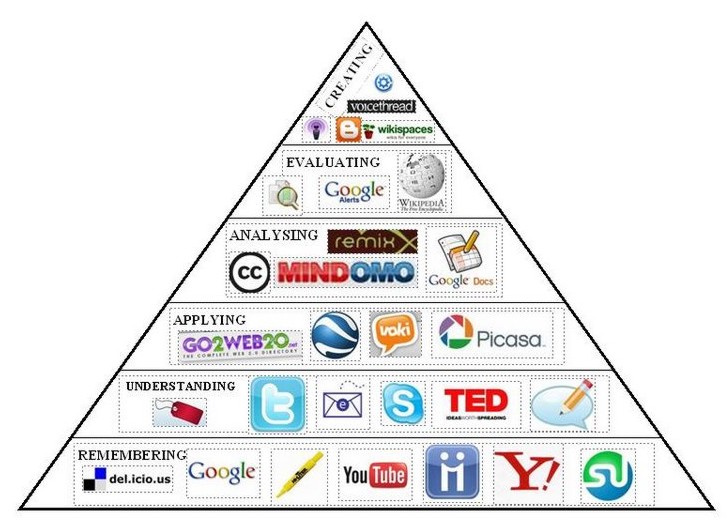
Visual Blooms Web 2.0 Taxonomy

visualblooms1

Bloom’s Taxonomy has come a long way. Well, so it should, since it originated in the 1950s.

Thomas, on Open Education, explains the logic underpinning the taxonomy:

The basis for the theory is rather straightforward, a person cannot understand something that he does not remember (know) nor can he/she analyze or apply that knowledge if the person does not understand the material. Though an ability to analyze and apply certainly supersedes the basic knowledge category, to synthesize entails divergently applying knowledge and/or skills to produce something new. Lastly, evaluating or judging the value of material is necessary to produce a worthy final end product.

The above image is  an easy visual overview of Web 2.0 tools and how they fit into Blooms Taxonomy. It was designed by Mike Fisher.  I think it’s open to interpretation. Twitter, for example, would fit in more than one category. What do you think?

For an extremely detailed and awesomely impressive account of Bloom’s digital taxonomy, here’s Andrew Church’s update on Blooms for the digital age.

Authoured by Andrew Churches, the digital taxonomy account for the use of social media and a variety of digital tools that can be used in educational contexts. Not limited to a discussion of the cognitive domain, the text includes discussions and suggestions for methods and tooling.

[scribd id=8000050 key=key-27g4ipakpdfrxflg9cr7]

Andrew’s work is invaluable in providing a framework for new technologies. As Thomas says in his post,

Churches digital examples at the evaluation level provide strong reinforcement for the use of blogs and Wikis to greatly enhance learning.

And if you want to go back and explore the taxonomy in depth, here’s a whole wiki on Blooms Taxonomy.