All posts by Tania Sheko

My name is Tania Sheko, and I am a teacher librarian at Melbourne High School, a selective secondary boys’ school 9-12 in Melbourne, Australia. ‘Teacher librarian’ usually requires a bit of an explanation. I think it’s a ‘School Librarian’ or ‘Library Media Specialist’ in the US and Canada. Often people are not sure what my role is, and it’s not easy to define. I like to think of it as the focus on ‘skills’ and ‘passion’ which exists in the spaces between the teaching of curriculum which is the domain of subject teachers. Some of my areas of focus include all sorts of literacies (information, digital, critical, network, etc.), collaboration with teachers as a kind of third hand (curating resources, differentiating learning, experimenting with blogs), and connecting people to ideas and an understanding of self and others through reading, discussion and debate. Most of our students go on to university, and we are always thinking about how we can best prepare them for the world of university and work. I’m interested in the educational environment, behaviours and directions of tertiary institutions, particularly as they move from traditional to innovative practices with connective courses. Connected learning makes sense to me, and I’m concerned that schools are often still envisioning learning as a passive consumption of content delivered by individual classroom teachers. With so much research-based evidence about student-centred, interest-driven and collaborative learning, and with the findings from the NMC Horizon Project, identifying and describing emerging technologies likely to have an impact on learning, teaching, and creative inquiry in education, I really think it’s time we woke up to ourselves about the anachronistic nature of our educational practices and took action. I learn from my colleagues, but also from my online network, reading their blogs, interacting with them on Twitter, exploring the wealth of their shared expertise online. This is what excites me about learning – connecting with people globally for a shared purpose.

Teach the child

Today I read Steve Shann’s recent blog post which I won’t try and fail to summarise.  I welcomed the introspective, quiet depth of his post. After my recent focus on the promotion of technology – always as a way to enhance learning and teaching – Steve’s anecdotal reflection led me back to the business of teaching young people, which is always about relating to them, and understanding them, awakening their understanding and wonderment. Sometimes we might get lost in perfecting rubrics, we might get stuck on assessment, ticking off technology skills – and then I always feel like something isn’t right, until I come back to what is essential – the kids.

In his post, Steve mentions how he feels about

some of what goes on in our classrooms, with children being made to perform unchildlike tasks, often to please a teacher, parroting back information for which they can see no use and to which they feel no connection.

Then he shows this video

[youtube=http://www.youtube.com/watch?v=f2p5augniQA&feature=player_embedded]

I don’t know about you, but this was one of the most powerful things I’ve seen in a while.  Steve wrote:

I found it deeply moving. As I watched those little faces live the song, I was catapulted back in time over 55 years ago when, as a very young child, the world was a place of heart-quickening wonder.

It’s good to see something like that and be reminded that we are teaching young people, not curriculum, not to the test or the marks. I’d like to believe that if we hold onto that, and when we inspire learning in our students, that they’ll follow through with the rest.

Steve’s post was about much more than this, and I recommend you read the whole thing.

Power of the network

The last couple of days have been very interesting. I’d like to share what I have learned since I shared on this blog a discussion about favouring an external blog to an internal one.

Above all, I learned that I could depend on the people in my network. Who are these people? Some of them I’ve met face to face; some I’ve come to know through my involvement in online networks; a few I’ve only just met in the course of this blog issue.

Amazingly,  over 200 people read my last blog post. Much as I’d like to convince you otherwise, I don’t normally record such a readership. How did I receive such a response?

After writing out my response to the Computer Systems Manager, then posting this with my response to him, I sent a link to the post out on Twitter, asking for people to enter into the discussion. I wanted to generate discussion, and to collect people’s views and perspectives. Discussion is a healthy and powerful thing. It’s a good idea to find out what others think even if they don’t agree with you, and in some cases, particularly when they don’t agree with you, since it pushes your thinking.

Apart from clarifying my own thinking with regard to the value of Web 2.0 technologies and their role in learning and teaching, in writing out this issue I gained valuable insights from others using the Web 2.0 platforms. Herein lies the power of these technologies – not in the technology itself, but in the powerful connections with people, people with unique backgrounds, experiences, qualifications, talents, and ideas.

The people who commented my post were educators or involved in education in some way. They responded quickly, and they came from around Australia (Melbourne, Sydney, Brisbane, Canberra and Perth) and overseas (Hong Kong and USA).  Click on their names next to the comments and read their profiles and their blogs to make their acquaintance.

My online networks are full of professionals whose reading and links, ideas and talents, I follow. If I need an idea, advice, professional reading, teaching material, and more, I go to this network. And I try to be helpful in return. Anyone who has experienced the collective wisdom of online networks will tell you the same. It is not about the technology.

Our students will go into the world needing support and continued learning. If we help them understand and navigate appropriate networks, we will be laying the foundations for support systems. We should allow them to learn within supervised online environments, teaching them how to write and interact appropriately and in a safe way, to share ideas and solve problems with relevant groups of people, etc.

As educators, our view of what is essential for student learning needs to change. Our students’ world will be fast-paced and changeable, requiring adaptability and resourcefulness. Our students will need to know how to find what they need, and who to trust. They will hopefully be able to discern who to follow and how to behave.

Change is never easy. One of my mentors, and co-founder (with Will Richardson) of the Powerful Learning Practice model, Sheryl Nussbaum-Beach, has just written a blog post about change, which she prefaces with the following quotations:

 “It’s not that some people have willpower and some don’t. It’s that some people are ready to change and others are not.”  James Gordon, M.D.

“Change has a considerable psychological impact on the human mind. To the fearful it is threatening because it means that things may get worse. To the hopeful it is encouraging because things may get better. To the confident it is inspiring because the challenge exists to make things better.” King Whitney Jr.

Sheryl uses the metaphor of her recent house renovation to deconstruct the journey towards building change, towards the creation of something new. She documents this process insightfully, and I recommend you read the entire post.   I thought I’d pull out some of the phrases that resonated with me in Sheryl’s post.  She talked about the challenge of

keeping the momentum and the dream of the transformation alive

She also said:

There are times I wanted to throw in the towel and thought as outdated as the home was at least there was peace and comfort.

 things will look worse before they get better

Fear is a big part of it too

Trust is another issue. Do the experts I have hired to make these changes a reality have the know how and wisdom to make it all happen

I’d like to end my post with another one of Sheryl’s quotes:

 For change to take hold and redefine people and the places they live and grow there needs to be a time of inquiry, reflection, and visioning.

I’m grateful that I have people with whom to share my inquiry, reflection and visioning.

School library blog – stay in or go out?

Recently I’ve moved my school library book review blog from an internal one within the school intranet (Sharepoint) to an external WordPress one. Just today I received an email from our Computer Systems Manager:

Do you realise that by using the WordPress site, you are denying most of our students easy access to your work. Sure, a few students might check it out in the Library at lunchtime but by the time most students get home, other priorities will have come to the fore. So, why not place your blog in the public section of the College Intranet? There you will get the best of both worlds, public access and, immediate and unhindered student access.

I should explain that we are a laptop school, but that internet access has to be booked by teachers, and is otherwise accessible to students before school, at recess and at lunchtime.

It was difficult to answer this email without writing a thesis! This is the best I could do:

 In answering your email, I started thinking about the meaning of ‘Sharepoint’ – a place where the school shares resources, information, etc.  Sharepoint’s  centralised, sharing facility is a powerful way to synchronise and share resources and activity in the school.  Yes, I did realise that by transferring my fiction blog to WordPress, students wouldn’t be able to access it during class times. I made the decision to move after using Sharepoint for almost a year, and I didn’t make that decision lightly, but based on important considerations.

 Funnily enough, the sharing within Sharepoint was limiting what I wanted to achieve with the blog. Sharepoint is an excellent school-based resource, but it didn’t meet our needs entirely. Firstly, there were restrictions, such as the fact that I couldn’t link to specific posts, so that when I posted more than one post, I couldn’t link to a specific one which had been pushed down by others.  I also couldn’t embed videos. Book and film trailers are popular with students, and often lead them to reading and discussing books.

 Access during classtimes did not increase readership, and I can only estimate this through anecdotal evidence with the Sharepoint blog, because, unlike WordPress, it doesn’t provide me with valuable data on readership.  As you say, students can only access the blog during lunchtime and recess, but they wouldn’t be able to read it in class anyway, unless given permission by the teacher, or when the teacher specifically books the internet. Since the move to WordPress, I’ve actually had an increasing number of emails from staff who prefer the appearance and options within WordPress, and following from their interest, I’ve been booked into classes  to introduce the blog and talk about books.  The blog is not generally something students are reading, unless I set a challenge or competition, but teachers who realise its potential are beginning to use it as an interactive medium for students.  

 Author visits are expensive, and so I find that embedding videos of author interviews  allows students to ‘get to know’ authors as real people, people they can relate to. When I show students the blog and give them time to browse, they inevitably veer towards the videos – not surprising considering their preference for media. We do what works in encouraging students to appreciate books and authors, and we must do what works best in engaging students in learning.  When students use Web 2.0 technologies, they are also learning netiquette – an important skill considering the dominance of technology in their future lives of work.

 The sharing aspect is the most important feature of external blogs . Just as teacher librarians and librarians encourage students to join local and larger libraries, so do we strive to share our reviews and comments with students and teachers in other schools, even in other countries. Every comment received is emailed to me for moderation before it is published.  I write the fiction blog for the whole school community, and I hope to extend our community to include other schools. We benefit from this interaction, and it enriches our discussion. Currently I’m compiling a list of excellent reading blogs of interest to both staff and students, which will be added to the blog as widgets.

 The work we do with Web 2.0 technologies at Whitefriars can be shared with others, and I find this enriching. I share, and I receive tenfold if not more. The School Library Association of Victoria blog, Bright Ideas, features what schools in Victoria are doing online, and our school has a positive profile throughout the state already, through its educational projects in wikis, blogs and nings.

 There are many more reasons for our choice to go with the WordPress blog, but it’s important to note that it is based on our commitment to Web 2.0 technologies rooted in the latest pedagogy. We are not ignoring Sharepoint, we are just selecting the best application for our needs.  As with any technology, it must be rooted in best pedagogical practice. Choice of online space should also be dictated by student learning within the context of the school’s mission statement. If we educate our young men ‘to take their place in society as valued individuals’, then  learning should take place not only in the classroom, but within the context of broader society. This, then, is the most appropriate context for blogs.

 I apologize for the wordy reply, but I thought it was important to give you a detailed answer. In conclusion, let me suggest you look at the Global Teacher website where you will find lists of school library blogs (under ‘Bookrooms’), school blogs and teacher blogs.

I appreciate the opportunity to define my reasons for external blogs in education, and also to receive excellent advice from my professional network. Just as you would ask friends for advice, so I ask my Twitter network for opinions and ideas. In a short space of time, seven people offered support for the use of external blogs. One even provided me with a  link to the exact webpage where I could find my school’s mission statement! (Thanks, Marita)

Here are some of the points raised in Twitter supporting Web 2.0 applications:

  • a global audience is important
  • so students can have input from a wider audience – authors, scientists, explorers – who knows who else can assist their learning
  • develop netiquette
  • students can see their work published.
  • Can share work with parents, grandparents.
  • Can make networks.
  • Show people they can use ICT.
  • schools should have policies that have been thoughtfully crafted by all stakeholders
  • online policies should be consistent with the Vision and Mission Statements of the school

I’m really interested in hearing your views on this subject. How would you answer this email? What approach would you take? I’m wondering if my answer is too heavy-handed. What do you think?

16 habits of highly creative people

Most people would deny being creative. Have you noticed that? People who display obvious creativity, but who say, ‘Who me? I’m not creative!’  It’s the strange fallacy that in order to be creative you have to be good at drawing or play an instrument like a prodigy.

Ken Robinson talks about creativity. I’ve written previously about his TED talk and his book, The element. He has also written a paper entitled Creativity in the classroom, innovation in the workplace. in response to the following question:

What should be the role of business and industry in the education of today’s youth, and what strategies can realistically be put in place by business now to foster innovation on the widest possible range of platforms?

Ken begins by saying the following:

Businesses everywhere have to compete in a world that’s changing faster than ever. To keep pace they need people who can consistently generate new ideas and adapt to constant change. Many companies say it’s getting harder to find these people. One of the major reasons is education. All over the world, formal education systematically suppresses creative thinking and flexibility. National strategies to raise standards in education are making matters worse because they’re rooted in an old model of economic development and a narrow view of intelligence. For economic, cultural and political reasons, creativity should be promoted systematically at all levels of education, alongside literacy and numeracy.

According to Ken, the problem in the workplace is not a shortage of graduates, but something entirely different:

Companies now face an unusual crisis in graduate recruitment. It’s not that there aren’t enough graduates to go around, it’s that too many of them can’t communicate, work in teams or think creatively.

 Shalu Wasu, a Singapore-based trainer and consultant,  conducts open programs on Creativity and Innovation and Blogging for Business at NUS extension. He offers 16 habits of highly creative people on the Tickled by life website.

1. Creative people are full of curiosity.

2. Creative people are problem-friendly.

3. Creative people value their ideas.

4. Creative people embrace challenges.

5. Creative people are full of enthusiasm.

6. Creative people are persistent.

7. Creative people are perennially dissatisfied.

8. Creative people are optimists.

9. Creative people make positive Judgment.

10. Creative people go for the big kill.

11. Creative people are prepared to stick it out.

12. Creative people do not fall in love with an idea.

13. Creative people recognize the environment in which they are most creative.

14. Creative people are good at reframing any situation.

15. Creative people are friends with the unexpected.

 16. Creative people are not afraid of failures.

Read the full article here.

If, as Ken Robinson says, creativity will be most sought after in work of our students’ future, then what implications does this have for education? Are the above habits of creative people skills that are teachable? One thing that is certain is that none of the habits are tied to measurable content, which is the weight of our present curriculum. Obviously, knowledge of content is necessary for any profession, but it may not be enough to succeed. If you want to be a driving force in any job, you may have to acquire some of the creative habits.

I like #14: Creative people are good at reframing any situation

Reframes are a different way of looking at things. Being able to reframe experiences and situations is a very powerful skill.

Reframing allows you to look at a situation from a different angle. It is like another camera angle in a football match. And a different view has the power to change your entire perception of the situation.

Reframing can breathe new life into dead situations. It can motivate demoralized teams. It helps you to spot opportunities that you would have otherwise missed.

If looking at things from different perspectives is an aspect of creativity, then in order to develop creativity in students, the method of teaching should allow for these different perspectives. There are teachers of English, Mathematics, Science, and other subjects, whose teaching is based on encouraging different perspectives. Do they realise how important this is? Or do they do it simply because it’s the way they think? Think on, we need more teachers like these!

 How would you design a curriculum that developed these habits of creativity?

I’ll finish this post with the quote at the conclusion of Ken Robinson’s paper:

It’s often said that education is the key to the future. It is. But a key can be turned in two directions. Turn it one way and you lock resources away: turn it another and you release them. In education as in business, it’s no longer enough to read, write and calculate. We won’t survive the future simply by doing better what we have done in the past. In the future, we must learn to be creative.

Creative alphabets

There are many things mulling about in my mind, none of them formed.

To intersperse the hiatus with some activity, keeping in mind that variety is the spice of life, I’d like to share a blog post about ‘Creativity with alphabets’ which I found on Crooked Brains. Who would have thought there could be so many different takes on alphabet.

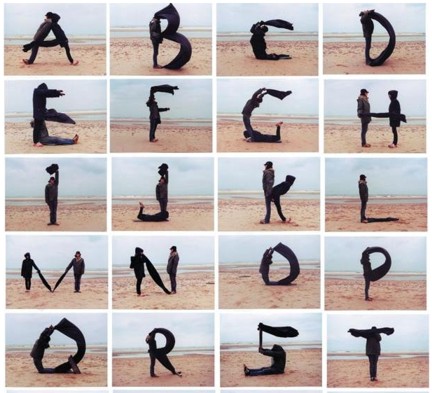
Most of us have seen Fonts by people

peoplefonts

Typeface by Kalle Mattsson, made at the beach of Zandvoort aan Zee in The Netherlands.

Google Maps alphabet is another good one many of us have seen

Googlemapsalphabet

Then there are those whose creativity are a little out of left field, for example

alphabets made of minced meat

mincealphabet

I’m not even going to show you the alphabet made from clothespegs and skin.

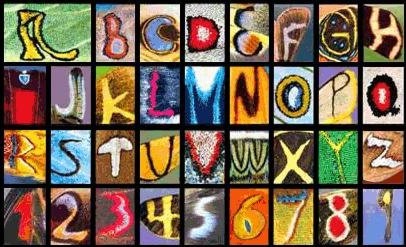
Some alphabets are quite amazing, for example, the one made by people who have spent a lot of time looking at butterflies

butterflyalphabet

There are quirky ones, like the alphabet made from paper clips, the one made of toilet paper, the eatalphabet made by people who aren’t hungry but play with their food.

One of my favourites is Type the Sky , a work by Lisa Rienermann, a woman with a very sore neck, I imagine. Read about her project if you understand German.

skybuildingalpabet

I love the idea of the space between buildings forming the letter of the alphabet.

But make up your own mind. Have a look at Crooked Brains’ blog post.

Learning from a phone?

One of The Simpsons episodes shows us futuristic learning that can go wrong.

[youtube=http://www.youtube.com/watch?v=mqU-EhfchkI]

Judy O’Connell gives us a more realistic idea of how technology can change teaching in her blog when she talks about  the soon-to-be-released Educate: The Ultimate iPhone and iTouch App for Teachers.

Educate is an iPhone/iTouch application designed to support teaching professionals at school, uni or college. It will allow you to:

  • plan your lessons
  • monitor student attendance and progress
  • engage with learning by posting content to your Moodle learning space, and accessing critical tools, eg. voice recorder and camera.
  • implement effective teaching strategies
  • collaborate with other Educate users through Facebook to discuss pedagogical practice.

It does make the robot look rather clunky.

Learning is a waste of time?

A day of conversations.

Good to record these and then reflect and analyse.

Firstly, a conversation with a Year 7 student who was ‘unable’ to do any work during English class because his laptop wasn’t working (note: he managed to remain undetected for most of the writing session before we realised, and then his visit to the computer centre was uneventful because he forgot to take the obligatory note, and the second visit left him without a computer until the end of the day). During our conversation, I told him that he should put the session down to valuable life lessons – taking the initiative to solve the problems instead of sitting aimlessly and wasting time, etc. – and he said these lessons were irrelevant because he was going to change schools the following year anyway. (My eyebrows raised involuntarily). He continued: the new school didn’t have a laptop program until the senior  years, and all his problems would be gone. What problems? You know, internet not working, things disappearing. He would get more work done. So, after a respectful pause, I asked him what he thought his future life of work would be like, wouldn’t it include functioning with technology? With all its glitches? And he would have to continue to problem-solve because there would always be problems? Yes, he agreed, but in the meantime he’d get more work done at school without the technology. It would all be in the book; easy to find and keep. (Has he heard of the technicality of losing the book?)

Hmm…

Get more work done…

Funny he should say that. Later in the day we had a meeting of the teachers involved in the Year 8 immersive project (mentioned in previous posts). I was late to the meeting, and I came in at the point where  groups of teachers were doing a post mortem on the project. The group I veered towards was engaged in passionate discourse, expressing negative views. There were too many points to remember them all, but the gist of it was that the big picture week-long, student-driven project didn’t work and was a waste of time. A waste of time because it took time away from the real work that had to be taught.  If it weren’t for the project, they would have ‘got more work done’. Work that was valuable.

Hmmm…

I ventured to say (I never learn, do I?) that all the problems and difficulties expressed were part of the teachers’ learning process, and that a collective discussion of these would result in a very different project next time – properly scaffolded, rubric based not on theory but on specific skills and capabilities demonstrated (or not) during the course of the project. The need to provide consistency throughout the different classes, the need to maintain seamless transfer between teachers, to deconstruct the questions at the beginning, to check for understanding, to get feedback from students on each day’s progress, etc. – all these observations I thought were valuable reflections, driving the discussion towards collective analysis and future improvement. But what I viewed as positive, some viewed as evidence that the project was a waste of time. The project took valuable time away from real work.

Interesting….

Not entirely surprising, though. I think you have to expect the initial digging in of heels, the panic and confusion when things are not spelled out, when teachers are just as much learners as the students, when stepping out onto unchartered territory. I can’t say that I”m not uncomfortable in new situations – of course I am. But if at least half of the teachers see the positive elements of the project, the rationale behind passion-based, student-driven, enquiry-based learning, then I hope that the scales will tip in favour of trying this out a second time. View this as a first draft, and collaborate towards an improved second draft.

Hopefully…

And please, consider the definition of ‘work’. Think about what it means to ‘get something done’. Or maybe you’d rather refocus on ‘learning process’ and navigate your learning  instead of getting it done.

Any thoughts?

The rules of school, or what is worth knowing?

It’s a great day when I discover a great blog, or, should I say, a person whose writing reveals someone I would love to meet. Just yesterday I came across Steve Shann’s blog, Birds fly, fish swim, and I don’t think I’ll be able to read anything else until I finish reading his posts.

In his post today, Steve describes what happened when he blasted his Year 11 students for not taking their writing responsibilities seriously on the class ning. The responses that followed in the ning were surprising (to me, at least) and revelatory. Here’s what one student (eloquently) said in this post entitled ‘Play the game’:

…in Years 11 and 12, it’s barely even about the learning at all. … In most subjects, we learn how to pass the exams… how to structure an essay, how to deliver a speech the way they want it, etc. School is all about how you play the game these days. It’s all about doing what you can to get an A, regardless of what you’re learning. … And I guess it does teach you stuff about the real world. Teaches you to try to beat the system, that menial busywork sometimes is what you need to do to do well in life, and, most importantly, no matter how much you hate your job, the best revenge is success.
I don’t think this is what the people who planned this school system had in mind. I guess those guys at the Board of Studies think that the system as it stands is a genuine attempt to educate kids in the subjects they selected for us. Simply put, they’re wrong.
…The reason why we (I) am having trouble with this course at times is because I have been trained to think like that. I do what I can to do well in the HSC. And I think some others in the class (although they may not know it) think the same way. Blogs aren’t marked, so I don’t do them; projects require organised creativity as opposed to just knowing shit, and suddenly I’m confused; Dr. Shann asks for dedication to the course but he can’t put a date or a number on it, so we just don’t try, et cetera, et cetera. 

I’ve already vented my dislike of teaching to the test, so I won’t say it again. Instead I’ll pull the same paragraph out of Greg Thompson’s post on his blog, Constructing meaning, as Steve did. Only I’ll include a little more of it because I think it’s worth the read:

Standardized textbooks work nicely for standardized testing. However, they do not do much for the idea that life is a big picture. Integration of content into a whole is hard work. It is far easier to teach a fractured curriculum because the result demanded is a standardized test that seeks the ability to see myopically, one subject at a time. Dr. McLeod is correct. This fractured approach has long been the model for education. The assembly line reality of the industrial age required each worker to do one thing and to do it well. Employee A did not need to know what Employee B did to complete their task five feet further down the line. That worked. Today, standardized testing requires each student to know how to do each thing in exactly the same way in order to produce the same product. The world they live in however, requires them to see the integrated picture. The test does not fit with reality.

I really do think that we must keep in mind the integrated picture when we teach, but it’s not going to happen unless we move things around in our education system, and in the way our classes and curriculum are structured. I can’t blame Steve’s students for not doing anything that falls outside of what is required for the final testing in year 12. Sometimes, when I talk to teachers about changing the way they teach, trying something new or integrating technologies into their curriculum to promote engagement and creativity, they will take on the challenge in the middle years, but the final 2 years of school really are devoted solely to the teaching of content that will get students their final ENTER score. If I were teaching senior years, I’d be torn between feeling responsible for students’ final scores, and wanting to  teach skills relevant to the world they were just about to jump into. It’s no doubt possible to do a bit of both, but I don’t think it’s easy, especially when students have been so carefully prepared for the test-readiness game.

Steve closes his post on a positive note. He quotes a student’s reflection which gives hope to teachers looking for evidence of a yearning for learning beyond the test.

English Extension and Studies of Religion are the only classes that allow us to be creative and have a relaxed teaching style that is more about us becoming educated, reflective, well-rounded individuals (if you’ve seen ‘The History Boys’, that is exactly what I’m talking about).

So what I’m saying is, give us a prod every now and then like you did today, because we are trying to untrain ourselves from what we know, or at least I am.

I hope that most students, deep-down, will want their schooling to help them become ‘educated, reflective, well-rounded individuals’, and not only young people whose formative years are summarised and evaluated in the one final ENTER score.

Wallwisher

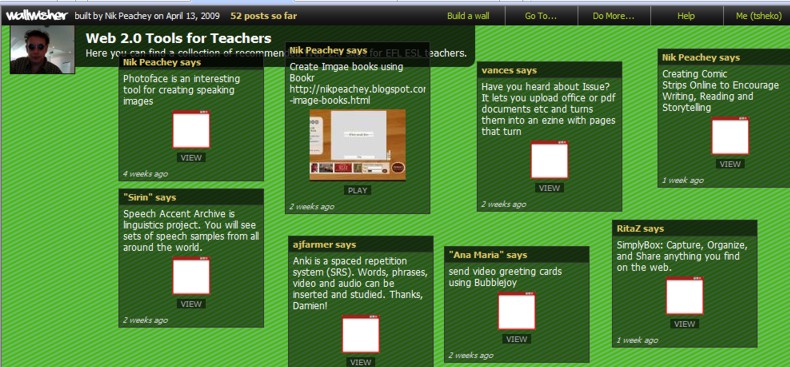
I discovered Wallwisher when I came across Wallwishers created by Nik Peachey and Ackygirl through Ackygirl’s link.

Wallwisher

Looking through the FAQs, I discovered the following information about Wallwisher:

Wallwisher is an Internet application that allows people to express their thoughts on a common topic easily.

A wall is basically the ‘web page’ where people actually post messages.

You don’t need to sign up to use the Wallwisher, but you do need to provide an email address. A temporary account will be created for you using your email address so that you can come back and make changes to the wall.

Have a look at FAQs for more information about how to use Wallwisher.

You can also share the Wall, embed it in a website or organise an RSS feed for Wallwisher.

I like the collaborative aspect the best,  the fact that it looks better than a list, it links to things easily, and you can even embed a video.

It would be an excellent way to brainstorm ideas and collaborate for students and teachers alike.

What are your ideas on the potential of Wallwisher?

Get tweets from space!

astronauts

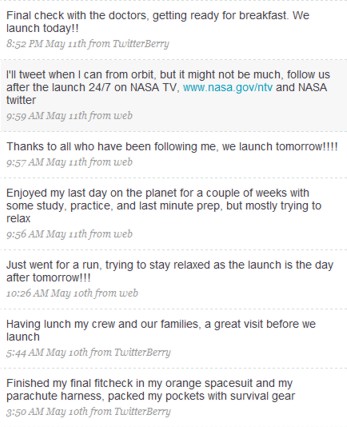
Tweets from space?  So, don’t tell me Twitter is just boring stuff about what people are having for breakfast. Follow NASA astronaut Michael Massimino (@Astro_Mike) on Twitter. You’d better hurry, he’s just launched into space.

From orbit: Launch was awesome!! I am feeling great, working hard, & enjoying the magnificent views, the adventure of a lifetime has begun!

And a little earlier

astromike

Thanks to @Zadi for the tip.