Category Archives: Web 2.0

Winding down

2487518879_ca2e8f3642

The school year is over for me. I know that many poor souls are still fronting up until the end of this week (is there a point?) but for me it’s the long stretch ahead, the one I’ve been waiting for. Time to wind down.

It’s been a strange end to the year for me in that I missed the last 4 days, and am now recovering from spectacular oral surgery, looking less like a hamster every day, and still turning sickly shades of yellow and blue (wish I had less yellow, more blue) down my face and neck. And now that the fear of losing feeling in the lip has been put to rest, I can think about the year, looking both back in time at events and learning, and forward to next year, planning new projects for 2009.

Funny how you don’t realise the extent of change until you stop to measure it. It was only May this year that I began this blog as part of a State Library of Victoria Web 2.0 PD initiative. During the course of the following 6 or so months I’ve learned many things – lots of how-tos and bits of technology – and I’ve acquired an online presence on Facebook, Twitter and NINGs.  Most  importantly, I’ve learned what it’s like to be part of a community of learners and educators, a community that never sleeps, always on the lookout for new ways of thinking, doing and sharing.


So, winding down…

Well, actually, it’s easier said than done. I know that I’m not as tired as many teachers, having escaped report writing (as a teacher librarian), and not having the exhausting face-to-face of constant classes, and that may be one of the reasons I’m not finding the winding down easy to do. Although, I think the main reason is the feeling of excitement which comes from new discoveries, possibilities and connections. Already I’m thinking about what I want to do next year (and I’m lucky to be co-teaching with two wonderful teachers), already I’m planning new ways of doing things in class, ways of engaging and challenging students, using technologies which will inspire creativity and authentic learning. And I’m reading, reading, reading other people’s ideas and experiences.

The best thing about holidays – if you still have any energy or brain capacity left, and amongst all the Christmas and New Year bustle – is the unregimented  time for exploration. The joy of investigating new blogs,  discovering people, and making connections, branching out and connecting those connections around the world, until gradually the world starts to shrink as your map is filled with people you know  and relationships amongst these. How can you wind down when people ‘out there’ are posting great links, new ideas and articles which inspire and challenge?

Yesterday, I started looking at the Edublogs Awards 2008, and here are the categories for nomination:

1. Best individual blog

2. Best group blog

3. Best new blog

4. Best resource sharing blog

5. Most influential blog post

6. Best teacher blog

7. Best librarian / library blog

8. Best educational tech support blog

9. Best elearning / corporate education blog

10. Best educational use of audio

11. Best educational use of video / visual

12. Best educational wiki

13. Best educational use of a social networking service

14. Best educational use of a virtual world

15. Best class blog

16. Lifetime achievement

As you  browse those 16 categories, you’ll come to know a group of people you’ll admire and want to keep in touch with. These people have spent the time making transparent their learning journeys and acquired skills, not keeping these things to themselves but sharing with the world. I’m having difficulty in unwinding because there’s so much to read and enjoy!

Merry Christmas to all. Happy, safe holidays, good family and friend times, and take the time to do what nourishes you.

Life is One Big Top Ten 2008

I’m up for a challenge, especially one which allows me to reflect on my learning for this year as we near the end of 2008. Paul C. of Quoteflections has set a challenge to share a top ten list for 2008. It’s a great idea because it makes you think about and evaluate your findings for the year. Now that I’ve stopped to think, I realise that this year has jet-propelled me into a whole new way of learning and connecting. In May I started my blog, slowly connecting to many other bloggers through reading and commenting. This year I have also joined, as part of my school team, the Powerful Learning Practice cohort led by Will Richardson and Sheryl Nussbaum-Beach. I’m only beginning to realise the depth and breadth of the  experiences within this learning network.

I would have no hesitation in saying that my most powerful ‘lesson’ this year has been that people are our most valuable resource, and so I’ve chosen as my Top Ten 2008 List:

Links to sites that demonstrate that we are better through sharing.
histografica

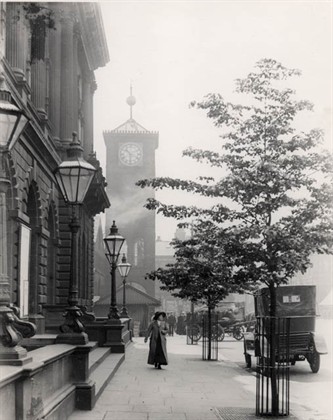
1.  Histografica: Picture the past

This site allows you to find and share historical photos of places around the world. You could discover photos of your old hometown or places you’ve been to. It’s a site that develops its archives as people share their photos. Only a few countries have been represented so far, but I’m sure the collection will grow.

2.  LIFE’s photo archive on view Google. Read about it here.

It’s one of the most magnificent photo archives of the past century and it’s now available on Google. It’s the Life magazine collection, some 10 million images altogether, and after the deal between Google and the keepers of the Life archive, a vast chunk is now at Google Image Search.

3. Phrasr allows you to create a visual phrase. The words in your phrase are matched with flickr images which you can choose for your picture phrase. The sharing part is the archive you can browse, and you can share your own visual phrases.

Here is my blog post about Phrasr.

4.  Flickr tools

Mentalaxis has a comprehensive list of flickr tools so that you can creatively share your photos. For example, Travelr lets you display your flickr photos geographically on a world map.

5.  280 slides

As it says on the website, create beautiful presentations, access them from anywhere, and share them with the world. With 280 Slides, there’s no software to download and nothing to pay for – and when you’re done building your presentation you can share it any way you like.

6.  Capzles

Capzles is a new way to combine videos, photos and mp3s into rich, multimedia storytelling. Read about it in my blog post.

7.   A picture’s worth  is a wonderful site where people are encouraged to write about the meaning or story behind a personal photograph. As the site says, “A Picture’s Worth” provides a haven for people to truly “show and tell”.

You can read more about it in my blog post.

8.  Larry Ferlazzo’s websites of the day

This is not a tool or website, but I’ve included Larry’s blog because I believe people are the best source of information and sharing on the web. Larry was nominated as a finalist in the Best Resource-Sharing Blogs category of the Edublogs Awards in 2007 and again this year, and here he shares a list of education blogs that generously share resources and links.

A list of resource-sharing blogs nominated for the Edublogs award 2008 is definitely worth a look.

9.  Us Now is a film project about the power of mass collaboration, government and the internet. Have a look at the ‘Your videos’ page, still in its early stages. Here’s a video called ‘Video republic’:

[youtube=http://www.youtube.com/watch?v=h0JX5jWv-tk&eurl=http://www.usnowfilm.com/clips/41&feature=player_embedded]

Read Clay Shirky’s  transcript of this clip.

10. I wrote a post about YouTube Symphony Orchestra a little while ago. This will be the first ever collaborative online orchestra.

We invite musicians from around the world to audition for the YouTube Symphony Orchestra. Your video entries will be combined into the first ever collaborative virtual performance, and the world will select the best of you to perform at New York City’s Carnegie Hall in April 2009.

This one tops the list for me. It’s collaborative, it’s global, it’s a celebration of talent, it’s inviting the world to make music together.

As suggested by Paul, I’ve tagged the following esteemed bloggers:

Marie Salinger at Just in time; Sue Tapp at And another thing; Allanah King at Life’s not a race to be first finished; Jenny Luca at Lucacept; and Rhonda Powling at Rhondda’s reflections: wandering around the web.



Different kinds of reading – internet and literature

noteasytostayfocussed

 Photo courtesy of imago2007

I’m aware that my reading behaviour on the internet is different from when I read a book, in particular fiction. In addition, I think that my book reading focus has altered since I’ve discovered hyperlinked online reading.

I’ve included a paragraph from a piece written by Sven Birkerts on Britannica blog, Reading in the open-ended information zone called cyberspace.

Again, I’m not saying good or bad, I’m just saying. When I am online I am perpetually aware of open-endedness, of potentiality, and psychologically I am fragmented. I make my way forward through whatever text is in front of me factoring in not just the indeterminacy of whatever is next on the page, I am also alert, even if subliminally, to the idea of the whole, the adjacency of all information. However determined I am to focus on the task at hand, I am haunted by this idea of the whole. Which is different than what I might experience sitting in a library chair knowing that I’m in the midst of three floors of stacks. The difference has to do with permeability, with the imminence of linkage, and it is decisive.

 Here is the complete article.

I’d like to explore this topic to gain an understanding of something that affects our students and us as teachers.

What do others think about the author’s views? What are your thoughts about the different kinds of reading? Do you think our generation of online students are affected, and is this positive or negative?

A balance between teaching skills and content

oldscales

Photo by takaken2008 on Flickr

What are 21st century skills and are these skills different to those currently being taught in schools?  How radically do we need to change our teaching practices?

Daniel Willingham has written an informative post in Britannica blog entitled Education for the 21st century: balancing content with skills, in which he asks and answers the important question: why the sudden concern for 21st century skills.

Willingham quotes reports and books  that point to:

changes in the skills required for most jobs. Our economy is generating fewer jobs in which workers engage in repetitive tasks throughout their day (e.g., assembly line work) and more information-rich jobs that present workers with novel problems and that require analysis and teamwork.

 Willingham quotes Elena Silva in defining these skills as having at their core the ability to

analyze and evaluate information, create new ideas and new knowledge from the information.

He also adds to creativity and critical thinking the following essential skills for the 21st century from a report from the partnership for 21st century skills :

new knowledge … [and] global awareness, media literacy, information literacy, and other new content.

Now, this is where I start sitting up and taking note. Although I’m fully on board with the need for 21st century skills, I haven’t felt comfortable substituting content for skills alone. Memorisation of facts without the skills is obviously a waste of time, and I understand that you need the skills to locate, manage and synthesize the freely available information to create knowledge, but we still need a knowledge of some content, surely, otherwise the skills are free floating and without context. 

Willingham ties up the skills/content dilemma very well for me. He says that the 21st century skills require deep understanding of subject matter:

Shallow understanding requires knowing some facts. Deep understanding requires knowing the facts AND knowing how they fit together, seeing the whole.

And skills like “analysis” and “critical thinking” are tied to content; you analyze history differently than you analyze literature … If you don’t think that most of our students are gaining very deep knowledge of core subjects—and you shouldn’t—then there is not much point in calling for more emphasis on analysis and critical thinking unless you take the content problem seriously. You can’t have one without the other.

As usual, a balance is required to make things work effectively, and this should surely be common sense. This way we avoid the too often pendulum swings that have occurred in the history of education

between an emphasis on process (analysis, critical thinking, cooperative learning) which fosters concern that students lack knowledge and generates a back-to-basics movement that emphasizes content, which fosters concern that student are merely parroting facts with no idea of how to use their knowledge, and so on.

For me, this balance is the key to identifying the problems and solutions of 21st century learning. I’m trying to understand the shift in education more deeply to avoid a superficial conversion. I think that, for me at least, more discussion will enable a deeper understanding of the learning processes and the corresponding teaching processes that are essential to prepare students for work and life in these times.

As usual, I welcome and am grateful for any comments, and look forward to generating some discussion.

Still trying to explain Twitter

twitterslides


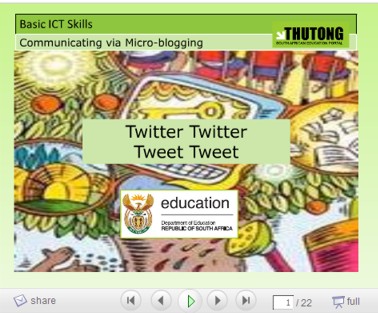
I’m only just becoming organically immersed in Twitter, but when asked to explain it, I’d rather point to the excellent slideshow Wesley Fryer included in his 13 September 08 post.  Wesley summarises the 3 learning outcomes of Twitter, as outlined by the South African creator of the slideshow, Maggie Verster:

  • Communicate using a micro-blogging system
  • Update your status
  • Create a learning network

Some people are still sceptical about the value of Twitter outside of banal chit-chat, but in light of Maggie’s outcomes, I think they should challenge themselves to give Twitter a second, more serious look.

The hardest part, for me, was to connect to a meaningful network, and that always requires initial hard work and staying power. A little like developing readership and comments for blogs. Once you do that, the rewards are apparent. Previously, I subscribed to a teacher librarian network, ‘oztl_net’, and that worked well for a time, but the advantages of Twitter are the global connection, the updated status which connects to the person in real time, the fantastic stream of links, the fluid conversation.

I’m interested to hear from others what Twitter means to them, or why they have avoided Twitter.

In a world in which information is like air, what happens to power?

[youtube=http://www.youtube.com/watch?v=LlqU1o3NmSw&eurl=http://www.usnowfilm.com/&feature=player_embedded]

JP Rangaswarmi  wrote a post about Us Now, a one-hour documentary by Ivo Gormley about participative citizenship, mass collaboration and the internet, and their implications on government as we know it.

The Us Now website links to the thinkers asked to determine the opportunity for government in the radical new models of social organisation. Some of these are George Osbourne, Ed Milliband, Don Tapscott and Clay Shirky.

It’s interesting to follow the new democracy that online social organisations have opened up. More than interesting. As stated in the Us Now website, ‘In a world in which information is like air, who has the power?’

The Us Now blog includes interesting information by Paul Miller from the School of Everything. The School of Everything is a social learning network that connects people who can teach with people who want to learn.

Having been led to read about the School of Everything, and linked to Wikinomics through Paul Miller, I started to think about how, on the whole, we accept schools as the way to go with learning and trust them with our kids. My father, who completed his school education at the age of  14 so that he could get a trade and contribute to family finances, revered Education as a hallowed institution. Throughout my schooling, though, he had moments of disillusionment when I was unable to understand the politics in the TV news report, when I was useless at practical things or what he termed as ‘common sense’, or when I started philosophy and started questioning whether the table was really there. My own experiences as a parent saw me disillusioned at times when my older son was told to dumb down by the primary school psychologist so that he could more easily fit in, and even now, fighting  frustration when my younger son is instructed not to cut and paste, but to use his own words in a project that simply asks for basic facts about a country.

I have friends who have home schooled their children. Is this an option? Hasn’t  home tutoring been one of the ways to educate young people throughout history? And yet, these options have always made me nervous. Maybe because I was told my children would be socially impaired without normal social contact with their peers. Or maybe simply because it wasn’t the norm, and therefore frightening.

I’ve just had a conversation about this and alternative schooling with my older son who has completed year 12 recently. He’s a good example of a passionately curious child who stood out from ‘normal’ children and suffered for it in his primary years, but eventually toned down to fit in. It was interesting to see him become defensive and uncomfortable when I mentioned the School of Everything and questioned the relevance of traditional schooling.

No, you can’t have that, he protested.

Why  not? 

Well, it’s not all about learning of content, it’s about being with people and learning from them.

Who said that an alternative or online learning program excluded face to face contact or social opportunities?

OK, well, you can’t just do your own thing. You have to learn that not everything in life is interesting.

Tell me, how many teachers did you find boring and unengaging, and how much of your schooling have you retained or found valuable in life?

(squirm) But you can’t have life without suffering. You need to learn to cope with disillusionment and disengagment. You can’t totally remove it.

I’m not going to unpack this. I’m just going to ask you to give me your thoughts.

Just do it – together

Allanah King  has made a lot of people smile with her collaborative project dance video. See if you can keep a straight face.

[youtube=http://au.youtube.com/watch?v=v3gbOfgzFBI]

Allanah commented:

The project started out as a bit of fun – it ended up that way too. We thought we would make a collaborative video in a similar style to the Where the hell is Matt video that is wildly popular on YouTube. By having a collaborative dance video we were able to transcend cultural and language barriers as everyone loves to move and dance- it is pretty universal.

Allanah collaborated with schools across New Zealand, as well as Canada, Bangkok and the United Kingdom. She talks about her process on the Time 4 Celebration site.

Why does this kind of thing make me stop in my tracks? Allanah said that she did it for a bit of fun. She also said that it transcended cultural and language barriers since dance is universal. I think it’s a simple example of what makes us human – just getting together and enjoying each other. The fact that there are things like dance or music that we can share across cultures gives me a clue about engagement in schools. It just takes a simple thing, a happening, celebration – as long as it brings us together as a group and gives us a sense of belonging. Great things can come from this.

I like Allanah’s blog title: Life is not a race to be first finished.

It shouldn’t be. It shouldn’t be aiming for good marks in a test. It shouldn’t be focussing solely on a result. It’s about enjoying the process and sharing it with others. I love the idea of creating online learning spaces to support, connect, share and celebrate. Learning shouldn’t be a lonely road. Not a journey kept to yourself. Never an experience without good fun.

I’ve been privileged to do some collaborative teaching with Maria Toomey in her English classes at school. Maria understands this instinctively. Understands and lives this. What her students learn in class they do with a sense of being valued as part of the group. She teaches the whole person, and gives of herself in the same way. She and the boys come together to think, discuss, review, display and celebrate. She shows them the value of learning beyond academic content, and they will remember her beyond the classroom.

By the way, do yourself a favour and read some of Matt’s dancers’ comments here. You can also get a Google Earth tour of some of Matt’s favourite places around the world. I loved this.

Sharing culture – Creative Commons video

George Siemens put a plug in for this Creative Commons video. Thought I’d share it.

[youtube=http://au.youtube.com/watch?v=1DKm96Ftfko]

Some of the thoughts I’ve taken out to give you an idea of the video:

What does it mean to be human if we don’t have a shared culture? What does a shared culture mean if you can’t share it?

We have all these new technologies that allow people to express themselves, take control of their creative impulses, but the law gets in the way.

Creative Commons wants us to be able to say ‘here’s the freedom that I want to run with any creative work’.

A Creative Commons license says give me credit for my work.

Creative Commons allows you to exercise your copyright more simply.

It’s really about creativity and connection, access and control

Creative Commons is a bridge to this future – thinking not about content but about communities

It’s the space for more speech, more expression.


What do you think about Creative Commons?

Capzles: time captured in a story

Capzles is a new way to combine videos, photos and mp3s into rich, multimedia storytelling.

capzleobama

Until I’m successful in embedding the widget, here’s the link to a capzle on Obama. 

Capzles promises to ‘claim your memories; tell your stories; travel through time’, and they do that eloquently. The Obama capzle traces Obama’s life sequentially, and includes photos, and video and transcripts of speeches. I can definitely see the value of capzles for teaching subject matter, but more than that, kids would enjoy creating capzles to present research. This application really does have the potential to capture what’s essential and interesting, and package it neatly for viewing.

It’s free and simple to join. You can browse capzles created in popular categories, eg. history, art and design, film and movies, people and life, vacation and travel, etc. Under history, for example, you’ll find ‘history of Apple computer’ and ’75 years of the popemobile’. It’s a great way to share travel experiences, or present biographies in an engaging format. Or encapzlate your old photographs. Oh, and of course, it’s another great sharing tool. Although there isn’t a huge amount there at the moment, I expect it will expand its archive very quickly.

Thanks to @grosseck for this.