Category Archives: Web 2.0

YouTube Symphony Orchestra

[youtube=http://www.youtube.com/watch?v=-T_SryRAXuw&eurl=http://gmodules.com/gadgets/ifr?url=http://hosting.gmodules.com/ig/gadgets/file/104671293108202388368/symphony.xml&hliurl=http://i2.ytimg.com/vi/-T_SryRAXuw/hqdefault.jpg&feature=player_embedded]

I’m really getting into the global potential and creativity of technology. Discovering YouTube Symphony Orchestra made me smile. Music plays a significant part in my life, with my two sons playing piano and violin, and my 15 year old spending most of his free time composing classical music. There is always music in the house, sometimes competitively discordant, but usually lovely to listen to. Here is what YouTube Symphony Orchestra is about:

We invite musicians from around the world to audition for the YouTube Symphony Orchestra. Your video entries will be combined into the first ever collaborative virtual performance, and the world will select the best of you to perform at New York City’s Carnegie Hall in April 2009.

This will be the first ever collaborative online orchestra. Pretty cool. It will unite professionals and amateurs from around the world. You can audition by submitting a video performance of a new piece which has been written for the occasion by the renowned Chinese composer Tan Dun (Crouching Tiger, Hidden Dragon).

Technology to audition and technology to help you prepare. YouTube provides tools to help you learn the music, rehearse with the conductor and upload your part for the collaborative video.

Finalists will travel to New York in April 2009 to participate in the YouTube Symphony Orchestra summit and play at Carnegie Hall.

The New York Times writes about this.

“The idea is to put together the world’s first collaborative online orchestra” and encourage musicians of all types and abilities around the world, said Ed Sanders, YouTube’s project marketing director for Europe, the Middle East and Africa and the person in charge of the effort. “It’s collaboration in a way and a medium never seen, both with sound and video.”

You can listen to the composition played by the London Symphony Orchestra:

[youtube=http://au.youtube.com/watch?v=Tqiro1kdRlw]


Fly a virtual paper plane into the future of education

futureeducation


I just had to show you this very creative and original site, although I had promised myself before this that I wouldn’t post another thing for a while.

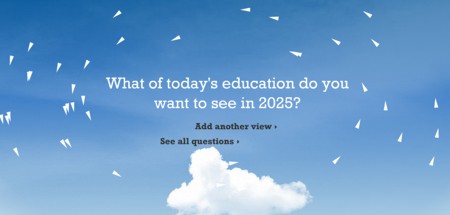
You’re going to love this. When you go to the Million Futures site, you see a blue sky with fluffy clouds and hundreds of paper planes flying around. These represent people’s views on future education. 

Million Futures is part of Beyond Current Horizons – a joint project conducted by the Department for Children, Schools and Families (DCSF) and education innovator Futurelab.

It’s an innovative way of consulting with the public to identify what people see as the biggest challenges facing the future of education, and to gain some knowledge of how people would like to envisage future education. The responses will contribute to a report from Futurelab which will be published on the Beyond Current Horizons website. This will be used to inform the UK government’s long-term scenario planning for education.

There are 6 questions revolving around the central question:

What of today’s education do you want to see in 2025?

When you click on a question, a paper plane flies in and opens up for you to write inside. When you’re done, it folds up and flies into the sky to join the other planes. You can open other planes to see what others have written. I’m not sure how this is going to reflect UK views, since I was able to contribute and I’m Australian.

I urge you to have a look, even just from an aesthetic perspective. What an original idea.

Thanks to @ggrosseck for finding this

Words come to life in Wordia

oscarpuppet

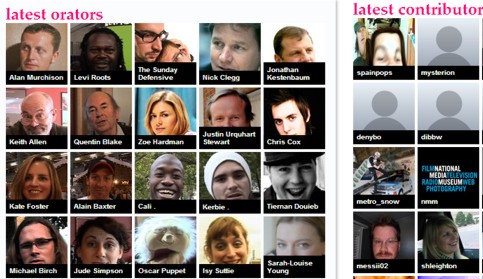
I love the idea of a dictionary created by many people, but Wordia is more than that. It’s a media dictionary created by people sharing their own videos. It’s people talking on video about a word that they’ve chosen. So it’s much more than a definition. Watch Oscar Puppet’s video defining the word ‘buncombe’ and you’ll see that it’s just as much about the person (or character) behind the chosen word – it’s a word definition with personality.

What else is Wordia?

It’s a community of people who, for one reason or another, care about a word enough to spend time making a short film to explain their chosen word.

wordiacommunity

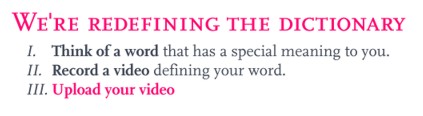
You, too, could join this collection of people who make this media dictionary. This is what you have to do:

wordiainstructions

 Wordia is in beta and is far from comprehensive. There’s something good about a brilliant, new idea in the making, especially when anyone is invited to contribute.

I got sick of searching for words that weren’t there so I browsed using the ‘words’ tab. There’s a list of ‘best words’ and that’s how I came across the definition for ‘fermata’. Very entertaining.

Wordia has it all. Aside from the obligatory dictionary definitions on the page, the list of synonyms, you also get comments from people, making Wordia not so much a dictionary as a linguistic peopleonary.

There are many ideas for the English classroom here. Apart from the kids watching or making their own Wordia clip, you could discuss which videos work best and why, or how the video presentations could be improved, or you could get the kids to choose 5 words they didn’t previously know, or 5 words that sound the most ridiculous, or 5 legal words, 5 words associated with emotions, etc. You get my drift.

Have a look for yourselves and tell me what you think.


Library Odyssey : 2029 future projection

jetsons


There’s been talk about libraries and librarians becoming an endangered species and eventually dying out. Personally, I think that’s a lot of rubbish. Nothing could be further from the truth. Although, you could say that libraries and librarians are shedding their skins, evolving with changes that are taking place.

The DaVinci Institute does a good job of discussing this and projecting a future snapshot of libraries. Thomas Frey, Senior Futurist of the DaVinci Institute, rejects the predictions that technologies will make libraries defunct, and says this:

Ever since the people of ancient Nineveh began storing and classifying their books nearly 3,000 years ago, libraries have been hallowed and largely unchanging bastions of learning. But in the information age, libraries have been caste with a new identity, and the future is evolving into a very different place.

Ten years ago, as the Internet began to take off, many in the tech elite were predicting the death of the public library. What the critics failed to predict, however, was libraries’ stirring ability to reinvent themselves. Much like plants that flourish with good soil, water and sunshine, libraries have actually begun to thrive in our information-rich environment.
In the school library context, many libraries and teacher librarians are not only reinventing themselves in keeping with the fast-paced changes in the availability and management of information, but they are also often leaders in the future direction of education. Despite this, I still hear people say that libraries should be closed, and that librarians will soon be unemployed.
Here are some of the predictions for a 2029 library by the DaVinci Institute:
Traditional lending has been replaced with downloadable books, which are never out of stock, formatted for electronic tablets and readers. A bigger change, though, has come with the very concept of what a book is. Where once a customer would passively read and, hopefully, absorb a book, every volume now is more akin to an online forum, with authors, experts and other readers available to discuss and answer questions on almost every important book ever written.
I look forward to this change, especially having become hooked on interactive online communities. It would be satisfying to be able to respond to text on the spot, and receive others’ responses. Librarything has paved some of this way, but I think it could go even further.
Here are some more snippets from Thomas Frey’s article
With the Internet having put increasingly powerful business tools into the hands of individuals, more people are working and operating businesses from home. To such people, the library offers not just a refuge from the isolation of their house, it also provides temporary office space complete with podcast recording studios, conference rooms and editing stations.
And of course, predictions should always include a future which inspires the imagination:
With technology having improved so dramatically, a central feature of this library is the Search Command Center, where a team of experts, both real and virtual, assists with complex searches that now incorporate not just words, but sounds, textures and even smells.
What would your predictions be for schools of the future?

Open mind

I thought I’d try Phrasr using the phrase ‘ Minds are like parachutes; they only function when they are open’.

Phrasr allows you to choose flickr images for each word in a phrase.

See it here.

parachutes

Photo by Fikirbaz

It’s probably not the best phrase to use, since some of the words don’t really match the pictures. Still, I can see students having fun with the image choices here. I like the idea of playing with a quote, and dressing it up with images. Students could use quotes from Shakespeare, for example. It would be a good way to remember difficult quotes.

Actually, it works much better if you omit pictures for the insignificant words, eg. prepositions and articles.

Some ideas for the phrase are: proverb, quotation (eg. from a poem, song, Shakespeare), alliterative phrase, colour-coded phrase, nonsense phrase. Limitless possibilities, really.

Here’s an example of a nonsense phrase.

Here’s an alliterative one.

Here’s one from Shakespeare (Macbeth, I think)

If you have made any Phrasr examples, I’d love you to share them.

21st century jargon

An article in The Telegraph voted the phrase ‘thinking outside the box’ as the most despised business jargon. Some of these cliches really get on my nerves. For example: Touch base (2), Pushing the envelope (18), In the loop (20). Others I haven’t heard of: Blue sky thinking (6), Singing from the same hymn sheet (10), thought shower (13).

The BBC News Magazine published an article entitled ’50 office-speak phrases you love to hate’. Tim from Durban, won my vote with a mixed-metaphor phrase from his boss –

‘You can’t have your cake and eat it, so you have to step up to the plate and face the music’. 

That’s not entirely ridiculous if you mean a dessert plate, but then you wouldn’t step up to it, would you?

What is it about language, that it can express something so well that it becomes popular usage, but that its  popularity leads to its demise? Or is it that we are too lazy to define our own meaning so we borrow phrases and use them to death?

What about ‘Web 2.0′, ’21st century skills’, ‘social networking’? Are these bandied about so much that they start to annoy? Are they loved by some, and hated by others? Sometimes I feel as if I should avoid talking about blogs, wikis, Twitter in front of people who don’t use them, because the very sound of these words are enough to turn people off. How should we speak about these things to people who haven’t embraced them?

Which phrases do you love to hate?

We connect students

[youtube=http://au.youtube.com/watch?v=e7oFzmr9_M4]

Jo McLeay has written an excellent post about connected, or networked, students, following her participation in the Connectivism 08 online course. She got this video from Wendy on Twitter. When I have time, I’d like to read both Jo’s and Wendy’s blogs post to post.

One paragraph that did stand out for me in Wendy’s blog was this one:

What can we learn from voices of resistance?
Resistance is good. Any new theory, or idea for that matter, needs vetting to fully develop and improve. Open-minded skepticism is healthy because it encourages creativity. There will be those who never change. However, our response to their arguments adds to the foundation on which we build a solid learning network. Learning may look different in a connective environment, but some traditional learning principles may be valid in certain circumstances. Resistance will help us evaluate those pedagogies and how they apply.

It makes sense to use resistance to test ourselves and grow stronger, instead of staying in gathering negative energy and creating enemies. And, of course, we gain strength from our communities.

So much to learn every day, and never enough time to do it. How do you keep up with all the excellent online courses and groups? How do you prevent superficial absorption of too many things because you feel like a kid in a lolly shop?

The power of Youtube – Queen Rania wins (and we celebrate Jenny Luca’s win too)

[youtube=http://www.youtube.com/watch?v=JPcw3fLeBHM&eurl=http://joi.ito.com/&feature=player_embedded]

Our own Jenny Luca has recently been recognised by the Victorian Institute of Teaching as the winner of the World Teachers Every Day competition. Well done, Jenny! You’ve certainly deserved this award, and you’re an inspiration and model for all educators.

Across the other side of the world, a member of royalty received a different award, but one which will be of equal interest to 21st century educators. San Francisco mayor, Gavin Newsom, presented the inaugural YouTube Visionary Award to Queen Rania of Jordan. Queen Rania wasn’t able to accept the award in person, so instead she sent a video.

Her acceptance speech shows that getting serious about something significant doesn’t preclude a sense of humour. Queen Rania warms up the viewers with humour and ends powerfully with a serious message: that suspicion, intolerance and mistrust are driving us apart. She says she wanted to kickstart a conversation in the world’s largest community. Her motto for the power of YouTube is:

We’re stronger when we listen and smarter when we share.

Queen Rania urges us to use the power of YouTube’s conversation. She admits that it’s not likely to change the world, but it will change some minds.

San Francisco mayor, Gavin Newsom, introduced the award by nominating YouTube as a dominant force in politics, a powerful tool for shaping policy, and communicating with the public world wide. He talks about this award recognising those who use technology to instigate change, who have had a real impact.

Mayor Newsom says that Queen Rania of Jordan has dedicated her time and talents to breaking down stereotypes, and combatting misconceptions about Islam and the Arab world. Her videos have created open dialogue around the world amongst millions of commenters and viewers. Her aim has been to encourage people to join forces and bring down misconceptions. Here is a message worth thinking about:

We can’t judge another culture through the lense of our own cultural compass.

So true.

Queen Rania encourages us all to make a difference through YouTube. She says: Your eyes can open people’s minds. She urges us to get our clips out there to create change. YouTube is a platform for the most powerful dialogue.

We need to look past technology as an end in itself, and realise its potential.

Thanks to Joi Ito for his post.

Blogs are NOT airy-fairy, soul-searching, self-indulgent

You know how you can’t let some things go?

Well, the back of my mind is often processing ways to demonstrate to people the value of reading and writing blogs. Recently I read an educator’s comments about introducing teachers to Web 2.0 practices, where he says he wouldn’t start with blogging, but provide teachers with examples of great blogs to read. Often people considering blogging will say that they don’t know what to blog about. It’s a bit like a student getting an open essay topic; it’s difficult because it’s undefined. That’s why reading blogs of people who share your interests is a good starting point for new bloggers or even sceptics. What I’m actually saying is – you don’t know what you’re missing – there are people out there who are really worth knowing, in all parts of the world and in many spheres of life and occupation.

John Connell linked to a series of blog networking interviews by Lilia Efimova in his post about passionate bloggers. People whose blogs centred around knowledge management topics were interviewed by Lilia about how they used blogs for networking. What’s particularly interesting is the variety of backgrounds represented. Lilia’s interviews covered the following:

  • professional background of a participant and characteristics of her network in KM field prior to blogging
  • changes in the network or networking practices because of blogging
  • uses of weblogs for developing, maintaining and activating relations as a starting point for articulating stages of the process at more granular level
  • place of the weblog in the ecosystem of networking tools (mainly focusing on what weblogs are good for and when they do not work).
  • important networking-related issues that haven’t been discussed

Here are some examples:

Brett Miller, a system engineer, says

 “I know more people in different areas of KM when I knew before.” Blogging helped him to reach people he wouldn’t be able to reach otherwise.

Dave Snowden is a founder and a Chief Scientific Officer of Cognitive Edge, a consulting company focusing on complexity, sense-making and narratives. He was formerly a director of IBM Institute of Knowledge Management and founder of the Cynefin Centre for organisational complexity. He has about 50 science bloggers in his RSS reader.

“They scan journals for me, so I don’t have myself … I’ve learnt to trust them over the years … it’s much better than summarisation surface”.

Euan Semple is an independent advisor for social computing for business (www.euansemple.com). He started blogging with his personal weblog The Obvious. He says:

“Previously I was subject to geographical constraints or social constraints or organisational constraints as of who I was likely to meet and suddenly with online networks I’ve been able to connect to […] the whole bunch of interesting and interested people whom I suddenly had an access to in a way in a normal life I would never ever had that chance. I could then establish relationships and (and again something I get very hot about) is that these are not pretend or unreal or virtual relationship, the real relationship, where you build up trust and affect and those powerful things that make people work together. Online.”

And also:

[Blogging] is “a collective pointing that helps to find stuff, once you have an established group of bloggers you read and trust. And their ability to find a good stuff to point to it, increases your signal to noise ratio on the web … Blogs do that better than other tools because of the context – you have to say why that is important, why are you pointing to something”.

Luis Suarez works at IBM as social software evangelist. He is located in Spain, but travels frequently for his work. He says:

Weblogs allow you to get beyond what people publish and to get as sense of what a person is like – to build a profile of a person as a person, not a business entity. Not how long you have been married, but how people write articles. When you write a blogpost you are giving yourself out as a person. The line between life and work is going to disappear.

The question of blogs developing trust is an interesting one. Luis says that trust is developed through a ‘willingness to expose what you don’t know’, and ‘a willingness to learn not yet finished thinking’ or ‘taking a radical position that invites criticism’, ‘being brave and bold’. He added that ‘there is something special about somebody coming to your place to leave their words there’.

Talking about changes in professional network as a result of blogging, Monica Andre, who worked in a research lab in Lisbon focusing on information behaviour and information management, says:

“I didn’t realise that linking and giving credits to someone’s work would extend my professional network extended very quickly.” She then told a story of being contacted by a municipality government from Spain who wanted her to speak at an event. “I didn’t know I was followed by them. If [people] leave comments, you have a clue, a footprint. It turns out that guy who was reading my blog suggested the government that I would be a good person to talk as a keynote speaker”. When she received an email she thought it was a joke, but they called to confirm.

These are only a few examples of what people had to say about blogging in Lilia’s interviews, just to whet your appetite. You can read all interview summaries on Lilia Efimova’s blog Mathemagenic.

It’s difficult to ‘convert’ people to reading and writing blogs and to online networking in general for a variety of reasons I’ve spoken about many times in previous posts. It may be as difficult as religious or political conversion. To those of you reading this post, I’m preaching to the converted, I know. So please tell me, have you had successful experiences in converting those resistant to blogging that you would like to share?