Category Archives: Web 2.0

Humanity meets in the library

This is how it goes.

I read Jenny Luca’s post ‘The future of libraries’ which she wrote after reading John Connell’s post ‘Education and the cloud’. John wrote his post after reading Kevin Marks. Kevin had read something Tim O’Reilly had written. Tim was writing after having read a book by Kim Stanley Robinson. Before spiralling further, I should redivert to the purpose of my own post which is to contribute my own thoughts following from these threads, and specifically following from Jenny’s valuable insights.

As John Connell remarks, ‘the world of knowledge is shifting inexorably onto the Web.’  Whether we like it or not, it’s true. Now, I’m not saying that, in agreeing with this statement, I’m ready to pull books off shelves, turn libraries into clubs and restaurants (as Russian communists did with churches), or make the whole population of teachers redundant. I’m here to say that the massive shift of knowledge onto the web is happening, and that people will be playing a new, even more important role in the location and management of knowledge and technology.
Thomas Frey, the Executive Director and Senior Futurist at the DaVinci Institute, has written an interesting account of the future of libraries, which is actually a history of information and knowledge, since libraries house information and knowledge in whatever form they take. Frey comments:
We have come a long ways from the time of da Vinci and the time when books were chained to lecterns.  But we’ve only scratched the surface of many more changes to come…
Throughout history the role of the library was to serve as a storehouse, an archive of manuscripts, art, and important documents.  The library was the center of information revered by most because each contained the foundational building blocks of information for all humanity.
So what do libraries become once information moves to the web? And what becomes of schools and teachers if information can be accessed by anyone anywhere?
Jenny Luca says:
There will still be a need for schools and teachers. I don’t think we will become obsolete. I do think the nature of learning will change; we will need to encourage and foster self directed learners and this is what I see the function of teachers will be in the future…
… What the point of libraries will be, I think, is as a meeting place for humanity to share ideas. A bit like Ancient Greece where the Sophists would meet up together to share ideas.

 Humanity. Both Jenny Luca and Thomas Frey have identified the larger concern as humanity. It’s not about books, computers, buildings or technology but the collective resources of humanity. It’s not about books versus the internet. And as Frey says, ‘books are a technology, and writing is also a technology, and every technology has a limited lifespan.’  People locate, write, store, use and share information. How revolutionary was Johann Gutenberg who unveiled his printing press to the world by printing copies of the Gutenberg Bible in 1455? But, as Frey says, communication systems are continually changing the way people access information:

If you were to construct a trend line beginning with the 1844 invention of the telegraph, you will begin to see the accelerating pace of change:  1876 – telephone, 1877 – phonograph, 1896 – radio, 1935 – fax machine, 1939 – television, 1945 – ENIAC Computer, 1947 – transistor, 1954 – color television, 1961 – laser, 1965 – email, 1973 – cell phone, 1974 – Altair 8800, 1989 – World Wide Web, 1990 – Online Search Engine, 1992 – Web Browser, 1994 – Palm Pilot, 1996 – Google, 1999 – P2P, 2002 – iPod, 2004 – Podcasting.

If we bring back the true meaning of libraries – to share knowledge and ideas, or, more specifically, to enable the human interaction with knowledge and ideas, then we can see that schools and libraries, as centres of learning and interaction, are challenged with a new, global purpose. Frey says:

Libraries themselves are a global system representing an anchor point for new systems and new cultures… The notion of becoming a cultural center is an expansive role for the future library.  It will not only serve as an information resource, but much more, with the exact mission and goals evolving and changing over time.
It’s humanity that Jenny focuses on when describing what libraries and schools should be:
The space where students can form relationships, the space where they can articulate ideas and glean advice and encouragement, the space where the human network forms and where they can find ways to make it grow.  

In redefining the library and its purpose, Frey advocates experimenting with creative spaces. He suggests new functionality in the library, including band practice rooms, podcasting stations, blogger stations, art studios, recording studios, video studios, imagination rooms, and theatre/drama practice rooms.
With the whole world changing so rapidly, we have the opportunity to reinvent our learning spaces creatively. In doing this, we don’t destroy what we had in books or teachers, we respond to changes by recognising what is essential, and reshape our learning instead of holding on to external structures out of habit.
Learning is about people as my first paragraph attests to. Thankyou to my learning community.

Own the info, keep the info, hide the info

bottled-coins


I was reading Will Richardson’s article Get. Off. Paper. where he talks about people’s dependence on paper, and the reluctance to let go of owning information in hard copy. I’ve also just read what Joi Ito, CEO of Creative Commons, has to say about sharing photos of ourselves. It’s made me reflect on the nature of owning and sharing information, and how that has changed dramatically in the last few years.

When I was at school and university, information was power. If you wanted to be successful and get good marks, you needed information.

I remember how scarce information was. I had to work hard to get it, and I had to work hard to get it before others did, or get it from places others wouldn’t know about.

Sound strange? Think about it. An assignment is set, and the class goes to the library, but there are only a few books about the single subject that needs researching. Once I was jumped from behind by another student who clawed me until I dropped the book she wanted. Sound unbelievable? Believe it; it’s true. That experience shocked me and I’m not about to forget it. I’ve wondered since then, how important is this information, that someone would behave in such a manner? Admittedly, this is extreme behaviour, but think about this. In those days, my assignments were based on the location of content. If I owned that content, I would regurgitate it and present it attractively. Would I be in a hurry to share this information? Well, that would mean that someone else would have the same information as me. Why would I share it? Did we ever do anything with that information? Analyse it, evaluate it, modify it, create from it? No. That information was what my mark was based on.

Will Richardson talks about a paperless society. What I remember most about university, was the time I spent photocopying chapers in the library. Not complete chapters, of course, just the legal percentage of what was permissable. I focussed on collecting bags full of coins so that I would be able to photocopy pages from all the books I’d found that were even remotely relevant to my topics of study. I needed those copies, I felt empowered with all that paper, all that information that I may need during my research. When I was finished, I kept that paper. I couldn’t bring myself to throw it out. I might need it. I think I still have it.

It’s a relief but also kind of strange to be functioning now in the potentially almost paperless world. I turn to people for my links to information, and I share freely, as well as receive in abundance.  My networks are not mean. They are made of people who are smart, connected, varied, informed, interesting and willing to share ideas and knowledge. I’m happy that I’m still learning so that I can turn my back on the old ways.

New young blogger and writer

Her post is called Scribbles, and she has a way with words.I love Varia’s blog, Siberian Pepper.  

“Education is not about getting the piece of paper at the end; it is hopefully, a community and an exchange between people all yearning for knowledge and new skills. I plan to suck it up as much as I can, put everything in, run my hands ragged over the keyboard and look in strange places for inspiration.”

Synesthesia or Remembering that learning is not all thinking

My son wrote an interesting post about his association of different keys in music with colours. Although his colour association is not synesthesia, he does intuitively ‘see’ colours in music.  It’s a great reminder that our learning and understanding come through different channels, and that we’re programmed in unique ways. Here’s an extract from his post where he explains the thinking behind some of his improvisations on keyboard which are named after colours:

The image underlying Green (G minor) was one of a forest, and so I worked in some (admittedly simple) cross-rhythms to give the sensation of the complexity of the forest, of the trees in three dimensions, randomly scattered. Blue (E minor) is an ocean, with a lapping, repetitve bass line; the waves rising and falling with cresendo and diminuendo. Finally, White is in C major, more conventional and ballad-y with a recurring tonic note in the higher registers. When I was playing around with the ideas on my upright, the image was one of ice and its cold purity, especially through the harmonics that it caused; but unfortunately these were lost when I recorded it on my electronic piano.

Sometimes I think that we should trust that we’re all wired to naturally absorb things, and that teaching should be the provision of the ideal environment to assist that absorption. If our teaching interferes with this, then learning is aborted.

I wonder if that made sense?

Bring Show and Tell into the 21st century

peacock

Does Show and Tell sound old fashioned to you?  Think again…

Remember Show and Tell in primary school? In my primary years (a long time ago), Show and Tell was possibly the only time that the teacher stepped aside and encouraged students to take centre stage to share sundry news items and paraphernalia. Think about what’s happening – a variety show led by students themselves. You can say or show almost anything – news (world news, local news, trivial or important news, news about your dog or about your uncle), opinions, and the freedom to bring in ANYTHING you like – stick insect in a jar, your dad’s gallstones, the latest in technology (for me, that was my talking Bugs Bunny), strange money, photos of a trip to exotic lands, a special book, something you have made, a science experiment (remember growing your own crystals) – wonderful, wonderful things. I imagine Show and Tell still happens in primary schools.

But why stop at primary school? How often does a student get free reign and the attention of the whole class? When else does the student audience get to see such a great show. By secondary school – correct me if I’m wrong – everything fits into neat little curricular boxes. Very full boxes. No room for randomness, for the unexpected, for student-directed sharing; no procession of ever-changing wonders, no exchange of opinions on student-directed topics.

And another thing. The time limits for each Show and Tell slot allow for a quick succession of small, tasty morsels. If you’re not interested in one thing, the next offering could be more to your liking.

Are you thinking what I’m thinking? Doesn’t this remind you a little of Twitter? The short, quick exchange of goodies just discovered, great links, photos worth sharing, questions offered to the group? Is blogging or microblogging our new version of Show and Tell? A reclaiming of our natural desire to share and learn with each other? Our instinctive knowledge that learning happens from and with others, and not just from the teacher?

What do you think?

What are your best Show and Tell memories?

Blogs, Twitter and the read/write evolution

I recently (five minutes ago) discovered this blog and read an analogy I liked between blogging and music formats. The author was discussing a possible reason for the recent slowing down of blogging:

I probably see blogging now as the album format with something like Rejaw or Tumblr as the EP format (macro-blogging?) together with Twitter and others (status updates) being analogous to the single in digital download format. Dubious though my analogy may well be I hope it illustrates that I see this dissipation as all being part of the same offering.

Well, I’ve come to blogging late and it seems, according to some, I’ve almost missed the boat. Should I stop embarrassing myself with the long blog posts which are apparently so passe? Or should I continue to indulge myself, knowing that my novice posts are a necessary part of my early stages of evolution, a purging perhaps, an outpouring of the silenced thoughts of previous decades?

Twitter I’ve only recently added to my online life (told you I was a latecomer), and I still feel like an outsider there, posting the odd tweet in the hope of being heard, of being accepted into a conversation. Mobile computing is not part of my diet yet, and that may change in the future if I reinvent my commitment to the latest technology. I agree with the abovementioned author that the initial overwhelming addiction to regular blogging is slowly receding –

I don’t have that mania for a daily post as perhaps I did in the past. I’ve allowed various social networking and micro-blogging outlets to soak up a range of smaller spontaneous thoughts.

The blog is still, for me, the place that I call my own, where I can take the time to express ideas and share interesting finds, whereas the microblogging is a little like fast food – it’s quick and it fills the spot, but you wouldn’t savour it.  As said author has stated so well –

My point is that it’s all just platforms, formats, vehicles or just another tool. It’s either the evolution of blogging or the slow dilution of a once powerful creative outlet into a series of side alleys and cul-de-sacs.

Military blogs? An authentic voice for the history class

military-blogs


Make no mistake, military blogs will be part of American History.  There are hundreds (if not thousands) of blogs already archived online, published books, the Library of Congress has a Veterans History Project, students are studying military blogs in the classroom, thesis papers being written, and so much more.

Milblogging.com is the world’s largest index of military blogs – searchable by a variety of attributes. Milblogging.com currently has 2,172 military blogs in 41 countries with 6,762 registered members.

Some recently added blog posts include: life as a military wife; patriot missive; four fans of freedom; salute to your service, and many more.

Amongst other things you’ll find personal diaries of Vietnam war veterans. Here’s a unique perspective of history, an authentic story for the history class. What is it about these blogs that add an extra dimension to learning?

What is significant about this particular wartime diary is the fact that this soldier arrived in Vietnam on Jan. 23, 1968, one week before the Tet Offensive, which engulfed South Vietnam and is considered by many to be one of the turning points of the war. Assigned to Military Assistance Command Vietnam (MACV), this young soldier had a front-row view of one of the significant events of the United States’ long involvement in South East Asia.


This is a goldmine of personal accounts that give an insight into history which would otherwise take much longer to be published.

Unfortunately, to show up in the history books, usually years and years have to go by first, so you might have to wait a little while before you see the writings of 365 and a Wakeup or Wordsmith at War in a History Book. 

 Read in the Washington Post how blogging became therapy for Captain Danjel Bout:

When Capt. Danjel Bout lost three comrades in a single day while on an October 2005 mission in Baghdad, he stifled his grief and remained focused on what seemed to be the longest day of his life.

The next day, he let it out.

 Blogs come from many perspectives – Afghanistan frontlines, Iraq frontlines, US army/navy/airforce, marine corps, military veteran, civilian, military spouse, military parent, foreign national military, etc.

 There is a wealth of material for teachers of English, History, Geography, and many other subjects, especially with a little imaginative application.


Microblogging American History – Twitter responses to Obama’s win

day-of-obama


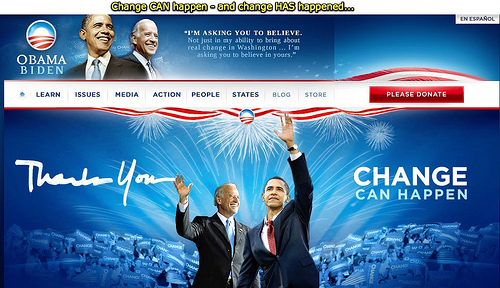
In its unique way, Twitter has commented on American history being made today. Never let it be said that Twitter is unable to convey anything more than little snippets of trivia devoid of any substance. The picture built up in the Twitter stream today as Obama’s victory became clearer and clearer was nothing short of emotional. The brief, fast-flowing tweets created a moving picture of people’s reactions to the historic event.

These are only some of the comments that I’ve selected. Remember, the most recent tweets are first, so you’re reading backwards in time. Kind of cool actually. Here goes:

wow – amazing – i’ve woken up in a better world – my only slight concern… what the hell is michael moore going to make films about now?

well done america 🙂 🙂 🙂

asked Yr 2 boy my reason for making him watch news – he said because it’s the first time a “brown person” has been elected president

Obama thanked me by text message. Wow, he looked pretty busy at the time

‘nite twitter. Welcome to Obamanation. The world approves, btw…

I have always been grateful to be American and I served it with my head held high… I have never been this proud

Analysis of Obama’s speech ( http://tinyurl.com/6xlvkl )

It’s been a long time coming, as the man says ♫ http://blip.fm/~ni0i

Balancing my delight in humanity with the grimness of Fox News pro-life, white supremacist babbling http://icanhaz.com/grim

Bless Obama and the people of the US

I may be a Canadian I am blown away by the history I have just observed. Very moving

awesome speech; told my kids that (let them stay up to hear it), both lass and lad noticed

“He talked of having to housebreak the puppy, they’re gunna also have to housebreak that new democratic majority in the congress”-Tom Brokaw

Oh, the place is vibrating

I like this image of Obama leaving the stage – a single man, walking to meet his wife, going off to meet destiny. Hard to hold back tears

I bet there’s a lady in Alaska who just fired HER personal stylist

We have a White House that looks like our country. Look at that stage, kids all over America are reimagining their world.

The last time I saw this much emotion on TV was death of Elvis when I was about 5 or 6. Better this time around

God, the image of the racial, national, and generational mix hugging on the stage in Chicago is a book in itself. History, history, history

Seeing all of the kids together is so cool!!!

Okay, I don’t think I’ve ever cried at a politician’s speech before in my life. Still kind of afraid to hope. But I think I’ll try

I like the sense of marital harmony I get from B and M. They really seem a pair that likes each other, a team. And those kids are fresh air

is it my imagination or did everyone stop tweeting during that speech?

Officially crying tears of joy

“if our children live to see the next century ..what progress we will have made? Open opportunities for our kids – peace. yes we can”

I am crying. Just from my right eye. Obama is great

He’s going to close with the speech we need

v v excited about Obama winning – maybe humans do have some ability to restore balance

Sitting in family room watching Obama’s speech. Wife and daughters waving American Flags at each pause. Great night!

“Our story is singular but our destiny is shared. A new dawn of American leadership is at hand.”

I gotta remember to buy different newspapers and magazines tomorrow to put in my daughter’s memory box

Okay, seriously… “the new puppy that is coming with us to the White House?” That absolutely made me laugh with delight.

holy wow… can that man speak.

Obama takes the stage! What a night!

anyone else terrified about what Those Who Hate Obama might attempt to do once he’s president, or before? I can’t shake it from my mind…

From another student — “I feel as if I can really do anything in the world now. Like for real.”

Just got a text from one of my advisees that made me cry, “Lehmann!!! We did it! President Obama!” This election really was about hope.

goodnight, tweeps. Pray for this nation, now more than ever.

Oh hurrah! My American friends have just texted me the news!!! Good old America, good old Americans! Xxx

Wow McCain’s speech was amazing. That was the McCain that should have been showing more during the campaign

well done to the people of America (and Obama), congratulations are in order. change is a necessity and a good thing

Magnanimous concession by John McCain. Well done.

There are moments in life that are too big to grasp. This is one of those moments. In total blissful shock. Too shocked to even cry… yet

Congratulations America!

Woo hoo! Just saw that Obama has won the election! I’m crying! Tears of joy 🙂

History in the making. . was this the first presidency tweeted through? Will Obama be known for changes in technology?

wow, nyc is going crazy, so loud outside.

“Don’t deny it, Obama is all Web 2.0” – http://is.gd/6n9j

When I watched his speech at the DNC 4 years ago, I thought “He could seriously be president.” Never thought it’d be in 2008.

“This is something so much bigger than Senator Obama”

nice to see my friends cheering too… yay twitter. hi dudes. i love loving america this morning.

McCain conceded via phone

Huzzah!

I am so proud of us right now…

wow. I don’t believe it. I just don’t believe it. WOW!!!!!!!!!!!!!!!!!!!!!!!!!!!!!!!!!!

O.M.F.G. Thank you America. You have made me extremely proud. Thank YOU!

Playing “Signed, Sealed and Delivered,” with all of the American flags waving is really moving

So happy to call Obama my PRESIDENT!

Congrats to President Obama! So much for going to sleep, gotta see his speech now!

Congratulations to my US friends – looks like you just got yourself a President

Hopes and Dreams!

gotta go hug my wife!

I can’t imagine being in the room with Barack when he got the word about becoming the next president……amazing time…..

Wow! This is exciting!

Fox just called it for Obama. That’s about as done as it gets. Congratulations President Obama! Please fix our country soon!

Obama. It’s over.

ABC News declares Obama the next President of the United States

I just got chills………..

CNN just called it

CNN calls it. Obama is the 44th President of the US

called. Omg

It’s all over!!!!!!!!


Educational resources in The New York Times

The New York Times has a ‘Teacher Connections’ section which is updated daily. Just browsing here today and saw some great stuff, so I thought I’d share.
There’s a Daily Lesson Plan and a Daily Lesson Plan archive, which has amongst its categories Civics, Global History, American History (of course), Fine Arts, Geography, Language Arts, Mathematics, Media Studies, and more.

I’ve copied one of the Fine Arts lessons into my art wiki: Art happens: investigating the modern art of Robert Rauschenberg. The overview states:

Students investigate the work of American Modernist Robert Rauschenberg by responding to his art and reading about his life and ideas. They then individually create a work of their own that pays homage to a Rauschenberg to demonstrate an understanding of his aesthetic sensibility.

The lesson is well planned, and includes objectives, resources/materials, background, activities/procedures, including homework, further questions for discussion, evaluation/assessment, vocabulary, extension activities, interdisciplinary connections, references and other information on the web. There is a feedback option at the end of the lesson.

The News Snapshot is an excellent idea for students to interact with the latest news:

Every Monday through Friday, News Snapshot features a newsworthy and provocative photo from The New York Times, along with the basic set of questions answered by journalists when relaying the news– who, what, where, when, why and how.

This section includes student handout, teacher’s page, suggested activities, and the questions.

Issues in depth is subtitled ‘Teaching with the times’ and includes curricular materials, news specials, and issues in depth. Each page provides a wealth of resources: lesson plans, Times articles, multimedia, archival materials, quizzes, crosswords, related Web sites and more. This section is designed to help students make connections between course material and issues and events in the news. There’s are wide variety of topics here, including the election, Iraq; and also material on literature, including specific books, poetry, Shakespeare, journalism, and more.

‘Science and Health’ includes topics, such as teen health, global warming, hurricanes, and more.

There’s more here – eg. crossword puzzles for the different curricular areas, ‘on this day in history’,etc., and I won’t go into detail for all of it; you’ll just have to look for yourselves. Actually, I do want to mention ‘Campus weblines’ where you can learn about how to produce a quality online newspaper from the student editors themselves. This is informative and detailed.

I recommend you give this section of The New York Times a squiz, and then dart over to Student Connections which ‘Science questions and answers’ and letters to the editor amongst other things.

But wait, there’s more! Parent Connections includes things like ‘coversation starters’ (they have thought of everything!) and a family movie guide.

I don’t know about you, but I’ll be keeping an eye on the educational section of The New York Times from now on.