Britannica blog featured this video on the less well known potential of blogging.
[youtube=http://www.youtube.com/watch?v=dQJ2SegGWyc&color1=0xb1b1b1&color2=0xcfcfcf&hl=en&fs=1]

Britannica blog featured this video on the less well known potential of blogging.
[youtube=http://www.youtube.com/watch?v=dQJ2SegGWyc&color1=0xb1b1b1&color2=0xcfcfcf&hl=en&fs=1]
If we want to shift learning and teaching into the 21st century, there are a number of people we need to take with us. Apart from teachers and school administrators, we can’t ignore parents in this move, and we really should be thinking about how we do this. The K12 Online Conference 2008: Kicking it up a notch tackles the subject of parents as partners – Parental Engagement in the 21st Century – Leveraging web 2.0 tools to engage parents in non-traditional ways – giving much food for thought, as well as practical suggestions of ways to move forward.
Lorna Constantini and Matt Montagna connect from afar online and ask how we can move forward from teachers’ and parents’ fear of the internet. They remind us that parents haven’t been brought up on the internet, so it’s natural for them to fear something that is foreign. The question is, what can we say to parents that will influence them in a positive way about their children’s online lives? I like the way Lorna and Matt have brought it back to what parents can understand – that we are all social beings, having an innate desire to connect with people and develop relationships, and that social networking is just a new form of traditional social connections. As Matt points out,
although online networks can be playful, they can also be powerful, enabling people to meet others with similar interests, solve problems together, create software programs together, participate in social and professional discussion with people we may not know in the physical world, etc. Our kids do this instinctively and fluently, posting content, interacting with content posted by others, learning from and teaching one another, having conversations with people all over the world – the opportunities to learn are tremendous. If we look at this new focus for young people, we should realise that they’ve moved away from what has long been the criticism of passive television viewing, and found new engagement in an interactive environment. If parents understand the positive aspects of social networking, they will realise that this shift is enormously powerful.
A major concern for parents is safety on the internet. Matt and Lorna talk about reassuring parents that young people are better at warding off potentially harmful situations than we give them credit for. They also ask a serious question, one that we need to discuss in schools: Who is guiding and mentoring our young people online now? Who is rolemodelling ethical and effective online interactions? And the answer is, apart from isolated individuals, nobody.
Schools may think they are by using filtering software, but it doesn’t encourage responsible use. All it does is encourage kids to find ways around filters, and it also blocks valuable and educational content. On the whole, parents don’t know what their kids are doing on the internet, so they are unable to provide guidance. This needs to change! Why? In every aspect of kids’ lives, parents provide key guidance that their kids need.
Here’s the best suggestion for parent PD that I’ve heard – why not get parents to set up Facebook accounts, blogs, and interact with some of the other Web 2.0 applications. This is a great way demystify their kids’ online socialising, enabling parents to shift from policing to mentoring their kids. Rather than lecture parents about the theory, we should just urge them to give it a shot.. give the example of email, which was new once, but we’re now used to it and depend on it.
And what a great idea to use new tools and platforms to reach out and connect to parents. Parents as partners is a Facebook group set up for parents – an online forum for questions and support which also models new technologies. I think modelling is the best way to teach someone. Just as important as modelling, transparency is a great way to let parents in on what their kids are up to. Have a look at the live video broadcast of kids away on an excursion, where parents can chat with their kids. Lastly, the NING network allows ongoing communication and collaboration between parents and teachers. Interestingly, the parents who were involved in the NING are the ones who were not involved in school in any other capacity – another example of the power of online tools.
We might feel isolated in our schools in advocating mindset change, and connecting with each other, either online or in person, is a powerful thing to do. But we’ll be banging our heads against the wall if we don’t find a way to effect a mindset change in all members of the school community. If we get parents on-side, they’ll be our partners in supporting students in 21st century learning. As it says on the Parents as partners blog, students achieve better when parents are involved in their child’s education.
Nevertheless, the point about disengagement of students is one with which most educators would not argue. Wesch entertains the idea of ‘play’ as opposed to dull routine and meaningless tasks.
Perhaps the word “play” is imperfect. I could say that in school, they should be invigorated or engaged or even inspired. But whatever the word, the idea is to create a stimulating environment were the learning comes natural and not forced, where the desire to learn is created first. Then, the labor of learning is a labor of love.
Technology is what students of today play with. As many advocators of 21st century learning suggest, technology plays a large part in the new vision of education. But technology is also the thorn in the side of a large number of teachers. Although we use the language – ‘integration of technology into learning’ – not many of us have actually taken this seriously. Managing technology in the classroom is often seen as asking for more problems. Wesch is clear about the role of technology in his classroom:
Texting, web-surfing, and iPods are just new versions of passing notes in class, reading novels under the desk, and surreptitiously listening to Walkmans. They are not the problem. They are just the new forms in which we see it. Fortunately, they allow us to see the problem in a new way, and more clearly than ever, if we are willing to pay attention to what they are really saying.
What are they saying? I think they’re saying that they’re bored, that their tasks are not relevant, that their projects are not engaging, that they’re sick of being passive recipients of content over which they have no control. When they turn to texting or web-surfing, they’re getting out of the classroom, they’re reaching out into the world.
Wesch explains this problem:
And that’s what has been wrong all along. Some time ago we started taking our walls too seriously – not just the walls of our classrooms, but also the metaphorical walls that we have constructed around our “subjects,” “disciplines,” and “courses.”
When I was in primary school, I had a strong sense of where I belonged. I belonged only with kids who were born within 12 months of my birthday. I was afraid of those a year ahead of me who belonged to an entirely differentand superior group, one that I wasn’t to have anything to do with. If I had known what learning took place in the older years, I would have wanted to be there, but I learned to sit and wait during reading classes, as students took turns to labour over stories in our reader, stories I had already read early in the year. There was no wider reading, there was no skipping ahead, we all had to be open to the same page, doing nothing but daydreaming. The reader was all we had for the entire year. And so would the next class the following year. Of course, now things have changed a great deal. Now we have many more reading choices, and in some cases primary students can choose to read library books instead of readers from the box.
But I’m not sure that things have changed as much as we think. We still teach from textbooks. We’re not all consistently planning scaffolded inquiry-based projects which ask rich questions. We’re not experimenting enough ourselves with technological applications and seeing educational possibilities. We’re still proud of research assignments that supposedly encourage independent learning, assignments which leave our students to google incompetently, to copy and paste, to present superficial findings, to lose interest, to just get the thing done, hand it in and sigh with relief.
Wesch is clear about the solution:
Fortunately, the solution is simple. We don’t have to tear the walls down. We just have to stop pretending that the walls separate us from the world, and begin working with students in the pursuit of answers to real and relevant questions.
He says we need to acknowledge the shift in learning based on information being everywhere. What we should do is let go of ‘the sage on the stage’.
When we do that we can stop denying the fact that we are enveloped in a cloud of ubiquitous digital information where the nature and dynamics of knowledge have shifted. In the process, we allow students to develop much-needed skills in navigating and harnessing this new media environment, including the wisdom to know when to turn it off. When students are engaged in projects that are meaningful and important to them, and that make them feel meaningful and important, they will enthusiastically turn off their cellphones and laptops to grapple with the most difficult texts and take on the most rigorous tasks.
Something is not right in the state of education. Wesch, to finish off:
And there’s the rub. We love learning. We hate school. What’s worse is that many of us hate school because we love learning.
It doesn’t have to be this way…
There are two places to be – immersed in Read/Write worlds and not. And never the twain shall understand each other. There are some things that cannot be explained theoretically.
Today a friend of mine, who is extremely intelligent and wise (I’m stressing this to support a point that’s coming) said to me in all earnestness that she never wanted to blog, didn’t see the point of it, and thought that a few years down the track, people would look back at blogging and say big deal. I’m paraphrasing loosely here. I told her that she didn’t get it because she didn’t do it. And that the only way she would understand it was if she did it. The same goes for other forms of online social networking and learning.
Now this friend, as I’ve already mentioned, is intelligent and wise, an extremely experienced and competent educator, and committed to her role as teacher librarian. So what keeps her in that other place when many of us have moved to the new improved place? And what will it take to give these gentiles an understanding of the transformative nature of the interactive, connected online world? Is it like convincing non-believers that Jesus actually walked on water? (I’m hearing you already, non-believers).
Following this discussion, another friend in the same business asked me if I had read many fiction books lately, and I said not many because there was so much to read and respond to online. Her brow furrowed, and with genuine confusion, she asked what was there online that took up so much of my time. Was it work?
Now here’s another prickly subject for me. Is it work when I spend most of my evening on the internet? Some of it is, and directly related to my job as teacher librarian, but much of it is self-directed reading and responding to the overwhelming mass of wonderful ideas, discussions and resources that are shared. A hollow and static concept – ‘work’. Do you mean, is it something that will be useful in your teaching and supporting role to teachers and students? Then, yes, it is. It’s that and so much more. It’s discovering gold mines many times a day, connecting with people and their knowledge and expertise, giving and receiving ideas, and surprising yourself with the ideas that are expressed by you – ideas you never thought you had, ideas you may never have known you had, if it weren’t for the blog or the comment box. If we’re going to justify the hours we spend online, then we must acknowledge once and for all that what we’re doing is valuable. It’s an ongoing learning process that feeds us so that we can feed our students and school community.
We don’t want to dry out. We must dry out if we don’t water. Networking feeds us, connects us to great minds and wonderful people from so many places. It’s not about the technology, it’s about people.
In leaving a comment in a discussion about the balancing act between actual life and online life, I quoted Lauren O’Grady in her blogpost “Hyperconnection!! Arggh this changes everything.. for me anyway” where she talks about a time when a friend made her realise how much her hyperconnectedness was affecting her relationships with family and friends. She also talks about Ariel Meadow Stallings whose addiction to the internet you can read about in her blog. After going to a workshop about finding balance between technology and soul, Ariel decided to unplug one night a week for a year – and then blogged about it (as one does). Her blog includes a video of her 52 nights unplugged on the Today Show. Kind of ironic. Like compensating for internet abstinence by embedding the experience online. Online therapy, if you will.
I have to admit that, since plugging in, my life has also been undeniably affected. I go to bed later, am less fastidious about housework, rarely bake, read less fiction, and never answer the phone! And I’ve started to develop some disturbing habits; I find myself scuttling furtively from blog to Twitter to Facebook to gmail to internet, and so on. And at the end of the day (well, yes, it’s already the next day by then) I find it almost impossible to disconnect cleanly, at least not without a final few rounds of furtive scuttling. Now I ask you – should I be looking at therapy?
I could justify my dependence on being online by saying that there is so much online that is interesting and important for my professional and personal development, but then I would only be saying a half-truth. Not everything I read online is absolutely essential; there are too many tempting forks in the road, and not so much forks as capillaries branching out like fractals. That’s why the question of balance is, for me, an important one while I still have my husband with me, and while I can still get out of the chair. I know I have to do something about it, but I don’t know what. And if anyone says moderation, let me say that I know that I should only eat chocolate in moderation, but how??
Stephen Downes, in his Seven habits of highly connected people, suggests that we should stop wasting time in order to make way for meaningful online time. Surprisingly, he includes in his definition of time-wasting such things as reading and telephone conversations. I had to re-read the paragraph about ‘connection’ a few times to make sure he wasn’t being facetious. I don’t think he was. We should be careful with our definition of what is a waste of time. There are always unproductive periods or times that could be labelled as time-wasting. But these times are hardly insidious. They might be essential for germinating ideas. Creative people – artists, musicians and writers – are not being productive all the time. We all have our ‘down time’, and I’m certain that this is some sort of ‘pause’ mechanism which gives us the break we all need. A reflecting time, a processing time, a human time….
[youtube=http://www.youtube.com/watch?v=W2j9qw-A0NM&hl=en&fs=1]
Is the picture of teachers in this video fact or fiction?
Let’s have a look at some of ideas here.
Firstly, teachers today work in a world that is fast-paced and rapidly changing.
Do we realise this fully?
Teachers today work together to facilitate, innovate, coordinate, participate, investigate, advocate and illuminate.
How are you doing so far?
Teachers today may have limited autonomy, opportunities and resources…
Is that true? Does that make you feel uncomfortable?
… but their possibilities are unlimited; they are leading, shaping, finding new approaches, new technologies and discoveries.
Sounds exciting.
Teachers today instil curiosity, extend possibilities, make connections, engage students, excite learners to solve problems of the new generation.
What are the problems of the new generation?
Teachers today overcome obstacles, embrace change, redefine education, are fluent in technological tools, are aware of global concerns.
This is a huge job and an amazing responsibility.
Teachers today are challenging students …
to find solutions;
to find their voices;
to change the world.
I’m interested to find out how teachers react to the messages in this video.
To quote a teacher recently:
‘Where does the academic fit into this?’
Isn’t it time we opened up our vision of what our role as teachers today is?
While you’re at it, have a look at Digital World: Kids today
[youtube=http://www.youtube.com/watch?v=0fu4vmiXxwc&hl=en&fs=1]
Thanks to Judy O’Connell for putting me onto these videos.
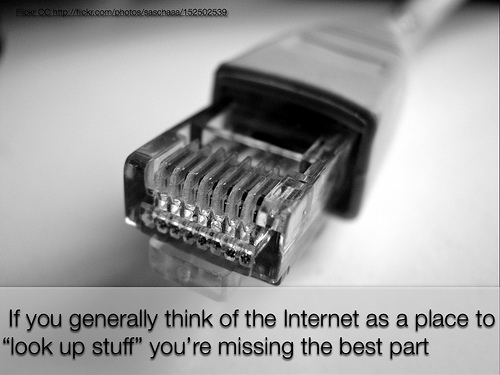
This image compliments of Dean Shareski
One of the things that made me pause for thought during the PLP Kickoff yesterday, was when Will Richardson and Sheryl Nussbaum-Beach told us to participate in the NING environment just for ourselves for the time being.
I was talking to someone recently and we were discussing how blogging and participating in Web 2.0 applications is such a joy for educators because it’s feeding us. Teaching can be exhausting. Teachers are giving non-stop but not always replenishing their own supplies. The best part about learning through connected networks, Twitter, NINGs,etc. is that you get so much out of what others put out there. It’s the interconnectivity (long word for connection, I think) that is so good for you. And so much choice, you don’t know where to start. If you don’t refuel, you eventually stop.
We need to be selfish, that is, to feed ourselves as well as our students. To take time to read, think, discuss and wait before giving out. That’s not as selfish as it sounds. Fact is, when we’re bursting with ideas from meaningful interaction with others, people around us can’t fail to see this. Modelling Web 2.0 functioning is like sending sparks out.


Even sitting in the same room but moving the chair to face the opposite way gives you a different perspective on things.
Today our team of 5 joined other Australian teams and our leaders, Will Richardson and Sheryl Nussbaum-Beach, for the first face-to-face Australian meeting for the Powerful Learning Practice program. Will and Sheryl spoke about how the world is changing but how schools are not. We’ve had this conversation many times at school. It always seems like a difficult challenge, one that weighs us down. It isn’t going to happen. We push and push but the resistance is too strong. But somehow, today, the same challenge wasn’t as threatening. It seemed understandable. I remembered my own recent beginnings with technology. No, back even further, times in my life when the comfortable and familiar were disrupted by change. My first child, moving overseas, my first online experience for a post-grad degree, things like this. We all have them. It’s good to remember these times, and sensible to expect them to happen again. We’re not different to those people who protest against change, except that we’ve climbed over onto the other side of the fence. Some of us have sprinted over, some have struggled over and got our pants caught on a nail, and others have climbed under.
Sheryl reminded us that we need to develop flexibility and patience when things don’t work out; we need adaptability. I’m thinking that we’re like some sort of evolving species as we try to move with the times. We’re not comfortable when we start growing extra legs; it hurts!
But when change freaks me out, I have to remind myself that I also like moving the furniture around. It gets boring sitting and looking at the same view. There are new configurations to be discovered.

This is a nifty little application I can imagine would make language learning fun.
Joe Dale (October 11) put me onto the Animate application for language learning on Jose Picardo’s blog
In the About section of his blog, Box of Tricks, Jose Picardo explains the role of technology in student learning:
Technology has been demonstrated to be a powerful motivator, helping to increase confidence and thereby encourage learning. Technology catalyses pupils’ interest, helping to establish an atmosphere conducive to learning and achieving.
Knowing how to make the most of the available technology is an essential skill for teachers to acquire in an age where pupils’ learning expectations are changing radically. Technology ensures that education remains relevant in our students’ increasingly digital lives.
Box of Tricks is full of great ideas for language teachers. Apart from ‘Animate your homework’ some of the many ideas include:
Using Animoto to promote speaking;
Podcasting in 5 easy steps;
Assessing with video: giving students control;
Edmodo: microblogging for the classroom;
Seeqpod: the easy way to take music to your classroom or blog;
Top 5 tips for creating resources for the interactive whiteboard;
Top 10 tips for using technology in your classroom;
Using Voki and a blog in a sequence of 3 lessons;
Wordle: using word clouds in a lesson;
Free comicstrip-creating website …. and much more!
Another great blog for language teachers is Nik Peachy’s Learning technology teacher development blog. Just have a look at his topics in the right-hand navigation. You’ll find exactly what you need for enjoyable and engaging language learning lessons, whether it’s a 5 minute fix or a new application you can add to your repertoire.
If you’re a language teacher and you think that you can’t use much technology in your lessons, think again!

Google Maps and Google Earth have astounded us all with new possibilities in viewing the world, connecting our photos and stories to real locations. But, as the Read Write Web has pointed out, many of the top-down images have been unclear so far. All this is about to change as Google connects with GeoEye-1 to produce high-resolution images. Wired Science has posted the first Google/GeoEye image. Compare the new image to the one without GeoEye-1’s superior resolution.
Here’s some information on GeoEye-1:
GeoEye-1 is equipped with the most sophisticated technology ever used in a commercial satellite system. It offers unprecedented spatial resolution by simultaneously acquiring 0.41-meter panchromatic and 1.65-meter multispectral imagery. The detail and geospatial accuracy of GeoEye-1 imagery further expands applications for satellite imagery in every commercial and government market sector. To learn more about GeoEye’s collection and delivery capabilities, please visit our launch site.
Google is GeoEye-1’s second major partner after the National Geospatial-Intelligence Agency, a U.S. government agency that analyzes imagery in support of national security. The NGA will be retrieving GeoEye-1’s imagery at the maximum resolution of 43 centimetres, but government restrictions will limit Google’s images to a 50 centimetre resolution. Thanks to an exclusive partnership, Google will be the only online mapping site using GeoEye-1’s satellite photos.
As far as education goes, we’ve come a long, long way from the boring geography lessons, trying to connect the pale, coloured maps in our textbooks with real locations, mustering up enthusiasm for places we could only appreciate in fertile imaginations.
I’m happy to take advantage of Google Maps’ and Google Earth’s new and improved visual mapping – as long as they don’t come any closer to me.
