Category Archives: Web 2.0

Social media is not all fun and games

The Age online has published an article entitled Social media rush as Victorian bushfires rage. It describes what has been evident during the recent and ongoing bushfires in Victoria to those using social media.

As the worst bushfires in Australia’s history raged across Victoria, Twitter, Flickr and Facebook lit up with condolences and horrific first-hand accounts, while many used innovative online mapping tools to assess the risk of the fires reaching their own homes.

Unaffected by the bushfires but geographically close to areas such as King Lake, and knowing people who live there, I found that social media sites were more current and informative than most other news sources, apart from the ABC radio broadcasts. Social media became the new journalism, providing current and detailed information, but also communication to the people.

Mainstream news outlets, battling to provide comprehensive coverage of the tragedy, have incorporated accounts published on the social networking sites extensively in their reports.

Using online social media to spread vital information and personal stories is becoming increasingly commonplace in times of crisis, but this may be the first time the social networking sites have been used extensively during an Australian disaster.

Google provided a map updated in real-time with information about the number, type and size of fires in a particular location.
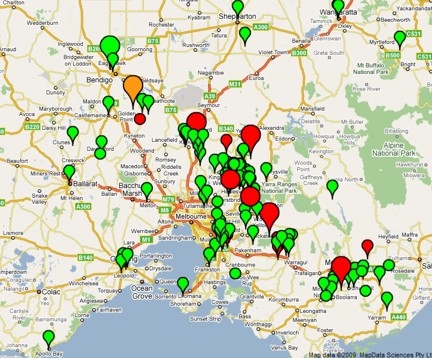
firesmap

NASA provided satellite images of the fires:
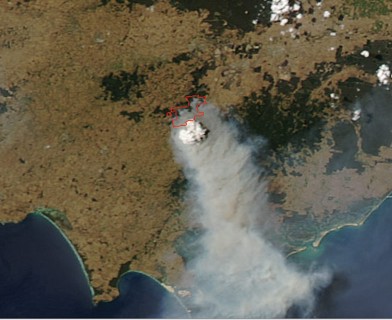
satellitefires

Personally, I found Twitter’s ‘bushfires’ – tagged tweets a mix of informative and disturbing, bringing up real-time information in the most personal way, mixing facts with personal appeals for lost family. The steady Twitter stream of contributions from people all over provided communication in a way that no other media could match.

Interesting to observe that Prime Minister Kevin Rudd also communicate via Twitter.
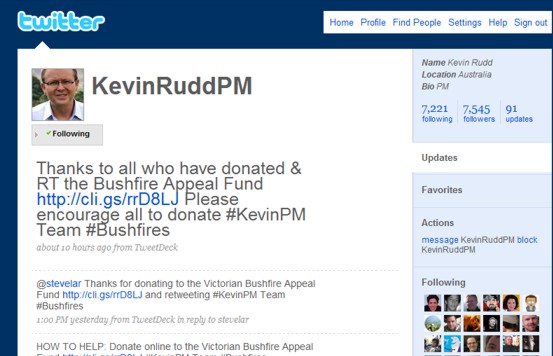
kevinrudd

For me, the most striking aspect of this form of social media is the human element. The article mentions the twitter account of a CFA volunteer, cfafirefighter . Follow this and you follow the man, his movements, his thoughts and his feelings.
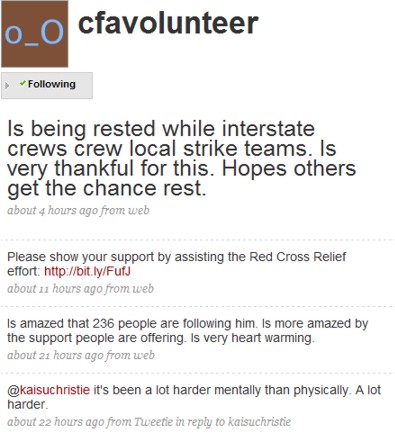
cfatwitter

Flickr also demonstrates a platform for communication, a place for people to share images of the fires, for example, the group Victorian bushfires 2009
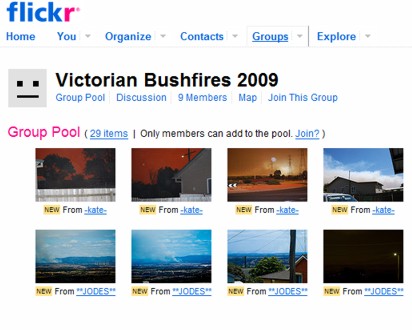
flickrfires

There is a very large number of photos here, and this is only one of the groups. Compare this to the few images chosen for the front page of the newspaper articles.

uploaded to Flickr by Monkeybizness February 9 2009

uploaded to Flickr by Hickey/Scott February 8 2009

Facebook groups have sprung up too. Although it may seem to be a futile exercise joining such a group since it doesn’t necessarily lead to action, the opportunity for solidarity online may just be the impetus for worthwhile deeds.
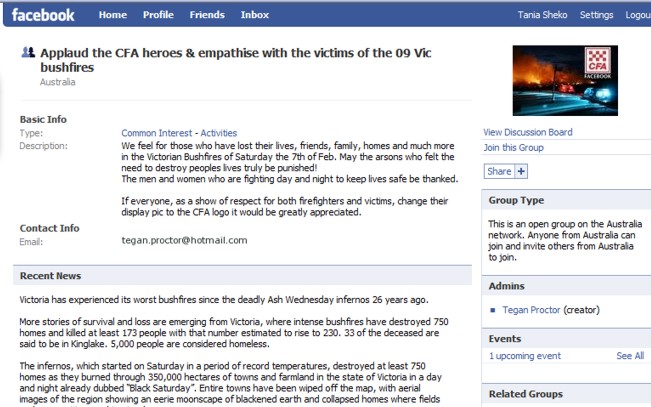
facebookfires


The Facebook group provides links to important numbers and websites.

IMPORTANT NUMBERS AND WEBSITES:

Wildlife Rescue – http://www.wildlifevictoria.org.au/cms/index.php

Gippsland Emergency Relief
Fund – http://relieffund.org.au/

CFA bushfire hotline – 1800 240 667, http://www.cfa.vic.gov.au

State Emergency Service – 132 500

State Inquiries Centre – 1800 727 077

Other information includes different ways to donate money, for example:

http://www.salvationarmy.org.au/SALV/NEWSRELESE/PC_62630.html
Myer will match dollar-for-dollar total customer contributions to the Appeal up to $500,000. The goal – to raise $1 million for the recovery effort.

The discussion board is testimony to many a community’s empathy, willingness to help and grief:

Tarita Conza wrote
at 8:35pm
R.I.P Raye Wynette (Lane) Carter 13/05/1940 – 07/02/2009
CFA Volunter, Great grandmother of Kyla Lawrence, loving Nan of Aaron Lawrence & special friend of Tarita Conza. Tragically taken too soon! trying to save your cherished goats. You will be sadly missed but greatly remembered, Love always and forever.

So, you thought that social media was just fun and games?
Thanks to Sue Tapp for the link on Twitter to the online article.
Sue has just informed me of the ABC bushfires emergency blog.

I’m not good at maths but I could be

googleearthlessons


As I’ve said already, I’m not good at maths but I think I could be. I get the feeling that my learning style wasn’t catered for in the maths classroom. Something like Real World Math might have done the trick.

What a great way to take maths out of the textbook and into the real wide world. Google Earth’s satellite views of the earth and the interactive 3D environment allow users to add placemarks, annotations, photos and models, as well as measure distances and draw paths.

Within this site you will find lesson ideas, examples, and downloads for mathematics that embrace active learning, constructivism, and project-based learning while remaining true to the standards.  The initial focus will be for grades 5 and up, but teachers of younger students may be able to find some uses or inspiration from the site.  Higher level thinking skills, such as analysis, synthesis, and creativity are encouraged as well as technology skills and social learning.  The scope of this site is mathematics, but many lessons lend themselves to interdisciplinary activities also. 

 Higher level thinking skills, creativity, technology, social learning, and potential for interdisciplinary activities! Just what we need for our students today.

The site has separate areas: the Lessons page; the Community page; the Update page; and the Resource page.

The Lessons are grouped into 4 categories: Concept Lessons, Project-Based Learning, Exploratory, and Measurement.

The Community page is a strong point enabling collaboration and communication amongst users. In my opinion, that’s the drawcard of technology in education.

The other two pages are self-explanatory.

Thomas J. Petra, the author of the site, says this:

Math teachers are always searching for meaningful, practical math lessons that engage their students.  I hope this site is useful to you and that your students learn real world math.computingwithscientificnotation

 An example of a lesson is ‘Computing with scientific notation’; here’s an extract of the instructions:


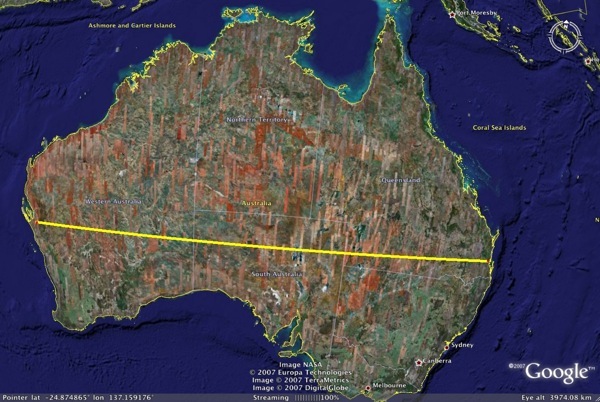
How long would it take to walk across Australia?  This lesson enables students to jump, walk, and crawl around the world without breaking a sweat.  The featured concept of this lesson is computing with scientific notation, but it also involves the distance formula, and measurement. 

In the left-hand navigation, you’ll see concepts used and grade level, eg.

Concepts used: Scientific Notation, Measurement, Rates, Algebra, Distance formula, Problem Solving

Grade level: Grades 7-9

When I clicked on the Community page I discovered it had been moved out onto a blog due to technical difficulties. The RealWorldMath Community blog provides a place for commenting, suggestions, feedback and lesson submissions.

I’m impressed with Real World Math and think it’s a rich educational resource for mathematics. If this was on the agenda in the Maths classroom, I might even give Maths another go.


What does learning and teaching look like for me in 2009?

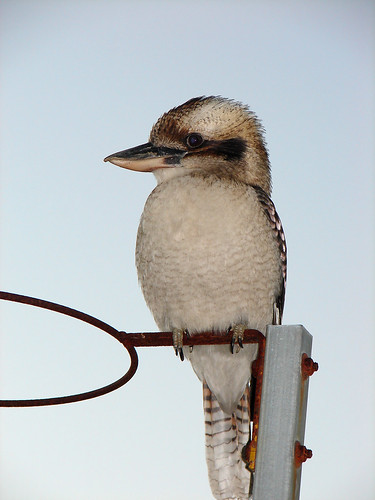
photo by aussiegall

Paul C of Quoteflections tagged me in a meme which goes a little like this:

What is the focus of learning for you in 2009?

What are the important new things you are teaching ?

In her meme, Joyce Valenza wrote

The landscape continues to shift and that means reinterpreting our standards for emerging tools, issues, and innovations. 

 The landscape is shifting and my own landscape is too.

 Here are 5 things I would like to focus on in teaching and learning this year.

1. Collaboration:

I’d like to focus on collaborative learning – encouraging students to learn from each other. I’m working on wikis for art and English, as well as a fiction blog, and this year I hope to bring the school community into it. I’d like these tools not to belong to me, but to be shaped by the whole community.

2. Global connections:

It would be good to break out of the metaphoric echo chamber this year. I’d like my learning and teaching to connect to people outside of the classroom, whether it be another class, another school, a different country or culture. I envisage using things like Voicethread to share ideas and opinions, commenting in blogs to build personal learning networks, and possibly Skype for author talks.

3. Picture it:

With the explosion of visual media, I’d like to think more visually and encourage students to do so. My teaching will expand the concept of literacy. I’m talking about focusing on visual literacy, learning to deconstruct images, creating visually, and exploring multiple layers of meaning in  images. Students are comfortable with imagery but  need to learn to use and manage visual images metacognitively.

I’d like to involve students in Flickr – putting pictures up, browsing the vast archive of flickr images, understanding Creative Commons, favouriting photos, connecting to others by commenting on their photos, participating in a photo project. I’d like to continue to show students visual search engines, such as Viewzi and SearchMe, and I’m pretty sure that similar search engines will continue to evolve.

4. Thinking!

In this changing landscape where learners need to be discerning and critical, there’s an ongoing need to focus on critical thinking. Not cramming content, memorising material or copying and pasting. Making kids think, question, debate, disagree, compare, synthesise, rethink.

5. The learning process

I’d like students to understand the learning process.

I will be constantly saying: don’t be afraid of making mistakes; that’s how you learn. Don’t be alarmed if something is difficult; it’s part of the process. Don’t give up, but push ahead. Don’t settle for what comes easily, take the challenge and go with what’s hard. Move out of your comfort zone. Know the fluctuation of emotions during the research process. Go with the flow. Learn something real.

That just about wraps it up. My learning and teaching goals for 2009. It’s good to make yourself write them down. Here they are, right in front of me, and I can come back to them at the end of the year to evaluate my progress.

Just realised (a day later) that I have to tag people for the meme. Ok, the following people are tagged; let me know if you’ve already done this and I’ll change my tag list.

Darren Kuropatwa

Frances Manning

Jenny Luca

Judy O’Connell

Jennifer Clark Evans

Is the book dead? Is reading dying?

dogreading

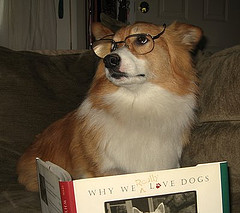
Photo by Sansanparrots on Flickr

Another article about whether reading – in the way we have known it – has changed forever; and is reading books becoming extinct as we are lured by  online offerings.

People of the screen by Christine Rosen in the online journal The New Atlantis: a journey of technology and society is certainly worth reading. It tackles this subject with a wide net, and even though you may not agree with everything that is stated, it is an excellent basis for discussion.

 The article deals with many aspects of the reading issue. Here it talks about the decline of reading for pleasure:

In 2007, the National Endowment for the Arts (NEA) published a report, To Read or Not To Read: A Question of National Consequence, which provided ample evidence of the decline of reading for pleasure, particularly among the young. To wit: Nearly half of Americans ages 18 to 24 read no books for pleasure; Americans ages 15 to 24 spend only between 7 and 10 minutes per day reading voluntarily; and two thirds of college freshmen read for pleasure for less than an hour per week or not at all. As Sunil Iyengar, director of the NEA’s Office of Research and Analysis and the lead author of the report, told me, “We can no longer take the presence of books in the home for granted. Reading on one’s own—not in a required sense, but doing it because you want to read—that skill has to be cultivated at an early age.” The NEA report also found that regular reading is strongly correlated with civic engagement, patronage of the arts, and charity work. People who read regularly for pleasure are more likely to be employed, and more likely to vote, exercise, visit museums, and volunteer in their communities; in short, they are more engaged citizens.

Here is an interesting take on the type of personality apparently suited to online reading:

 For centuries, print literacy has been one of the building blocks in the formation of the modern sense of self. By contrast, screen reading, a historically recent arrival, encourages a different kind of self-conception, one based on interaction and dependent on the feedback of others. It rewards participation and performance, not contemplation. It is, to borrow a characterization from sociologist David Riesman, a kind of literacy more comfortable for the “outer-directed” personality who takes his cues from others and constantly reinvents himself than for the “inner-directed” personality whose values are less flexible but also less susceptible to outside pressures. How does a culture of digitally literate, outer-directed personalities “read”?

I disagree with the contention that screen reading discourages contemplation; in fact, the commenting in blogs, for instance, creates a string of contemplative replies. That this type of contemplation is interactive is surely a positive outcome.

There is too much in this article for me to cover it in a short post. The advantages and disadvantages of the Kindle are discussed, the attention span of young people, the changing nature of libraries, research and librarians’ roles, as well as the future of literature with the advent of hand-held devices that save books as iPods do with music, creating mashups of the paragraphs within different books.

Have a read. Tell me what you think.

Rethinking young people, rethinking ourselves

schoolkids

Photo taken by Chris Suderman

In his book Through the children’s gate, Adam Gopnik said this about children:

Children reconnect us to romance. For children, … every day is the first day of love: The passions that for us grown-ups rise and fall only in exceptional circumstances, unexpected storms on the dull normal beach where the tide breaks unchangingly, rise every day for them. Shock, hatred, infatuation: “I hate you,” they cry, slamming the door, and they mean it; and then the door opens fifteen minutes later for dessert. They compel us to see the world as an unusual place again. Sharing a life with them is like sharing a life with lovers, explorers, scientists, pirates, poets. It makes for interesting mornings.

I like this quotation for a few reasons. Firstly, to remind me of the passionate and immediate nature of young people. If at school they seem indifferent, apathetic, unengaged, then we need to ask ourselves why. We look to ourselves and what we are doing as teachers to make them behave in a way which is actually contrary to their nature.

Secondly, this passage tells me what we can gain from being with young people, what we can learn from them. Our role as teachers is not to ‘teach’ them in the sense of pouring into them what we know better, it is to listen, to bring out, to – with time, the time it takes to know a person – understand where their interests lie, what their passions are, how we can harness their dreams to educational opportunities. We provide the environment, teach skills, encourage and guide, but we work with the unknown – the unknown possibilities of what each young person is yet to create, to achieve.

As I think about returning to school soon, starting along that well worn cyclical path again, I’m gathering together the technology tools that I look forward to using with students, but I’m not thinking about the technology – I’m thinking about the process, the learning and teaching process that will take place. This year I’d like to focus on providing learning experiences which are from people, from communities, learning not from static texts but from living, thinking people – some from other hemispheres – from conversations, comparisons, real discoveries. I’m hoping that this year’s learning will not come solely from one teacher. The net will be cast wide. What treasures will be collected in the net?

Playful, seductive, digressive, literate…

sketch

More on the differences between reading a book and reading on the internet…

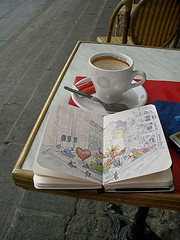
I was reflecting about what it is I like about reading blogs. Something I hadn’t thought of before – a blog post is like a sketch – incomplete, open, promising ideas, suggestive, an impression to be used for further thought. It doesn’t replace a published book, nor should it. Books are wonderful, complete, well-thought out, often definitive writings. I have books on my must-read list, and look forward to devoting  myself to them completely. Sometimes, though, I feel pressured after I’ve bought a book; I feel obliged to read it, from start to finish, obliged to give my full attention to it out of respect for the author, or at least because I’ve paid for it. Occasionally this detracts from my enjoyment, particularly when guilt creeps in.

Blog reading is like dipping here and there, like enjoying tapas as opposed to sitting down to the main meal. Blog posts in themselves are snippets of thought and opinion, allowing for impromptu reflection, without the pressures of serious writing. My Google Reader is bulging ridiculously, but it allows me to dip here and there, unpressured, enjoying every moment.

I was reading Jonathan Jones’ blog at guardian.co.uk, Art and design. In his latest post he talks about the science writer, Richard Fortey. Here’s what he says about Fortey’s talent as a writer, and I think this could easily apply to good blog writing:

The strength of Fortey as a popular science writer is that he is a real writer. His prose is playful, seductive, digressive and literate.

The blogs I enjoy reading the most – not for their information, but for their writing – demonstrate these qualities. And I’m beginning to realise that being digressive in blog writing is not a bad thing – it’s sharing more of your ongoing interests and changing focus, and therefore more of yourself, with the reader. The blogs I love to read are those whose authors generously share of themselves, and so reading the blog is synonymous with reading the person.

What do you like about blog writing?

Guggenheim 2.0

The Guggenheim Museum in NY has a great little online event going which encourages interaction and collective thought around some of its collection. 

Catherine Opie is an American artist specialising in issues around documentary photography.

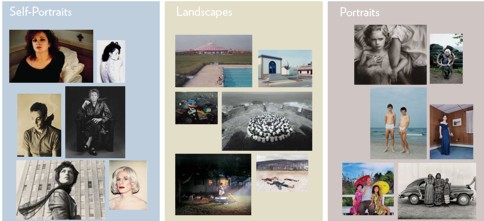
For this exhibition, Catherine Opie has selected images from the Guggenheim Museum’s photography collection and organized them into three sections: Self-Portraits, Landscapes, and Portraits. Visitors can write responses to the questions Opie poses about them and read other people’s responses.

Here are some more details from the Guggenheim Museum website:

September 26, 2008–January 7, 2009
While celebrated for her role behind the camera, Catherine Opie remains acutely aware of the voices of her subjects, and the diverse readings all images engender. Exploring this circuit of interpretation, Opie has selected images from the Guggenheim Museum’s photography collection to present alongside questions about the works’ themes and meanings, inviting museum visitors to respond with stories of their own.

People can participate online by writing about a photograph or reading other people’s comments.

guggenheimThe

I clicked on one of the portraits.

3infrontofcar

 These are the questions asked about the portraits:

What do you think makes a portrait interesting?

  • How do the titles of these photographs make you think differently about the people they portray?
  • Some of these images are made spontaneously while others are carefully staged by the artist. How does this difference in approach affect your response?

Here is one of the responses:

An interesting portrait to me is one that represents people honestly. Not only is it usually aesthetically pleasing, but it also is educational and interesting. In Keita’s photo of 3 women, she presents them in their usual daily clothing, telling the viewer something about their environment and status, and then the juxtaposition of the car brings to mind a completely different world or environment. The two together represent a very real albeit somewhat staged composition that’s intriguing and interesting.

I was excited to find this, and I’d like to keep up with the many innovative programs and ideas coming out of cultural institutions such as museums. The idea of  an artist selecting images from the collection is a creative way to bring out to more people what would normally remain within the walls of the museum, and perhaps not be accessed by as many otherwise. The addition of the questions and options to comment is added value,  inviting interaction and the sharing of opinions. I also like the fact that, whereas people would normally just look at the photos at an exhibition, maybe read a little about them, in this case the public is invited to express their impressions and opinions.

I was a little disappointed that only one or two responses were accessible, unless I’m missing something. I was looking forward to a real discussion and debate around the photos.

Nevertheless, an inspiring concept. This would be an excellent way to initiate discussion and reflection in the art classroom.

Newsmap – attractive news

newsmap

What is Newsmap?

Newsmap is an application that visually reflects the constantly changing landscape of the Google News news aggregator. A treemap visualization algorithm helps display the enormous amount of information gathered by the aggregator. Treemaps are traditionally space-constrained visualizations of information. Newsmap’s objective takes that goal a step further and provides a tool to divide information into quickly recognizable bands which, when presented together, reveal underlying patterns in news reporting across cultures and within news segments in constant change around the globe.
Newsmap does not pretend to replace the googlenews aggregator. Its objective is to simply demonstrate visually the relationships between data and the unseen patterns in news media. It is not thought to display an unbiased view of the news; on the contrary, it is thought to ironically accentuate the bias of it.

So, in a way, Newsmap is an interpretation of the news, allowing patterns and biases to be visualised.

I think this needs to be viewed over time to get a feel for it. Meanwhile, it stands out as being a very attractive way to get world news.

Has anyone explored Newsmap? What are your thoughts?

PicLits

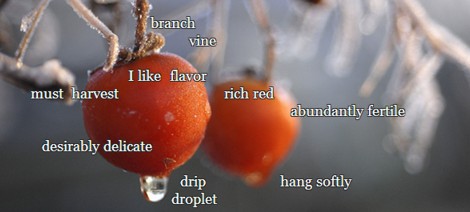
piclit-1

I thought I’d try out PicLits: inspired picture writing.

PicLits.com is a creative writing site that matches beautiful images with carefully selected keywords in order to inspire you. The object is to put the right words in the right place and the right order to capture the essence, story, and meaning of the picture.

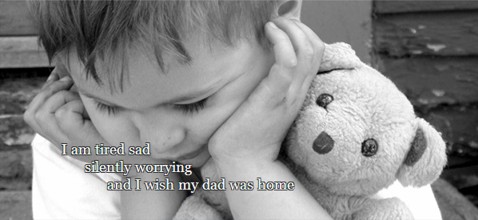
I wasn’t that pleased with my first effort, so I tried another one.

piclit2

Well, unless I’ve missed something, the list of words is limited. Then again, I haven’t read the instructions, just had a go.  I think there’s something to be said for adding text to a picture from a limited supply. The challenge is to work with what you’ve got, thinking about the position of the words, whether you want a sparse message or story, or whether you want a more crowded and descriptive text. 

Definitely much to play with either in English, foreign language or English as a Second Language classes.

I almost forgot to thank Tom Barrett for this application, and if you go to this post you’ll find 9 other digital writing opportunities.