Social media for lawyers (and regular people)

@ggrosseck shares some excellent links on Twitter and this is one of them.

[slideshare id=3619005&doc=researchinginaweb2-0worldfinal-100402045408-phpapp01]

I agree with @jennyluca who commented that this presentation is just as relevant to educators. The humour doesn’t detract from the truths expressed; I think it’s very effective. I like the way it addresses people’s attitudes to social media and in a light-hearted way before going on to all the benefits.

It also asks important questions such as Do I really want to be in a community? and supplies altruistic and selfish reasons. There’s a lot more depth to the coverage and more specific information than is often included in write ups about social media.

For a person who is trying to make sense of social media, it’s very helpful. For example, in explaining the social bookmarking site Delicious, it informs that

clicking on a link will show all the people who recommended it and under what categories (tags).

and provides a snapshot of a Delicious user’s page.

The most effective aspect of this presentation is the fact that it addresses the whys, eg. Why bother blogging?

A range of social media is covered, including Twitter, blogs, wikis, Delicious, RSS feeds and more. It really gives a good overview as well as answering specific questions people may have, finishing off with ‘So what does all this mean?’ and a list of links to further information .

I’m impressed by the depth of this presentation and would like to collaborate with somebody in producing a similar one for educators. Any takers?

The new citation

Photo courtesy of kharied on Flickr

As we continue to teach students how to seamlessly embed quotations into their writing, it occurs to me that we have developed a new way to cite our sources, namely online and using hyperlinks.

The hyperlinked citations are much more than an attribution of cited sources; they are also:

  • a direct link the the source itself
  • a solution to wordy explanations which interrupt the flow of the sentence
  • a dense and complexly charged way of writing

Here’s an example from a  blog post I was reading this morning:

(Brian Lamb is writing about the notion of curation as a model for teaching)

Yet again, I’m reminded of my favorite band of mad, bad content curators at WFMU (this year’s fundraising marathon is over, but they’ll still take your money), and how its Free Music Archive places curation at the centre of its mission. There’s an interesting interview on 3 Quarks Daily with WFMU station manager (and killer OpenEd 2009 keynoter) Ken Freedman that cuts to the intersection between freeform weirdness and careful curation.

Not only is this hyperlinked method of citation a new way of writing, but it’s also a new way of reading. You might say that the writer has done the work of bringing in the textual background for his ideas, but the reader also has to do the hard work of going to the sources and reading for understanding.

Footnotes? Why have these at the foot of the page when you can embed them directly?

I’m thinking that this hyperlinked writing should be the way of student resources at school and universities. How much richer and more efficient would online resources be which embedded background knowledge and served as a model for referencing sources?

What I like best about hyperlinked citation is that it leads me to places I haven’t discovered, giving me the option of following new research paths, often serendipitous. It’s an exciting way to learn – not didactic, not limiting, but opening up options for independent learning.

Shouldn’t we start to teach students this new way of reading and writing?

Who’s leading? How a movement is made

Derek Sivers received a standing ovation at TED for this talk about leadership.

[youtube=http://www.youtube.com/watch?v=fW8amMCVAJQ&feature=player_embedded]

This really made an impression on me. I realised that, yes, it’s the first follower who plays a crucial role,

he publicly shows everyone how to follow.

This is so true, and I can speak from experience when I say this. Last year, when I took the risky step of creating a ning for a class, my brave and trusting friend Maria was the one who said yes, I’ll do it with you.

It takes guts to be a first follower! (Thankyou Maria! You’re the best)

She trusted me (even when I didn’t trust myself), and together we joined forces not only to create the ning as a learning and teaching platform for the year 7 class, but we forged new territory as we went, supporting each other and later demonstrating to the rest of the staff what this new learning environment looked like.

The first follower transforms a lone nut into a leader.

This year our school has taken off with Web 2.0 platforms for classes, a couple at first, serving as examples for others. Thankyou, Una and Catherine, for making the ning such a rich learning environment and inspiring other teachers.

The 2nd follower is a turning point: it’s proof the first has done well. Now it’s not a lone nut, and it’s not two nuts. Three is a crowd and a crowd is news.

Now there are more and more teachers wanting to try nings, having seen the wonderful examples.

Now here come 2 more, then 3 more. Now we’ve got momentum. This is the tipping point! Now we’ve got a movement!

I may be jumping the gun a little, but I’m predicting that soon the Web 2.0 learning platforms and tools will be part of the everyday learning and teaching practice at my school.

As more people jump in, it’s no longer risky. If they were on the fence before, there’s no reason not to join now. They won’t be ridiculed, they won’t stand out, and they will be part of the in-crowd, if they hurry. Over the next minute you’ll see the rest who prefer to be part of the crowd, because eventually they’d be ridiculed for not joining.

I love the advice that Derek Sivers gives about leadership – listen particularly if you don’t consider yourself a leader:

The best way to make a movement, if you really care, is to courageously follow and show others how to follow.

When you find a lone nut doing something great, have the guts to be the first person to stand up and join in.

Check out Derek’s biography.

Howard Rheingold knows crap when he sees it

Howard Rheingold knows what he’s talking about when he says we need to teach our kids to be crap detectors, critical examiners of what they find online. No, not censorship – Howard recommends teaching kids to be detectives and investigate the authority of what they read online. Our kids need skills more than they need content to navigate the explosion of information available to everybody. The video goes for 24 minutes and is well worth viewing and reviewing.

[blip.tv ?posts_id=3352757&dest=-1]

Here is Howard’s blog post of the same title.

There is a growing list of links to related online resources at the end of the article.

A teacher’s evaluation of ning

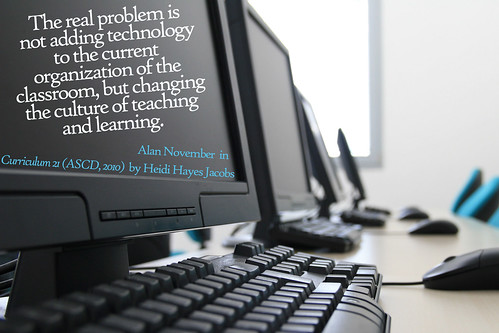
“The real problem is not adding technology to the current organization of the classroom, but changing the culture of teaching and learning”.
Alan November in “Curriculum21” by Heidi Hayes Jacobs (found on Flickr in Great quotes about learning and change)

I want to share with you a teacher’s evaluation of a ning as learning and teaching platform for a Year 12 English class. Although Catherine has only been using the ning for a couple of weeks, she has used the features of ning to their full capacity, enhanced student learning, and created a real  learning community. It’s a shame that the ning is private – otherwise I’d show you what it looks like and how it’s working. Instead, read Catherine’s excellent summary and description.

A couple of weeks ago I began a ning with my Year 12 English class. After their initial disappointment that this ‘wasn’t facebook’ and once they worked out how to post a blog and replies to discussions, the class began to embrace their ning, and I have been thrilled with the results!
Our ning contains the following:
1. Photos of our class. Once a week, I bring a camera into the class and the boys take turns with being the ‘class photographer’. They capture moments from the class and ensure that everyone in the class has a photo. We have also added photos from college activities such as the Athletics Carnival where all the boys dressed up. These photos have been placed in albums in the ning and have been great in inspiring a sense of class spirit and unity.
2. Videos related to the text: I have been able to upload a number of videos related to the text we are currently studying – ‘Maestro’ – at the moment there are videos of Cyclone Tracy, Wagner, Peter and the Wolf, and Vienna.
3. Notes: I am able to write notes that highlight upcoming events / work that is due etc. I have arranged the format so that this is the first thing the boys see when they log on.
4. Groups: I have made groups for each of the texts we are studying, so all of our comments, quotes and resources can be located in easy to find areas.
5. Discussion Forums: Each group has discussion forums. At the moment our discussions are taking place in the Maestro group. As a class we have decided to pool all the quotes we find into these areas so that when writing a text response, everyone knows where to find the resources.
6. Chat facility: this enables everyone in the class to be online at the same time in the evenings and ask questions that everyone can contribute to, if they wish.

At the moment my class is preparing for their first text response, and I have found the chat facility to be extremely useful. A number of boys over the long weekend asked for help with their introductions and were able to place their work on chat and receive feedback from other students as well as myself. It was wonderful to see students help each other, as well as to see the particular student edit and re-edit their work. We have missed a number of classes in the past week due to public holidays and college activities, so it was wonderful to be able to assist students in this way in the lead-up to their assessment. It has also been good to see students ask each other for help with specific quotes and to see other students provide answers.

The ning has given students a central place to go to, when finding their resources for English, and has also allowed questions to be asked and answered very quickly. One of the boys told me this afternoon how much he loves being able to use the ning and how helpful it has been for him. I have also enjoyed seeing boys who never contribute in class, feel confident using this technology to voice their opinions. One boy in particular has become a ‘guru’ when it comes to knowing specific quotes in the novel, which has been wonderful for his self-esteem. However, without a doubt, the best part of the ning is the fact that students are discussing and analyzing the text outside of school hours – of their own volition! What more can an English teacher ask for?!

How did my presentations go?

How did your presentations go?

People have been asking me this since last Friday when I faced two groups of people and talked about my experiences with nings, flickr (and briefly blogs) in the classroom, and how these things can create learning communities.

Well, I’m not sure how I went, to tell you the truth. I’m really not certain.

This is the first time I’ve presented at a whole-school professional development day – I did present with Maria Toomey last year, very briefly, about our Year 7 English ning at a staff meeting. And that’s it.

So here are my thoughts:

It was definitely a good experience for me. I had many moments during the session where I realised things, and this will contribute to my own learning and hopefully improve further presentations if they ever occur.

I realised that my Web 2.0 experiences have been predominantly within humanities areas, centering on discussion, reflection and sharing of ideas and viewpoints, construction of deeper understanding, and peer interaction. I haven’t had as much contact with maths, science, commerce teachers (apart from Nicole’s forensic science blogs), and haven’t seriously considered the fact that not every educator’s teaching depends on these things.

I’m usually hard on myself, and I will acknowledge the many supportive, positive comments I received from staff, but I think that I have a lot to learn about presenting in an engaging, relevant way. I intend thinking about this and perhaps paying attention to good speakers – our guest speaker, Travis Smith, being one, and the speakers who have just participated in the TEDxNYED talks which I missed because my notebook’s connectivity has been so sporadic.

Here is what I had in mind, and what I did for the presentation:

I wanted to show how rich the learning can be within collaborative Web 2.0 platforms, so I created a ning as a temporary sandbox for newbies. Within the ning, I created groups for some of the subject areas, and as more people joined my session, I expanded these groups, and tried to include a few resources and questions for discussion to give people an idea of how the ning could work for them. I created a collection of videos which provided either background to Web 2.0 technologies, or the future of education.

I had so much to share, and I knew that I wouldn’t have time for everything. The last thing I wanted to do was overwhelm everyone with theories and pedagogy, so I included a few of my blog posts which had already detailed the ning and flickr experiences. I added bits and pieces for discussion, including relevant and challenging quotations, a cool little flash demo about how high blog commenting rates in Blooms Taxonomy, and so on.

Photo courtesy of ecastro on Flickr in group ‘Great quotes about learning and change.’

My original plan was to start the session by acknowledging change, and how, as educators, we may feel overwhelmed or frustrated by it. I showed Karl Fisch’s video, What if?

This is what I showed the first session. I followed this up by asking the question, ‘How do you learn?’ I had set up a discussion for this within the ning, and included my own answer as a starting point.

I learn by writing things out, by making colour-coded charts and maps. Obviously now it’s much easier to locate information – I google instead of going to the library or consult an encyclopedia. In some respects, the way that I learn has changed over the years. I used to learn from one teacher, or by myself. Now I learn from and with people. I ask, I have discussion with others, I ask questions. I’ve built up an online personal learning network – people who are experts in different fields, educators mainly, but also people who push my thinking. I can ask these people for information, advice or their ideas any time and anywhere.

Teachers wrote their answer, read other teachers’ replies, and commented on these. The idea was to immerse them in a ning discussion, giving them an idea of how the threaded discussion worked, and how valuable this online discussion was in terms of collaborative peer unpacking of a topic.

That worked pretty well, without any dramas. Most of the staff wrote thoughtful replies,

I like to find things out for myself and discover new pieces of information. I like to take information or ideas from one field and apply them to another field. I like to see the possibilities of things and explore their extent.

others had a bit of fun,

We’ll try to make sure the office is a calm place for you to learn. Would you like us to bring some scented candles in???

and I think that’s a fair indication of what our students might do. So that’s cool.

It was interesting to see the beginnings of dialogue which extended the thinking through collaboration:

I learn through discussion with others. I find that discussion inspires me, and helps me to order my thinking. I tend to use this style of teaching in my classroom.

reply to this:

Do you think that how we learn and how we teach is different?

Originally, I had intended to follow that up with a video that showed how students learned, The digital generation. This was to be the lead-in to the whole point of the nings, etc. – as a connective learning platform within which our students felt comfortable, one which suits the way they are used to interacting with each other –  the point being that they learn best with and from each other instead of from the teacher, and writing for the teacher only.

I didn’t show this video in the end, either session. I don’t know if I just chickened out, but I got the feeling from my audience that they hadn’t come to think about the future of learning, pedagogy or anything like that. I felt from them that they’d come to consider whether nings and things were the way to go with their compulsory ICLT project. I made the decision on the spot to modify my approach and just supply practical and relevant information and instruction.

So from that point, I showed them a couple of nings which had been working very well – both within senior English classes. As I spoke about these, and later our flickr global photo project, I was aware that teachers who didn’t rely on the construction of knowledge and understanding in students from discussion and predominantly through writing, wouldn’t find my information relevant.

I have to say, it did affect my confidence and I felt that I withdrew in terms of dynamism. It’s not that I lost all enthusiasm, it’s just that I felt I hadn’t prepared sufficiently for all members of the audience. That had something to do with the fact that many of these had only joined my session very recently, in some cases that morning. Still, I think you do have to think on the spot and make spontaneous decisions after you get a feel for the audience.

As I mentioned earlier, many people were generous with their supportive feedback to the session. I would like to follow up with the rest, and find out whether they found the talk useful, and how I can provide answers to any questions they may have. I do feel I can do more through individual conversations.

It was disappointing that some teachers were not able to get into the ning – not sure why – and I’d like to try again, so that they can at least have a look around and see if there’s anything that interests them. The videos alone are a good resource, and I’m hoping that someone might take the time to look through these, as well as read some of the posts I’ve included.

I wonder if the ning will become a place I can continue to throw out interesting resources, links and videos. It may just die a natural death. I like the fact that it encompasses the whole school, and that I could potentially replace the separate emails to staff with ning group resourcing.

I wonder if the flickr project sparked any ideas in teachers other than those of English, foreign languages and English as a second language. I’m really keen to see what teachers can think of, where they can take some of these ideas. There’s no doubt that people will think of things that I haven’t, and I hope to gain from these perspectives.

Overall, it’s been a valuable learning experience for me, taking me out of my comfort zone, connecting me with teachers I would normally not see, and providing me with the challenge to synthesize my own experiences into an oral presentation to a broad audience.

If anyone has experiences or resources to share, I would be grateful.

Are we still learning? Global flickr project

This has been cross-posted from Through Global Lenses @wfc.

Photo courtesy of Flickr Creative Commons

Time to do a stocktake on what we’re learning here. Una and I smiled when the boys yelled out an enthusiastic ‘Yay!’ when she announced we’d devote the first half of the lesson to the Flickr project.

Looking around the room, I saw heads bent down to view photos and comments, unmistakable eagerness in reading, eyes darting about from comment to comment, fingers working at top speed to keep up with written responses.

Yes, but is this learning?

Just in case any of us started to think this was just chat – not that we would – I thought I’d take stock of the types of learning happening here.

First of all, I think it needs to be stated at the outset that engagement is a healthy precursor to any kind of learning. Although this project has clear guidelines and timeline with weekly themes and questions to answer, there are obvious reasons for the engagement we are seeing:

  • peer audience
  • global connections
  • familiar ‘chat’ platform for communication
  • ease of communication through Flickr comments setup
  • transparency of all activity
  • cultural curiosity
  • natural desire to socialise with other young people wherever they are

As I’ve said previously, it’s a far cry from writing on a prescribed topic for the teacher. The themes and questions have been chosen to encourage sharing of background, passions, hobbies, etc., and the students want to write about themselves and their lives because it’s part of a natural desire to share these things in order to make meaningful contact with others.

Cultural curiosity sparks questions like ‘What is AFL?’  or ‘What is that fluffy thing?’ (dreamcatcher). The desire to connect is clearly demonstrated too – ‘I also love watching crime investigation shows’; ‘my parents are also the most influential people in my life’, etc.

The positive comments and encouragement the students give each other is good to see, and much more meaningful to them than any comments from their teacher. I find this heart warming, actually, and cling to it when I read all the negative press in the media about young people being bullied and abused by their peers online. I think we could organise more of these types of learning environments to bring out the best in our young people.

There’s much still to be discovered in this learning process, some of it related to the options within Flickr itself. For example, for now we haven’t too fussed about tagging or organising photos into sets. That will come, and some students will learn that themselves just by browsing the site. Then there’s the photographic aspect – so much to learn about the potential of a picture. Even within Flickr there is an editing button above the photo which takes you to Picnik where you can play around with the image.  When students think about how they want to present their picture, what message they are trying to convey – this is visual literacy. I expect initially they will be focussing on satisfying the weekly theme, but later they may think about creative elements such as focus, colour, texture and so on. The potential for differentiated learning exists both visually and within the written text.

Flattening the world with Flickr in the classroom

Photo courtesy of matthewpAU on Flickr

In his book, The World is Flat, Thomas Friedman says that there are certain ‘flatteners’ that promote and allow for connection, collaboration and creation via distance.  He was referring to technological applications which shrink geographical barriers and make global connections possible. This is my aim for a special project at my own school – a project which would enhance teaching and learning through ‘connection, collaboration and creation’, taking the students out of the classroom and into the world.

In 2009 I decided to take up a Flickr challenge to upload a photo every day for a year and post it to appropriate flickr groups. As a result I connected with others through interest and dialogue, and three of us –  Marie Coleman, Sinikka Laakio-Whybrow and I –  agreed that a similar project  would be an enriching experience for students. I was lucky to find a teacher who was interested in the project and who has supported it wholeheartedly.

Sinikka reflected:

‘I would really like to challenge my students to bring out their real personalities in the foreign language. I have learned over the years that Finns especially seem to suffer greatly from a sort of ‘personality reduction syndrome’ when using a foreign language. I blame our text books and language classes for this, since students hardly ever get the chance to express THEMSELVES in the target language, but are always asked to talk about external topics, or role play. Their use of the language is also far too fact-based – emotions and feelings are hardly ever touched upon’.

I think Sinikka hit the nail on the head by underlining the importance of students expressing themselves, instead of practising their writing skills using isolated topics and writing mainly for the teacher.

The learning is happening for us as teachers too. In the planning stages, we collaborated in a Google document, using Google spreadsheets and slideshow (thanks Marie!) to brainstorm and formulate our project. The geographical time differences weren’t a problem at all, and occasionally Sinikka would catch me in Google chat before going to bed if I was online early enough in the morning.

The final product is an 8 week project with a weekly assignment based on a photo and written description following a theme. The first assignment is to take a photo which ‘is not you, but represents you as a person’ – so, an introduction to initiate the sharing of personal information and interests. Although almost every student included sport and music in their introduction, there were diverse details which created interest in the group. The cultural differences were obvious conversation starters, and the similarities brought the students together through shared interests. I know that our boys, being in a single sex school, were interested in the opportunity to connect with the girls!

Photo courtesy of MorganT7.USA on Flickr

The project is quite  simple but with very rich results. The weekly themes set  diverse tasks. Some themes ask for the sharing of personal, cultural or geographic information, some encourage photographic creativity (‘Take a photo: of something you go past every day and take it from an interesting new perspective”), while others require deeper thinking and creative solutions (‘Take a photo that goes with the title or lyrics of a song’ or ‘Take a photo that somehow represents learning to you’).

We have used Flickr as a platform for this project. Flickr provides an easy way to upload photos, an automatic photostream for each student, and a profile for identification. Our group, Through global lenses, is a one-stop shop for the whole operation. It holds all the members from the three schools, allows for instructions and program, as well as storing all essential information such as netiquette, creative commons, commenting guidelines, etc. It even has email.

Challenges

Following  a weekly theme and guiding questions, students’ task is twofold. Firstly, to take their own photo – this requires thinking and reflection, creativity, individuality, and it is hoped that, as students become accustomed to the challenge, they will become more creative and try different things. Secondly, to write something which responds to the theme, answers prompt questions, and informs and entices readers.

When students view each other’s contributions, this sparks curiosity, natural questioning, and ensuing dialogue. It also brings out  a desire to do as well or to do something different. Students are not writing for the teacher, but for a peer audience, sharing generational views and tastes, and learning about cultural differences.

It really is one big conversation, with everyone getting a go, and nobody feeling they can’t get a word in. Several people can engage in dialogue under the same photo. Conversation arises from shared interests and curiosity about cultural differences. Students encourage each other and develop trust and respect for each other. The result is writing from desire instead of duty.

Differences in language are often the subject of conversation. Students ask and explain linguistic and semantic differences, for example, the first week’s photo has resulted in a discussion of the differences between American and Australian football.

Challenges for us include encouraging students to move away from ‘chat language’ and to write correctly and fluently. Despite our instructions, I’ve noticed in the early stages students reverting to their preferred chat in the comments.

Practicalities

It’s easy to keep up with who is commenting on your photo, or further conversation in photos you’ve commented on, when you visit the homepage for the group. Another useful feature is the availability of editing comments or writing. Teachers can ask students to improve or correct their writing at any time.

Reading through comments in the early stages, I can already see the conversations developing as more people enter the conversation, as questions are answered and elaborated on, and the desire to develop the dialogue becomes self motivating. This is very different to writing for your teacher which is a static exercise. Here the writing is interactive and can continue at any time.

I’ve noticed that our boys seem different in their writing and comments to the way they present themselves at school. In the comments they seem unafraid to say that something is beautiful, comment on cute dogs, and be generally more open. I guess that’s what comes with writing to a peer audience. That and writing to connect with kids like them from distant places. For these reasons I’m excited about this project which, even in its initial stages, has sparked authentic and engaged conversation, and which will no doubt develop for each student  his/her voice through images and words.

Photo courtesy of BasseFI‘s photostream on Flickr

Blogs, nings and wikis – taking learning out of the classroom

Photo via @jennyluca as part of an ebook Field Guide for Change Agents

At the end of last year our school committed to embracing Web 2.0 technologies, and some teachers have begun to explore the potential of blogs, wikis and other platforms for teaching and learning. Others are still either reluctant, don’t see the relevance for their teaching, or consider the challenges in supporting Web 2.0 technologies greater than the benefits.

More and more often I find myself wondering how it is that educators can have such a different view of what education is about, and which skills are more important to students for their future. And how can we talk about learning outcomes before we procure for ourselves a comprehensive and consistent picture of the kind of world in which our students will be working and living?  If we don’t inform ourselves, aren’t we way off the mark  and therefore failing our students?

Why should we use external blogs, wikis, flickr, and other cloud-based applications? Why is it important to connect students in their learning with each other and with those outside their school? In answering these questions for myself and for others, I thought I’d investigate research into future trends which affect education and the world of work.

Recently I  came across an article via Will Richardson in Twitter, Defining the big shift by John Hagel on his website Edge perspectives with John Hagel. John identifies trends which support a move away from teaching content and toward facilitating networked learning:

We are moving from a world where the source of strategic advantage was in protecting and efficiently extracting value from a given set of knowledge stocks – what we know at any point in time…  Finding ways to connect with people and institutions possessing new knowledge becomes increasingly important. Since there are far more smart people outside any one organization than inside, gaining access to the most useful knowledge flows requires reaching beyond the four walls of any enterprise.

The greatest economic value will come from finding ways to connecting relevant yet diverse people, both within the firm and outside it, to create new knowledge. They do this best by addressing challenging performance requirements that motivate them to get out of their comfort zone and come up with creative new approaches that generate more value with fewer resources.

From transactions to relationships

The transactional mindset undermines the ability to build long-term, trust based relationships. And in the absence of those relationships it becomes almost impossible to effectively participate in the knowledge flows that matter the most. It is very difficult to get diverse people to come together and constructively engage around challenging performance issues by sharing their tacit knowledge unless long-term trust-based relationships already exist. Once again, since the most valuable knowledge flows are distributed well beyond the boundaries of the firm, these trust based relationships must also extend into broad, scalable networks that literally span the globe.

And so, relationships and connections with a global network are recommended. Isn’t this the whole point of Web 2.0 technologies since they enable these connections and provide a community of learners?

The Horizon Report 2010 is a ‘qualitative research project established in 2002 that identifies and describes emerging technologies likely to have a large impact on teaching, learning, or creative inquiry on college and university campuses within the next five years’. It identifies key trends resulting from changes in technology:

People expect to be able to work, learn, and study whenever and wherever they want to. Life in an increasingly busy world where learners must balance demands from home, work, school, and family poses a host of logistical challenges with which today’s ever more mobile students must cope. A faster approach is often perceived as a better approach, and as such people want easy and timely access not only to the information on the network, but to their social networks that can help them to interpret it and maximize its value. The implications for informal learning are profound, as are the notions of “just-in-time” learning and “found” learning, both ways of maximizing the impact of learning by ensuring it is timely and efficient.

And further:

The work of students is increasingly seen as collaborative by nature, and there is more cross-campus collaboration between departments. While this trend is not as widespread as the others listed here, where schools have created a climate in which students, their peers, and their teachers are all working towards the same goals, where research is something open even to first year students, the results have shown tantalizing promise. Increasingly, both students and their professors see the challenges facing the world as multidisciplinary, and the need for collaboration great. Over the past few years, the emergence of a raft of new (and often free) tools has made collaboration easier than at any other point in history.

It concerns me that many of us are still functioning in the very old ways of teaching and learning. What percentage of teachers, principals and deputy principals, heads of faculty, heads of IT, have read The Horizon Report 2010?

One of the main arguments against Web 2.0 applications, such as blogs, nings, flickr, etc. is that resources can be more efficiently provided and shared on the school’s intranet, and that this way is safe and easier to control. However, according to the  Report:

A growing emphasis on collaboration in education — and an increasing recognition that collaboration is the norm in many modern workplaces — has led more teachers to seek tools to facilitate group interaction and teamwork in their classes. ..  Collaborative environments provide the means for students to work with peers both local and distant, practice creative teamwork, and develop peer relationships.

Last year I was involved in a pilot project for our school in the form of a ning which supported a year 7 English class. Instead of writing for their teacher alone, the ning provided transparency in discussion and the sharing of writing which sometimes took place in class or otherwise at home in the students’ own time. It also enabled a connection with two Australian authors, Allan Baillie (whose book we were studying) and Michael Gerard Bauer, who provided individual feedback to students’ questions and contributions specific to the class’s needs. This experience made real for us precisely what the research has shown:

The common features that unite collaborative environments are that multiple people can work within them at once; that users can leave evidence of their thoughts, and reflections on the thoughts of others; and that they can support users in any location at any time.

This year a few more teachers have expressed an interest in this new kind of learning, and so I’ve been happy to set up these Web 2.0 learning environments which not only enhance peer interaction but also provide opportunities to connect with people and classes outside the school, even in other countries. A ning I created for Year 12 Literature sparked hours of engaged and rich discussion amongst the students in their own time and going late into the night. Students obviously didn’t consider this ‘work’ and at one point a student remarked, ‘Hey, I just realised I’m doing homework!’

I’m also collaborating with a teacher at school and two overseas educators and their students, one from Florida, USA, and the other from Finland, in a project which operates entirely in Flickr. I’m excited about the global connections and conversations which will be created through this project.

Collaborative environments of all kinds extend the classroom, eroding geographic and time limitations that used to constrain academic interactions. Students can work on group homework assignments with their peers whether or not they are able to get together physically, and can receive feedback and coaching from teachers outside of school hours, if both parties wish.

Collaborative environments foster teamwork and collaboration, but students can also develop individual skills in such spaces. By practising critical thinking in a more or less public forum, students can benefit from seeing what their peers have to say and from critiquing each other’s work. In a world where factual information exists side by side with incorrect or misleading statements and opinions stated as facts, students must learn to critically examine what they see and hear. Collaborative environments provide workspaces in which such activities may take place in an open, constructive way, linked to classroom content.

The Year 12 Literature ning, although in its early stages, provides evidence of such a collaborative environment which becomes the space where knowledge and understanding is constructed in an open, collaborative way. The students develop an understanding through the conversation which is supported by the teacher but which also takes off as a result of students’ own interaction.

Collaboration in an in-class setting presents teachers with the challenge of capturing and managing ideas that often come and go in student discussions at a very fast pace. Such dialog is beneficial to students and supports constructivist learning goals, but assessment can be difficult in real time. Collaborative environments can be used to record such conversations in various ways, so that both teachers and students can revisit and review discussions throughout the school year. Blogs and wikis are ideal means for this.

What better way to revise or collect material for an essay than referring to the conversation archived in the relevant space on the ning? And how much richer is this discussion if it includes people outside the walls of the classroom, even across the other side of the world?

Online collaborative environments invite global initiatives… Students working in collaborative environments also have opportunities to connect with experts, professionals, researchers, and others beyond their classroom walls.

It’s not just students but teachers who benefit from these new ways of learning. My own online experiences convince me of the unparalled advantages of collaborative environments.

The benefits of collaborative environments extend to professional interactions for teachers as well. Shared professional spaces create opportunities for teachers to dig deeper, ask questions of their colleagues, explore projects that others are doing, and engage in ongoing professional development wherever they happen to be. Classroom 2.0 is a community of nearly 20,000 teachers that is supported by the Ning environment; the teachers can join interest groups within the larger community, post and respond to questions, share links, and take part in deep discussions about integrating emerging web technologies into the practice of teaching.

And if you think that Facebook or similar social networks are just for superficial chat, then think again:

The value of online communication tools goes well beyond social interaction. Access to these tools gives students an opportunity to experience learning in multiple ways, to develop a public voice, to make connections with others around the world, and to compare their own ideas with those of their peers.

Having moved to Web 2.0 platforms such as Twitter, nings, Facebook, etc., for my own professional learning and networking, I realise that learning is not something that can be limited to a designated space or time; it often happens when you least expect it.

The best moment to teach a student something is the moment they are curious about it — but what about when that moment happens outside of classroom hours? Online communication tools create opportunities for “the teachable moment” even if students are at home, at the mall, on a field trip, or anywhere else.

Anytime communication also helps make students available to teachers when needed. Teachers can manage classroom activities even outside of classroom hours through synchronous, two-way online communication that can provide time-sensitive information about projects and assignments and reach multiple students at once.

The challenges which face schools today are not only relevant to teachers and principals, but also to those who support the IT infrastructure.

The technologies we use are increasingly cloud-based, and our notions of IT support are decentralized. The continuing acceptance and adoption of cloud-based applications and services is changing not only the ways we configure and use software and file storage, but even how we conceptualize those functions. It does not matter where our work is stored; what matters is that our information is accessible no matter where we are or what device we choose to use.

Just this weekend our school server has been down, and teachers have been unable to access resources on the school intranet. This is where cloud-based applications are advantageous.

I apologize for the lengthy post, but it’s difficult to be selective. I’ve written this out for my own benefit, to have a clearer and more comprehensive understanding of the value of Web 2.0 applications. Perhaps someone else will also find this useful.

The Horizon Report 2010 can be downloaded as a pdf here.

I followed a museum into the 21st century

 “America Face To Face With Itself”

This morning I received a Facebook update from The Museum of Modern Art (MOMA) suggesting I follow a museum a day on Twitter. The link took me to this page with a directory of countries which linked to a variety of museums. In less than half an hour, I’d discovered a range of diverse museums worldwide.

I followed the hashtag and came across the About page which unfolded the whole project:

Over one million people are following museums on Twitter.

What if each of these people told a friend about a museum that they enjoy following?

What if someone who hasn’t visited a museum for years was inspired to engage with art by Twitter?

What if more people used Twitter to tell museums what they think about their exhibitions?

Follow a museum day

On February 1st 2010 we want you to spread the word about museums on Twitter.

Just tell your followers about a museum you follow, or point them to our directory of museums on Twitter so that they can pick one for themselves.

I love museums and galleries but I don’t think about going on a museum discovery mission very often. It’s too much work – where would I start? What a brilliant idea!

Jim Richardson explains where the idea came from; I read that, then followed a link in Jim’s biography to MuseumNext where it became even more interesting:

We’re really excited about our next event. It’s about where museums, technology and audiences meet and we have an incredible line up of speakers from Europe and USA ready to share their experience.

This one day conference will share success stories from some of the world’s top museums and galleries. How are they using technology to keep up with audience expectations? How are they using the web to build deeper relationships? How are they using technology to meet their wider objectives?

You will be able to benefit from their experience to get practical advice on how to make the most of the web for your organisation and how to make your museum more web 2.0 savvy.

Here’s my favourite phrase: How are they using the web to build deeper relationships?

It turns out that there is a Museum 2.0.

What is Museum 2.0?

Museum 2.0 explores ways that web 2.0 philosophies can be applied in museum design. For more information, click here.  Nina Simone started the Museum 2.0 blog in November 2006

to explore the ways that the philosophies of Web 2.0 can be applied in museums to make them more engaging, community-based, vital elements of society.

I think Nina does a mean definitition of Web 2.0; she really nails it:

What do I mean by 2.0? “Web 2.0” is not just a buzzword; it’s a definition of web-based applications with an “architecture of participation,” that is, one in which users generate, share, and curate the content. The web started with sites (1.0) that are authoritative content distributors–like traditional museums. The user experience with web 1.0 is passive; you are a viewer, a consumer. Web 2.0 removes the authority from the content provider and places it in the hands of the user. Now, you are a participant. You determine what’s on the site, and you judge which content is most valuable.

Traditionally we’ve been passive viewers, consumers, in museums and galleries. If Web 2.0 removes the authority from the content provider and places it in the hands of the user, then I’m for it.

I’m for it in museums and galleries, and I’m for it in schools. What about you?

You see, Twitter isn’t the waste of time many people think it is. Twitter is very cool.

Button up, we’re out in the open

css.php