

Here’s a Web 2.0 application with stylish presentation. Issuu allows for viewing and publishing online within categories: academia / architecture / art / comics / culture / design / fashion / fun / gadgets / games / illustration / magazine / motor / nature / portfolio / photography / shopping / sport / sketchbook / street / technology / travel. It’s marketed as a living library where users can upload their own documents to share ‘in cool magazine’ format. It’s like Flickr in magazine format, giving the authors a place to store and share work; allowing viewers to bookmark favourites; share links or embed in an aggregating service, such as Facebook; share comments. Continue reading Web 2.0 in magazine format
All posts by Tania Sheko
#080808 Olympic Games

Connecting with the Beijing Olympic Games is more interesting and dynamic with technology. Think of what the moon landing would have been like if we’d had the same possibilities. I remember being spontaneously sent home from school so that we could all watch the landing on TV. (Grade 5, in case you’re wondering. Linda Fewings came home with me and we ate crumpets.) What we have now is almost instant visual information (videos, slideshows, pictures), dynamic news through RSS (Twitter; Very Recent search engine) and interactive tools (trackers and maps). A great way to introduce students to Web 2.0 technologies when they’re already engaged in the Olympics.
I’ve been fishing for links to the Beijing Olympic Games and here’s what I’ve caught:
Interactive map of Beijing Games on New York Times
Teacher Planet (lots of resources on the Olympic Games) Continue reading #080808 Olympic Games
Who am I being
benjamin_zander_on_music_and_passion.html
This inspirational talk is by Benjamin Zander, a leading interpreter of Mahler and Beethoven, known for his charisma and unyielding energy, and once conductor of the Boston Philharmonic.
Benjamin Zander has ‘two infectious passions: classical music, and helping us all realize our untapped love for it — and by extension, our untapped love for all new possibilities, new experiences, new connections. He uses music to help people open their minds and create joyful harmonies that bring out the best in themselves and their colleagues’ (TED). Continue reading Who am I being
Socialnetworking is BIG
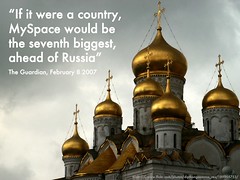
if it were a country myspace would be ahead of russia
That’s almost unbelievable. Well, when you think about it, MySpace and similar ‘countries’ have their own language and customs.
Originally uploaded by lynetter
Teaching up a storm

Wes Fryer compares good teaching to good cooking. He talks about ‘recipes’ being modified in a Web 2.0 context to suit specific needs and situations. His six main ingredients for powerful teaching and learning are del.icio.us social bookmarks, Flickr photo sharing, VoiceThread digital storytelling, collaborative writing tools, websites for phone recording as well as SMS polling, and videoconferencing. How do these tools and applications differ from traditional 19th century teaching and learning? Replacing a one-way direction from teacher to student, where the teacher is the expert and the student a passive receptacle, these ingredients enable active and interactive learning.
I’m interested to find out more about the websites for phone recording and SMS polling. Are Australian teachers doing this?
Book Week

Reading book…
How can we define Book Week? Frankly, I think we need to rename it, broaden it a little. Maybe brainstorm the implications of ‘books’. Let me see: reading; writing; responding; discussing; thinking; analysing; imagining; challenging. Then there’s: using stories and themes as a springboard; using imagery as an inspiration for further creativity; pondering the importance of free expression in our lives; appreciating depth and difference in culturally differentiated texts; forgetting your worries through humour; finding soul mates in shared responses. I think it could be called ‘sharing responses to people’s stories’ week – but that’s too long. Why don’t we just leave it as ‘Book Week’?
Originally uploaded by Tapio Hurme
Censorship

If you click on the photo of the banned books banner, you’ll be directed to its Flickr home, and you’ll be able to hover over each book to discover what it is. An interesting theme – banned books.
Censorship. It takes me back to when, as an Australian of Russian descent, I attended a Saturday Russian language school (RS, we used to call it), during the time when our parents’ fear of Russian communism was raw. My own grandfather witnessed his father being shot at the age of six. The censorship that ensued at Russian School (RS), through the eyes of young people, took on a comical aspect. The more paranoid members of our community (am I being unkind?) decided to protect us from ‘evil’ by eliminating our exposure to all things Soviet (which means ‘council’, by the way). We spent our Saturdays drawn like moths to the flame, peering through thick black texta-covered chunks of text through the light, or trying to unstick glued pages. In most cases, our discoveries left us disappointed or confused when the forbidden words revealed themselves as ‘pioneers’ (soviet scouts) or the date of a celebration we weren’t supposed to know about. Continue reading Censorship
Bravo Hawkesdale

I realise that many people would have discovered ages ago what Hawkesdale College has been doing with blogging, but since I’ve only just looked through properly, I have to do my little rave because otherwise I’ll burst. It’s so fantastic!
The Hawkesdale K-12 blog : Techno7 (Our first year 7-12)
is about students and teachers blogging through the 7-12 school journey.
What’s on the blog?
• There’s a page for each subject, plus extras, eg. study skills, etc.
• Each student has a blog for each subject
• Each teacher has a blog following their Web 2.0 journey, posting stuff for students, or just ideas, findings, etc. Continue reading Bravo Hawkesdale
Green Pageflakes

Here’s a useful way of using Pageflakes in the classroom. A not so recent but still very exciting and relevant blog post by Will Richardson in Weblogg-ed (dated 21 November 2006) discusses Pageflakes as a dynamic student portal. Will talks about creating a topic-specific page on Darfur/Sudan built on tag feeds from YouTube for videos, Flickr for photos, the New York Times and the Sudan Tribune for news, del.icio.us for what people are bookmarking, and Google Blogsearch blogs.
I like this on so many levels. Firstly, Continue reading Green Pageflakes
A vast and diffuse cocktail party

Clay Shirky raises an interesting discussion about weblogs and the mass amateurization of publishing. Personally, I think it’s about time people were able to express themselves so publicly and globally without having to publish in the traditional sense. Discussing the problem of making money from blogs, Shirky says, ‘we want a world where global publishing is effortless … However, when we get that world we face the paradox of oxygen and gold. Oxygen is more vital to human life than gold, but because air is abundant, oxygen is free. Weblogs make writing as abundant as air, with the same effect on price’.
He then goes on to talk about Continue reading A vast and diffuse cocktail party
