
 John Larkin’s blog struck a chord with me when he talked about signing up for everything under the sun ‘in a drunken Web 2.0 haze’. Me too. My ‘registrations’ information word doc is now into its third page – yes, you heard correctly. But what am I to do!? There’s so much out there, and I’m like a child in a lolly shop. All the lollies are free, did I mention? As John says, ‘too much choice does create paralysis. Like the aisles in a supermarket. Too much choice is a legacy of the twentieth century I guess’. And I do love knowledge, discussion, recommendation, links to fabulous resources. And I love passing these on to other people. Still, this weekend I have done other things: boring house stuff, baked a blueberry crumble cake, helped my younger son with a project about earthquake-safe houses, bought a barbecue, watched an energizing Nigel Kennedy concert on DVD, had breakfast at Brunetti’s, visited Wunderkammer, read my older son’s year 12 psychology research essay, played with the dog…. so you see, it’s not that bad.
I loved one of the comments on John Larkin’s blog: ‘Set up a new group? What should we call it? “Clayton’s 2.0″? The group you have when you are not having a group?’
All posts by Tania Sheko
Wait a second, which life is this?
 While thinking about how problematic Second Life can be, I came across a phrase by Alex Iskold in a post he wrote last year on the ReadWriteWeb site, ‘our inevitable digital future’, and it got me thinking. We can kick or turn away as much as we like, but the future will still be digital. Iskold coins the term ‘Digital Life’, defining it as ‘a collective of the virtual world technologies that are bringing life to the digital realm’. He also points out that the core of Second Life is social, unlike virtual world video games which are quests. Digital Life, according to Iskold, is a set of technologies that aims to put a digital realm on top of our reality. He compares this to ‘magical glasses that overlay digital information on top of real-world scenes as you walk around. The closest modern version of this technology is Google Earth, a detailed 3D visualisation of the earth’. This application tags and annotates our physical world with digital tags which, according to Iskold, makes our world much richer.
It’s natural for us to sometimes resist change or, at least, to be uncomfortable about it. I suppose it’s a basic survival instinct, testing the waters before jumping in. But I think that, over time, we will be able to see more practical and inspirational applications of Digital Life. The bigger picture is yet to become clear for us. I agree with Iskold – life is becoming more digital and digital is becoming more alive.
Animation

Although this looks like something more akin to primary level, a little bit of fun never hurt anybody in secondary school either. Fodey.com also offers talking squirrels, cats, owls and flowers. You can custom-make a newspaper, wizard text and movie clapper board. I followed the link to the generator blog – have a look; some fun applications. Just apply and add imagination.
Starry starry night
[youtube=http://www.youtube.com/watch?v=LxVDVggLqsA]
Skoolaborate put me onto this video by a young film maker, Robbie Dingo. The author of this blog uses this example to illustrate the learning potential of virtual worlds. He lists learning areas, such as maths, geography and problem solving that are demonstrated in the creation of this short and creative film.
Still browsing in my search for clarity and understanding of the purpose and potential of virtual worlds. What do you think?
SPLONK

Originally uploaded by el estratografico
I really enjoyed looking at scans of old comic book sound effects mentioned in the illustration and cartooning blog, Drawn! . I’ve been researching information about comics and manga for desktop author booklets to go into my art wiki. My wiki is growing but nobody is using it as far as I can see. No matter; I’ve scheduled a show-and-tell session at the next art faculty meeting. Meanwhile, the list of blogs about comics/manga is growing. Eventually these will be added to the wiki. You can have a peek at the wiki if you like; there’s still a lot to do, and the navigation bar needs fixing.
Doppelganger
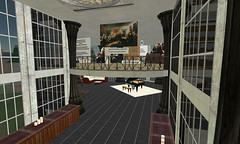
Originally uploaded by Pathfinder Linden
The weekend heralded a remarkable journey, fraught with virtual dangers, as I embarked on a Second Life adventure. Embarked, yes – not that I actually arrived at any destination. Yes, I registered, assumed my fantastic identity (as far removed from my real one as possible), but the parallel universe did not agree with me. I lurched and teetered, having failed in transferring my ability to walk into this second life. After some time, I was able to follow a relatively straight line, turn corners without stumbling onto the road or falling into a large body of water. Not satisfied with my ungainly gait, I decided to take up the challenge of controlling a vehicle – how difficult could it be? After all, I do have my licence. Well, as you can imagine, this experience was not without mishap. Driving as if inebriated, I became aware of another’s presence, and before I knew it, a stranger was forcing himself into my automobile! I held on stubbornly, and he finally stopped trying to squeeze his way in, and was later seen driving happily in an alternate vehicle. My adventures did not stop there. I rambled across roads, footpaths, grass, and pavilions, lost and clueless as to my destination, until finally my hapless voyage came to an abrupt end in a spectacular crash.
I may take a break before returning to this strange place.
The Dick Tracy Show

Originally uploaded by tsheko
There are many educational YouTube videos to be discovered. Then there are these…
#20 Casting the net

Originally uploaded by tsheko
Camilla Elliott provides many useful links for podcasting on her Linking for Learning site. I took up her recommendation to subscribe to the ABC’s EdPod RSS feed. Now the latest EdPod audio files are automatically sent to my iTunes every fortnight. Love the idea of getting stuff automatically. It’s like someone working for me while I sleep.
I listened to ‘One long yawn? History in the classroom’ and pondered the podcast. What’s not to like? Continue reading #20 Casting the net
History of libraries – fascinating

Originally uploaded by tsheko
After a brief hiatus, due predominantly to brain fag, having almost exhausted all things Web 2.0 (or is that, exhausted myself?) I decided to offer a morsel of general interest, to whit, a fascinating site detailing the early history of libraries. Have a look, too, at Survivor: History of the Library from History magazine.
Notice my reversion to bombastic and antiquated expression when I have nothing to say.
Wait, I do. Continue reading History of libraries – fascinating
