Category Archives: 21st century learning

More great quotes about learning and change

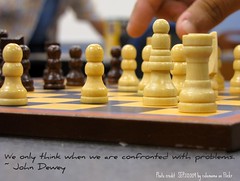
Originally uploaded by colemama

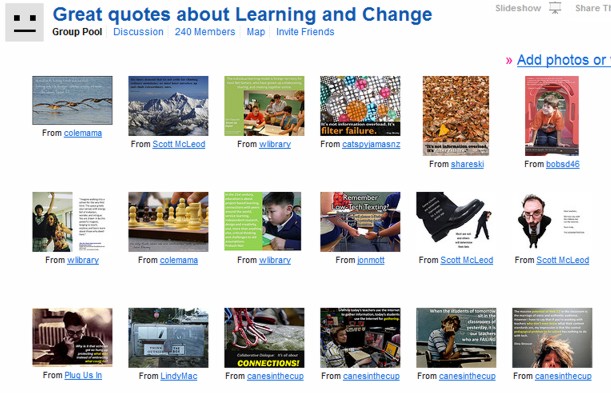
I’m spending more and more time on Flickr. It’s a rich resource in terms of creativity and content. I wanted to remind you about the Group Great quotes about learning and change.  I’ve mentioned it before, so forgive me, but I think it’s worth featuring again.

greatquotes

 Contributors to this group add photos with quotations about 21st century education. I like the succinct way quotations express multiple ideas and concepts, but coupled with an apt image they are even more effective. These can be used as posters to stimulate thinking, to promote discussion or even to remind yourself daily of what’s worth thinking about.

Top contributors currently are Dean Shareski, Scott McLeod, Darren Kuropatwa, Langwitches and Darren Draper.

There are other people who are using images for conceptual purposes on flickr. I stumbled across a few today. Amongst these was Costel Mago who uses beautiful photos to support his insights.

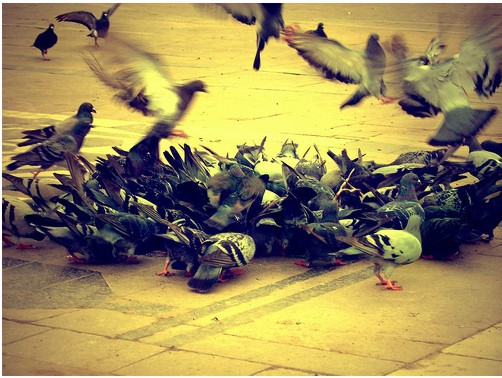
Here’s one of his that resounds with me:

All happiness depends on a leisurely breakfast.

pidgeons

Personally, I find that I’m turning to images more and more for a powerful and succinct way to express ideas. Flickr is a well of shared thoughts and ideas, as well as images. Dont’ underestimate what you will find there. Find the message in the picture.

I’ve been finding so much that’s valuable to my personal and educational life on Flickr lately; I think I’ll write another post about what I’ve found for learning and teaching in Art. See you next post.

We all need a regular kick in the pants

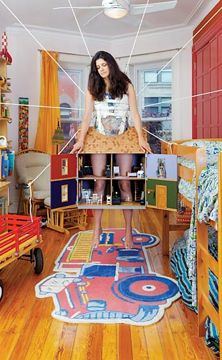
Antoni-INhabit2

Janine Antoni, “Inhabit,” 2009. Courtesy of Luhring Augustine Gallery

 I agree with the Art21 blog post, Another kick in the pants, that everyone needs the occasional kick in the pants, only I think that maybe we need it regularly. Joe Fusaro says

I use Art21 for a kick in the pants from time to time, whether it’s to inspire my teaching by watching Carrie Mae Weems or to give my studio practice a jolt by listening to Kiki Smith talk about her process for making works of art. I mean, everyone needs an occasional kick in the pants, don’t you think?

Joe goes on to mention TED talks as another source of inspiration, and I have to agree with him –  TED.com and Art21 have been regular sources of inspiration for me too.

TED’s theme is Ideas worth spreading, and its mission is of epic dimensions:

…our scope has become ever broader…. We believe passionately in the power of ideas to change attitudes, lives and ultimately, the world. So we’re building here a clearinghouse that offers free knowledge and inspiration from the world’s most inspired thinkers, and also a community of curious souls to engage with ideas and each other. This site, launched April 2007, is an ever-evolving work in progress.

A clearinghouse that offers free knowledge and inspiration from the world’s most inspired thinkers is an amazing boast, and the reason why so many people either discover TED with joy or continue to return to its rich storehouse.

The scope of Art21 is enormous, and its themes a dream for teachers of art. The series explore such themes as compassion, consumption, ecology, fantasy, humor, identity, loss & desire, memory,paradox, place, play, power, protest, romance, spirituality, stories, structures, systems, time, and transformation. Each theme is tantalising in its scope, eg. compassion – artists explore conscience; reconcile past & present; expose injustice; express tolerance. It makes me wish that Art were compulsory, or at least, not separate from the official literacy which seems only to reside in English. A sharpening of higher order thinking skills will find no better place than the Arts (although it certainly resides in all subjects).

Every day I still find myself explaining, justifying and defending my online activity. I always point out that it’s the connections to people and ideas, information and images, which I would otherwise not discover, that keep me coming back to my laptop. It’s a breathlessly vast source of inspiration and ideas, a regular kick in the pants – pushing my thinking, challenging me, jolting me and enriching my life.

I would recommend Art21 to anyone, not just art lovers, because it provides a window into a world of ideas and creative concepts, and of course, TED.com because of its amazing array of interesting people who have a way of making complex things simply fascinating.

Should teachers be more like conductors? TED tells

Orchestra conductor Itay Talgam has discovered that the secrets of good conducting shed light on leadership in general. I found the messages in this TED talk to be very relevant to teaching.

[ted id=663]

Itay Talgam’s TED biography observes that Talgam

finds metaphors for organizational behavior  — and models for inspired leadership — within the workings of the symphony orchestra. Imagining music as a model for all spheres of human creativity, from the classroom to the boardroom, Talgam created the Maestro Program of seminars and workshops.

Talgam’s workshops aim to help everyday people develop a musician’s sense of collaboration, and a conductor’s sense of leadership: that inner sense of being intuitively, even subconsciously connected to your fellow players, giving what they need and getting what you need. It’s this art of listening and reacting in the moment that makes for a swinging jazz combo, a sublime string quartet, a brilliant orchestra — and great teams at work.

Talgam talks about the conductor’s ability to use a small gesture to suddenly create order out of the chaos. When he asks who we should thank for the success of the performance, he is asking what the role of the conductor really is. In the same way as the teacher, the conductor is the single leader responsible for the success of his people. The question is – how does he create music out of the chaos?

According to Talgam, it’s not all about complete control of the orchestra. It’s about the joy of enabling other people’s stories to be heard at the same time – the story of the orchestra, that of the audience, unseen stories of people who made the concert hall and even those who made the instruments.

Talgam shows examples of different styles of conducting. There is the example of the conductor who is so clear about what he wants that he becomes overclear. Talgam describes this type of conductor as having a strong sense of responsibility. This type of conductor insists that there’s only one story to be told, only one interpretation of the music, and that’s his interpretation. In this case, the musicians feel they are not allowed to develop, but are only used as instruments. 

Talgam insists that leadership of the orchestra can be achieved with less control, or with a different kind of control.

One of the conductors is shown conducting with his eyes shut, confusing the onlooker with his apparent withdrawal from control. Talgam explains that, in this case, the musicians get their cues by looking  at the conductor’s face and gestures, and then looking at each other, with the first players of each section leading. This conductor claims that the worst damage he could do to  his orchestra would be to give them an overly clear instruction which would prevent them from listening to each other.

In another example, the conductor explains that by not telling the musicians exactly what to do, he’s opening a space for them to put in another layer of interpretation, another story. Talgam explains that this method without clear instructions works because it’s as if the musicians are on a rollercoaster, whereby the forces of that process put the action into place. You know what to do and you become a partner. This experience is exciting for the players. 

And what happens when there’s a mistake? The conductor’s body language is enough. When it’s needed, the authority is there  but authority is not enough to make people partners. This kind of conductor is there 100 percent but not commanding, not telling them what to do, instead enjoying the whole experience with them. In this case the conductor creates process but he also creates the conditions in the world in which this process takes place. The soloist is allowed to be autonomous and is consequently proud of his work. Developing a partnership brings about the best music.

I think we can take a fair bit out of this talk and apply it to teaching. Teaching is like conducting or leading. What resounds with me is the fact that overly explicit instructions and tight control can be at best limiting, and quite possibly suffocating. Setting up the process and allowing room to move seems like a good way to teach. Realising that your interpretation is not necessarily that of everyone else opens up rich possibilities for learners. Understanding that members of the orchestra or class learn from each other. Getting to the point where you know the students so well that they can read your every nuance, and standing back and smiling, just enjoying the process unfolding before you, is possibly every teacher’s dream.

When, as a teacher or leader, you create the environment, give support, and then step back – you get to the wonderful point of ‘doing without doing’. As Itay Talgam says,

if you love something give it away.

Michael Gerard Bauer joins our writing project

mgbphoto1a

This is cross-posted on my English class blog and fiction blog.

A little while ago I wrote on my English class blog about my hopeful expectation that Michael Gerard Bauer would accept my invitation to join our creative writing project after we listened to Lemony Snicket’s The composer is dead.

It’s a brilliant, witty and hysterical story narrated by Lemony Snicket himself. The entire production is fun – the story with its personified musical instruments presented as murder suspects (boisterous trumpets proclaiming loudly and with a certain arrogant rudeness), its alliteration (’we conquered the concert’; ‘battered the band’), and its playful use of language (the percussion instruments ‘percussed’, and ‘employed xylophoniness and cymbalism’).

Similar to Peter and the wolf, the story skilfully weaves plot around descriptive information about the orchestra. The boys seemed transfixed by the story, although the musical interludes may have been a bit much for some.

As a creative writing exercise, the boys will be writing their own story –

The … is dead

based on a group of inanimate objects who are suspects in a murder mystery.

Well, to our absolute delight, Michael generously agreed, and very quickly wrote a brilliant and witty piece which I’m going to share with you now.

Police Investigation Report by Chief Inspector Iva Noclue written by Michael Gerard Bauer.

It started out as just another routine investigation, but all that changed when I opened the fridge door.

The body was there lying before me. It was wrapped in plastic, naked, plucked and headless. It was obviously the work of a madman. I examined it more closely: female chicken, size 20, possibly from Ingham, and judging by the aroma – marinated.

You have to deal with some sick people in this job.

I immediately set out on the trail of the killer. I threw open the chiller door.

‘Freeze!’ I shouted. Luckily everyone already had.

I approached my first suspect. He claimed he was a famous rap singer called Ice Tray. I didn’t like his attitude at all. He was cold and hard and refused to answer my questions. He seemed very set in his ways.

I decider to move on. I found my next suspect lurking at the back of the freezer.

‘You, what’s your name?’
‘Ice-cream.’
‘Really? Why? Did you see something?’
‘What are you talking about you idiot?’
‘I want to know what made you scream. Did you witness the murder? It was Ice Tray wasn’t it?’
‘No you fool. That’s my name, Ice-cream. Strawberry Ice-cream. But what’s this you say about a murder?’
‘That’s right sister. There’s one dead chicken downstairs. You see or hear anything suspicious? Notice any strangers hanging about?’
‘Yes as a matter of a fact I did. Yesterday a whole family of eggs moved in down there.’
‘Right. Was that was before or after the chicken bit the dust.’
‘How would I know if I’m not the murderer?’
‘Good point. I’ll work it out myself. Hmmmmm let’s see, what came first, the Chicken or the Eggs? This could be a tough case.’

I left the Freezer but not before I arranged for Ice Tray to come to the Station the next day for a more thorough interrogation.

My investigation continued. I questioned all the Eggs but they refused to crack. (Just between you and me I think some of their brains were scrambled – or possibly fried.) Then I grilled the Cheese but got nowhere. Next came the Honey. She was a real sweetie but she couldn’t tell me anything either. I was getting nowhere so I decided to offer the Bread a hundred dollars to help me find the murderer. He refused. Said he already had plenty of dough.

My chief suspect was still Ice Tray but there was another guy who made me suspicious – wouldn’t tell me his real name. First he said he was called Vegemite, then he reckoned his name was iSnack2.0 then it was Cheesybite. I decided I’d run those aliases through the computer when I got back to the Station.

Only when I was about to call it a day did I noticed the trail of what looked suspiciously like blood spots. They led me right to a tall red haired chap who went by the name of B. B. Q. Sauce. Of course he claimed he was innocent like the rest of them. Said it was just a nose bleed or something. But then B.B. told me something that got me interested. He said he’d seen Chicken getting friendly with some unsavoury characters recently, said he often saw Chicken mixing with Avocado or Chicken with Mayonnaise or Chicken with Salad and once he’d even seen Chicken with Sweet and Sour sauce!

The case was getting more and more complex and rumour had it that Gladwrap was involved in some sort of big cover up. Then, just when it looked like I’d never get to the bottom of the Chicken case, there was a major break through.

I was interrogating Ice Tray the next day under the hot lights at the Station when to my amazement, he went totally to water. I figured that was as good as a confession so I locked him away in the freezer and threw away the key.

I never did work out how Ice Tray actually committed the murder. I mean it must have been quite difficult with him not having any arms or legs or eyes or ears or brain or any visible means of support or movement, but you could just tell by looking at him that he was obviously a cold-blooded killer and a hardened criminal.

Ice Tray – his heart might have been made of ice, but I saw right through him from the start.

Our boys have been collectively brainstorming possible characteristics for their group of inanimate suspects, but as you can imagine, first time round, it’s challenging.

Thankyou so much to Michael for taking the time and donating his creativity so that our students can learn from an expert, so that they feel special, and appreciative of the privilege they’ve received.

As I’ve said many times before,

technology makes possible the connections between people which would otherwise not have occurred.

This is a great example.

Design the school of the future, but do it now (GPS)

As I’ve said in my previous post, Green Pen Society is Paul Cornies’ brainchild, and has brought together bloggers (thinkers, writers) from different parts of the world.

It’s my turn to devise a theme for October’s post, and I’ve chosen the theme of school design, namely:

What would your ideal school look like? Design the school of the future – but do it now!

A tweet from @kentmanning led me to the designers’ website of the award-winning International School in The Hague, Design Share: designing for the future of learning, and I started thinking about what was essential pre-thinking for a school design. These statements make a lot of sense:

The classroom is the most visible symbol of an educational philosophy.

It is a philosophy that starts with the assumption that a predetermined number of students will all learn the same thing at the same time from the same person in the same way in the same place for several hours each day.

Personally, I never felt comfortable with that assumption, and as early as kindergarten, which I attended on and off from the age of 2, in order to learn English (Russian was my first language at home), I knew I was starting from a different place in terms of what I had to learn.  Further on, in early primary school, I remember sitting obediently, silently, while students took turns to read aloud (and struggle through) the one reader for the year, whereas I had finished it at home in the first week. Statistically, I would not have been the only student, although my respect for authority kept me squarely on my chair, not even moving to fiddle with ruler or doodle in the margins.

How many of us learned to daydream away the waiting time in classes which expected all students to learn at the same pace and level?
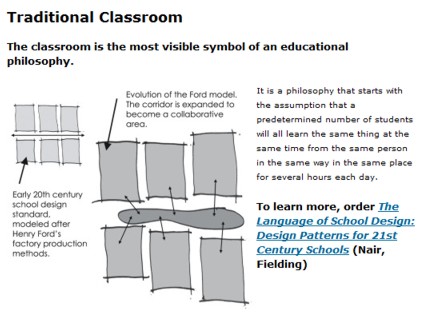
tradschool

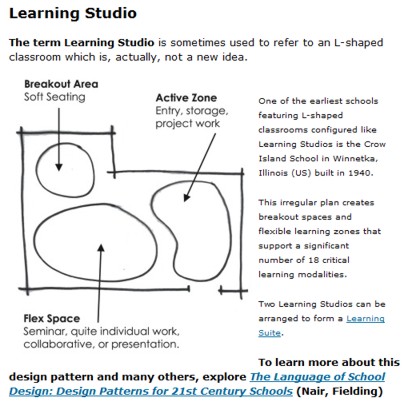
In contrast to the traditional classroom design is the Learning Studio. The L-shaped room includes 3 separate but open areas: Active Zone, Breakout Zone and Flex Space.
learningstudio

 The L-shaped classroom was first built in 1940, but the classrooms in the schools in which I’ve taught look like the first design, with rows of students sitting facing the front. Wait, there has been a change – we don’t have single rows any more. Do we think that having 2 or 3 students sit together in rows is a significant enough change to classroom design?

I think the trouble lies in the need to rethink the philosophy behind our learning spaces. How do we learn? How do we teach? What I’m still seeing is the predominance of the teacher as ‘sage on the stage’ and the students listening and responding in turn, or writing their own responses for only the teacher to read and correct.

If learning is to be student-driven, research-based and collaborative, then our learning spaces definitely need to take this into account. If we are to stop separating learning into discrete disciplines, and realise that in life we function in an integrated way, then we surely need to redesign our schools. But a physical reconstruction will have no effect unless we all start with a communal rethinking of the philosophy of learning and teaching.

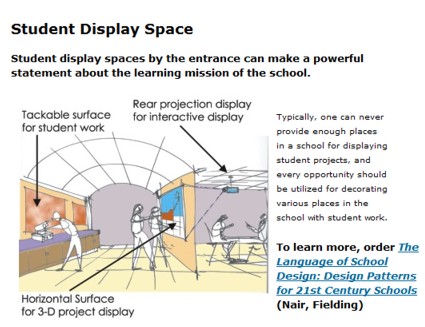
One of the aspects of design in the index of this book is that of display space for student work.
studentdisplay

I know that there are schools that display student work around the school, and I think this is a great idea, and should be taken into account when designing the school. If the school takes pride in what students have created and displays it everywhere, not just in designated subject classrooms, then the message is that the school belongs to the students.

 As a teacher librarian, I also think that the library should be the centre of the school – physically and philosophically. It should be a central working, displaying, playing and meeting place, welcoming of all the different subjects and activities. It is, after all, a place which specialises in the location and use of information and ideas, as well as one which encourages leisure and relaxation in the form of reading and discussion.

Public libraries are changing their image and moving away from strictly controlled quiet areas, where people read or research in isolation, to places offering diverse learning programs, meeting places and leisure activities. I think school libraries should learn from them, as well as from book shops which create a welcoming environment and put the customer first, providing attractive and helpful displays and signage. And there’s nothing wrong with injecting a sense of fun. This applies to all aspects of learning in the school; learning should include time allocated to playing with ideas or tinkering with things – because that’s where the creativity steps in, especially in collaboration – instead of focusing on completing tasks for grades. Spaces in the school should be designed for this tinkering.

I’ve posted this TED talk video previously but I think it’s worth revisiting at this point.

Gever Tulley uses engaging photos and footage to demonstrate the valuable lessons kids learn at his Tinkering School. When given tools, materials and guidance, these young imaginations run wild and creative problem-solving takes over to build unique boats, bridges and even a rollercoaster!

[ted id=588]

Tinkering allows for learning through discovery and this type of learning is richer than learning from the assimulation of theoretical information.

As far as physical design goes, I’d love to see spaces that

  • encourage connection, collaboration, discussion, performance and celebration;
  • transparency and flexibility between rooms and to the outside;
  • a natural outdoor environment maintained partially  by students;
  • places to socialise in free time;
  • spaces for quiet, reflective or creative projects.

Of course, technology will become more and more ubiquitous. I think that technology is developing so quickly that we won’t need to think about design in terms of spaces housing cumbersome computer equipment, but spaces to provide for the learning and interaction of social networking using small, handheld technology.

Although, it would be kind of cool to have a school in a Jetsons-type world…

win-pics-jetsons

Random facts I learned from Flickr today

They may be random, but I’m still learning.

Flickr is fun to browse, but more and more, I’m discovering Flickr to be an interesting way to learn. The photos take me into places I’ve never been, to things I normally wouldn’t see, often providing interesting background information.

Here are a few random things I learned from Flickr photos today

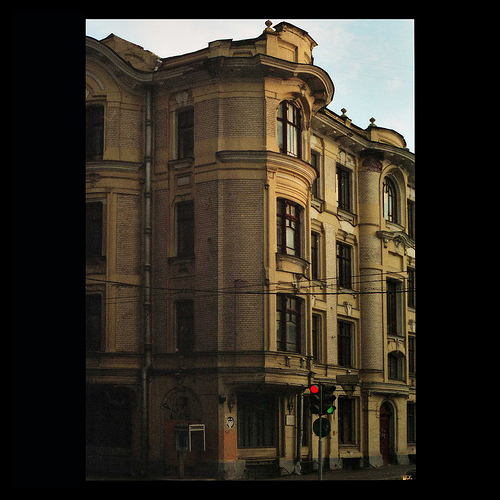
This photo was taken in Russia by seriykotik1970

russianbuilding

An art nouveau building near my office that was gutted by fire last week. Sadly it’ll now probably be demolished and ‘rebuilt’. In Moscow fires of this sort are often started deliberately by unscrupulous developers.
Designed by Lev Kekushev in about 1910.
Photographed in 2007

Turkish roosters are very colourful

turkishcock1

turkishcock2

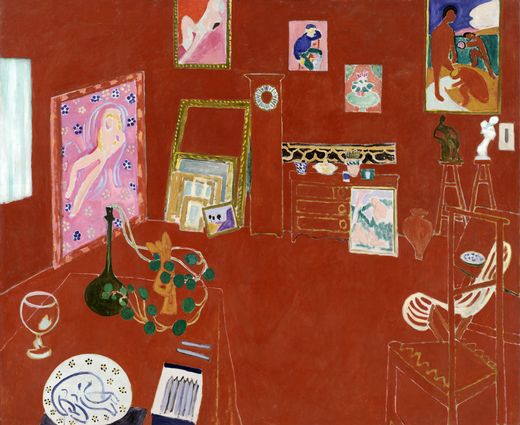
Smarthistory is a group on Flickr which complements the website smarthistory.org. The purpose of this website and Flickr group is to enhance or replace the traditional art history textbook.

For example, you can learn about Matisse’s Red Studio from a short video using Flickr pictures of art collected by group members. 

Redstudiomatisse

If you read About Smarthistory, you will understand the motive behind the creation of this website and Flickr group:  

We are dissatisfied with the large expensive art history textbook. We find that they are difficult for many students, contain too many images, and just are not particularly engaging. In addition, we find the web resources developed by publishers to be woefully uncreative. We had developed quite a bit of content for our online Western art history courses and we had also created many podcasts, and a few screencasts for our Smarthistory blog. So, it finally occurred to us, why not use the personal voice that we use when we teach online, along with the multimedia we had already created for our blog and for our courses, to create a more engaging “web-book” that could be used in conjunction with art history survey courses. We also realized that this content would be useful to museum visitors and other informal learners. We are committed to joining the growing number of teachers who make their content freely available on the web.

Smarthistory is an excellent example of what can be done to create high-quality, free educational resources through collaboration. You’ll understand the scope of this project when you look at the site map which provides a hyperlinked timeline of art history. I also like to check out the discussion in groups.

The best thing about learning on Flickr is that you don’t expect to.  That’s why it’s so enjoyable.

Don’t bag Facebook


Photo courtesy of phillipsandwich on Flickr

This is for all the people who think (and write) that young people use Facebook to waste their time with pointless dialogue, flaunt themselves inappropriately, engage in banal chat about drinking or bully others online.

Here’s a thread started by my 16 year old son who loves classical music and composing. Statistically, you could say he would be a target for derisive comments, and yet, read for yourself:

Maxim is composing his 8th symphony in B minor “Sinister”about an hour ago

good man maxim

cool

Bloody talented composer here. 🙂

I like! I like!! I like how’s already been pre-nicknamed

Maxim Yeah, it’s gonna be really dark and ominous. The very beginning has cello, bass, contrabassoon and bassoon with a dark unison theme. I got the inspiration from Borodin’s 2nd symphony for that.

YAAAAAAAAAAAAAAAAAY!!!! You must send it to me when you’re done!

Maxim Yes, but it may take a while.

can you please send it to me aswell???

YAAAAAY!!

Maxim Sure! Maybe 1 mvt at a time. This’ll take me a pretty long time.

YAAAAY!! It took brahms over a decade to make his first symphony… Take your time

Maxim Not that long, maybe a month or 2 I meant.

cool!

are there 1000 performers?

Maxim Is that a piece of music? Or are you asking whether my symphony requires that many players? Mine probably wouldn’t require 1000 players.

Well it does now!! It will include a huge choir!! And an orchestra at least 3 times the size of a normal one! YAY!!
(there’s a challenge maxim!)
Mahler’s 8th Symphony is also called “Symphony of a Thousand”. One of the best performance experiences I have ever had. Check out the ending: http://www.youtube.com/watch?v=uYM54vhLYTU&feature=player_embedded#t=20
Maxim  Oh, ok. Thanks.

My older son says that his friends often share links and information about new bands or where to get sheet music. They’ll find sites which teach you how to play an instrument; they use Facebook to help each other learn or create.

For those who focus on the negative aspects of social networking, think again. There will be negative interaction online, just as there is in life, but platforms like Facebook have enabled young people to connect in new ways, to learn from each other.

Can we see the process in the end product?

indoorlanewayproject

Last Saturday my sister (art teacher) and I finally saw the exhibition of work which was the culmination of The Indoor Laneway project. My last post explains the project.

The exhibition space is quite large and the ideas behind the exhibit well thought out. The adolescent bedroom and laneway leading to the main screen showcasing students’ work is effective. We sat on the chairs provided (I felt a little like Papa Bear on Baby Bear’s chair) and enjoyed the mix of styles and perspectives.

As we were going out, I said to my sister, ‘It’s more than it looks’.

That’s not to denegrate it in any way. I thought the exhibition looked professional, and considering the short six-week time period for the whole thing to come together, it was very impressive. It is true about art in general – and many other things too, of course – that there’s more to the whole process than meets the eye, and I think it’s worth thinking about. The Indoor Laneway Project blog solves that problem for students and educators involved, and in this way it holds the valuable stuff – the evolving thoughts, thrown-up ideas and resources, positive feedback, documentation of the process which leads to the final product, but which is almost more than the final product.

I thought I’d pull out some examples of what I mean from the blog:

Eugenia defines the most important part of the experience – collaboration:

Hi Indoor Laneway creators,

I can see you’ve been working hard and exploring the remix idea which is so excellent to see. A big part of this project is about connecting with others even if you live hundreds of kilometres apart and using this blog as a portal – and Terrie and Rebecca it’s so cool that this is the concept you’re using in your portal/portrait work.

Nikita (student from Mooroopna) says:

Hi everybody. I’m Nikita and i was thinking about making a virtual dance video if Daniel was interested…It would be great to have us both filmed in front of a green screen and then all footage is combined here… The most exciting thing about this is it could be the first time that this has been attempted. Hope you guys are really interested in this idea.

Yolander called for a combined effort from the cohort:

We need sounds such as laughter, voices of family and other important sounds that will relate to it, would you be able to assist me in writing this particular way?… Help in researching sounds. (it is easy to spend all day…) We have 8 min of swamp sounds as the birds all wake up for background… 

We would also like to use lots of home bits and pieces from both schools, sporting things and home items and animate them in and out. HELP!!!

Nikita thinks out ideas and process:

I was thinking of the way we could tackle this Virtual Dance video. Firstly we need to find a soundtrack from Jamendo that goes for 3 mins minimum that has an easy beat to dance a simple routine to. Then we should choreograph a simple routine for Daniel and I.

Pros- It will look great when finished.

Cons- It will look a little artifical and the greenscreen size will restrict movement but thats ok.

Kayla and Laura share an idea:

We are working with the other students on this project and we are glad that you like the idea of involving everyone.

We would like to get some Photos and/or short Clips of close ups of eyes or people pointing in and looking from WFS when possible to add to our project.

Emma, Yolander, Tom, Josh, Maddison ask for contributions:

A group of us have decided to concentrate on our original idea of the light beams coming from the computer screen. We would like to have the photos from home going into the computer with Indoor Laneway open on the screen, with the light beams as a way to remix them. We have recorded or sourced sounds that will be appropriate for this project, such as ‘catch it’ when a cricket ball goes into the screen and waves for a surfboard. This idea will incorporate everyones work. Could you please send us HEAPS of high res. photos and if possible with the objects eg. cricket ball, skateboard, guitar, etc. selected out and saved in a .PNG format? That would be really awesome

 These are just some of the extracts from the interactive process at the heart of The Indoor Laneway Project. I think you get an idea of where the strength and value of this project lies.

Will viewers of the exhibition understand the depth of this project? Probably not. If they took time to have a look through the blog on the computers provided in the exhibition, then they’ll have some idea. If they browse the tab ‘Make and create tasks and responses’ on the blog, then they’ll have an even better understanding of the project.

Does it matter? Do viewers need to know every aspect of the process? Well, from an assessment perspective, yes. Surely the entire process would be considered in the final evaluation. This brings me to the question of assessment in general. If we understand that the entire learning journey is valuable, and not just the final product, are we convinced that our method of assessment is appropriate, or should we rethink it?

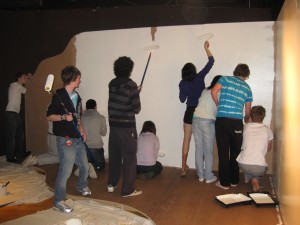
Clearly, what the kids get out of it is more than the finished product. Their learning experience has been enriched by the challenge of a multi-tasked program, through online collaboration with another school, spurred by a project taking them out of the school to a public audience. I can imagine that the face-to-face meeting would have been fantastic, and building the sets together enjoyable.

Wouldn’t it be good if there were more opportunities for students of every discipline similar to this one?

Art students collaborate – Indoor Laneway Project

Sometimes things happen in schools. Days and lessons go by and pile up but occasionally an exciting kind of learning takes place. Marie Salinger, art teacher and Director of Learning Enhancement at Whitefriars College (my school), has been a catalyst for this kind of learning. Marie has taken the plunge with her Year 11 Studio Arts class – diving into unchartered waters and taking on the challenge of long-distance, shared learning with Mooroopna Secondary College many kilometres away. Did I mention they had less than a term to produce a show for the public? I’m talking about the Indoor Laneway Project.

Marie talks about how she feels about the project

I am feeling so energised and excited about the Indoor Laneway Project and am especially enjoying the chance to tap into some wonderful, rich resources so easily. Working with Dan West (the Arts Centre) and Eugenia Lim (ACMI) and having access to their wealth of experience, knowledge, technical expertise and creative talents has been a huge incentive and is adding a whole new level of excitement to my work in the classroom. I have also noticed a big shift in how the students are approaching the set tasks. They feel that there is a real purpose to their work and are very aware that they will be addressing a much larger audience than would usually be the case. Normally we might have the opportunity to display their artwork around the school as well as at our VCE exhibition in October. Displaying student work in this way for the school communitiy is great but now we have the chance to show our artwork to anyone, anywhere in the world, who is interested . A daunting but also very exciting possibility.

In the About section of the Indoor Laneway Project’s website, you’ll read this:

Education at the Arts Centre Presents Indoor Laneway – an online collaborative arts project. Its intention is to allow regional and metropolitan secondary school students to develop digital sound and art work.

 Under the mentorship of an established media artist and school based digital media educators, participants remix and re-contextualise each others work and collectively assemble sound and images to explore artistic practice that focuses on key concepts of: 

  • Self
  • Home
  • Global and Local Positioning
  • Connection
  • Exchange 

Over two weeks in September, the Indoor Laneway will establish a virtual space in the Arts Centre’s BlackBox where work generated will be displayed, results disseminated in a public forum and location based performances will take place.

Of all the outcomes listed in the About page, this is one which resonated with me:

  • encourage within participants a community of collaborative creation and a sense of unity working towards a common artistic outcome;

Talking to Marie during the very short span of several weeks before the opening, she spoke of a sense of excitment and engagement amongst the students, and a noticeable increase in productivity and bouncing off others’ ideas. On the day that the two classes met at the Black Box in the Arts Centre to build the sets, I would have loved to be there to witness the shared activity which prepared for a real exhibition in a well known Melbourne Arts space and open to a real audience. I have a feeling this will be something the students will always remember.

Reading Marie’s blog posts, you can sense her involvement in the students’ engagement with the project:

It is so wonderful to see these young students bouncing ideas around. They are so creative and innovative and I am loving the vitality that surrounds the project. There is a lot of dialogue going on about the actual exhibition space and how we might use it to display the very large, diverse and amazing art mountain that has developed from the Indoor Laneway Project.

I’m looking forward to seeing the exhibition this Saturday. Congratulations to Marie, to students and art teachers of Whitefriars College and Mooroopna Secondary College, for your amazing, inspiring work! A real example of authentic learning beyond the walls of the classroom and out of the textbook. Learning from each other, creating together and exhibiting to the world.

Great quotes about learning and change – Flickr group

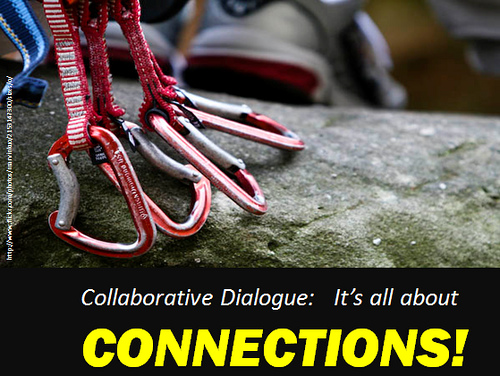
collconnections

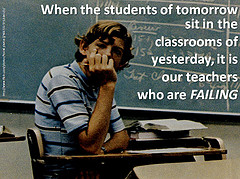
Yes, another post about Flickr. This time, I’ve discovered the Group Great quotes about learning and change. The image/quote above has been added by canesinthecup. If you look at the rest of canesinthecup’s photostream, you’ll find more quotable quotes, such as this one:

teachersfailing

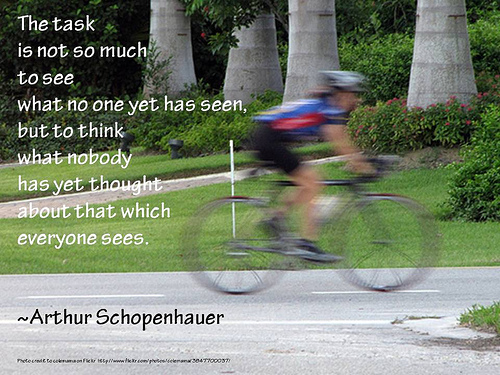
 This Schopenhauer quote is a favourite of mine and was added by colemama:

extraordinary

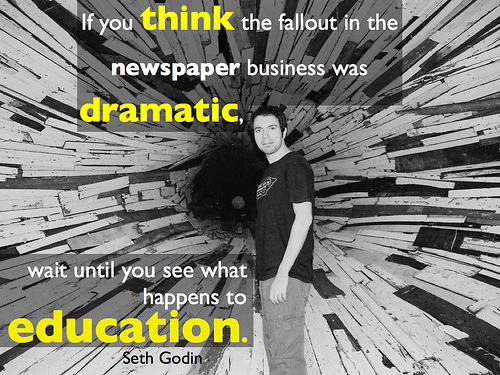
Darren Kuropatwa, an educator I’ve known since my involvement with Powerful Learning Practice Program, and who is a mentor to me, used a powerful Seth Godin quote for this slide:

educationgodin

I like his choice of Jared Klett’s image – very apt. Darren took the quote from a blog post by Seth Godin which has resonated with him.

It was actually Darren who initiated a collaborative slideshow within the PLP cohort. Darren selected the theme Teaching well for the slideshow. PLP cohort members were invited to sign up on a Google Document for a slide. 

We will collaboratively create a 20 slide presentation (not counting the title slide) called “Teaching Well”. 20 slides in 10 pairs of contrasts: “Teaching well is more like < slide 1 > than it is like < slide 2 >.” or however else you want to create contrast.

Each day one slide is added to the deck that builds on those that came before. The final 4-6 slides must bring the presentation to some sort of close.

The final product demonstrated, in its collaborative opportunity, that we are much more than the sum of our parts. It was fun to browse Flickr  in search of an image which would best illustrate the idea expressed. I still hope to do this with a class.

Darren included a few instructional slideshows. One of them is Brain Rules for Presenters. Another is Dodging Bullets in Presentations. And also Taking Your Slidedeck to the Next Level. All excellent guides to visual accompaniment to a conceptual presentation.

In a PLP discussion, Darren recommended his friend lynetter‘s  Digital changes everything on Flickr. She has 3 sets. One of them is Interesting Snippets which she explains is

my personal dumping ground for various cool quotes, the odd stat, as slides to talk around when describing how things are changing online and in media & communications generally.

It’s a great collection of visually supported quotations.

lynetter

So much to be discovered on Flickr. It really is more than just a bunch of pictures.