Category Archives: Education

Blogging about blogging; and before you know it, I’m thinking about PLP

What do young people think about blogging? Let’s have a look; here’s what one 18 year old has to say. This one happens to be my son, but I don’t think that prevents him from representing his generation:

‘People no longer are just able to blog, but blogging is increasingly becoming accepted as a legitimate medium of information; albeit quite different to others. At the cost of the credibility associated with major news services and other more traditional ways of getting our information, a whole new world is opened up- of personal opinion, a perspective into the lives and experiences of others and original creativity. When subjective experience and opinion is sought over objective fact, blogging becomes a medium very difficult to beat.’

Here’s the recognition of the value of the input, not of academics or editors, but of people like any other people, all contributing to whatever kind of information is important to them. Here’s a preference for what people have to say about something, for collective advice by people who care about their interests.

Technical applications are seen as enabling more direct ways of communicating, showing, connecting.

‘Photographers can take photos of their home city or holidays and post them on Flickr, along with geotags (so that people may see exactly where the photos were taken); performing artists can upload audio or video recordings of themselves on services such as Youtube to increase their exposure; political commentators can by series of hyperlinks to other blogs and news services critically analyse current affairs and provide explanations, arguments and challenges to what is reported in traditional established media. All of these forms of expression can be directly embedded into blogs, providing an individual with a space in which to express themselves- in the case of writers, musicians, etc…, to publish their work for free (or close to it)!’

All in all, there’s a noticeable excitement about the possibilities and the connectedness; about the possibilities for the individual’s self-expression. But could you imagine a similar passion from a young person if asked to talk about the possibilities in school education? What do you think? Are students encouraged to become involved in socialnetworking for learning? Are they encouraged to use Web2.0 applications to present their ideas and opinions? What do you think?

With this in mind, I’m thinking ahead to my school’s involvement with the Powerful Learning Practice program, and looking forward to making a difference to the mindset and teaching habits of teachers (including my own). Jenny Luca posts about PLP from the Learning 2.008 Edubloggercon conference in Shanghai:

‘Why do I feel alright about where we are? Because we are at least being proactive and have ourselves involved in Powerful Learning Practice . We are going to be immersing our staff in a learning community, and community is going to be what drives change. It’s not a discussion about the latest Macbook Pro that is important. It is a discussion about the connective relationships our students can form and learn from that is going to be the tipping point for many of our schools.’

‘Connective relationships’ – this is what it’s about. Information becomes meaningful through our relationships with people. Learning becomes meaningful through connective relationships.

If you’d like to read more of the authentic, passionate literacy that springs from real interest and involvement, read the rest of this new blog.

Sharing pictures – We are the library

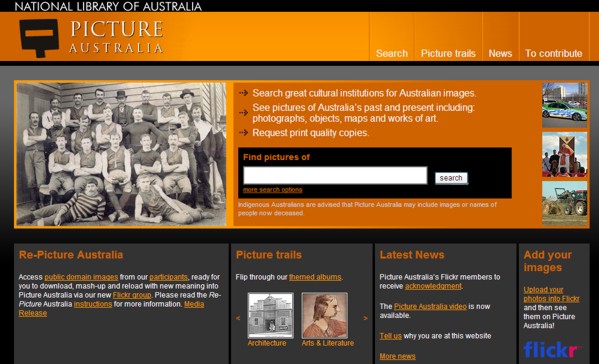
I love the sharing that’s going on now with information, pictures, videos, wikis, etc. Picture Australia, wants to recognise the outstanding contributions of its Flickr members, so they are introducing an award, which will be given once a month to an outstanding contributor. You can read about it here, and you can view the first winner’s pictures – 228 of them!

If you want to play your part in telling the story of Australia, read this.
This is a wonderful example of the new way of sharing information and of becoming part of the information itself. I imagine that young people would be interested in contributing to The National Library of Australia’s archive of pictures, and in creating a current pictorial record which will eventually be history.

In participating in this project, students will be encouraged to licence their images with creative commons. What better way to learn about copyright and the choices for owners and users of created works. Students will also need to learn how to supply detailed titles, descriptions and tags for their photos.

This is another example of authentic educational opportunities. There are many of these if we look out for them.

Poetry and sport? What a challenge

Today during our library meeting, I received a less than positive reaction to a suggestion that poetry be the subject of a display or activity in a boys’ secondary school. Eyebrows were raised sceptically and scornfully, and ‘you must be kidding’ was all over everyone’s faces. Boys would never be coerced into read poetry; they preferred sport, war or anything that made you want to beat your chest and shout ‘Oi’. OK, I may be using some of my own poetic license in describing people’s reaction, but that’s just to set the scene.

By some poetic miracle, or perhaps the gods of Poesie were smiling down upon me, but later today I read about the Red Room Company’s mission to create, promote and publish Australian poetry in unusual ways.

‘Eight pigeons will race along the New South Wales south coast on Sunday – in a time trial the organisers liken to the Tour de France – with a piece of original, Australian poetry strapped to the ankle of each bird’. The day’s events began with live poetry readings at Stanwell Park, after which the pigeons flew to the breeders’ HQ in Mt Ousley, transmitting pigeon-cam video back to the launch site.

And just when you thought gambling and poetry didn’t go together, they do! You could put a (free) wager on whichever pigeon and poem you thought would win, and the winners would get a single poem as their prize, and also go into the draw for the grand prize: a “Pigeon Poetry Sculpture and poetry books from all states and territories”.

The website proclaims the success of the strange union of sport and poetry, as it occurred on 3 August this year. You can view a picture of each pidgeon, and read each pidgeon’s poem. Don’t forget to read about the pidgeon and the poet, especially since the write-up is so creatively metaphorical, that you’re not sure if the poet is a bird or if the bird is a poet. For example, reading about the pidgeon ‘Real Radio’, you not only get its weight and wingspan, but you also find out about its reading habits, and the languages it speaks (Hebrew and Wave, in this case).

When everything is presented in such a wondrously confusing way, young people won’t even realise what they’re doing, and before they know it, they’ll have read some great poetry without meaning to. I think this approach is fantastic: distract with strange coupling of poetry and sport (you could come up with your own version), blur the lines between the two, then confuse everyone, throw the poetry in while they’re blinking in confusion, and there you have it! This has given me food for thought…

Learning through discovery at the Melbourne Museum

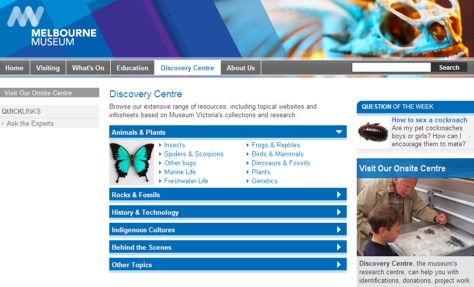
The Discovery Centre within Museum Victoria makes research interesting and hands-on. A young person can wander in and spend a few hours without realising that it’s been a learning experience. Let’s say you came in and browsed some of the 2,000 plus natural or cultural objects available – not just on display in cabinets and drawers, but also available to touch and examine – then you’d be able to delve into a little research in a number of ways; you could:

have a close look at these objects under magnifiers or video microscopes;
use the reference library of books, journals, education kits, DVDs or videos;
browse through the extensive collection of online resources on public computers;
and you could always ask a staff member for help.

When I visited the Discovery Centre as a student of teacher librarianship, the staff were eager to help, but not eager to supply a quick and easy answer – they encouraged students to find information and answers for themselves, pointing out resources available and suggesting ways of searching. The research process becomes a challenging discovery task, well supported by the excellent variety of materials and resources. It’s great to find research modelled in such an enjoyable way.

The Discovery Centre’s website is user-friendly, and offers an ‘Ask the experts’ section. If you have something you want identified, or you need help with a research project, you can email the museum’s information experts, either with a general request, or an identification request. Every week, there is a ‘question of the week’ published on the website.

I think this is a valuable resource for primary and middle years students. It’s great to take research out of the classroom, and into such a dynamic and resource-rich environment.

Collaborative project – Harvest of Endurance scroll

Human potential and creativity never cease to amaze me. Today I came across an online version of a work of art in the form of a 50-metre-long scroll representing two centuries of Chinese people in Australia. Harvest of Endurance is a painting in the traditional gong bi style depicting the story of hardship and resourcefulness of the Chinese in the history of Australia. Taking a little over 12 months to complete, the scroll is made up of 18 elaborately painted panels. It was purchased by the National Museum of Australia in 1992.

Appreciating the actual scroll is one thing, but just as impressive in its own way is the accompanying interactive website produced by the National Museum of Australia. You can explore the scroll from right to left along a timeline from 1788 to 1988 by clicking on stages which are described as eg. Australian gold rush; the rise of merchants, etc. In selecting a period, a scene forms in front of your eyes, first as an outline, then graudally as a complete coloured picture. Clicking on red arrows outlines an object or person, and provides you with a brief explanation or definition. There is a detailed audio-visual explanation of how to read the scroll, including how colour and form create the story, and an explanation of how the scroll was created from the point of view of the artist and the researcher.

The presentation of historical facts in artistic form, coupled with an interactive, multi-layered online representation, is a clever way to facilitate learning through exploration. Wouldn’t it be fantastic to create a similar project for students where each would have a choice whether to contribute as either a researcher, artist, technical expert or other. In particular, I like the way you can select parts of the picture for explanation or background, and I think that would be a great way for students to present their newly found facts.

The collaboration between the people of Australia and China in the form of the Australia-China Friendship Society aimed to promote friendship and understanding between the two countries and their cultures. It would be interesting to connect Australian students with students from another country, perhaps through blogs, in order to create a final product requiring collaboration and fostering friendship and mutual understanding. That would be an authentic and meaningful project.

crowdsourcing

[youtube=http://www.youtube.com/watch?v=TCM7w11Ultk&color1=0xb1b1b1&color2=0xcfcfcf&hl=en&fs=1]

Found this video on Education Innovation and it prompted reflection. How quickly things have changed in the world of technology in the last few years. Well, ‘last few’ to a person of my generation could mean anything from 5-20. The theme of the video is crowdsourcing. The basic message – we used to have to be physically together to create a crowd, but suddenly, with the internet, we’re able to create a virtual crowd. That is, virtual communities can just form themselves on the basis of shared interests. Fascinating, also, to acknowledge how technology has changed possibilties with photography. Three things have changed what photography can do forever: the development of affordable digital cameras; photo-editing software; and the internet. People are sharing photos, and more and more applications are popping up for creative use of images. Stock photos which used to be expensive are now abundant and therefore cheap because of amateurs’ communities. Think Flickr, think Picasa. Think about photo sharing on Facebook and MySpace. Think about the combination of photos and Google Earth.

Interesting, too, is the blurring of lines between amateur and professional, company and customers. Crowds, or groups, can change a business dramatically, or so the video says. And the most interesting thing, in my opinion, is that online communities organise themselves – what used to take corporate managers to achieve. Could the same be said for schools? How could we free up the system to allow for self-organising groups to form on the basis of shared interest and passion?

ePals – connecting globally

I was talking to one of our Indonesian teachers, and he asked about the possibility of connecting his class to one in Indonesia. At a recent SLAV PD, Camilla Elliott suggested ePals. It’s a secure place for teachers to connect their students to classrooms around the world, taking advantage of a cultural exchange far beyond the limits of the textbook. You can connect with classrooms either through the forum on the project index page or the search box on ePals’ home page. Through ‘classroom match’ I typed in ‘Indonesia’ and the age range of the students. There were many results such as this one:

I’m an English teacher at one of the middle school in Padang West Sumatra Indonesia. Our first language is Indonesia and Minangkabau but we learn English as our foreign language. My students are very interested in English and want to…

ePals is supported by project ideas and forums, eg. The way we are:

What makes me who I am? In this project, students will engage in a collaborative learning experience. Through email exchanges, students learn about the daily lives, cultures, climates and geography of children who live in other regions of the world.

The project structure includes essential questions, objectives and culminating activity. The 4-part project elements include pre-activity prior knowledge and context-building questions, an exchange of 4 emails with ePals, a presentation of information about ePals’ countries, and a reflection/assessment activity. Each of these steps is well supported for teachers with detailed suggestions, estimated time taken and links to resources. In the culminating activity, students create digital presentations about themselves and their ePals which reflect their newly found cultural knowledge.

There’s a project index
including topics such as The way we were; global warming; habitats; maps; natural disasters; water. Links to information are supported by National Geographic. The home page also includes featured teacher, video and forum, and top 10 ePals activities. There’s a running list of new classrooms that have joined, showing their flag for easy identification.

It’s a great way to use blogging for authentic communication and global connection, be involved in collaborative projects, use technology and build literacies. And it’s safe and protected by blocking spam, pornography and offensive language, and managed by teachers and administrators.

What children get out of a Montessori education

[youtube=http://www.youtube.com/watch?v=hW7JgQHHVJc&hl=en&fs=1]

While I was thinking about what I wanted to say in this post, I took a peak at what Jenny Luca had been writing recently, and ended up commenting about why I had chosen a Montessori education for my boys in their preschool years.

‘As far as what parents want for their children – I’ve just revisited the Montessori education online; watched a couple of videos. Both my sons had a preschool Montessori education before going mainstream in primary school. I love so much about Montessori, but the reason I chose it in the first place was because I looked at how young children naturally loved to learn and initiated their own learning, then I looked at the middle years students I was teaching – often disengaged with traditional classroom teaching – and I thought: something is not right. I desperately wanted my children NOT to lose touch with that fire within them that lit up so many areas of learning.

Yes, I care about whether they get the marks to enable them to go on with their tertiary learning, but more than this, I want them to be empowered, independent thinkers and lifelong learners, part of the local and global community, taking responsibility, solving problems, making decisions, caring about people and the environment, connecting with others.

If these ideals are at the base of our desire to integrate new technologies into teaching and learning, then we can honestly say that we use them as tools to enable new ways of lifting off the page of a textbook and into a global world of limitless possibilties and connection.’

Apart from an excellent core education with an integrated curriculum based on choice, Montessori educators prepare students for the world, firstly by giving them a context in the world (literally by showing 3 year olds where they are located on the world map) and giving them a firm sense of belonging on this earth. Then by instilling in them the belief that life has meaning and value, and that they need to value themselves, others and life itself; that their decisions are important, and that they will learn and develop from their mistakes. In this way education is empowering; it teaches children to live in a community, to build communities, to be part of a team. Montessori students develop into flexible, self disciplined, independent learners.

The next video, Joyful scholars – Montessori for the elementary years, asks the question of parents that I think begs deep thought –
‘What kind of child do you want at 18 years?’
Hopefully, the answer to that question would include something more than a student with a good ENTER score.

[youtube=http://www.youtube.com/watch?v=GGFYVRSWokg&hl=en&fs=1]

Have a look at a summary of the Montessori educational principles.
There are many points that are worth a closer look. For example,
The premises of a Montessori approach to teaching and learning include the following:
That children are capable of self-directed learning.
That it is critically important for the teacher to be an “observer” of the child instead of a lecturer.

Montessori or other type of education – let’s think personal, communal, global. Let’s think about preparing students for living in the 21st century.

21st century learning

‘Our students are changing … but schools are not.’
This is a leitmotif of a professional development program, Powerful Learning Practice (PLP) run by Sheryl Nussbaum-Beach and Will Richardson, which will run in Australia soon, and in which our school has the privilege of participating.

As stated on the PLP website, ‘Powerful Learning Practice offers a unique opportunity for educators to participate in a long-term, job-embedded professional development program that immerses them in 21st Century learning environments. The PLP model is currently enabling hundreds of educators around the country to experience the transformative potential of social Web tools to build global learning communities and re-envision their own personal learning practice’.

As a result of our participation in the Web2.0 program through School Library Association of Victoria, we were invited by Jenny Luca, who is organising the Australian contingent of the 100 educator-strong global cohort , to join the 7 or 8 Australian teams of 5 educators per school. We almost jumped for joy, but remembered our respectable standing and did some mental leaps instead. After all, how long had we been passionate about transformative learning environments, recognising the potential of emerging web technologies in engaging students and creating global learning communities? And how difficult it is to create a voice that is heard above the clatter of the old school machine? How helpless and ineffective we often feel, like door-to-door evangelists in our own schools, with the door being slammed in our faces, people telling us they have their own god, or that they have no time to listen. At best, we’ve ‘converted’ small, isolate pockets of educators but not had any significant effect on the school community.

Now we have the opportunity to take part in a program based on a highly successful pilot carried out in Alabama and supported by internationally recognised practitioners of 21st century learning technologies. Not only has this given us the opportunity to formulate our thoughts in a proposal to the principal class, but it has also created interest from staff, led to conversations where we have had to explain and justify the cause, and opened up planning for a collaborative team. Suddenly we had something that was worth doing across the school, that was supported both from the top and the bottom. We weren’t isolated any more!

Two of us were able to attend the initial talk by Sheryl Nussbaum-Beach at Toorak College this afternoon. I was excited to meet Jenny and Sheryl, and they were as passionate and inspiring as I had expected. Sheryl was amazing – stepping off the plane and straight into the talk, her body clock still at 3am, and engaging the audience with her passion and ideas. I asked her how she managed to deliver an hour-long talk after travelling halfway across the world, and she said that her tiredness was evident in her slower than usual speech, which, for us in Australia, was a comfortable speed to follow.

I thought I’d mention some of the things that stood out for me as I listened to Sheryl’s presentation. Firstly, she emphasised that 21st century learning, although based on technologies, was primarily a human network. These technologies enable global connections and wisdom of the crowd. Sheryl gave the example of Twitter as a means of finding the best information about buying a new car. I suppose it’s an extension of the network of friends and colleagues people turn to when looking for a good car, or finding a good plumber, only the global aspect facilitates expert knowledge more effectively. In a fast-changing world, where the information today will be outdated tomorrow, rather than teach memorisation of content from a single text, we need to teach students how to work collaboratively. As Sheryl said, ‘don’t think computers, think innovation’. Our students need to be able to be productive, self-directed and effective communicators, understanding digital communications, and not be overwhelmed by the fast pace of change in their lives. It’s not about the tools, the technology, but about learning.

Sheryl challenged us about the relevance of school education, and spoke about the low percentage of students who thought that what they had learned at school would be relevant to their future lives. She spoke about the learning that takes place outside of school within the networking communities of young people. We saw Darren Draper’s film that asked educators if they had been paying attention to students in their classes, if they had been watching them or listening to them, and challenged educators to use the technologies that these students loved in order to teach and engage them.

What inspired me, towards the end of the talk, was Sheryl’s prediction that members of the PLP cohort would eventually have the courage to be bold and challenge the status quo. How true, that, in order to inspire change, we have to model it. As Sheryl said, ‘you can’t give away what you do not own’. I’m ready to share what I’ve learned. I’m not learning to keep. It isn’t much, and so I’m also ready to keep learning. We need to keep up with the pace of change. We hope to help diminish the digital divide – between those who know how to collaborate digitally, as the world shrinks through global connections, and those who don’t. Our job is to prepare students to be responsible, global citizens. We need a change in pedagogy, playing to students’ strengths instead of their weaknesses (ie. what they don’t know, what they’re not good at). We need to cater for different learning styles. We must become 21st century educators. These are the main ideas from Sheryl’s deep-reaching talk today.

What I’d like to say to teachers is what I read on Darren Draper’s excellent blog, when he talked about Kevin Honeycutt and one of his ‘favorite quotes regarding teachers and our relationship to our students: “We’ve got to be willing to play where they play… even if we don’t feel comfortable.” ‘

I’m looking forward to an enriching, collaborative, global PLP experience.

Is school bad for kids?

Further to my recent post about open assessment tasks and true learning, you may want to have a look at Clay Burell’s posts on his blog Beyond School. I suppose I’m late to discover Clay but I figure others will be able to share my new discovery. Here’s what he says in his post entitled ‘Beyond school’ : on the death of genius for the sake of college’ (he’s talking about young people’s time being taken over by ‘education’:
‘I mean the ones who are so over-scheduled with schoolwork, homework, SAT test-prep cram schools, and all the other madness that keeps them focused on memorizing the data and pounding out the grunt-work, one assignment and one GPA-increment at a time, year in and year out – from what, grade 9? Or is that too late to begin worrying these days? – that they rarely have time to pull back and reflect on anything at all’.

I can’t help thinking back to my primary school years; for some reason memories of those days keep coming back as a kind of lost paradise, and what stands out is the time spent in idleness. And during that idleness, whether it be walking home from school in the slowest way possible, or sitting in a tree, creating a cubby house – a long-lost sense of freedom full of possibilities, ideas and dreams is evoked. So much time to reflect, time that is taken up now as an adult with adult responsibilities, and sadly, for many young children, this is also the case. By the time they’re in secondary school, the freedom is gone, the dreams taken over by instruction, the self-initiated learning through curiosity replaced by delivery of prescribed content during the school day, and fulfilment of prescribed homework tasks at home.

We would do well to remember that our students were awake to the wonders of the world as very young children – not knowledgeable wondering, but eager to experience, keen to ask questions. But do we, as teachers, ask young people what they’re interested in, or do we make their learning relevant to their world? Do we give them time to reflect? Is reflection valued?

Clay Burell, some time ago (not sure when), set up Students 2.0 to give young people a voice. In the ‘About’ section of the blog, he talks about the past paradigm of schools being effective for the times, but not so any more:

‘For decades, students have been stuck in classrooms, behind desks, being told how and what to learn… However, we have now entered a new age: an age where thinking is more important than knowing, where thoughts out-do the facts. Borders are melting away; project teams collaborate across the globe and intelligence is being continually redefined. The world’s information is at our fingertips and anybody can publish their thoughts for virtually no cost… Everywhere, we see changes: with how business operates, how people interact and how success is accomplished. There is unfortunately one place that remains unchanged, the place that could benefit most from the changes we see today… the classroom.’ He then explains the purpose of the blog: ‘This blog is an attempt to give students a voice in where the future of education is headed.’

I looked up some of the individual blogs of the students involved; it’s great to read what they have to say, their ideas, etc. Here are some of them:
Two penguins and a typewriter
Love and logic
The bass player’s blog
Betaphor

Newly ancient
(archived)

Another thing I’d like to get off my chest:
if we as educators are working towards integrating Web 2.0 tools in order to engage students and create authentic learning, then we drop all that at year 11 because we have to focus on preparing students to regurgitate prescribed curriculum content so that they can get the highest scores and get into university, etc. then it’s crazy. Surely we need a bigger change. Surely this is a mindset change. Otherwise, we’re doing a little Web 2.0 here and there, then we say, hang on, we just have to go back for a bit; this is really important. Just doesn’t make sense.
Does anybody see a bigger change to the whole system in the near future? Is this really going to happen unless we change our assessment criteria?