Writing – audience optional

For a very, very long time we have accepted the fact that teaching writing to students takes place without an authentic audience. Students’ writing is the property of one subject teacher, and if the students are lucky, they’re permitted to read their piece to the class. Generally it’s considered that learning takes place once the student has received a mark and feedback from the teacher.

There is a much better way, and students are often finding this independently, outside school. This is why, as moderator of my school’s Competition Writing Group, I’ve created a blog and a Facebook Group so that students can share their writing, receive feedback and feel like part of a like-minded, community. It’s taken a while for the conversation to develop as students gradually embrace ownership of the group, and that’s when I can pull back to allow peer learning to take over.

I’d like to post something written by a student who has experienced the benefits of a global writers’ community. Best to hear it from the source.

As a young writer looking to develop my skills, I started writing many short stories, and novellas and the like. After having written a large amount of stuff over the course of a year, I was faced with another problem. I was in need of feedback, but wary of going outside of my immediate circle of friends to find it.

One option was suggested to me, and that was to submit some things to competitions for students. I thought about doing this for a long time, before I realised I had a problem with that as well. Friends of mine had submitted things only to get a reply email saying they hadn’t made the shortlist, and that that was the end of that.

This was something I didn’t want. I wanted somebody who was good at writing themselves to look at my work and maybe leave me some constructive feedback, and the seemingly faceless judges of these competitions didn’t seem to be too willing to do that.

So it was by pure chance that I discovered another medium to gather feedback for my various writings, one that I still participate in today, and one that has led me on a literary journey of amazing experiences and wonderful creations. I discovered two websites, fanfiction.net and fictionpress.com, from a friend of mine.

Fictionpress.com was more relevant to me to begin with, because it is a site where authors can effectively post any kind of original material, and the wide variety of reviewers and other authors on the site can respond. I found the society there to be highly constructive, and highly informative. These days, some three years later since I began that journey, many things have changed. I now give tips more than I take them, but that is a perfect example of how the site has affected me. It breeds a community, where new people get help, become experienced people and cycle goes on and on. With many friendly people, the experience has been brilliant to be engaged in, and while it is also a faceless medium, it is certainly far more constructive than entering competitions.

Fanfiction.net wasn’t something that I got involved with until later, when I became more confident in my writing skills. Ironically, most people step the other way, and begin with fanfiction.net and move to fictionpress.com. One of the reasons for this is that fanfiction.net provides writers who want to improve their writing without spending enormous amounts of time creating a world and creating characters. On fanfiction.net, the worlds and characters have already been created for you, which is sometimes really useful. All the writer has to do is invent a plot and write.

The site is also particularly good because the community is very friendly and very informative. When I first began to work on this site, people critiqued my writing effectively, and in return I critiqued theirs, and since, I have had some amazing opportunities through the community. I have had the opportunity to review works by some truly outstanding writers, and the opportunity to work on things collaboratively with up to as many as five authors from all over the world. The experience is amazing, and the friendliness of all involved has been outstanding.

Overall, I like the online community because of its productive kindness, as opposed to judges for a writing competition who are mostly nameless, faceless and not really helpful at all.

Cheers, Leon 

Thanks, Leon.


Videos + rich class discussion = Vialogues

https://vialogues.com/vialogues/play_embedded/3402/?width=540

A retweet by Jenny Luca informed me of Vialogues

Vialogues supports meaningful discussions around video. Video can be a powerful instrument with which to engage an audience. However, while videos are essential to the equation, the conversations surrounding these videos are what characterize a vialogue. Vialogues gives you the opportunity to participate in a focused environment that allows you to absorb the content of a video while commenting on it.

The heart of Vialogues is embedded into its name; a vialogue is a video plus a dialogue.

This is a neat way to use videos for class discussion online. Currently I’m involved in the rich sharing of writing in Year 9 blogs. Videos can be fantastic for sparking discussion. The advantages of online discussion directly under the video include participation for every student and an overview of the whole conversation. I hope to be able to use this or other Vialogues with the Year 9 students soon.

I had trouble embedding the Vialogue on my Macbook Pro using Chrome. It may just be an issue on my machine and if anyone can help me embed successfully I’d really appreciate it.

Click the ‘explore’ button to browse people’s Vialogues – so many ideas here to use or modify. I’m interested to hear if you’ve used Vialogues in your classes and how successful they were.

https://vialogues.com/vialogues/play_embedded/328/?width=540

London Unfurled iPad app – beautiful example of creative options

[youtube=http://www.youtube.com/watch?v=6YblAELwZ9k&feature=player_embedded]

Here’s a wonderful example of the creative potential of iPad apps. Matteo Pericoli has created a guide to London through pen and ink sketches.

In 2009 Matteo Pericoli (author of the bestselling iconic book Manhattan Unfurled) made an intensive twenty-mile journey along the River Thames, from Hammersmith Bridge to the Millennium Dome and back again. Over two years later, he finished the most astonishing document of his journey, London Unfurled: two thirty-seven-foot-long freehand pen-and-ink drawings. (Read more here.)

I love the option to select a section of the illustration and send it as a postcard. Of course the interactivity is always a winner; students will be more engaged navigating their iPad app, zooming in to what interests them, tapping on something to find more information. Much more engaging than just listening or reading a print book.

Who said the iPad is just for consumption? I can imagine students creating their own apps, can’t you? This is the kind of project which highlights possibilities for individual interpretation which I’m excited about. It’s the direction I’m interested in pursuing with students and teachers once we introduce iPads to the school (very soon I hope!) I’m interested in how students and teachers can use apps in a transformative way, not just using technology to do things in the same way we did them before.

(Read another review here.)

What’s our future – school libraries and librarians

It disturbs me that we are not seriously thinking about the future of school libraries. This statement will receive incensed objections; teacher librarians are, after all, talking about changes in what we do and how we do it at conferences and in their own libraries. We talk about some of these changes in my own school library – delivering ebooks, providing transferable skills such as critical literacies to our students, delivering online resources. Well shoot me down if I upset you but I still think we’re not getting it. We can’t make changes to our libraries and continue to hold onto the way we’ve always done it. I seriously think we’ll be out of a job soon unless we move along with public libraries and transform what we’re doing. We need to look at future predictions for education and the world of work, let go of what we’re comfortable with and make serious and fast-moving plans for change.

I don’t know about you but I can’t stop thinking about this topic. I don’t plan to retire for a long time (God willing) and don’t like to see myself made redundant. I’m also enamoured with my job and its possibilities, its enormous range of roles, its creative and connective nature, its freedom from the daily grind of curriculum and assessment of exhausted and time-poor teachers, its focus on school community, the empowerment of essential skills teaching, its embracing of transformative technologies. I could go on.

Just this morning I asked Jenny Luca on Twitter what she would be speaking about at the SLAQ2012 conference. She said she hoped ‘to talk about the future of the profession – what we need to do to ensure there is one’. I look forward to following her talk online because I know Jenny understands the imperative nature of this topic and will be worth listening to.

Also this morning I found on Twitter (via Judy O’Connell) a link to this article from Northwest England: ‘Special report: The future of public libraries; what the senior managers think’. I can see in many ways that school libraries (at least the ones in Melbourne, Australia) are lagging behind public libraries in their unwillingness to move with the times. New, shiny, colourful spaces – lovely, but that’s not fixing the problem. I found myself thinking that many of the points made in this article applied equally to school libraries. (You can read notes summarising the meeting here or listen the 60 minute  recording.

I’ve pulled out what I think is relevant to school libraries (open to discussion about these) –

What are the core services of libraries now and in ten year’s time?
  • To provide unbiased access to info.
  • To promote community and civic engagement (For us we definitely need to take a more pro-active role in connecting to the school community and also the wider community. Yes, we’ve been doing that through parent book clubs, providing our libraries for school related meetings and events  but I think we could break out even more and organise events which are not traditionally associated with libraries and books)
  • Digital access (We should provide more online, taking notice of an attractive and user-friendly web design – how outdated are some of our web pages! Let’s not ignore – or block- the students’ mobile devices which already enable them to connect to and create so much)
  • No longer transactional [that is, not based on stamping out books] but moving to transformational [presumably, this means, improving people’s life chances]. (Oh yes! Some school libraries have got this but at my school we are still spending most of our time stamping books and putting print credit on our boys’ printing accounts! How can we move into a transformational role? Something we should be discussing. I’m going to tread onto dangerous ground and even suggest that we avoid freeing ourselves up from the desk because provides us with the busy work our school community is used to observing. If we freed ourselves up we’d be challenged to organise engagement with teachers and students).
  • Force for social change (We can be leaders in modeling and integrating social media into learning and teaching. What other kinds of social change can we impact?)
  • Libraries can be a space for businesses and entrepreneurs,  providing meeting space, patent clinicsinventor clinics.  (Our school libraries should provide spaces for teachers to get away, relax, take part in discussions, collaborative planning – whatever. How many TLs are finding it difficult to catch a teacher on the run for a meaningful conversation? Money is always an issue. Some schools have been able to afford refurbishment, creating beautiful new and welcoming spaces. That hasn’t happened in our library yet but I think we should seriously think creatively and rearrange our spaces. So much space is taken up by our vast and archival non-fiction and reference collection. Beautiful but not the most contemporary face for our library. We also have small rooms housing journals and text books going back so far! What we can’t afford we can make up for using collective creative thought.)
  • In the larger cities, libraries can in the future supply 3D printing and fab-labs (Wow, I’d never heard of fab-labs before) (More about 3D printing here.)
  • Community spaces for all sorts of different things (Bring our school community in! Who has done this and how?)
  • Libraries will increasingly work with communities, where “anything can happen”.  Libraries will be very different “two miles down the road”. Volunteers can deliver more so “every neighbourhood is different” and every library will be different.  We need to employ people who positively react to community and allow libraries to be places which  “people can recognise as their own space”. (I wonder if our school community views our library as their space or our space? Certainly our students treat our library as they would their lounge room – noisy but vibrant. How can we do the same for teachers? I know that Kevin Whitney (Head of Library at Kew High School) does this by providing a quick, friendly service, a ‘yes, we can do that for you’ manner and a cup of coffee and CD playlist.

I like the idea of libraries being places where ‘anything can happen’. Yes, we should run ‘library-type’ events, as we always have, but what about breaking out of our mold and planning something unrelated to libraries and books. How better to dislodge the community’s narrow view of us and our role? I think public libraries are doing this better than us.)

This point interested me –

Public libraries will need to engage more with e-books and encourage “live” literature such as author visits which are really important. [However, it seemed like all the participants, with the possible exception of Ciara Eastell of Devon, did not really have their heart in this one and saw the delivery of books as, well, tedious and somewhat old-fashioned.  This was summed up by one panel member who said “we’re going to get savvier than offering just books”.

Of course school libraries focus on reading for enjoyment and literacy which is central to education. There’s so much more we can do (and are doing in many cases). Reading is not just decoding the writing and that’s why we offer audio and ebooks. But it’s also about many others things such as the thinking, discussion and debates that come out of it. Why not provide regular activities which focus on these things? Some of these things are happening in our libraries and others outside the library. Let’s become event organisers and creators for these things so that we’re not just limiting ourselves to author talks (fantastic as these are). We could do these things in different ways. I haven’t yet skyped an author but I plan to. I have brought authors into our yr 9 English student blogs, and students are thrilled that authors are commenting on their posts and sharing ideas. I’m hoping to organise a Slam Poetry event at the school – outside the library and hope to include teachers from different curricular areas to sit on the judging panel. What are you doing? What would you do if you had more courage?

Are there any limit to what libraries can do?
  • Libraries are provided by local authorities so need to have a responsibility to make life better for people.  However within this,  “the sky’s the limit” as long as framed by core needs.  “The ambition is to create surprises.”

I really like the idea of surprises. I have a plan for a surprise which I can’t share in case it’s not going to be realised. If I had my way, our library would overcome its financial limitations by decorating ‘grunge’ or be a kind of Wunderkammer. What I’ve seen in beautifully refurbished and designed school libraries is fantastic but it’s more a reflection of what librarians want and how they perceive their space than what students want. I say we listen to our students and include popular culture in our designing of spaces.

And this brings me to my final, and most dangerous, paragraph. This is where I lose friends (I hope not!) I’ve observed a defensiveness in our profession. One which occasionally divides teacher librarians and technicians into class distinctions; which sometimes sees us frustrated when we understand more about important literacies than teachers do but are unable to get a foot into classrooms to make any difference; which sees us taking up our precious class time cramming what our professional journals have told us we should be doing – unaware that nobody sees the value in this, unaware that the teacher really only wanted a quick 15 minute talk. Sometimes we don’t listen enough to the teachers, don’t have enough patience to build trust in the relationship before we go for it. Sometimes we don’t ask students if they already know something, or ask them what they really need help with, because we are determined to ‘do’ our planned information literacy lesson. If this isn’t you, then I apologize but I know I’ve been in all these situations at some stage and I’m never going to be there again. Our separation from the rest of the teachers and from ‘owning’ classes of students is difficult, and we have to work hard to build these relationships, because we know that relationships need to be forged before we can successfully teach our skills. I believe these relationships have to be sincere, real, not just as a way of promoting ourselves, and teachers can see through the marketing approach.

The Institute For The Future (USA) has published its Future Work Skills 2020 report. If you look at the summary below, you get an idea about what we should be thinking about in terms of our own future for school libraries.

You’ll have to view the original version to be able to read this. There’s so much here we could be helping the school community to realise: novel and adaptive thinking, new media literacies, transdisciplinarity, cross cultural competencies – we have the potential to play a role in all of these. We should take note of the ‘rise of smart machines’ prediction and free ourselves from the repetitive work which stops us from getting out and doing more essential things. We can do so much for social media competencies across the school so that the whole school focus is on a globally connected world. Just take a look at the Optus Future of Work Report 2012-2016 and its appeal for flexible workspaces. Futurist speaker, Tom Frey, lists teachers as one of the jobs which he predicts will disappear by 2030. But coaches and course designers will stay, according to the report.

Believe these reports or not, we should be looking at the future; things can’t stay the way they have been. We have been lulled into thinking that education will not be subject to the changes which take place in business because it actually hasn’t changed for such a long time! But this disconnect will not last too long, and we need the mindset and understanding to move with the changes. We should be part of schools which educate students for their future world; let’s look outside the walls of our libraries and our schools, and start moving.

(I am a secondary school teacher librarian and speak from this perspective. Views expressed are my own and do not represent those of my school).


Writing for an authentic audience, being real. Thanks Isobelle Carmody.

Nick and I are very excited about the way our Year 9 blogs are developing. But before I go any further – Isobelle Carmody has visited us in a guest post!! Isobelle has been very gracious and has taken the time to write down her thoughts for our boys. I would like to share her entire post with you:

I was never much for diaries, and then I read the Diary of Anne Frank, and it was so vivid and real and it felt so true, that I have on and off again over the years, tried to write diaries. I was never very good at them, perhaps because I was the only audience and it seemed to me that I poured the best of myself, the truest words I could write, into my books. You might smirk at this, given I am captive in the fantasy genre corral (save when I can jump the fence and go for a midnight roam in the other paddocks or even out into the wild, where there are no rules or fences). But I don’t see the best fantasy as escapism. I see it as an attempt mostly to try to look at human existence from the outside. To get outside of ourselves, because reality always feels like I am too close to the mirror to see properly. You know when someone shows you something and they hold it too close?  For me right from the age of 14 when I first started to write, I was striving to get some distance, some breathing and thinking space, and fantasy and science fiction allowed this. For me it is a very philosophical genre – it allows me to grapple with the great questions of human existence. Why am I here?  What is the nature of existence?  Am I (are we) FOR anything? Why are humans capable of such wonderful and dreadful extremes of behavior? etc
When Ms Sheko asked if I would like to post on your site, I came to visit to see how I would fit in there. I was immediately taken by the techno-beetle, and then that lovely quote from Thomas Mann had me hooked. It was also timely because having resisted blogging as I resist all new things that force me to pay attention to the world and hence to neglect the worlds I am building in my imagination, I was asked by the State Library blog for a month Inside a Dog. I was intrigued and agreed before I could stop myself. So, ten days and five posts in, I am really fascinated and interested in the process, because it seems to me like a diary and yet it does have an audience and feeling that, it causes me to treat the material I want to talk about differently. Unlike books, it does exactly what Mr Fairlie talks about in your site – it allows me to try out ideas on paper (well, cyberpaper) for an audience that may or may not read me, but they might, and so I have to take their presence seriously. It allows me to find out what I think about things- that in fact is what I think all writing should be about. Writers figuring out the world for themselves.So, good luck to all of you and take full advantage of this site. It really does help you to think better.

Oh, and if any of you would like to visit me, either send me a friend request on Facebook or better still, come visit me this month on Inside the Dog– it is a lot less unsavoury than it sounds. Here is the link to the latest blog and you can read down and back from there. There are lots of other fabulous blogs too, and you gcan get to all of them.http://www.insideadog.com.au/blog/short-story-pt-1

best wishes

Isobelle Carmody

I particularly love this section of Isobelle’s post

I am really fascinated and interested in the process, because it seems to me like a diary and yet it does have an audience and feeling that, it causes me to treat the material I want to talk about differently. Unlike books, it does exactly what Mr Fairlie talks about in your site – it allows me to try out ideas on paper (well, cyberpaper) for an audience that may or may not read me, but they might, and so I have to take their presence seriously.

Having an audience, even a potential one, apart from the teacher and outside the classroom, sets the boys in a completely different space. I know that because I’ve been writing blogs for a few years, and although I’m never sure who will read my writing, I have a sense that somebody out there might, and so I write for that somebody. That’s entirely different to writing a prescribed piece of writing you know your teacher will read – not for pleasure, but in order to give a mark.

Amazingly, Nick has already seen evidence of this awareness in our boys within a very short time –

They are all really experimenting with voices. I love the difference in voice between the first and subsequent posts. They very often go over the top, and mimic what they think is an adult voice. This is so much better than what they usually produce, which is the voice they think is the ‘right’ one (bland and devoid of personality).

I’m overwhelmed by what is happening in these blog spaces within such a short time. The boys have demonstrated some excellent philosophical thinking. In the second task they have reflected on what constitutes learning, whether this happens in or out of school and about their ideal learning context. They have been reading each others’ posts and have started to have meaningful discussions. This is a far cry from the banal commenting which is often associated with teenage social media environments. This is high quality writing, reflection, evaluation and interaction.

Most of all, the boys are feeling their way into their blog spaces. They are starting to feel comfortable in their blogs and are finding their authentic voices. As Nick has observed, the quality of their writing has increased noticeably. Some are using images to complement their writing. It hasn’t taken long at all.

Who says deep learning isn’t possible within social media?

Take a look at the boys’ blogs, their online conversations. Please come in here and leave a comment.

Open minds welcome – Year 9s begin blogging

I’ve noticed that Melbourne High School has two mottos. One is ‘honour the work’ and the other, perhaps more recent, is ‘more than just marks’. The school is a hub of co-curricular activity which attests to that. And yet, not surprisingly for a selective school full of bright and competitive boys, the focus is largely on attaining high marks and, in particular, a high ATAR in VCE. There’s nothing wrong with that if it doesn’t interfere with what matters more – the development of a love of learning, a thirst for understanding and thinking.

When English teacher, Nicholas Fairlie, and I put our heads together in the hope of doing something different with Nick’s two Year 9 classes, we decided to try out Posterous as a blogging platform. Nick found the perfect quote by Thomas Mann to introduce the point of blogging, a quote which so beautifully expresses the reflective aspect of blogging.

Keeping a Diary

“I love this process by which each passing day is captured, not only its impressions, but also, at least by suggestion, its intellectual direction and content as well, less for the purpose of rereading and remembering than for taking stock, reviewing, maintaining awareness, achieving perspective.”

(Thomas Mann, Thomas Mann: Diaries 1918-1939)

Nick had the boys spell-bound as he introduced the project –

And so, boys, this is why we’re blogging. Not for the rightness or wrongness of our ideas, but for the having of the ideas and shaping them fit for the page. These pages will celebrate and affirm thinking: bold thinking, creative thinking, subtle and robust thinking. What goes here is valuable because it is the product of our minds and because of that will be respected by us all.

Without making a big deal of it, Nick spoke to the boys about responsible and respectful behaviour, pointing them to the guidelines:

5. Nice as it is to read encouraging comments, such as “well done” and “good job”, try to give some more feedback than this. Work on building a dialogue.
6. Keep track of what has been said by others before, and then try to provide some new viewpoints. You can also ask thoughtful questions, as there may be new and unfamiliar cultural references in other students’ photos and commentary.

Past experience has taught me that rich commenting is an art which has to be taught. So much learning takes place without much effort though – writing not just for your teacher and a mark, but for a peer audience and a potentially global readership, will open up the scope for authentic discussions and social learning.

And so we have made a start. Two classes of Year 9 boys have created their own blogs and personalised them (as they all naturally want to do), and these blogs have been linked on the front page of Nick’s blog. They have written their first blog post on a topic which has yielded some mature and thoughtful responses (to ‘We are what we know’). It was exciting to read such interesting responses to an open and abstract topic which may have intimidated much older students – a rich start to something that promises to truly be “taking stock, reviewing, maintaining awareness, achieving perspective.”

After sending out a tweet and Facebook status to promote the blogs and encourage commenting, we sat back and waited for readers to bite. My generous network jumped in immediately with responses to encourage and challenge the students in their thinking. My online colleague, Sinnika Laakio-Whybrow, from Finland, was amongst these and will no doubt impress upon the boys that their writing attracts a global audience, and that it’s just as easy to have a discussion with someone on the other side of the planet than with someone interstate.

sinikkalw responded:

I would go along with your reasoning that most of us don’t really know who we are or what exactly we know. But why is that perfectly fine with you? Wouldn’t we all be better off if everybody knew a bit more about themselves and what they know?

1 day agoAndrew Poxleitner responded:

Andrew Poxleitner
I would agree that if people knew more about themselves than they do right now, not only would they benefit, but the contributions to society would also be invaluable.Perchance I was a bit vague on this, in the post, but we also have to question ourselves on how to do so. How do we find about ourselves? I believe, at least, I’m in the dark in regards to who I am, and how to figure out who I am.
Therefore, I’m perfectly fine with the fact that maybe not many people know who they really are, because from the very start of the discovery, it’d be like picking needles out of a haystack.
Being realistic, not everyone can figure out who they are, and that’s a fact. Well, at least to me it is.

1 day agosinikkalw responded:

Technology truly is amazing, here I am on the other side of the world having a “discussion” with you!In hindsight, and with life experience, I can assure you that teenage is the very time when you really start on the lifelong journey of “finding yourself” and becoming your own independent individual. What seems like needles in a haystack to you now, will become clearer and clearer to you as years go by. If there was a reliable method of “finding your true self” that worked for everyone, I’m sure we’d know about it. The beauty of life is the journey, the process, the gradual deepening of our understanding, the willingness and openness to find out. Because not everybody can figure it out, doesn’t mean that you can’t, does it?
I’m grateful to be collaborating with a teacher who has a focus on the deep learning beyond marks, one who is excited about the possibilities of social learning and willing to take the small and larger risks associated with such a project. Our clustrmap already shows over 80 visitors from different parts of the world. Nick has been in touch over the weekend and is cooking up a meaty follow-up for the boys.
This is going to be so good. Here is the link to Yr 9 English MHS blog. Please come in to read the blogs which are linked on the right hand side of the blog. We would love you to leave a comment and add to our rich conversation.

Poetry Graffiti at MHS

The library is a space with unlimited potential. Of course I’m not talking about things that are financially prohibitive. It’s not bound by faculty, it serves an enormous range of purposes; it’s the social and cultural centre of the school – at least potentially.

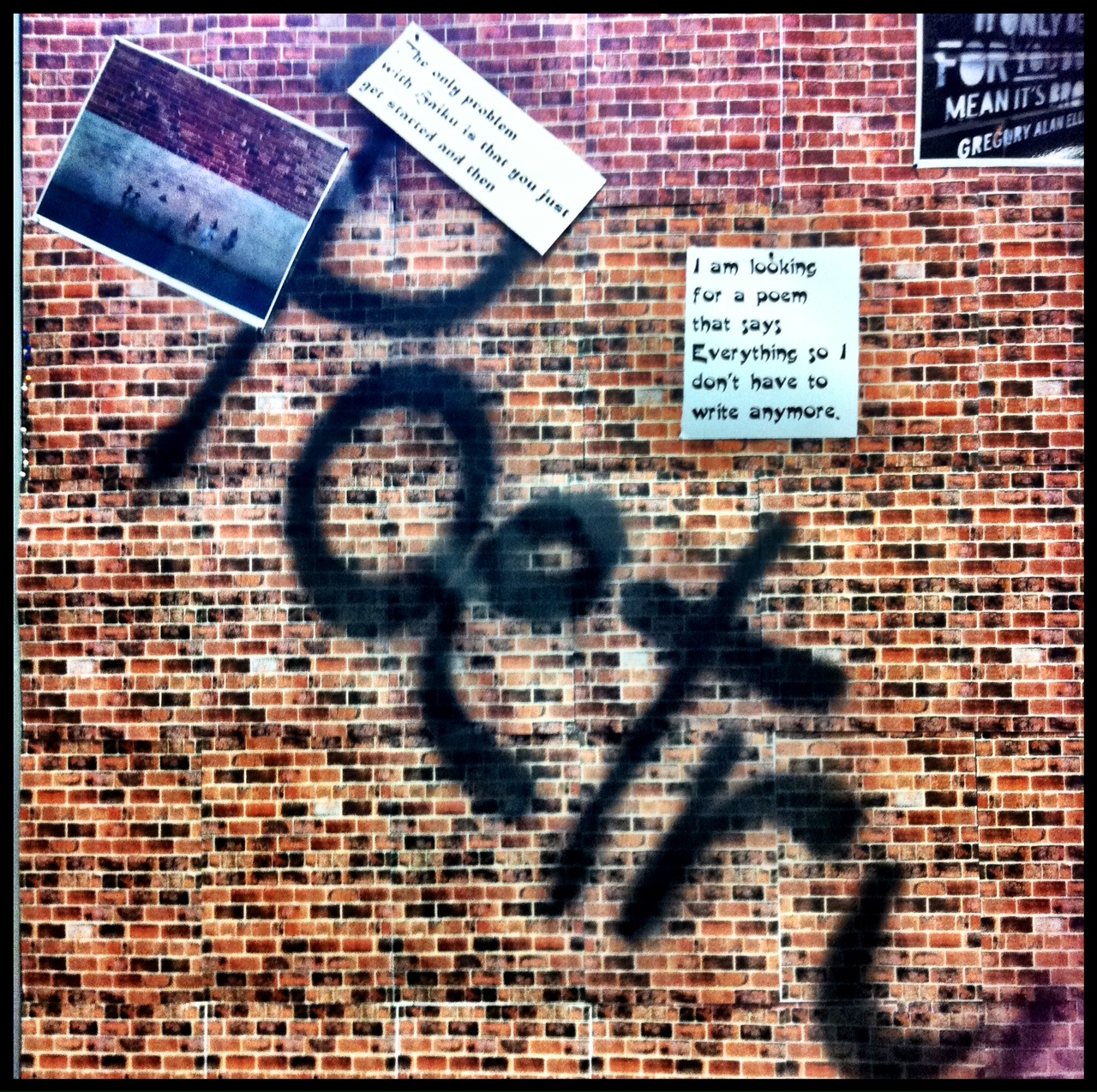
I’ve been thinking about how to dispel the fallacy that the library is just about books, how to include popular culture and encourage students to feel that the spaces in the library belong to them. It’s good to start small. I spoke to my colleague, Denise, about setting up a ‘Poetry Graffiti’ board. The idea is that students pin up poetry they like and have either found written. I thought we’d add some pictures to inspire thinking and whimsy, and we hope the students will understand ‘poetry’ in a broad sense and contribute both text and images.

To share pictures with Denise without the hassle of emailing them back and forth and keeping separate folders, I decided to try Pinterest. I warn you about Pinterest, it does suck you in if you’re a picture person (no, I’m not talking about wedding photos or recipes). My Pinterest boards have grown amazingly fast. I started collecting interesting or quirky images into a poetry board.

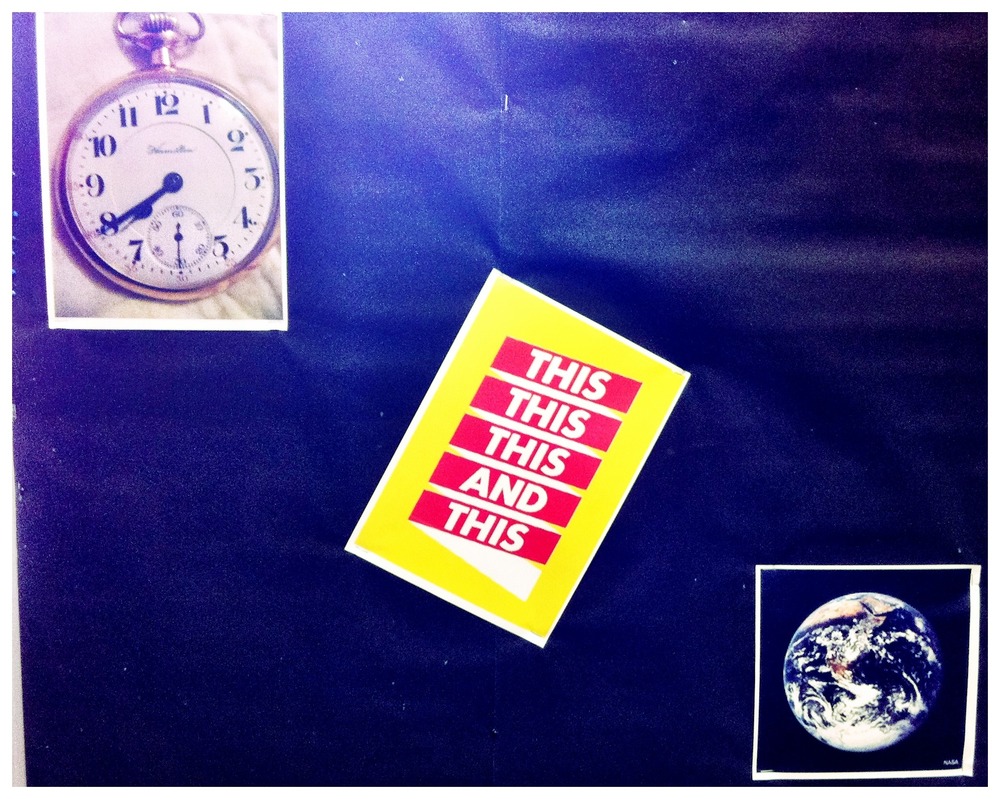
To provoke interest in a cryptic way, we decided to start off by creating a ‘Watch This Space’ board. This is how we did it.

Denise has done a fantastic job on creating the board. In the solitude of a library on Athletics day, she has created a brick wall using A4 prints and pinned up a couple of poems to get the boys started.

I hope this board will take off and that creativity, love of poetry and poetic image will fill the space and give students the chance to contribute their graffiti. We’ll see. I’ll keep you posted.

Libguides, Pinterest and other online stuff

Well, I have to write a post mainly because the vibrating gif is driving me crazy and I feel the need to push it down. What’s happening that I don’t use the blog to reflect any more? Perhaps this is not my reflective phase. Yes, that’s it. I’ve been quite satisfied creating resources and getting to know staff members at my relatively new school. And I have to admit to an obsession – pictures! I can’t stop looking at and saving gorgeous pictures from Flickr and other parts of the web (my groaning Google Reader). Just this week I finally decided to give Pinterest a go. The account has been sitting there for a while – can’t remember exactly how long – and I suppose I’ve been frantically trying to keep up with other things, not least Scoop.it which has taken off in a big way. Also because so many Pinteresters are dominating the place with food and wedding photos. Lovely. But not for me at the moment thanks. Just to give it a go, I created a couple of boards and threw in my YA book trailers as well as some books covers. Yes, not bad, looks great and neatly organised at a glance without having to scroll down too much. Well, woah! Now I have too many boards and possibly Pinterest OCD. Please help me.

Libguides have still got me burning the candle at both ends. Some of my colleagues tell me a don’t have a life. Hmm… (I have a life *she says weakly*) Some of you may understand the obsessive finding/saving/sharing/creating cycle and I blame my PLN for giving me so much of the good stuff. I love my job (have I said that before?) I love finding the good stuff for teachers and students. It’s  like being a conjurer – pulling wonderful and unexpected things from a hat. Reader, if you’re a teacher librarian, please support me here. Don’t you feel the same way?

So, to finish off the post (so that I can keep playing with pictures – it’s a bit like swap cards from my youth), I will share the things I’ve been doing. Some of these you already know but, hang on, I’ve been adding…

Pinterest first:

Book trailers board 

Art Inspiration board (from my Art Does Matter blog)

There are more but I’ve only just started them. The illuminated manuscripts have got me salivating and I will be continuing my obsession until I have a full board.

LibGuides:

Even though it’s called Competition Writing, this resource supports any kind of writing and so is useful to students and teachers of English.

I am responsible for the weekly weblink of interest for the school newsletter, and this week I shared the link to my Digital Citizenship pages (4) into which I added two excellent articles by well-known and respected Australian educators, Chris Betcher (Have you googled yourself lately?) and Jenny Luca (5 reasons why our students are writing blogs and creating e-portfolios). These are under ‘Your digital footprint’ tab which is my favourite section of the resource because it explains the importance of helping students create a positive and responsible digital identity. Don’t go on about the dangers of the internet without balancing this out with a clear and positive direction for digital citizenship. Teachers are still telling me they prefer the things of their time to what kids are using today. Not even kids, what about businesses. Mobile technologies and social media have been taken up by businesses but sadly schools are still pulling back. And I say, that’s all very well but it’s not about you. It’s not about me either, it’s about preparing our students for their future.

I’ve also added things to the Debating LibGuide. This is good for persuasive writing and orals. Take a look.

Of course it’s not secret that I have a particular interest in visual arts. Here’s the link to these guides and don’t forget to look for drop-down arrows.

The French language guides have been growing too.

At the moment we are all taking the wider reading classes for the year 9s. I developed a couple of guides for this. My aim is to help students find different ways of finding what to read by using libraries and social media such as Good Reads – to mention a couple. I threw a whole bunch of book trailers into this page; I hope you find it useful. Please let me know what’s missing.

Well, it’s getting late so I won’t go on. For a change.

What’s a stereogranimator?

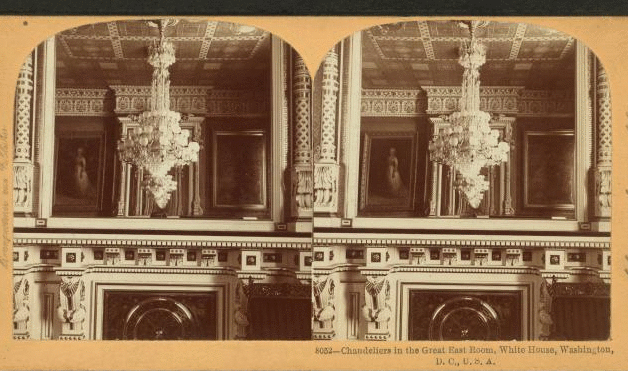
What’s a stereogranimator  you ask? Well, I used it to make this 3D animated gif with photos from the archives of the New York Public Library.

GIF made with the NYPL Labs Stereogranimator - view more at http://stereo.nypl.org/gallery/index
GIF made with the NYPL Labs Stereogranimator

The instructions are sparse so I’m not sure if my picture is supposed to vibrate so violently – but what a concept! I read about this on the iLibrarian website –

The NYPL’s Stereogranimator lets users create and share animated GIFs and 3D anaglyphs using more than 40,000 stereographs. Users can browse through the NYPL’s collection of dual photos and then combine them to make a 3D image. This project was inspired by Joshua Heineman’s project that he started four years ago. The San Francisco-based artist was using the NYPL’s collection of stereographs to create animated gif images for his Cursive Buildingssite. His project went viral and the Library took notice and began collaborating with him to create the Stereogranimator.

Go ahead, make one yourself.

Button up, we’re out in the open

css.php