All posts by Tania Sheko

My name is Tania Sheko, and I am a teacher librarian at Melbourne High School, a selective secondary boys’ school 9-12 in Melbourne, Australia. ‘Teacher librarian’ usually requires a bit of an explanation. I think it’s a ‘School Librarian’ or ‘Library Media Specialist’ in the US and Canada. Often people are not sure what my role is, and it’s not easy to define. I like to think of it as the focus on ‘skills’ and ‘passion’ which exists in the spaces between the teaching of curriculum which is the domain of subject teachers. Some of my areas of focus include all sorts of literacies (information, digital, critical, network, etc.), collaboration with teachers as a kind of third hand (curating resources, differentiating learning, experimenting with blogs), and connecting people to ideas and an understanding of self and others through reading, discussion and debate. Most of our students go on to university, and we are always thinking about how we can best prepare them for the world of university and work. I’m interested in the educational environment, behaviours and directions of tertiary institutions, particularly as they move from traditional to innovative practices with connective courses. Connected learning makes sense to me, and I’m concerned that schools are often still envisioning learning as a passive consumption of content delivered by individual classroom teachers. With so much research-based evidence about student-centred, interest-driven and collaborative learning, and with the findings from the NMC Horizon Project, identifying and describing emerging technologies likely to have an impact on learning, teaching, and creative inquiry in education, I really think it’s time we woke up to ourselves about the anachronistic nature of our educational practices and took action. I learn from my colleagues, but also from my online network, reading their blogs, interacting with them on Twitter, exploring the wealth of their shared expertise online. This is what excites me about learning – connecting with people globally for a shared purpose.

How is Google indebted to Maria Montessori

I take this passage by Maria Montessori from a blog post in Space Collective:

“Scientific observation has established that education is not what the teacher gives; education is a natural process spontaneously carried out by the human individual, and is acquired not by listening to words but by experiences upon the environment. The task of the teacher becomes that of preparing a series of motives of cultural activity, spread over a specially prepared environment, and then refraining from obtrusive interference.

Human teachers can only help the great work that is being done, as servants help the master. Doing so, they will be witnesses to the unfolding of the human soul and to the rising of a New Man who will not be a victim of events, but will have the clarity of vision to direct and shape the future of human society”.

I was drawn to Maria Montessori’s understanding of the natural learning inherent in all of us from my first readings, so much so that my two sons spent their formative years in a Montessori preschool and early primary school.  For unavoidable reasons, they returned to mainstream education, but I come back to Montessori philosophy of education again and again, still trusting in its founder’s views.

The author of the article cited above has made an interesting and I think, significant, discovery:

…it came to my attention that at least three pillars of the current internet were informed by a century-old educational system conceived by Maria Montessori … both Larry Page and Sergei Brin attributed Google’s success story to Maria Montessori. According to them their Montessori education taught them to be self directed and self starters, adding that their schooling taught them to think for themselves, giving them the freedom to pursue their own path, which would lead to the snowballing success of Google, which aims to provide the world with near universal access to all information known to man.

A similar background informed the career of Jeff Bezos who created the groundbreaking online retail organization Amazon.com, and another online celebrity on the list is no less than Jimmy Wales, whose Wikipedia has become the online fount of encyclopedic knowledge. Interactive game designer Will Wright also mentions Maria Montessori as his main inspiration for his seminal hit The Sims, while crediting like-minded Dutch educator Kees Boeke for the Powers of Ten metaphor that helped him create his new game Spore.

Photo courtesy of cogdogblog on Flickr

I think that’s very impressive. How can we help our students to be self-directed and self-starters? Are we helping our students to think for themselves, to direct their own path?
David Pogue – satirical medley

[youtube=http://www.youtube.com/watch?v=xF7cHmyEJ-c]

New York Times tech columnist David Pogue performs a satirical mini-medley about iTunes and the downloading wars. Village People fans, this is for you. Very clever and part of the TEDxMelbourne talks.

David Pogue is the personal-technology columnist for The New York Times. Each week, he contributes a print column, an e-mail column and an online video. In addition, he writes Pogue’s Posts, one of The Times’s most popular blogs.

Read more about him here or go visit his website.

Take a look at the other talks at this event. I’m impressed by these amazing vocal play artists. I hesistate to say singers because they actually sound like musical instruments.

[youtube=http://www.youtube.com/watch?v=JNJlhtNpuiU]

By the way, I was very disappointed to discover that these TED talks were held in Melbourne, FL, not Melbourne, Australia.

Facebook’s wall a consolation in death

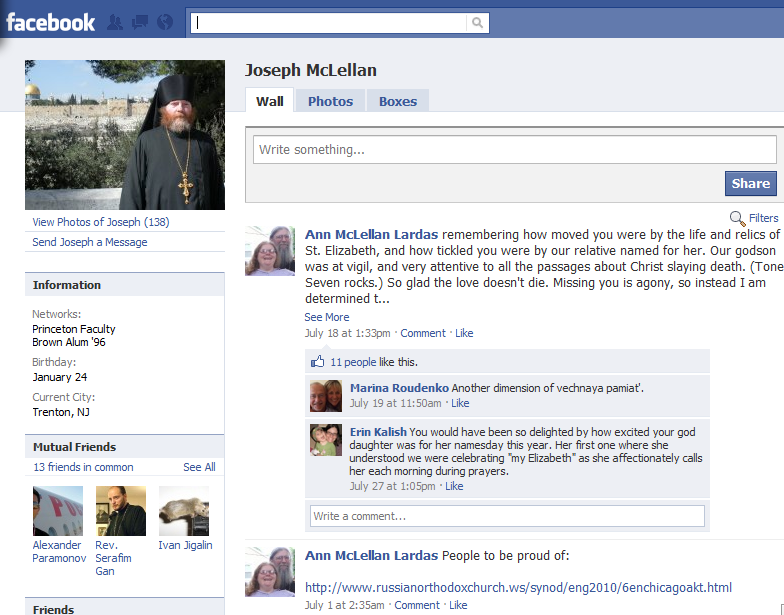
People use social media for different purposes. The wall of Joseph McLellan’s Facebook is a touching tribute to the loving relationship between him and those family and friends who have survived him. Joseph McLellan, Archimandrite Joasaph, left this world too early for those who love him. And yet his Facebook wall is still a living noticeboard posted with regular notes to him.

I knew Fr Joasaph in my first year of marriage when I accompanied my husband to Jordanville, upstate New York, in his third year of seminary. He was a year ahead of my husband, and although I lived there for nine months only, Fr Joasaph clearly made an impression because my memories of him, his academic brilliance, his talents and wonderful sense of humour remain clear.

It was on Facebook that my husband and I were reunited with Fr Joasaph after a lengthy lapse in communication. At a time when I heard many people criticise those who ‘wasted their time’ on Facebook, we were enjoying the ease with which it allowed us easy communication with those who lived far from us.

In the short period of Facebook friendship, we learned that Joseph had decided to leave Princeton University where he had been teaching Russian and enter into monasticism, moving through the ranks of ordination quickly and being elevated to the rank of archimandrite. At the time we didn’t know of his illness and wondered what the rush was.

In December 2009 we joined many others in expressing our grief at his passing, and in expressing our condolences to his family.

And now his Facebook remains open. Family and friends continue to ‘talk to him’, to remember him, to console each other.

I open his Facebook page on and off to see how he continues to live through the comments of those who still love him. I hope it stays open forever.

Don’t forget TED for teaching

Engagement in the middle years of school may well be an oxymoron.

This was recently confirmed for me when starting off a year 9 class of boys in their research for an effective speaking competition. We gave them a brief: talk about an event which has had a significant impact on society or has stood out in history.

Hmmm….  reading long chunks of text wasn’t something they were going to do willingly, especially during the last period of the day. What about videos? Yes, miraculously focus was rediscovered, and the boys managed to maintain their concentration for almost an hour as they browsed the list of videos I’d prepared.

Fact known by all: young people respond well to information presented in video format.

That’s why TED is such a great teaching tool. I forget about it sometimes, but really, there’s so much information to spark thinking, discussion and debate.

Today the TED blog recommended the childish thinking playlist.

Today’s playlist is about kids and their brains, which hold the dreams and possibilities of our future. How can we teach them … and how can we learn from them?

TED recommends, amongst other videos,  Adora Svitak, who makes the case that grownups have lots to learn from “childish” thinking — creativity, audacity, open-mindedness.

[ted id=815]

Here’s another one:

Who are the leaders of tomorrow? Joachim de Posada shows how to find them — with a marshmallow

[ted id=553]

Dave Eggers thinks like a child to create a massively popular after-school tutoring club — starring pirates, superheroes, time travel …

[ted id=233]

Then you’re invited to share your favorite stories about kids in the TEDTalks archive –

Add your suggestions for this playlist to the comments below, or email contact@ted.com with the subject PLAYLIST: KIDS. (Jog your memory with the TEDTalks spreadsheet.)

A brilliant way to share best TED content within a theme.

The spreadsheet is seriously informative, and lists the name of the TED talk, the speaker, a short summary, duration of video and publishing date. Very nice. I really like seeing, at a glance, the shorter videos because they are often just what I’m looking for to show students.

I found Sirena Huang, an 11 year old prodigy on violin, playing beautifully and talking about her instrument.

[ted id=45]

TED’s format is satisfying, providing biography and links, as well as transcript. Excellent for teaching purposes. It also provides relevant websites, you can bookmark the speaker on the site if you like, and you also get a list of related speakers and themes.

I think I should plan to use TED in teaching regularly.

Has anyone used TED talks in teaching? Would you like to share your experiences?

Where have I been and what have I been doing

That’s a rhetorical question, by the way. To make me feel a little appeased in my guilt for blog abandonment.

A few things have been happening, and these things would normally require a detailed and possibly time consuming write-up. Hence my blog absence. This is, sadly, not going to happen at a time when too many other things need to be done.

So…

Monday night I was one of the lucky ones to find a seat in BMW Edge for the free talk by Bill Henson (The light and dark and the shades of grey) to open the Melbourne Art Fair. Notice I didn’t say ‘the controversial Bill Henson’, the reason being that his talk was not, as some may have expected, a political or moral justification for the (fairly) recent censorship of his art (not photography, which is merely the medium). Surprisingly, his extremely esoteric talk used broad brushstrokes to paint a picture of civilisation shaped by centuries-old art, architecture, literature and music. I won’t attempt to summarise his talk but I think that one of his main themes was the need to expose young people to the history of our civilisation, to the breadth of artistic expression, in order to open up thinking, questions and discussion, and maintain a fuller context for the formation of understandings. Some may have expected a bitter, insecure man, lashing out at critics, as claimed in The Age article (written, surely, during Bill’s talk – or even before) which I read when I got home from the talk. These people were disappointed, then, because Bill’s composure and lack of defensiveness was noticeable.

We should be wary of governments and interest groupswho try to impose restrictions on the free exercise of theartistic imagination. Our zeal to protect innocence should not come at the cost of violating artistic experience.

If we believe that art is a high form of education, thatits basis is moral and its goal truth, then we should resistthe impulse that would deny the artist the right to deal with what may sometimes be ambiguous, complex anddisturbing.

Artists can seem like holy fools, they can seem likedevils. They may exhibit the cunning of the insane orthe illumination of the saint. But genuine art is the greatbridge between the inner world in each of us and theordinary world in which we live. Art shows us the truthand it should never be the quarry of the witch-hunter orthe social engineer. Any attempt to make the world betterby destroying or shackling art represents a repudiationof the truth.

(Not all reviews of Henson’s talk were unreasonable; this one wasn’t.)

So, that was that. And since then, I’ve enjoyed many conversations with various people about censorship, art and the education of young people.

The recent School Library Association of Victoria PD is another potential essay in the making. But I’m tired, so suffice it to say, I was immensely satisfied with the line-up of speakers, particularly the guest speaker, Joyce Valenza, and our own Adrian Camm.

The Bright Ideas blog has covered the main information and links from this day. I would just like to say that Joyce  is a passionate educator who surely never sleeps because how else would she have managed to create such amazing resources. It wasn’t hard work at all listening to Joyce – she’s blessed with a vibrancy and creativity which makes everything look deceptively easy. Take a look at her wikis and look up the rest of her stuff too.

Adrian, I’m not a games person, but after your talk, I might consider conversion…

What else?

Well I’ve taken up the challenge at Kew High School of running a couple of PD sessions introducing Web 2.0 tools for authentic and connected learning and teaching. Since I’m new to Kew, it’s an entirely different experience presenting to people I don’t know, feeling uneasy about the fact that I can’t read their faces to ascertain their reaction to my assault on them. My Whitefriars experiences, on the other hand, were based on relationships and the gradual introduction and integration of Web 2.0 technology, often in context of a class which I taught collaboratively over a period of time. I much prefer ‘preaching’ to people I know, so that the conversation comes from a knowledge of how these people think and with respect for their individual styles as teachers.

Well, that’s enough for this post. Apologies for the rave.

It helps to have a hand from the top

I think I have mentioned that I’ve been working at Kew High School one day a week. It’s been 9 weeks now, and I’m happy and excited to play a small part in connecting the school community with transformative aspects of new technologies . It’s the ideal role for me – introducing Web 2.0 tools, creating and sharing blogs and wikis, helping teachers integrate connective technologies into their curriculum.

This could have been a frustrating experience, considering I’m only at Kew one day a week – trying to catch people throughout a very busy day which happens NOT to be their day for professional development. It could have been, but it wasn’t thanks to the brilliantly supportive and proactive deputy principal, Bernie Lloyd, who organised a lunch in the library (my ‘office’) and lured staff with free lunch. Not only did she bring the sandwiches but she also cut up the fruit and washed the dishes afterwards! How many DPs would do that? She is definitely a linchpin.

That lunchtime session made all the difference. I was introduced to teachers, I pulled out my bag of tricks, gave them a whirlwind tour of Web 2.0 projects and possibilities, and answered questions. I wasn’t sure how much of an impact this would have – although Bernie had assured me that Kew teachers were open to new things – my past experiences had made me somewhat sceptical. Not so at Kew. Teachers gave positive feedback and some immediately arranged meetings to get started. Wow.

I’d started a blog for Kew which Kevin Whitney, Head of Library, named I get to say what’s culture. Just as in my Whitefriars blog, Fiction is like a box of chocolates, I wanted to bring the school community in to assume ownership. Kew’s blog, though, will have a broader base, since it’s not  library-centred, and will showcase people’s talents and passions. That’s why I’ve only thrown a few posts in, just to populate it a little, but have stopped posting with the intention of handing it over to the Kew school community. In order to do this I need the collaboration of teachers and their knowledge of the students.

Collaboration with the deputy principal, collaboration with the staff, eventually collaboration with the students. I can’t wait to see the blog in the hands of the Kew High School community.

Thanks, Bernie.

Who are you online?

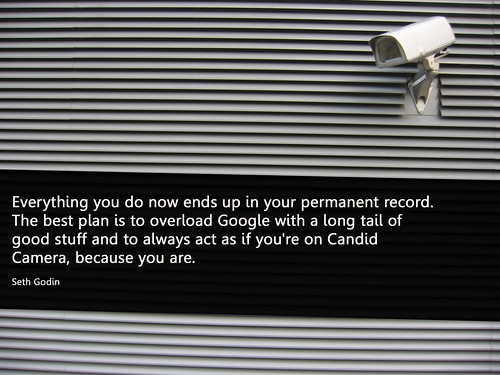
Photo by Will Lion on Flickr

The first time I heard this was when Will Richardson spoke at a conference in Melbourne. I thought…. yeah, I suppose… but who looks anyway? I dunno…

But then I looked at  what a Google search said about me, and used links to my online stuff when applying for a job, and I realised this…

Photo by Will Lion on Flickr

So if this makes us feel uncomfortable, we could – let’s say – stay offline. At my age I could, easily. But I don’t. Our students (largely), on the other hand, will never get offline. Their future world of work and socialising will definitely be online.

I found Lisa Nielson’s excellent and comprehensive blog post on this topic which, amongst many other resources, includes this slideshare presentation by Dean Shareski – You or Google? Who controls your identity?

[slideshare id=4768828&doc=blc-identity-100715233458-phpapp01]

What about you? Are you actively creating your digital identity? Or is it creating itself? Have you checked out who you are?

Steve Wheeler explains Web 3.0 : The way forward?

I don’t know about you, but if someone asks me to explain the difference between Web 1.0, Web 2.0 and Web 3.0, I’m not sure if I do a great job. But this is brilliant –
[slideshare id=4744923&doc=web3-0thewayforward-100713084114-phpapp02]

Well done, Steve Wheeler, for explaining the evolution of Web 3.0. Here’s the source of this presentation in Steve’s blog post.

New tools for traditional skills

[youtube=http://www.youtube.com/watch?v=5OLP4nbAVA4]

I found this video in a blog post on Art in the real world.

An Apple ipad live fingerpainting demo that David Kassan streamed live from my Brooklyn studio on Monday June 21st. 2010, The model sat for 3 hours as David painted and answered questions on how I use the iPad and the Brushes app.

This is an amazing example of how the latest technology can still be used in a traditional way, so to speak. I love the sped-up version at the end which makes transparent the pattern of layering in the creation of the portrait.