All posts by Tania Sheko

My name is Tania Sheko, and I am a teacher librarian at Melbourne High School, a selective secondary boys’ school 9-12 in Melbourne, Australia. ‘Teacher librarian’ usually requires a bit of an explanation. I think it’s a ‘School Librarian’ or ‘Library Media Specialist’ in the US and Canada. Often people are not sure what my role is, and it’s not easy to define. I like to think of it as the focus on ‘skills’ and ‘passion’ which exists in the spaces between the teaching of curriculum which is the domain of subject teachers. Some of my areas of focus include all sorts of literacies (information, digital, critical, network, etc.), collaboration with teachers as a kind of third hand (curating resources, differentiating learning, experimenting with blogs), and connecting people to ideas and an understanding of self and others through reading, discussion and debate. Most of our students go on to university, and we are always thinking about how we can best prepare them for the world of university and work. I’m interested in the educational environment, behaviours and directions of tertiary institutions, particularly as they move from traditional to innovative practices with connective courses. Connected learning makes sense to me, and I’m concerned that schools are often still envisioning learning as a passive consumption of content delivered by individual classroom teachers. With so much research-based evidence about student-centred, interest-driven and collaborative learning, and with the findings from the NMC Horizon Project, identifying and describing emerging technologies likely to have an impact on learning, teaching, and creative inquiry in education, I really think it’s time we woke up to ourselves about the anachronistic nature of our educational practices and took action. I learn from my colleagues, but also from my online network, reading their blogs, interacting with them on Twitter, exploring the wealth of their shared expertise online. This is what excites me about learning – connecting with people globally for a shared purpose.

What skills, what intelligence, what’s important

I’m having trouble embedding the video, so here’s the link to Daniel Goreman’s talk about emotional intelligence: http://www.edutopia.org/daniel-goleman-sel-video
I’ve been mulling over what 21st century learning is, and why we need to change our understanding and approach to teaching and learning, as well as how to explain it to teachers and parents in a way that will create a lightbulb moment for them. Here’s what’s been going around in my head:

Alvin Toffler, in Rethinking the future, said the following: ‘The illiterate of the 21st century will not be those who cannot read and write, but those who cannot learn, unlearn, and relearn’. Keywords: change, flexibility, skills-focus as opposed to content-focus.

I found in Edutopia a video where Daniel Goleman, author of Emotional intelligence, speaks about the value of social and emotional learning. He talks about the need to get over our fixation with academic achievement and reminds us that we are educating the whole child. He calls for a shift towards helping kids become more self-aware, and being able to make good social decisions. These are social-emotional skills – getting on with others, managing anger and impulses – the skills that form the basis for a better world.

In her video presentation for the Learning 2.008 Shanghai Conference, Sheryl Nussbaum spoke about change happening extremely fast in our world, and suggested ways to manage that change as teachers. She quoted those famous statistics (can we verify those anywhere?) that by 2010 knowledge will double every 72 hours. That makes the focus on content mastery, which is still the main focus of our teaching in schools, a misguided one. Sheryl points out that our current system of schooling is based on the premise that knowledge is scarce, but since that is obviously no longer the case, this current system will not work, and will not prepare our students for the 21st century world. Sheryl advocates the teaching of Web 2.0 technologies to enable students to pursue meaningful, authentic, passionate scholarship, to connect them with global communities and allow collaboration in projects that have been chosen by students themselves because they mean something to them. Sheryl also speaks about 21st century education preparing students to become responsible and self-motivated citizens, getting out of the classroom and involved in real projects in life right now, not after they finish their schooling. This is something I feel was lacking in my own education, which prepared me for expert knowledge of certain areas (which I’ve largely now forgotten), but not for the ‘afterlife’. I see many schools now offering more opportunities for students to take on positions of leadership, to get involved in community, environmental or social projects, to work in teams and learn to get on together, appreciating each other’s differences and unique talents. With global connections through new technologies, the stage is set to free students from traditional classroom practices, but this is not yet happening as quickly as it should.

As educators we have a responsibility to keep ourselves up to date with the way the world is headed, to connect with others instead of staying within the walls of our own classrooms or staff rooms; to notice what young people are doing and what they’re passionate about – to move, ourselves, even if we’re comfortable where we are, or tired. It’s not about us, whether we feel uncomfortable about the changing world – it’s about the students. We should continually ask ourselves: what kind of world are we preparing our students for?

[youtube=http://www.youtube.com/watch?v=nZskNGdP_zM&hl=en&fs=1]

Blogging about blogging; and before you know it, I’m thinking about PLP

What do young people think about blogging? Let’s have a look; here’s what one 18 year old has to say. This one happens to be my son, but I don’t think that prevents him from representing his generation:

‘People no longer are just able to blog, but blogging is increasingly becoming accepted as a legitimate medium of information; albeit quite different to others. At the cost of the credibility associated with major news services and other more traditional ways of getting our information, a whole new world is opened up- of personal opinion, a perspective into the lives and experiences of others and original creativity. When subjective experience and opinion is sought over objective fact, blogging becomes a medium very difficult to beat.’

Here’s the recognition of the value of the input, not of academics or editors, but of people like any other people, all contributing to whatever kind of information is important to them. Here’s a preference for what people have to say about something, for collective advice by people who care about their interests.

Technical applications are seen as enabling more direct ways of communicating, showing, connecting.

‘Photographers can take photos of their home city or holidays and post them on Flickr, along with geotags (so that people may see exactly where the photos were taken); performing artists can upload audio or video recordings of themselves on services such as Youtube to increase their exposure; political commentators can by series of hyperlinks to other blogs and news services critically analyse current affairs and provide explanations, arguments and challenges to what is reported in traditional established media. All of these forms of expression can be directly embedded into blogs, providing an individual with a space in which to express themselves- in the case of writers, musicians, etc…, to publish their work for free (or close to it)!’

All in all, there’s a noticeable excitement about the possibilities and the connectedness; about the possibilities for the individual’s self-expression. But could you imagine a similar passion from a young person if asked to talk about the possibilities in school education? What do you think? Are students encouraged to become involved in socialnetworking for learning? Are they encouraged to use Web2.0 applications to present their ideas and opinions? What do you think?

With this in mind, I’m thinking ahead to my school’s involvement with the Powerful Learning Practice program, and looking forward to making a difference to the mindset and teaching habits of teachers (including my own). Jenny Luca posts about PLP from the Learning 2.008 Edubloggercon conference in Shanghai:

‘Why do I feel alright about where we are? Because we are at least being proactive and have ourselves involved in Powerful Learning Practice . We are going to be immersing our staff in a learning community, and community is going to be what drives change. It’s not a discussion about the latest Macbook Pro that is important. It is a discussion about the connective relationships our students can form and learn from that is going to be the tipping point for many of our schools.’

‘Connective relationships’ – this is what it’s about. Information becomes meaningful through our relationships with people. Learning becomes meaningful through connective relationships.

If you’d like to read more of the authentic, passionate literacy that springs from real interest and involvement, read the rest of this new blog.

Deletionpedia

Paul Stewart (thanks Paul) put me onto Deletionpedia, a wonderfully annihilistic-sounding encyclopedia. Rhonda Powling has blogged about Veropedia, a verified Wikipedia, so I thought it would be interesting to check out Deletionpedia, an archive of more than 63,000 pages which have been deleted from the English-language Wikipedia. As with histories within any wikis, it’s interesting to see changes made, and you can browse through different deletions, such as pages deleted after more than 1000 days on Wikipedia; pages deleted more than 200 times; pages deleted this month, etc. The process of editing becomes transparent. Deletionpedia also provides ‘page of the month’, ‘list of the month’, and ‘category of the month’.

Did you know that Wikipedia allowed reuse of its content, including pages it has deleted, using the GNU Free Documentation License? To comply with this license, Wikipedia rescues the full edit history of its pages. Wikipedia splits up the archive into ‘we don’t like’ and ‘we do like’. And so, ‘we don’t like’ copyright violations, serious libel problems or offensive material; and ‘we do like’ interesting or quirky pages, including creative writing, opinions and original research (which do not belong in a wiki).’

All of this works by automated script following a Wikipedia user tagging something as appropriate for deletion. The tagged pages are uploaded to a temporary store; the deletion log is checked and the deleted pages are uploaded from the temporary store to Deletionpedia. A forthcoming feature is the addition of a rating system for easy identification of interesting pages.

What wonderful -Pedias await us in the future?

Very much like Wordle, another tag cloud application: TagCrowd

Just when you thought that Wordle was the be-all-and-end-all of the word tag cloud, along comes TagCrowd.com The tag cloud above is generated using Senator John McCain’s statement regarding the continuing Wall Street saga and the US government’s $85 billion bailout of AIG. The result is a handy visualisation of the most frequently used words in the speech. These word visualisations were found on The Online NewsHour in a post entitled ‘McCain pushes regulation, Obama blames failed economic philosophy in AIG statements.’

Here is Barack Obama’s reaction in a word cloud:

How is Tagcrowd different from Wordle? Both applications require the user to enter text, url or file for cloud generation. But whereas with Wordle, fonts, layouts and colour schemes can be tweaked, TagCrowd has more options for greater manipulation. The user has control of things, such as setting a maximum number of words to show in the cloud, setting a minimum frequency (not showing infrequent words), showing frequencies or not (word count next to word), ignoring words from a stoplist (ie. customised list of words to be removed), grouping similar words (eg. learned, learns, learning), ignoring common English words (eg. and, of, me), and other options. TagCrowd also allows the user to print a full-screen version of the tag cloud.

TagCrowd is more specific about the possible uses of the tag cloud:
‘When we look at a text cloud, we see not only an informative, beautiful image that communicates much in a single glance, we see a whole new perspective on text.’

There are some good suggestions for TagCrowd’s applications: topic summaries for speeches and text; a blog tool or website analysis for search engine optimisation; visual analysis of survey data; help for writers and students in reflecting on their work; and others.

I put in my blog url, and the result seems to have captured the front page:

Sharing pictures – We are the library

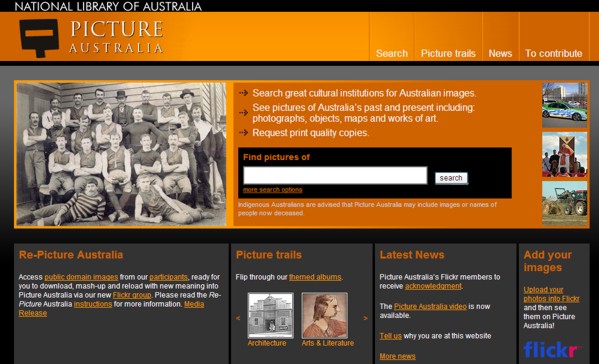
I love the sharing that’s going on now with information, pictures, videos, wikis, etc. Picture Australia, wants to recognise the outstanding contributions of its Flickr members, so they are introducing an award, which will be given once a month to an outstanding contributor. You can read about it here, and you can view the first winner’s pictures – 228 of them!

If you want to play your part in telling the story of Australia, read this.
This is a wonderful example of the new way of sharing information and of becoming part of the information itself. I imagine that young people would be interested in contributing to The National Library of Australia’s archive of pictures, and in creating a current pictorial record which will eventually be history.

In participating in this project, students will be encouraged to licence their images with creative commons. What better way to learn about copyright and the choices for owners and users of created works. Students will also need to learn how to supply detailed titles, descriptions and tags for their photos.

This is another example of authentic educational opportunities. There are many of these if we look out for them.

Poetry and sport? What a challenge

Today during our library meeting, I received a less than positive reaction to a suggestion that poetry be the subject of a display or activity in a boys’ secondary school. Eyebrows were raised sceptically and scornfully, and ‘you must be kidding’ was all over everyone’s faces. Boys would never be coerced into read poetry; they preferred sport, war or anything that made you want to beat your chest and shout ‘Oi’. OK, I may be using some of my own poetic license in describing people’s reaction, but that’s just to set the scene.

By some poetic miracle, or perhaps the gods of Poesie were smiling down upon me, but later today I read about the Red Room Company’s mission to create, promote and publish Australian poetry in unusual ways.

‘Eight pigeons will race along the New South Wales south coast on Sunday – in a time trial the organisers liken to the Tour de France – with a piece of original, Australian poetry strapped to the ankle of each bird’. The day’s events began with live poetry readings at Stanwell Park, after which the pigeons flew to the breeders’ HQ in Mt Ousley, transmitting pigeon-cam video back to the launch site.

And just when you thought gambling and poetry didn’t go together, they do! You could put a (free) wager on whichever pigeon and poem you thought would win, and the winners would get a single poem as their prize, and also go into the draw for the grand prize: a “Pigeon Poetry Sculpture and poetry books from all states and territories”.

The website proclaims the success of the strange union of sport and poetry, as it occurred on 3 August this year. You can view a picture of each pidgeon, and read each pidgeon’s poem. Don’t forget to read about the pidgeon and the poet, especially since the write-up is so creatively metaphorical, that you’re not sure if the poet is a bird or if the bird is a poet. For example, reading about the pidgeon ‘Real Radio’, you not only get its weight and wingspan, but you also find out about its reading habits, and the languages it speaks (Hebrew and Wave, in this case).

When everything is presented in such a wondrously confusing way, young people won’t even realise what they’re doing, and before they know it, they’ll have read some great poetry without meaning to. I think this approach is fantastic: distract with strange coupling of poetry and sport (you could come up with your own version), blur the lines between the two, then confuse everyone, throw the poetry in while they’re blinking in confusion, and there you have it! This has given me food for thought…

Learning through discovery at the Melbourne Museum

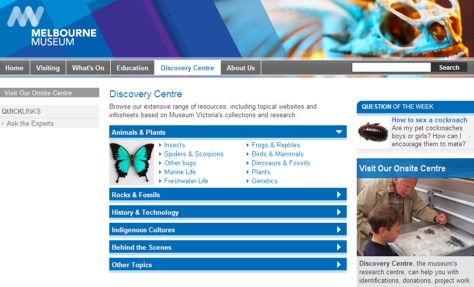
The Discovery Centre within Museum Victoria makes research interesting and hands-on. A young person can wander in and spend a few hours without realising that it’s been a learning experience. Let’s say you came in and browsed some of the 2,000 plus natural or cultural objects available – not just on display in cabinets and drawers, but also available to touch and examine – then you’d be able to delve into a little research in a number of ways; you could:

have a close look at these objects under magnifiers or video microscopes;
use the reference library of books, journals, education kits, DVDs or videos;
browse through the extensive collection of online resources on public computers;
and you could always ask a staff member for help.

When I visited the Discovery Centre as a student of teacher librarianship, the staff were eager to help, but not eager to supply a quick and easy answer – they encouraged students to find information and answers for themselves, pointing out resources available and suggesting ways of searching. The research process becomes a challenging discovery task, well supported by the excellent variety of materials and resources. It’s great to find research modelled in such an enjoyable way.

The Discovery Centre’s website is user-friendly, and offers an ‘Ask the experts’ section. If you have something you want identified, or you need help with a research project, you can email the museum’s information experts, either with a general request, or an identification request. Every week, there is a ‘question of the week’ published on the website.

I think this is a valuable resource for primary and middle years students. It’s great to take research out of the classroom, and into such a dynamic and resource-rich environment.

Coveting covers

The Book Cover Appreciation gallery is for hardcore bookcover lovers. You can get into really heavy discussion about the details of the book cover. Clicking on the cover takes you to the comment page. The blog is updated several times a week.

Here’s an example of a comment about an Animal Farm book cover:
Although I have often conflicted about Shepard’s work and his source materials which could be debated as dubious. The propaganda style works especially since these are anti-socialist/communist novels. The Obey logo I find quite funny on the covers, how many designers have the balls or be allowed to put there personal logo on a book cover, the mark of an iconoclast

Can you get passionate about a book cover?

Collaborative project – Harvest of Endurance scroll

Human potential and creativity never cease to amaze me. Today I came across an online version of a work of art in the form of a 50-metre-long scroll representing two centuries of Chinese people in Australia. Harvest of Endurance is a painting in the traditional gong bi style depicting the story of hardship and resourcefulness of the Chinese in the history of Australia. Taking a little over 12 months to complete, the scroll is made up of 18 elaborately painted panels. It was purchased by the National Museum of Australia in 1992.

Appreciating the actual scroll is one thing, but just as impressive in its own way is the accompanying interactive website produced by the National Museum of Australia. You can explore the scroll from right to left along a timeline from 1788 to 1988 by clicking on stages which are described as eg. Australian gold rush; the rise of merchants, etc. In selecting a period, a scene forms in front of your eyes, first as an outline, then graudally as a complete coloured picture. Clicking on red arrows outlines an object or person, and provides you with a brief explanation or definition. There is a detailed audio-visual explanation of how to read the scroll, including how colour and form create the story, and an explanation of how the scroll was created from the point of view of the artist and the researcher.

The presentation of historical facts in artistic form, coupled with an interactive, multi-layered online representation, is a clever way to facilitate learning through exploration. Wouldn’t it be fantastic to create a similar project for students where each would have a choice whether to contribute as either a researcher, artist, technical expert or other. In particular, I like the way you can select parts of the picture for explanation or background, and I think that would be a great way for students to present their newly found facts.

The collaboration between the people of Australia and China in the form of the Australia-China Friendship Society aimed to promote friendship and understanding between the two countries and their cultures. It would be interesting to connect Australian students with students from another country, perhaps through blogs, in order to create a final product requiring collaboration and fostering friendship and mutual understanding. That would be an authentic and meaningful project.