The photojournalism of The Wider Image app – we don’t need to grow up without pictures

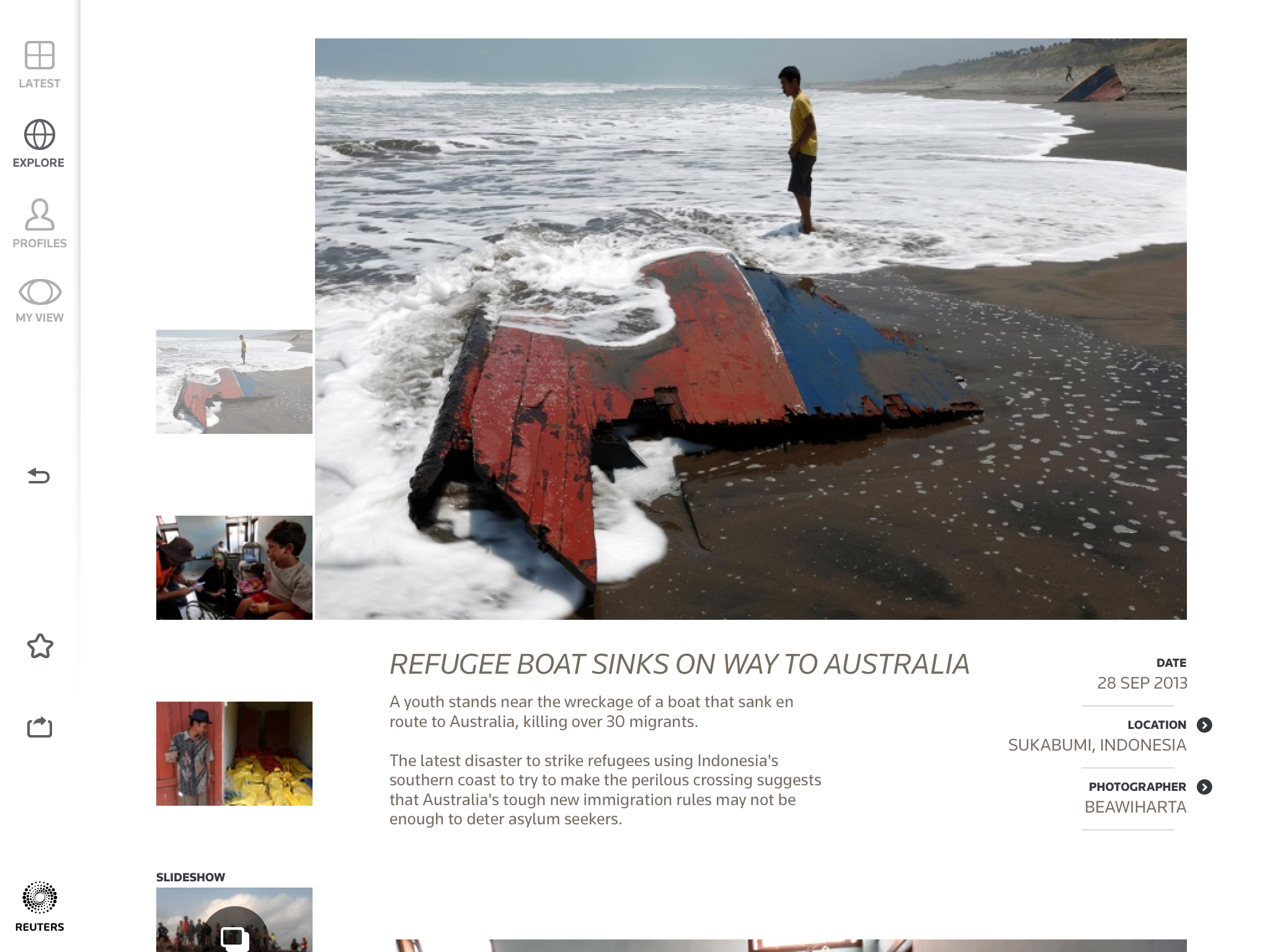
refugee boat

I’m sure that I’m never going to grow out of my love of images  – I still love pictures as much as I did as a young girl. Language too, hence the linguistic focus in both my undergraduate and Masters degrees. And I couldn’t choose between the power of words and the immediacy of images. So Readers like Feedly and Pulse, bookmarking sites such as Pinterest, all make me very happy in the way they combine text and image. I appreciate information much more when it’s enhanced by imagery.

Today I came across The Wider Image app –

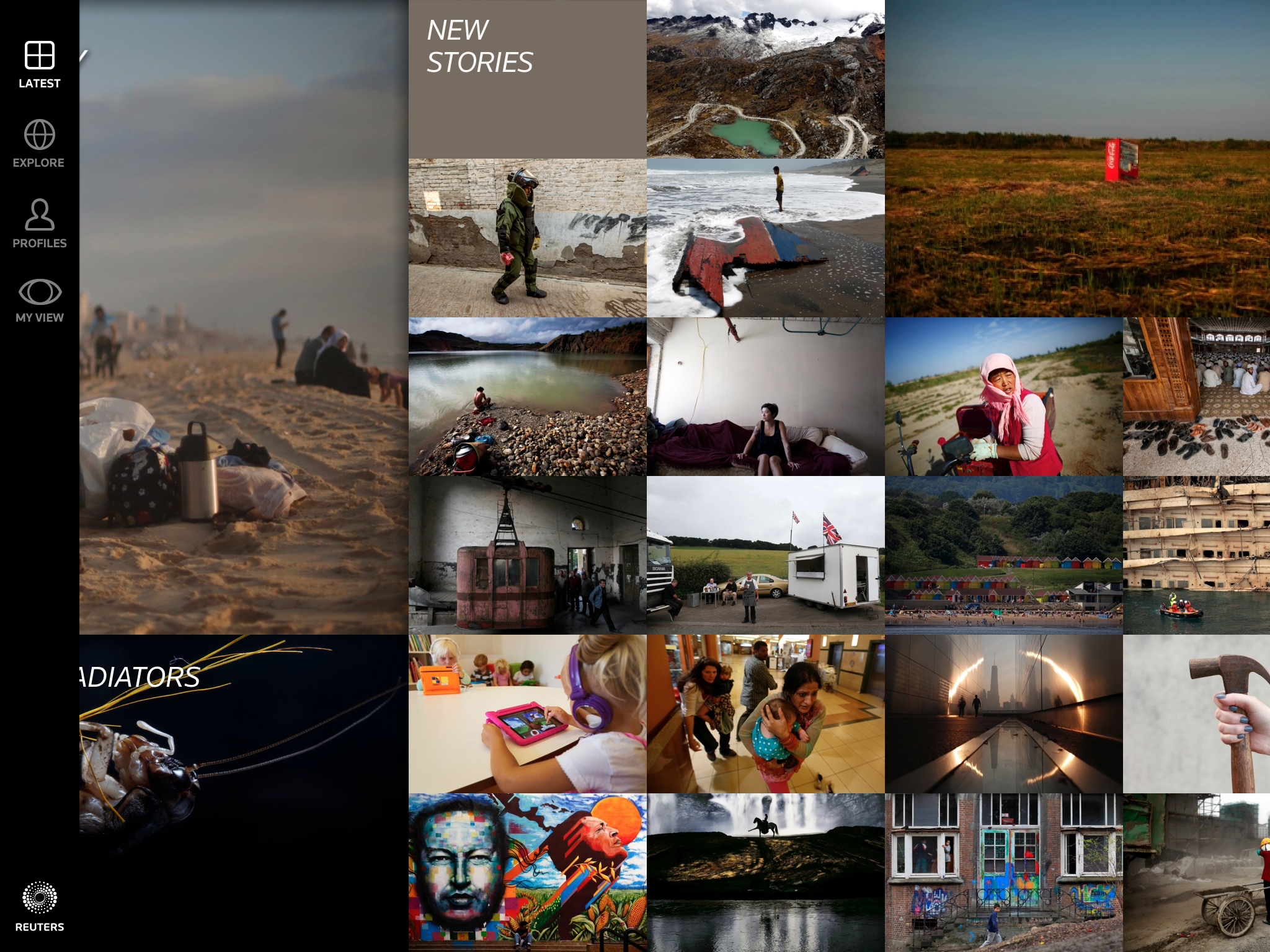
The Wider Image app for iPad was conceived to reimagine the way news photography can engage through evolving platforms, to position imagery at the heart of multimedia and to realise the unique potential of photojournalism.

all stories

‘Reimagine’ is a great word, isn’t it? Reimagining news is adding a human, aesthetic perspective on news. When I was a teenager, a good friend gave me a copy of an annual digest of Life Magazine and encouraged me to cut it up and stick it all over my bedroom walls. It seemed like dessication but I did it. Those photos were powerful. I discovered photojournalism. You read the news article once but you can’t stop looking at the photos.

We should definitely be introducing our students to diverse ways of viewing information. Students uninterested in news, in factual reporting, in long articles, are much more likely to be hooked by a powerful image. An image leads to endless possibilities for discussion and writing.

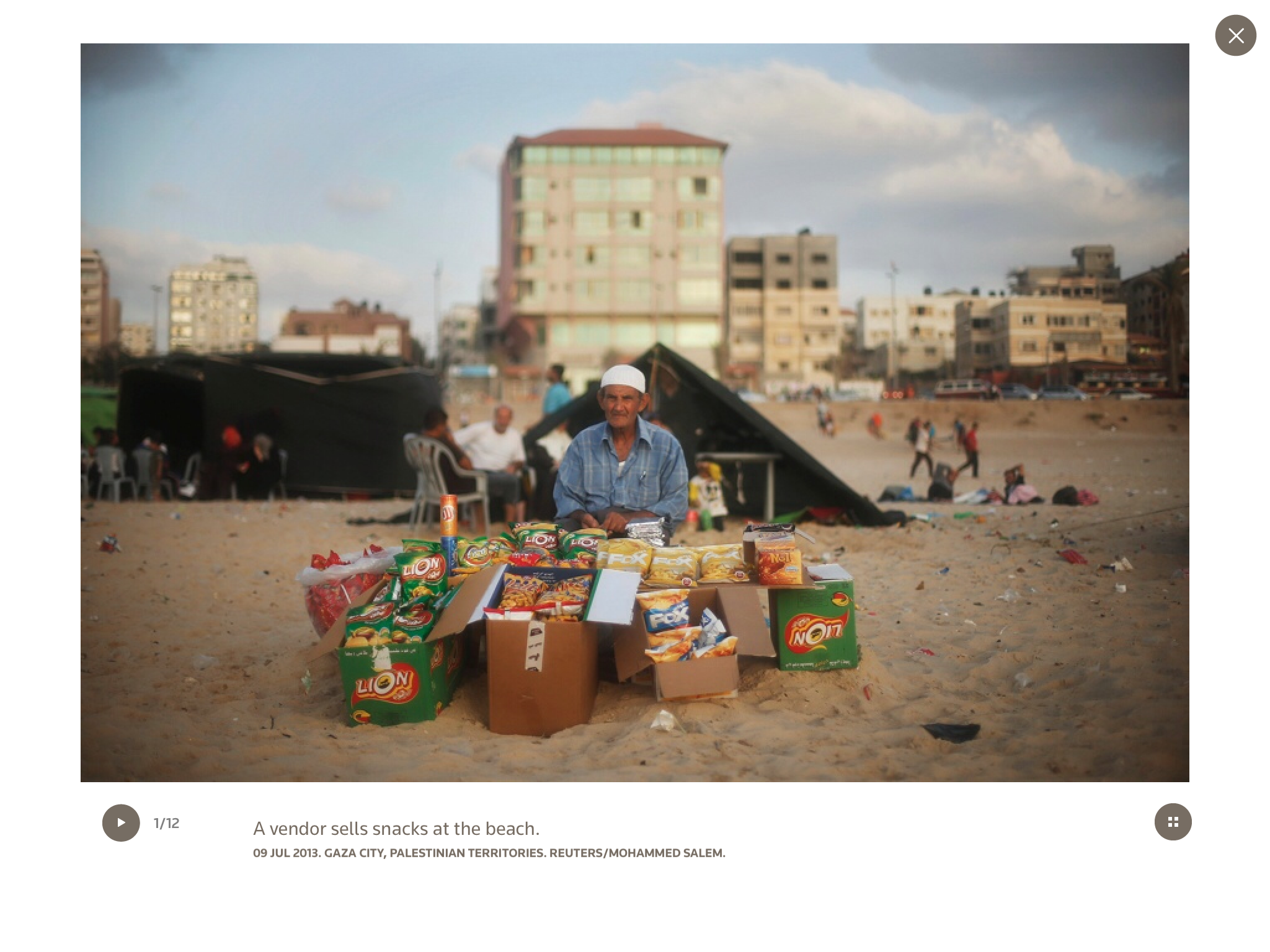
vendor

The Wider Image app transforms news and news stories by using Reuters’ photographs, and creates an interactive experience for the reader. Although you can see these new pictures on Reuters’ blog, Reuters Pictures, I would recommend that you get the free app if you have an iPad.

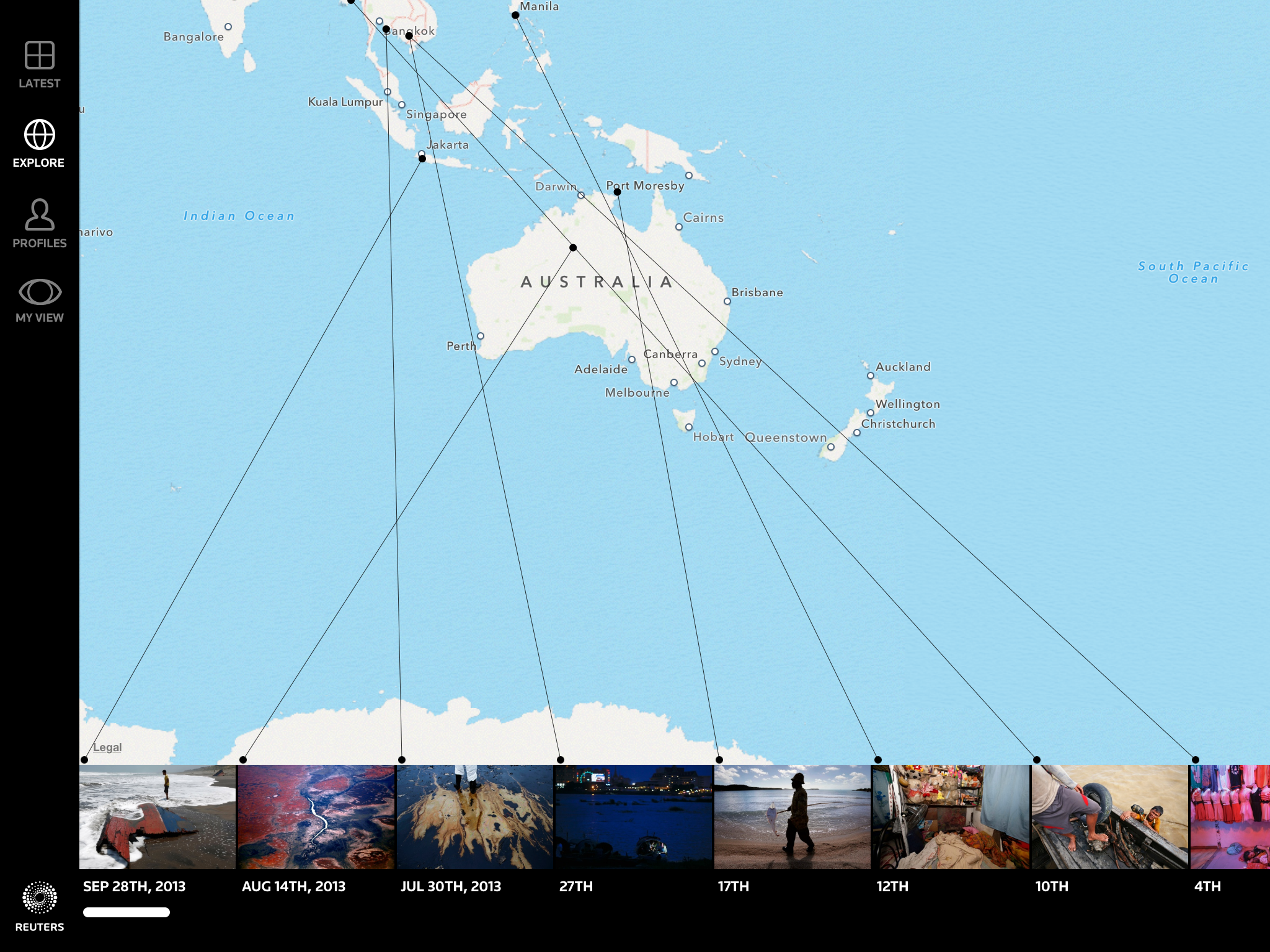
An interesting part of The Wider Image app’s interactivity is the map linking stories with location.

map

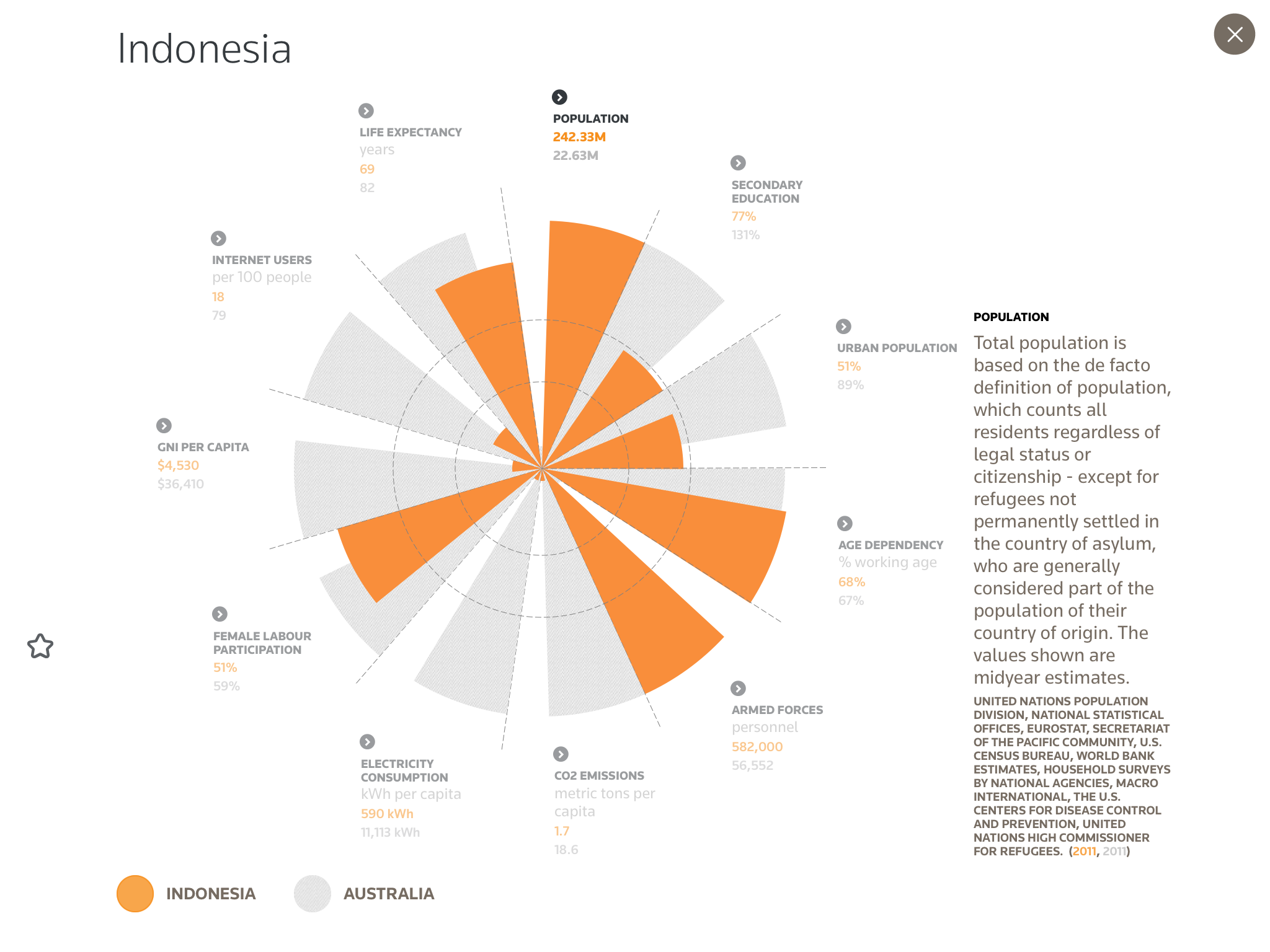
Further data is provided about the country of location.

infographic

I admit, I do go on about pictures. So many posts about imagery. And I still feel strongly that the education of our students is missing the richness of visual literacies. Ever doubted that images are just as important as text? Let me leave you with pictures from Shaun Tan’s The Arrival.

Book Week is over. Reflecting now.

Book Week has been my main focus and the focus of my colleagues for many weeks now. And it’s over.

I’m happy, relieved, grateful, reflective, critical, and future-focussed all at the same time.

The posts on our Melbourne High School Library blog are here, here, here, here, here and here, (in reverse order) if you want to have a look at what we did.

I’m not entirely happy with the title ‘Book Week’. It’s ridiculously oversimplified, but then, it does the trick. I don’t think we can make a satisfactory conglomerate of relevant terms, for example, Literature-Reading-Literacy-Makerspaces-Community-Promotion-Art-Library-IdeasExplosion-HeadsTogether-SupporingCauses-Fun-Week  –  could we? Perhaps we could use a descriptive term – but again, you couldn’t just use one; you’d need to use many. Here are some that come to mind:

Making the library a space for whimsy and serendipitous adventure; Reminding the school community that the library is alive and kicking – come and see for yourselves; Combine forces with the other planet in the school solar system that concerns itself with Literature – the English Faculty (hello, we have so much in common); Making books come alive and Pulling out ideas and richness from them – oh, I could go on, but I might never stop, so.

Did we do all this? Some of it. We did so much, and we had varying success. We celebrated our successes, and we learned from our disappointments. We have ideas for next year which we should write down before we forget about them. We did it together.

Seeing is thinking, feeling, understanding – let’s not neglect visual literacies

Pablo Picasso

The SLAV conference, ‘Transliteracy, multiliteracy, makerspaces: how can you participate?’ I attended recently (16 August) gave me much to think about, as they always do.  The featured address, ‘Ways of seeing’: The visual in Australian curriculum by Helen Kent and Catherine Reid from Melbourne Graduate School of Education, University of Melbourne, highlighted an often neglected area of  focus on important visual literacies at the secondary level.

There does seem to be a stronger focus in schools on the analytical responses, and I am concerned that students are missing out if we ignore the visual aspect in favour of what we see as the more important textual analyses. I agree with Helen and Catherine that we need a response to the aesthetics, not just analysis, in our approach to the curriculum. Visual literacy is extremely important in the 21st century, and is particularly engaging to students, and must include affective responses if we want to develop emotional intelligence.

What happens to children who are surrounded by rich visual content in their early childhood and primary years who enter secondary school where this is suddenly cut off?  My guess is that, firstly, engagement decreases, and secondly, they miss out on developing the essential skills that come out of visual analysis. It’s not realistic to pretend that we live in an exclusively text-centred world, especially with the immediacy of images and multimedia at our fingertips now.

Are we mistaking visual literacy as being tied exclusively to the Visual Arts? The occasional comic prompt in an English paper? I realise I need to look again at AusVels to see where exactly I can find opportunities for students to articulate an emotional and aesthetic response – History, Civics and Citizenship, Maths and Science, for example, offer the opportunity for aesthetic responses, so I need to have a closer look.

Some takeaways which I’ll follow as leads for futher investigation:

  • First We See: the National Review of Visual Education which recommends  a whole new pedagogy to deal with visual literacies
  • the term ‘wreading’ – interconnected fluid process of learning reading and writing
  • Do we need a new term ‘Visualcy’  which describes the connection between literacy and numeracy ?

What we should be looking for is a pedagogy that enables emotional response to visual prompts. We have the Arts and teachers of the Arts to look to in learning about how to develop visual literacy in our students.

One of the questions which arose from the session was ‘Can we assess students’ emotional responses?’ I would be interested in a good conversation about this with people who have a keen interest or experience. In any case, as our speakers said, what is curriculum for? If it’s to guide us in addressing goals and skills acquisition, and if ‘viewing’ is one of the strands, then we should seriously develop this more in our curriculum to align ‘viewing’ with the other strands. Interesting to note that the rationale doesn’t emphasise enough the importance of visuals in Indigenous culture.

                                                                                                                    Rene Magritte – Ceci n’est pas une pipe

I haven’t summarised the entire content of the two talks, and I don’t intend to. I’d like to share resources I’ve been creating that might be helpful for anybody thinking about resourcing Visual Literacy in their schools. At this stage, my resources are targeted at English teachers, but I’ll make an effort to keep my eye out for visual prompts for different domains. Some of these below may possibly be adapted for others but I haven’t looked at this specifically yet. The images can be deconstructed, used as writing or discussion prompts, but these are just some of the suggestions – it’s really up to the focus of the teacher in deciding how the images can be used. Often they can be used for more than one purpose or approach. So, it’s over to you to think about how some of my collections can be used. Don’t be shy to share your ideas in the comments section of this post. It would make my day.

An old blog, Storyteller, with various writing prompts, including visual.

My Pinterest boards (selection) –

Art Inspiration

Awesome

Banned books

Bigger Picture

Clever

Imagine

Looking out

Lost

Maps

Mathematics

Old stuff

Photography

Story

Visions of the future

Words

Well, that’s it from me. For now. Hope you’ll share your ideas – look forward to the conversation.

No more razzamatazz – Libguides go light

After an initial leap into Libguides a couple of years ago (inspired by Joyce Valenza’s passion and inspirational examples) when we crammed our guides as tightly as we could with fantastic content, images and videos, I’ve decided to go the other way and start stripping my pages down in favour of user-friendliness. Of course, in the teacher librarian world, we delight in our bounty of wonderful websites, infographics, and the such, and we want the world to see and marvel. But we must eventually admit that the world is not always marvelling because they are running away in fear – isn’t it overkill? and doesn’t it stop people from doing what we really want them to do – FIND stuff?

My friend and (now distance-) colleague, Dawn, helped me see the light but not without some time passing, during which I remained in denial, and stubbornly held on to my bursting boxes in our libguides, my pages which had to be scrolled and scrolled and scrolled. Oh, and how could I forget my tabs – crowded clusters of them, but wait! under these tabs I also had more pages.

Enough!

At some point I have had to accept the unpleasant truth – that I’ve been carried away with sharing with the world my resplendent array of finds (every day – from Twitter, Facebook, Google+, Diigo, Feedly, and similar places). I’ve had to admit with a heavy heart that it’s been more about ME (look what I can do!) and less about my readers – students, teachers, others. Sigh.

So, it’s going to be a long, hard slog, but I will get there, and my online resources will be easy to find, logically organised, selected with restraint.

I promise.

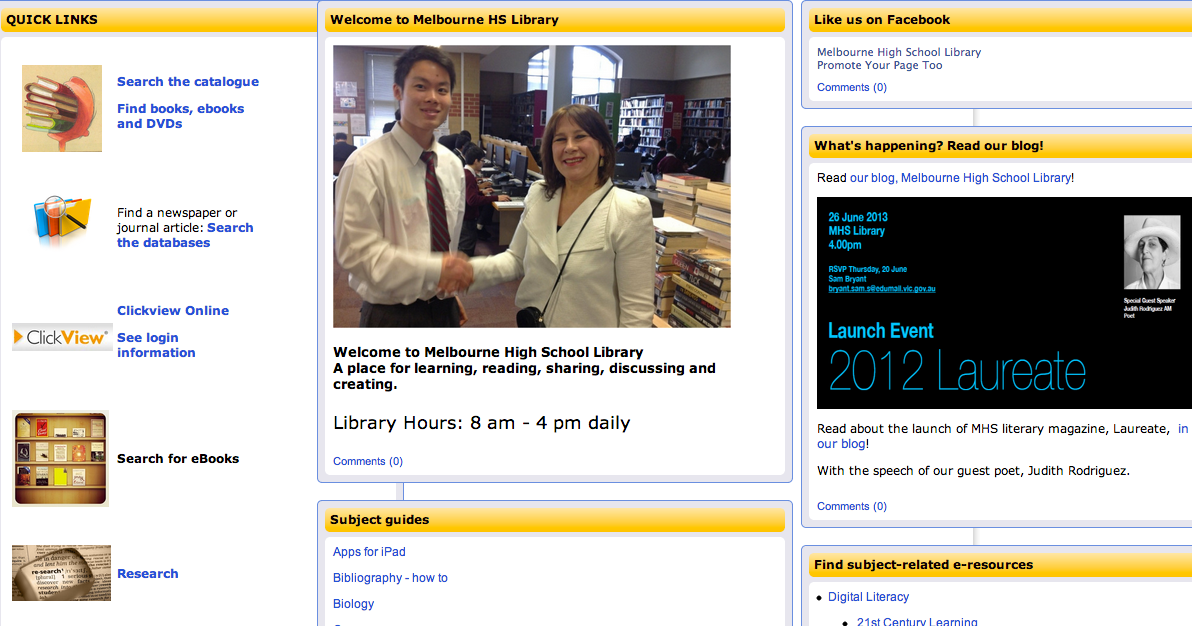
See, the library webpage is much neater and more inviting.

libraryfrontpage

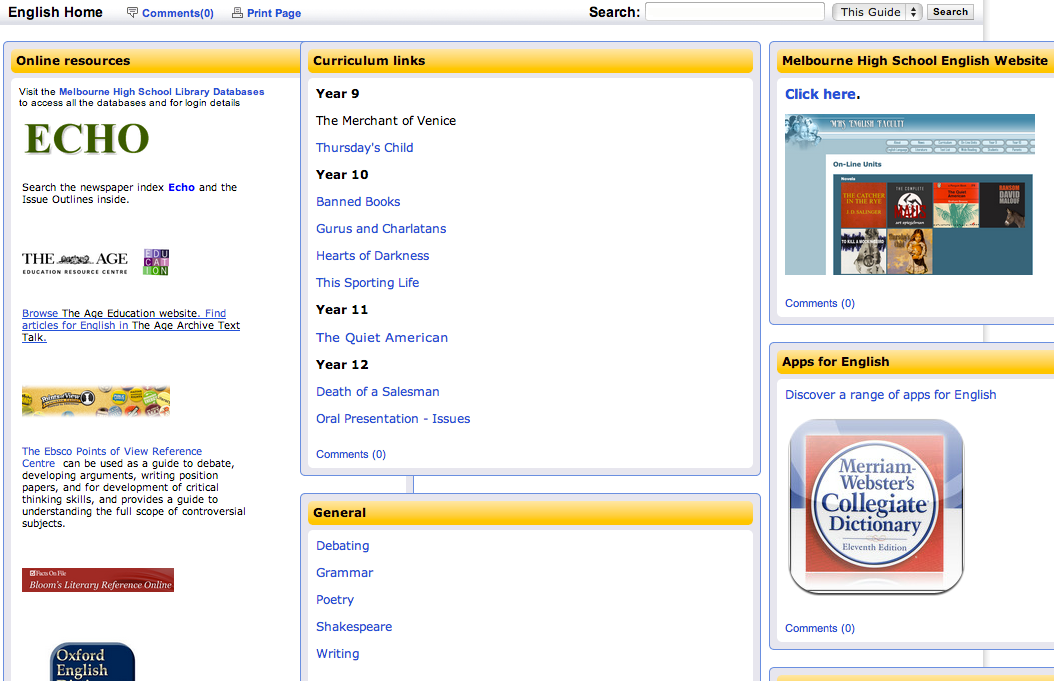
Currently I’m working on English. Got rid of 5 tabs today; moved the pages into the body of the guide as hyperlinks.

englishlibguide

What do you think?

The Laureate Launch

[slideshare id=24118935&style=border: 1px solid #CCC; border-width: 1px 1px 0; margin-bottom: 5px;&sc=no]

(This has been reposted from Melbourne High School Library blog)

The Melbourne High School student literary publication, Laureate, has been revived after a ten year hiatus. English teacher, Sam Bryant, has been instrumental in this revival. Melbourne High School celebrates worthy events in style, and thanks to Sam and his colleagues, the Laureate Launch was a successful event which included assistant principal, Dr Janet Prideaux, staff, students, parents and the guest speaker, Judith Rodriguez, renowned Australian poet, author and educator. Since the publication comprised of student writing from 2012, we were pleased to welcome back past students to receive their congratulations and a copy of Laureate.

Here is Sam Bryant’s speech delivered on the day (26 June 2013):

Special guest Judith Rodriguez, parents, students and staff,

It gives me great pleasure to welcome you here to this special occasion, the launch of the 2012 Laureate. On behalf of the Melbourne High English Department, I thank you for coming to celebrate the creative writing of MHS students.

Although this is the fourth edition of Laureate, it is now ten years since it was last published. Early last year it was decided that the magazine would be revived as it was recognised that once again there needed to be a student literary publication at Melbourne High School. The students of Melbourne High School have a long and rich tradition of creative writing, and it is fitting that their work will once again be published and shared with the wider school community.

The English Department extends its congratulations to the students who have been selected to appear in this year’s edition of Laureate. This is your publication. Nevertheless, many thanks should also go to the teachers of the English Department for their tireless work in nurturing the students in their creative endeavours, providing them with advice and feedback, and also for proofreading the work submitted for this publication.

It is envisaged that Laureate will now become an annual publication and that it will further the already thriving culture of creative writing at Melbourne High School. Hopefully, a gathering such as this is will become an anticipated event on the school calendar, and one that continues to celebrate and promote the literary talents of Melbourne High School students.

It now gives me immense pleasure to introduce to you our special guest speaker, Judith Rodriguez.

Judith Rodriguez was born in Perth, but lived in Brisbane from the age four until she was twenty-four. Her years at Brisbane Girls’ Grammar School and the University of Queensland are among her fondest memories.

She has published thirteen volumes of poetry.

Judith’s first poetry collection was published in 1962 as part of Four Poets, the others being fellow Brisbane poets David Malouf, Rodney Hall and Don Maynard. In 1974 she began making woodcuts and linocuts for book decorations; these appear in several of her poetry collections, and have been exhibited. In 1978 she was awarded the inaugural South Australian Government Prize for Literature in for the collection, Water Life. Mudcrab at Gambaro’s received both the Sydney PEN Golden Jubilee Award for Poetry and the Artlook/Shell Literary Award in 1981. From 1979 to 1982, she was poetry editor for the literary journal Meanjin, and from 1988 to 1997 she was a poetry editor with the publisher Penguin Australia.

In 1994 she was awarded the Fellowship of Australian Writers C.J. Brennan Prize for Poetry.

Judith collaborated with Australian composer Moya Henderson on the opera Lindy, about Lindy Chamberlain, which premiered in 2003 at the Sydney Opera House, and with Robyn Archer on the play Poor Johanna, produced in Adelaide in 1994. Her long ballad, The Hanging of Minnie Thwaites, with an historical account of the life that led Thwaites, aged 26, to the gallows, was published only last year and along with many of her other works can be viewed on the table over there, and I encourage you to have a look at them after the presentations.

Yet it is significant that Judith has not only shared her passion for poetry and creative writing through her own works. She has also devoted her life to the teaching of creative writing. She taught English at La Trobe University from 1969 until 1985. In 1986 she was writer-in-residence at Rollins College, Florida, an experience commemorated in her ninth collection Floridian Poems (1986). In 1989 she took up a lectureship in writing at Victoria College, which in 1993 became part of Deakin University, where she continued to teach until 2003. Judith has taught literature and writing in universities on four continents and continues to teach at the Council of Adult Education in Melbourne. She is a life member of Writers Victoria, a member of the Australian Society of Authors Council, has chaired the Melbourne Shakespeare Society and continues to work for PEN International.

In 1994 Judith was made a Member of the Order of Australia, for services to Literature.

Year 9 Art project on paper, iPad and Pinterest


Our year 9s have been working through a project in art which combines the best in hands-on activity, iPad technology and social media. Mihaela designed a project in which students worked through a process starting with research of patterns from different cultural backgrounds and culminating in the students designing their own patterns using the iPad app, iOrnament, and creating an oversized paper plane decorated with their pattern designs.

The research process encouraged students to dip into a rich and diverse cultural store of patterns before deciding on the designs of their own, and including some of the elements of water, fire, earth, air and wood. They were to select one or more of these elements to fuse with the theme of rejuvenation of the spirit and sense of self.

I relish my partnership with Mihaela, Head of Art at Melbourne High School. Every teacher librarian appreciates the teacher who is happy to collaborate, and in my case the partnership is built on respect, reciprocal interests, love of creativity and experimentation,  a desire for excellence, and determination to create a challenging process leading to a synthesis of understanding and original design. After we chatted, I was clear about what Mihaela wanted for the students and how I could support the project. I created libguides with visual examples and links to further resources to get the students started and hopefully inspired.

patterns2

My research into examples of patterns within a broad range of cultural contexts was a joyful task for me. Pinterest is a rich online resource which allows the discovery and collection of an enormous number of high quality visual examples. I searched The Grammar of Ornament on Pinterest and was overjoyed with the results.  I referred the students to the Symbol Dictionary online for a bit of research on symbolic background. Delving into the how and why is always fascinating, and often informs the direction of research.

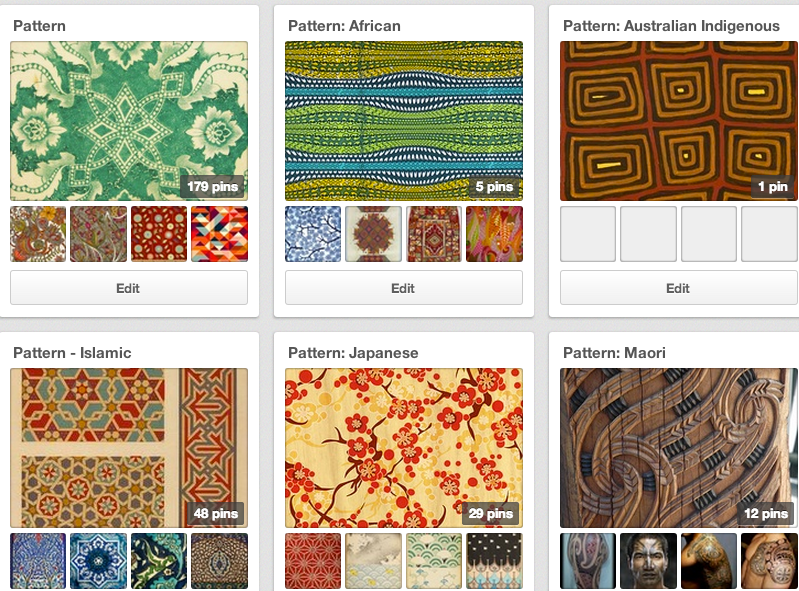
I didn’t want to overwhelm the students so I limited my pattern examples to some of the main cultural sources, but also linked to Pinterest boards I was creating along the way. If the students chose to, they could continue to browse collections of general patterns, and also African, Australian Indigenous, Chinese, Indian, Islamic, Japanese, Maori, Mexican, Moroccan, Russian and Turkish.  One of the advantages of using Pinterest is that you can continue to add visual examples to the collection without changing the link, so students will be able to view a continuously edited collection with one url. Students can also search within Pinterest itself. Design of online resources presents the challenge of depth without overwhelming the user, and a reasonable number of external links for further research.

[slideshare id=23985162&style=border:1px solid #CCC;border-width:1px 1px 0;margin-bottom:5px&sc=no]

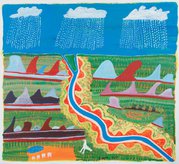
The students were also introduced to four artists for whom patterns were an intrinsic part of their art works. I created Pinterest boards for Shirin Neshat, Ah Xian, Ginger Riley Munduwalawala and Sangeeta Sandrasegar.


It’s a shame that the quality of the images in the following slideshow is not fantastic. I’ve included some general art study, such as colour theory, amongst the Pattern mix. Although you can’t read some of the text, you get an idea of the type of process journalling they have done.

[slideshare id=23999499&style=border:1px solid #CCC;border-width:1px 1px 0;margin-bottom:5px&sc=no]

The best part of this project, as far as I’m concerned, is the richness of the process. This is what I love about art – it is an example of the kind of process which should be embedded in all subjects. I was intent on documenting this patterns project in a blog post because it makes transparent what is most valuable about learning – the process of research (wondering, browsing, getting lost, refining search), working and re-working ideas and techniques, synthesizing found and created concepts and ideas, evaluating and reflecting and much more. Wouldn’t it be a smart world that required all students to study Art?

If I stayed in my library…

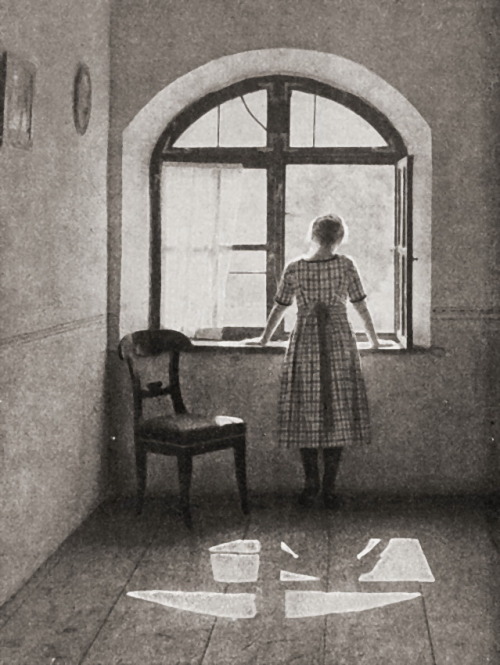
Am Fenster, 1922 by Hans Kammerer

In keeping with a limited budget for professional development, the question about relevant choices came up.  The conversation that arose centred on proven relevance for my role as teacher librarian, and in terms of being in line with we’re doing at school. I wanted to go to  Gary Stager’s part in a leadership seminar series. Here is an extract about the seminar –

For school leaders, the immediate challenge is to create productive contexts for learning where there are greater opportunities for inquiry, project-based learning and student leadership, regardless of gender, ethnicity or socio-economic status.

The relevance of professional development is an interesting topic for conversation especially for me as a teacher librarian. My role is not subject centred, and I find that I usually have to explain the types of things that I do, and the types of PD which might be useful. I understand that a limited budget forces the question of relevance, and might lead to the opinion that Gary’s talk is not specifically targeted to my role or even what we are doing at our school. It might be reasonable to expect that the chosen professional development session should be specifically targeted at what we do in the library.

Why does this not sit right with me?

As much as I appreciate and enjoy professional development opportunities related to my profession (teacher librarian) – and there is so much variety here since this role has an impressive array of hats – what I love most is an opportunity to be stretched, challenged and even surprised; to be reminded about the basic core of our jobs at school – LEARNING! – and to interact with people from different walks of life.

People who attend Teachmeets will know what I’m talking about. We hear from educators in different roles – primary, secondary, tertiary, from principals, heads of elearning, IT, program coordinators at museums, non-school libraries, and the such. You get what I’m trying to say. There is so much to learn from each and every speaker, regardless of their role, and that’s precisely because of the diversity of experiences. Sometimes a primary teacher will have a unique approach to teaching which a secondary teacher will not have thought of. I know that I have so many connections and ideas while I’m listening to these people. And the conversation following is just as valuable. How sad, how 2-dimensional, to receive professional development which is carefully measured, predictable and safe.

What would I be like if I stayed in my library, if I stayed in my school, my staff room, my neighbourhood?

8edf9e34c1a9d096d0c48858d42f976a

Coding literacy

Here’s something I’ve been hearing about and ignoring. Coding sounds too much like maths to me, and I was never good at that. But it’s not about me, I keep having to remind myself. It’s not about what I’m comfortable with, what I’m drawn to. Knowing how to code is going to be something really big in the life of our students. I don’t even know if our school is teaching this; I should really find out. Take a look at this video from Bill Gates and Mark Zuckerberg.

[youtube http://www.youtube.com/watch?v=dU1xS07N-FA&w=560&h=315]

Bill Gates and Mark Zuckerberg are teaching coding online here. Reluctantly I’ve signed up just to see what the course is like for coding luddites like me. I’ve read a little about the role of schools in teaching kids these skills but haven’t delved any deeper until now. Darcy Moore’s article on ABC Splash caught my attention in my Facebook feed this morning. The fact that students are seeking out these free online learning opportunities outside school underlines the need for schools to revise what is worth including in the curriculum. School is no longer the only place to learn, and this is becoming more and more evident. Although it’s not a bad thing for learning to take place outside school, it does beg the question: are schools as relevant as they could be?

The Starter League is another place to go if you want to learn to code and design on the web. Thanks for the article, Darcy, it’s given me something to think about.


Network literacies are essential – what are we going to do about it?

Being netsmart is something Howard Rheingold has been talking and writing about for some time. In this video, he very recently presented a keynote on this topic at Utrecht University.

[youtube=http://youtu.be/eKvtG4H1y5I]

Howard talks to the audience about network literacies: attention, participation, collaboration, crap detection and network know-how.

As I listened to his talk – nothing new for those who have been following his thoughts and writing, but certainly always worth listening to – I thought again about the need to recognise the importance of teaching network literacies to our students. And I don’t mean the once a year session snuck in by a teacher librarian, I mean a recognition by staff and leadership that we need to seriously work on a plan to integrate network literacies into our curriculum.

I’ve been working with others on a plan of attack for helping our VCE students who are having problems with study – time management, literacies, etc. Howard’s first identified literacy in the networked age is attention, and this is something I’d like to spend some time unpacking with the students.

Howard recounts a realisation during his lectures that students were not looking at him but multitasking online. He quotes statistics warning us that multitasking is disrupting our attention span more than we realise, and that only 5 or 10 percent of people manage to multitask without losing attention. What is it about these students? I really like his term, mindfulness or metacognition – being aware of where you’re putting your attention. I agree that we could identify for students attention probes which would encourage them to be aware of their use of media during class, lectures or while doing homework. Since trying to be more aware of my own online habits, I’ve had to admit that my attention is dispersed and that I’m addicted to following that little sound that alerts me to a tweet or Facebook message. I realise I need to exercise self discipline, knowing that these things can wait until I’ve finished what I was working on. This is what I plan to discuss with my students.

The aspect of manners is an interesting one in an age when private phone conversations are heard by everyone on a train, or when tweeting during a conference means you might look rude to others or even the speaker. As Howard says, maybe in the future it won’t be considered rude not to pay attention to the lecturer, but as far as I’m concerned, there are times when I ask students to close their devices and look at me, and other times I’d like to allow them to be productive online and take notes or do some on-the-fly research while listening. Listening without doing anything can be difficult. Why do you think people doodle? Still, we do have to make decisions all the time about what we are going to pay attention to. Are we going to look at that cat meme right now? Oh, why not! What was I saying again…?

So what Howard is recommending is that we take that unconscious process of multiple distractions and our behaviours and make it conscious so we take some control. Do I follow this link or email now? Why might I want to? What else am I supposed to be doing? Am I going to pay attention to it later?  How am I going to make sure I find it again? (This is where I couldn’t live without Diigo). This is a conversation I’d like to have with my students. Howard suggests that we could modify our attention behaviour and make it automatic, following strategies instead of impulses.

He’s right when he says that you’re the only one who knows what you need to get done today, and your priorities need to be your own. This is why I won’t conduct the study skills sessions with students in a rigid way recommended one way of doing things. Howard recommends establishing new habits, finding a regular place for these and repeating them. A simple act of writing down 2 or 3 goals on a piece of paper, away from the computer with the space to think, can make a difference when you keep those goals close to your sight while you work as a reminder, to help you refocus and assess your productivity.

As Howard says, attention can be trained, and we know this from thousands of years of contemplative traditions and also from neuroscience.

As I’ve mentioned in an earlier post, some of our English teachers have started using Goodreads for wider reading. Yes, I’ve been pushing it a little – well, maybe a lot. It is about the reading network but I also believe it’s going to provide many opportunities for teaching network literacies. I expect students will feel so comfortable within this platform that it won’t be all deep and meaningful conversation about literary things. But, as Howard points out, casual conversations may seem trivial but help people get to know each other and trust each other, and understanding how networks work is part of esssential literacies these days. We do live in the age of social media, and the information society is becoming more of a network society, with the interconnection of all sorts of knowledge from different disciplines. Do you agree that diverse networks are more important than expert networks? That they are more likely to come up with better answers?  

I really do believe that we should teach our students the importance of switching off regularly, and I say this as a person who has problems switching off. I assume it’s very difficult for our students to not be connected all the time. It’s not common to be alone for long – does that mean we lose our ability to feel comfortable in silence, in our own heads, with our own company?

I really think we, as educators, should have this conversation and then do something about creating the regular opportunities to talk to students about these things.

I’ll leave you with Howard’s minicourses.

Where I am now, where I’ve come from. Reflection.

Reflection and evaluation have always come easily to me, for which I am grateful. It’s not always pleasant but it does help to move forward, or rather, break out of one skin into the next.

In my professional life, I’ve celebrated with my colleagues our first term ‘under my leadership’. I say that with a smile because my role as head of library at Melbourne High School has been passed to me like an unwanted basketball, and my leadership has depended desperately on the experience and good will of my colleagues. Still, at the end of a term which contained an unusually high number of new challenges for all of us, we acknowledged (and celebrated with Laurent cake!) our successes and triumphs, our new directions and relationships. It’s always been a challenge for me to see the positive things amongst the clutter of problems and unresolved issues which tend to cloud my clear vision, being a perfectionist, and often demanding of myself unrealistic goals, but I’m happy to say that, with the help of good friends, I accepted the cake and focused on the whole picture. We had, after all, successfully managed the move to RFID (with related technical issues, as always); moved the huge cultural shift of a silent library – having provided the VCE students with an alternative space for their private study sessions – which surprised us all by demonstrating that most students actually preferred to study under our politically incorrect hovering and insistence on silence than go to the more relaxed space with a moderate amount of noise;  acted on our determination to leave the library more often to make connections with teachers and be associated less with desk duty and ‘library duties’ and more with meaningful support for teachers and students; made a good start on our promise to staff for delivery of services which responded to their specific requests for support, both in curriculum creation and collaborative teaching; worked on the planning and preparation for a refurbishment of the front of our library involving a temporary reallocation of desks, shelves, books and the like in readiness for demolition some time next term, and many more things I won’t mention because this paragraph is getting much too long.

In my personal professional life, some things changed – as they do. My activity within social networks was reduced but not weakened. Obviously I had much less time for online interaction, and sadly missed some opportunities and events (not all), but my focus was more strategic, more targeted and less serendipitous. Twitter, Facebook, Google+ and other online communities have still been my lifeline, professional development, inspiration and connection to new developments and ideas. Blog posts have become less regular as priorities have shifted – all as it should be – in exchange for projects which have resulted in the satisfaction of making things happen, introducing good changes and bringing some people with me.

Do I still have readers? I’m not sure – but then this blog hasn’t attracted dialogue with others for some time. Does it matter? Maybe a little – everyone wants some kind of response when they write (I think), but then again, the writing clears my head and creates another record amongst all the posts since 2008. It may be sand art but I value the opportunity to share my thoughts with what is potentially parts of the world – at least a world further than my own backyard.

What have I learned this year?

My colleagues are my strength and support – at school and beyond. If you openly value and respect people, they will reward you with good things and surprise you with unexpected things too. Leadership is not control; it can survive uncertainty as long as that doesn’t turn to fear which makes you lose trust in your people. Life’s too short to keep on the tried and true, safe path – follow your instincts. The change you want will take time. Celebrate with your friends – and cake!

Button up, we’re out in the open

css.php