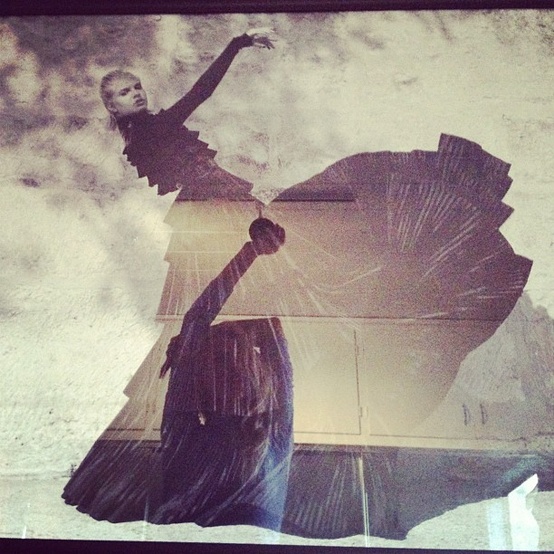
Marc Chagall, The Window
My focus for peer observation (as part of my Professional Learning Practice) is my collaboration with Nick Fairlie and his 2 Year 9 English classes. Nick asked if I could help him do something different with his students, we decided to try out Posterous as a blogging platform. Readers of previous posts will know that we created a main teachers’ blog which we used for instruction and writing prompts, and the 2 classes of students created their own blogs which we linked to the teachers’ blog.
Our aims for this project:
- to provide a collaborative and open online platform for student in the hope that an authentic and peer readership (beyond that of the teacher) would develop an authentic writing voice.
- to increase student motivation through the dialogue in the commenting section of the blogs as well as through the ownership of the students’ own personalised blogs.
- to create a community of thinkers and writers across 2 classes by linking all blogs to Nick’s blog
- to motivate students’ writing through dialogue with a broader and global reading audience
- to provide opportunity for personal dialogue with Australian authors (Isobelle Carmody and Michael Gerard Bauer)
After blogging with 2 year 9 English classes for a year, it was time to provide students with the opportunity to reflect on and evaluate their experiences. I wrote a post entitled ‘Reflect about your blogging experience’ with a broad range of questions but open response format.
The students responded honestly and thoughtfully. Their reflections were based on a retrospective analysis of their blogging experiences and addressed a wide range of aspects to result in rich analysis and valuable metacognition. In all cases, despite varying degrees of recorded satisfaction with the blogging tasks, students acknowledged an enriching experience including learning they didn’t expect but appreciated.
The mix of personal writing in a public space was challenging, and we expected this. I’ve observed that initial apprehension was replaced by the excitement of being read by an authentic audience including that of peers and also of those from the other side of the world. Students felt increasingly safer in the supported environment with specific guidelines for appropriate and positive online responses and interaction.
It’s interesting that such a competitive and mark-oriented cohort has taken the time to write so much and so well in their own time when nothing was assessed. The comments in the students’ final evaluative post attest to engagement due to factors outside the reward of marks. The community of thinkers and writers which developed allowed students to feel that their writing mattered, and that their personalisation of their space and style enhanced their sense of self. Many students identified the blogs as a highlight of the year’s English classes and hoped to continue blogging next year.
Certainly the experience further developed students’ tolerance of others’ ideas, and pushed them out of the comfort of their own views, often resulting in a wider reading to gain a greater context for their own writing. In some cases students initiated further involvement in online writing and reviewing spaces for their personal satisfaction.
Our aim in this project was explore the possibilities of writing as metacognition, providing opportunities for students to think deeply, question and write honestly – not what they thought the teacher would want to read but as a form of personal consciousness. We were aware of the confronting nature of these tasks but we are also convinced that the outcomes have been even more valuable than expected. Although we focused on metacognition above pure writing exercises, we realised that the writing improved in sophistocation and fluency as a result of the flow of ideas.
In conclusion, this has been a highly motivating and enjoyable experience for us as teachers, and the students’ reflections and evaluations also attest to their enjoyment of the experience. There is always room for improvement, and the students have provided us with ideas for a modified approach for next year. We have been continually impressed with the high quality of thinking and writing overall, as has the global community of readers who have attested to this in their numbers and positive comments.
What follows is a very lengthy detailed description of featured student responses linked to their full posts. (Readers can stop here if they’ve had enough).
In his post, Simon has eloquently expressed the transformative possibilities of an open community of writers enabled by blogging.
“This Posterous adventure has brought a new beginning to my use of the social network. Looking back at the few posts I’ve published to the world, I can see the journey I have taken, but it is not over yet. For all I know, I may not be what I know; there are still some things I haven’t explored. This experience is like one of an engaging classroom; you never want the bell to ring. I have planted precious seeds that are now fully grown evergreen trees. I have the motivation to express my ideas and about myself, even if it is in the blog form. I have discovered new ways to express my word art. I have explored a vast network of shared information. I have discussed controversial issues. I have expressed myself. And now I am here. Reading everyone else’s comments and posts was also a fully rewarding experience. I could grasp the perceptions of things from different angles. I could get more takes on a different item. I could get to know other people. Blogging was a different experience, but it still is an open gate full of opportunity and answers. That’s how amazing it can be. So thank you everyone for staying with me till the end of the year.”
In his post, Krishnak appreciated being able to read what his peers had written:
“Reading other blogs also allowed me to gain a perspective on the opinions of others. What others thought about and what others wrote about opened my eyes to new ideas. The interaction between fellow bloggers allowed us to expand on new ideas and thoughts about life, and also helped me to gain an insight to what people with a different background thought about the same topic.”
In his post, “jialew” reflected on how blogging improved his writing:
“Writing had always been one of my many dislikes, with the help of classmates I started to grow out of that shell and approach the task. By reading their posts I gained an insight of what they had put into their posts, and most importantly what their views of the world is like.”
He understood how difficult good quality commenting actually was:
“Commenting may look simple, but I found it very hard, especially commenting on the friends’ posts. Thinking about it rendered my thoughts and contention blank, I had no clue what to do.”
He appreciated the global connections –
“Being able to connect to people outside of a restricted classroom is interesting, especially when you think about the distance that that separates the writers and viewers.”
Technical problems are unavoidable. Students should be given the opportunity to become independent problem solvers, not to expect everything to work smoothly, and not to be afraid of experimenting with solutions. He faced technical issues and worked through them.
“ I had some unfortunate issues with the technology within Posterous, at times it would freeze and reload the page when I’m nearly finished. To solve these issues I either just ignored it or wrote a brief plan for the topic; soon I would find out that I would either go off track or become focused on an unintended subject.”
In his post, Ashley admitted that blogging ended up being a valuable experience for him.
“Blogging this year has been an interesting and rewarding activity and I will continue to blog. I always thought that blogging was a boring outdated activity but after experiencing it for myself it has changed my mind. I recommend that everyone should be blogging even if it’s only occasionally because it is such a unique and unmissable activity.”
He understood the value of recording his thinking in his blog writing –
“Many times I’ve said to myself, “what is the point of writing it down when I know in my head I think what I will”. While this is true to a point, it is also very wrong. I thought I could remember it all but as I grow the more I have to remember. I think it is the same logic as why we take photos. Sure, we can remember things we did in them but they can still be forgotten and can remain fresher on photos.”
Kobie (post here) appreciated the reflective and open nature of the writing prompts which offered a freedom that assessment tasks did not have. The blog writing was not assessed.
Having in a sense, a homework assignment revolved around writing what you feel, was pretty refreshing a different… better than any assessment tasks!
I approached the task initially enthusiastic, but wary: I thought it’d be more of a ‘write this and make sure you do it to these requirements’ task. Once I realized it was about free expression and thought, I became more comfortable with it.
He also had trouble with commenting –
Commenting was… to be honest, difficult. Mostly because it felt awkward; being told to comment on your classmates writing and critique it felt strange…
My reflection:
This response is understandable for a few reasons. Firstly, commenting is responding to others’ writing, and should ideally be a natural and voluntary thing. Young people use commenting in a conversational way without any particular structure, often using ‘text speak’, and not necessarily as constructive criticism. Commenting is a valuable aspect of written dialogue which needs practice. To make it easier for students, we could provide examples of rich, authentic commenting. Students already have a choice as to which students’ posts they respond to.
Eric Wong (post here)
had blogged before but enjoyed the wider audience and interaction of this blog much more.
“This was actually not my first blogging experience as I had a previous one in year 8 where i had to blog about my experiences and findings when doing an assignment therefore i was pretty comfortable about blogging. This was not as significant as it didn’t have many comments and views. Using posterous spaces is so much better because of the various topics i receive from my teachers and it actually makes me think deeply about my life as a Melbourne High student.”
He eventually understood the value of the online writing community:
I initially didn’t like the fact that i had this blog to myself but as time passed, i found out that this blog belonged to the world and especially my classmates.
Hanan (post here) was one of many students who identified the valuable aspect of freedom in the blogging format. He comments on the fact that initial discomfort with the new form of writing disappears with practice and is replaced by enjoyment.
“Blogging gives me the freedom and time to express my thoughts and past and present experiences. As I write more, I enjoy it more and become more comfortable with it.”
He understood the importance of exposure to differing viewpoints:
“You may agree or disagree with other bloggers, but this creates an interesting conversation on what is being discussed.”
William (post here) understood the value of the open writing platform enabling a community of writers:
“The fact that we can see other blogs means we can get a profound and meaningful view into the minds of the people we learn, forge deep relationships with and see every day”.
William expresses beautifully the transition from initial apprehension to embracing the blog as a place for ‘soul searching’ and heartfelt writing:
“When we first began writing our blogs, I felt slightly apprehensive. I almost felt as if it was meaningless; who in the right mind would read the ramblings of teenage boys? This was the first time I had ever ‘blogged’, and I just followed the instructions of my teacher and the actions of my peers. But as I typed, I found it wasn’t hard at all. It was almost as if I was releasing a burden from my mind onto virtual paper. It was in a sense, soul searching. As I wrote, I started examining myself; my desires, my hopes and actions. I started examining the world and its happenings closer than I had ever done before. I explored key fundamental issues with today’s society and myself.
The apprehensiveness disappeared almost instantly. I enjoy writing immensely and it was a natural process; it felt productive (since it was homework and I was improving my English skills at the same time) and somewhat enjoyable at the same time. If only all our homework was like this! The liberty and freedom to express your creativity and thoughts is my favourite part of blogging. I didn’t have to think of things to write; it just came to me as I wrote in a logical order”.
Unlike some students, who found the open-endedness of post prompts challenging, William embraced them:
“Best of all, it felt casual. We were told that there was no pressure, and we could write anything we wanted. This lack of restriction meant that anything I thought would immediately get written down.
I feel blogging has been an invaluable experience and it has been the most enjoyable type of homework we get for English.”
Hayden’s response (post here) is testament to the challenge of writing prompts which encouraged higher order thinking and pushed students’ thinking and writing to a high standard:
“I found that the hardest part of blogging was always to start. I could never consider a way to start my blogs without serious thinking.”
He appreciated the ability to share his writing and read his peers’ writing:
“ I also find that having an audience for my blogs compels me to review what I have written much more thoroughly to ensure that I did not make any typing mistakes. The most important thing about these blogs were that my classmates had to do the same task as I, allowing me to see their views on the same topic, how they expressed it and what was good about it, allowing me to mimic their techniques as well.”
He understood the value of learning with and from his classmates:
“ I feel as though all of this was simply a program where we, the students, improve each other’s abilities without the assistance of a teacher. “
He appreciated being able to personalise his blog space:
“The fact that I could customize my wall meant that I was able to feel much comfortable with viewing my space and writing the blogs to my heart’s content”.
Simon (post here) understood the value of the global audience:
“ I think it’s great that we are writing for the world, and knowing that you are really makes you go that extra mile to make it the best.”
Tony (post here) solved his problem of writers’ block by broadening his reading and expanding his exposure to different ideas. This kind of independence and initative is undoubtedly valuable:
“When I started blogging on posterous, I felt the challenges of writing. My first blog was tedious and I couldn’t think of nothing to write about. I didn’t have developed ideas. The hardest part about blogging is thinking what to write which will impress the global audience. As a result, I began to read the newspaper daily to accumulate some fresh ideas. The editorial section was full of sophisticated ideas that I could not fully comprehend. As you read more and more, you take more in and begin to realise there are different ideas, elements and aspects you have not even thought about.”
He suggested that his writing had improved due to his reading audience:
“I am fully aware that my writing has changed over the course of my posting experience. My ideas, sentence structure and fluency have improved drastically, ameliorating my overall writing. I believe it is because I have to put lots of effort to come up with these deep thoughts. It is important to have an audience for my writing because they can critique my work. They can help me find the flaws of my piece of work and improve it, make it unblemished.”
Tony’s blogging experience has led him to explore other online writing opportunities:
“Due to the fact I like blogging quite a lot, I have started writing blogs and comprehensive guides for several websites such as maplewiki and basilmarket. I write on them because I use to play the game MapleStory and I found it quite enjoyable. I want to help out new players in the best way possible. I already have about 24,000 views on my guides.I am going to continue blogging as a hobby. Thank you Mr Fairlie and Ms. Sheko for introducing this to me.”
This is an example of how an initial understanding of blogging satisfaction can lead to the initiation of further, authentic writing outside school. In this case the student has chosen to write for personal satisfaction, identifying an area of expertise and sharing this with a global audience. The student has gone beyond the confines of writing for assessment only.
Michael (post here) gave an honest and poetic evaluation of the value of his peers’ blog posts:
“As you scroll down the countless posts of the two classes of year 9, you will inevitably find shards of preciousness — sometimes golden dust; other times, fool’s gold.
But, undeniably, the thing that gives away the shine of a man is the title of his blog.
You really do dig deep with blogs.”
Patrick (post here) appreciated the development of quality writing through the posts, and acknowledged an improvement:
This was the first time I had made a blog which is why in the beginning of my Posterous space, my posts were short and had little content for pondering. As time goes by and as I practise, my posts get longer and contains a far better quality of content up until now although there had been some variations. This made me to believe that creating a blog could actually supplement and even improve my English writing skills.
We had no trouble with inappropriate comments, as Patrick stated:
“Fortunately there was no cases of trolling or cyber bullying which is unlikely due to the nature of my audience.”
Alan (post here) identified the peer and global audience responsible for the improvement and enhancement of writing skills and broadening of perspective:
“Through the blogging my writing has changed. Ideas are easier to put into words and I now have a different perspective on topics. I feel it is important to be able to read other people’s blogs so that you can gain another perspective on the topic an it is also important to be able to comment and ask questions so that you can fully understand what they are saying. It is also important to comment with overseas people so that we can get an even wider view on the topic. Overseas commentator also made the blogging experience more enjoyable as you felt your views were being read by more people. Through blogging I was able to get a better understanding of myself and others.”
Vinh (post here) was honest in his evaluation of the blogging experience. Blogging opened up experiences he would not normally seek out:
“A blog, in its core, is basically a part of your mind. Just typed out, and shared with the world. I don’t see myself in the future as being the artsy, blog-keeping type but i think this years experience has opened me up to a whole new side to the internet, which I would never have bothered to explore.”
Writing to a public audience was challenging to Vinh:
“I don’t really like putting myself and my thoughts up for public judgement. Even if its anonymous. In a way, you could call me quote introverted, i like keeping things to myself.”
He found writing fluency of ideas challenging, especially since English is his second language. The example of metacognition here is worth noting:
“At first, I had quite a bit of difficulty making my writing fluid and connecting ideas effectively, just because I was, literally, translating my thoughts as i wrote them down. The way I think also made this harder as I tend to think in chunks of ideas, rather than words or single ideas. Sometimes these chunks all link together nicely and so i write fluently and quickly. Other times i get stuck. Having these chunks in Vietnamese also doesn’t help the block.”
Blogging has opened up a new world for Nathan (post here):
“Blogging hasn’t changed my style of writing, but it has reignited my passion to do some recreational reading and writing. I now realise that the world of literature and writing is endless and I should never be empty of ideas if I have the right determination and will.”
Lachie (post here) appreciated the value of having an authentic audience for writing:
“It was also a great experience to have such a diverse audience to write for. Writing without an audience is pointless. You may as well be talking to a wall. Nobody hears your opinions, your beliefs if you have no audience.”
He summed up the value of a global audience nicely:
“Having people from Finland and America or any other country viewing and commenting on my work is truly a great privilege and honor. However, with this comes a greater responsibility to only write appropriate comments and pieces. These connections made me feel as if my writing actually meant something, that people enjoy my writing”.
He gained a valuable insight into his peers through their writing. Herein lies the value of sharing writing with peers.
“The insight that I have gained from blogging is that there is more to people than meets the eye. That is, that you cant judge people from their exterior but what its on the inside that you should judge and that counts.”
Andrew (post here) commented that the quality of writing follows the sophistocation of thoughts expressed:
“The insight that I have gained from blogging is that there is more to people than meets the eye. That is, that you can’t judge people from their exterior but what its on the inside that you should judge and that counts”.
He offered some insights into how writing prompts could be more engaging to students:
“For one, I feel as though the topics were too abstract, and too different from student life. Having debates about school curriculums, education systems and subjects, sounds slightly more appealing than having broad, abstract ideas, that don’t really relate too much. Though I enjoyed it, I believe having debates on things that we can relate to, would be better. The ideas can still be abstract and broad; just more relatable to education, or student life.”
“xiangxxu” (post here) identified the personal space of the blog and audience as affirming:
“Having a blog that i can control and customise as i please made me feel responsible and important, as i can do as i please on the blog and it was up to me to control what i would like to express, thus making me feel responsible. Also it made me felt important as narcissistic this may sound, but i felt more valued as a person when i have people from around the globe able to read my thoughts on multiple issues.”
Less confident students have acknowledged a development of confidence in writing, as well as the value of being able to read others’ posts. “Flaming ball of doom” (post here) reflects honestly on his shaky beginnings:
“I was reluctant at first as I wondered why would anyone want to read what I had to say? Then I realized nobody was forced to read it and the people who did would hopefully like it. When I began to write my first post I was slighty nervous but excited and as I kept writing I stopped being nervous. My readers’ comments on my posts helped me a lot as it allowed me to see how others interpreted my posts and I had to answer some tough questions.”
Vincent (post here) loved the opportunity for dialogue with the Finnish students:
“Having the ability to communicate with Finnish students provided a wonderful knowledge and insight into the way they live.”
Andrew (post here) valued the authentic audience:
“Of course, without an audience, writing would be somewhat pointless. Nobody hears what we have to say, our opinions, our beliefs are just ignored”.
In his post, Sasank described his initial apprehension about sharing his thoughts with a public audience online, and admitted being reassured by the secure and supported blogging space:
“Before this year, i had never blogged as i was protective of my privacy. I was afraid of entering a new world, where i would be sharing things very personal to strangers. HOwever, as the year has gone by, i have developed a confidence in myself and others, as my views have been accepted and constructively commented on”.
His observations underlined the importance of giving students the opportunity to learn constructive feedback and tolerance of others’ opinions:
“ I had to comment on things which i did not agree to, and i still had to be ‘nice’.”
It was interesting to read that the blogging tasks set for homework were experienced differently to other homework:
“It also provided a great diversion from other homework, and basically just gave me some time to myself.”
He admitted that this experience had given him new confidence in his own ideas and writing:
“Again, it gave me more confidence and i came to know what others thought about my style of writing.”
Ilan (post here) acknowledges that a good blog post takes much thinking, time and rigorous editing.
“At the start blogging was a bit of a challenge. I had all of these ideas in my head, most were absolutely terrible, a couple I could form into a semi reasonable post but there is a big difference between half thought out ideas and a well written posterous post. The problem was transferring a thought front my head onto the page and making it make sense.”
The open and personal nature of post prompts allowed students to express their thoughts in a way unrelated to curriculum, and students were able to focus on refining their writing to best express their ideas:
“This didn’t only help get the ideas out, it also helped refine them and make them more logical and understandable.”
Brendan (post here) was initially sceptical about using social media for serious writing but he was soon convinced otherwise:
“At first I was skeptical because I thought it would be just another Facebook however the passages written by my fellow students were not stupid and useless such as ‘I’m bored’.”
If you’ve read to the bottom of this page, I hope you appreciate as much as I do the value of students’ reflection and evaluation of their blogging experiences, using Posterous spaces to create a community of thinkers and readers. Nick and I have found the experience extremely rewarding, and we’ve learned as much from the students as they have from us. I hope to continue to provide deep learning opportunities using social media next year.