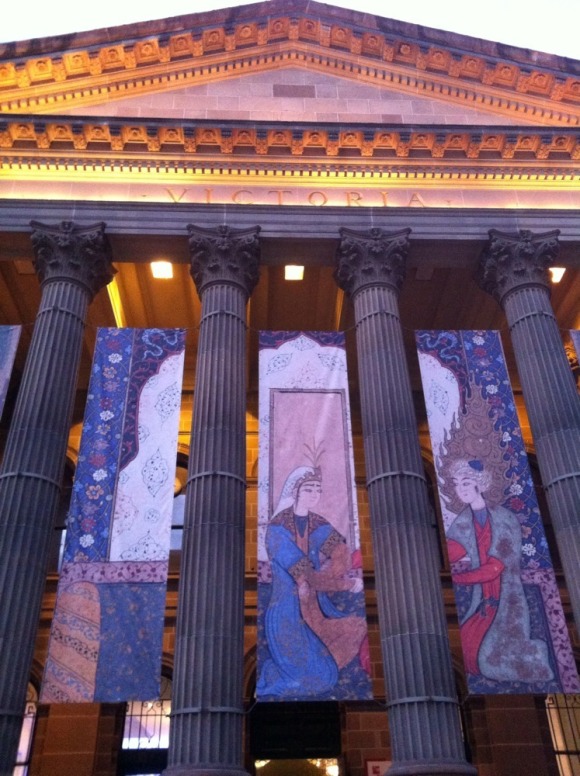
What is school for? Have we really asked this question? – Seth Godin

There are some questions which are avoided by many and avoided indefinitely, and these questions are actually very simple. Important simple questions are the worst because just asking these questions throws us into hot water. That’s because answering these questions honestly might leave us questioning everything  we do. One of these questions is – ‘What are schools for?’  Are we brave enough to ask this question?  Let’s hear it from Seth Godin. And then please leave me a comment about whether you ask this question and whether it makes you feel uncomfortable teaching in our schools.

 [youtube http://www.youtube.com/watch?v=sXpbONjV1Jc&w=560&h=315]

Facebook is like chairs – and bridges, dance floors, door bells?

A first for Facebook – its first advertising campaign. Facebook CEO Mark Zuckerberg announced:

For the first time in our history, we’ve made a brand video to express what our place is on this earth. We believe that the need to open up and connect is what makes us human. It’s what brings us together. It’s what brings meaning to our lives.

How do you like it? The point of Facebook is not the technology but the connections between people, global connections. Absolutely agree with that.

“Chairs, doorbells, airplanes, bridges – these are things people use to get together so they can open up and connect about ideas and other things.”

Okay. Starting with a chair is quite clever; a chair (or seat) is one of the simplest cross cultural symbols and has existed for centuries.

“Dance floors, basketball, a great nation. A great nation is something people build so they can have a place where they belong.

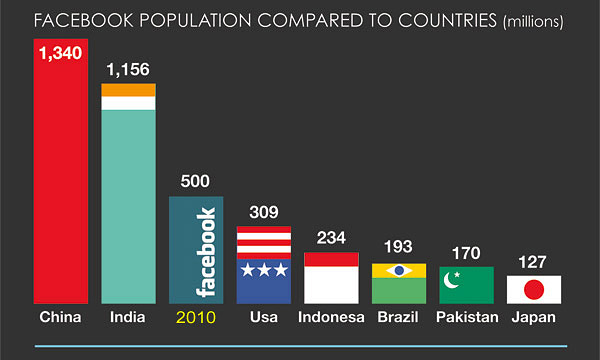
So now Facebook is getting a teeny bit ambitious perhaps. Or are they, considering their place in world populations? Here’s an infographic comparing Facebook’s population with that of the most populated countries in 2010.

Here’s an updated one showing Facebook’s population in a different context.

“The universe – it is vast and dark and makes us wonder if we’re alone. the reason we make these things is to remind ourselves that we are not.”

Facebook – really? Suddenly you are the answer to the world’s ontological questions? Get real, please.

Mashable posted its reaction to the video:

Mashable editor-in-chief Lance Ulanoff previously pointed out what he thinks is wrong with the ad: confusing analogies, absence of technology and a plethora of vagueness that spoils an otherwise beautifully shot commercial. “It was created to celebrate the social media platform’s 1 billion active monthly users and my takeaway is that Facebook is an empty chair,” he says.

And then spoofed the Facebook ad with this image –

I don’t know about that one either. It leaves me luke warm.

Don’t get me wrong – I use Facebook a lot. Despite the frustrating, intrusive and changeable nature of its dealings with users, it’s still one of the most effective ways to communicate both personally and professionally. Connections are great – it’s what you make of them. As a teacher, you have a love-hate relationship with Facebook. It’s unwise to befriend students but, knowing they’re there, it’s the place to set up groups that students will inhabit – because they’re already switched on. Most of the time.

Good try, Facebook. Maybe you should get some user feedback for your ads before you decide on the best one.

“Trial by social media worry in case of Jill’s Meagher’s death” – Social media and the law

Jill Meagher’s recent disappearance and death has touched many people. How do we know? Because social media has been a platform for the sharing of news and emotional comments from an enormous number of people. Not only family and friends shared Jill’s photo on Facebook, it seems the shock of Jill’s disappearance and fear for her life has touched many others, and they have been publicly expressing their reactions. The Facebook page set up to find Jill currently has over 83,000 likes.
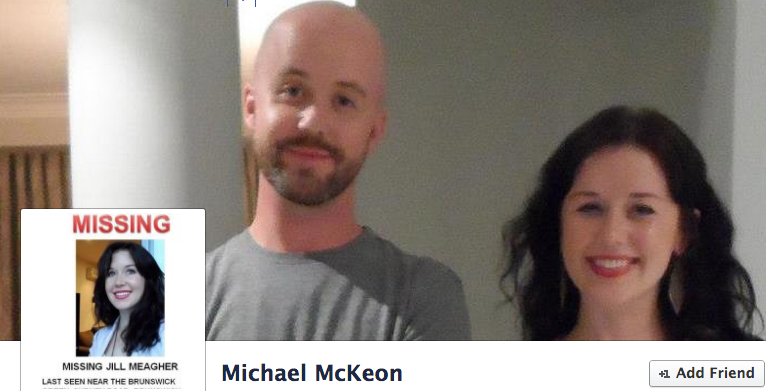
There’s no denying that social media – in particular, Facebook and Twitter – have been harnessed by people who believe that dissemination of information through these media will reach the widest audience – and hopefully make a difference to the life of Jill Meagher. Sadly, although this journalism from the ground has allegedly aided the search for Jill, and led to the arrest of Adrian Ernest Bayley, the outcome has been tragic, and people have continued to use social media for their outpouring of sadness and condolences to Jill’s family and friends. Now the Facebook and Twitter updates point to the possibility of interference with the legal proceedings if people continue to use social media as a platform for anger and accusation.

“Overnight, the sentiment was very much of grief and sadness and now this morning, anger is starting creep into what is being shared and re-shared.”

With that anger comes responsibility to social media users, who become content publishers when they post. That may require a knowledge of media law.

Thomas Meagher, Jill’s husband, today urged people to consider what they posted on Twitter and Facebook.

“While I appreciate all the support, I would just like to mention that negative comments on social media may hurt legal proceedings so please be mindful of that.”

This message has been tweeted by the Victorian Police and others today. Julie Posetti is one of these people.
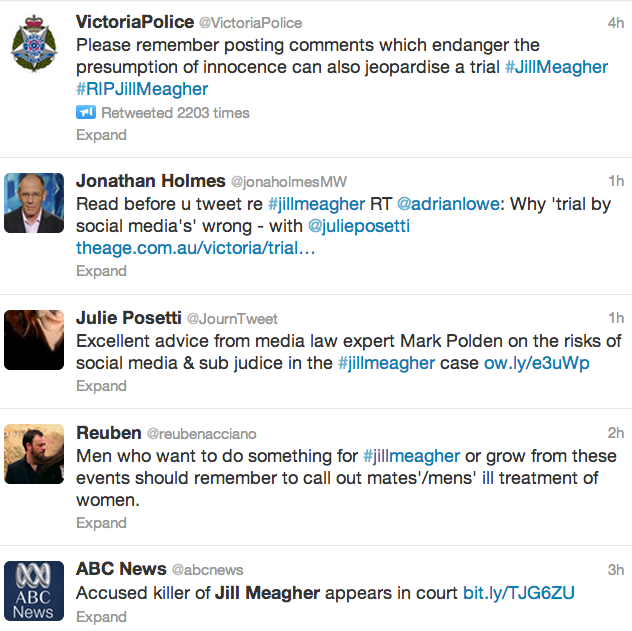
Julie is a prominent journalist and journalism academic, and is currently writing a PhD dissertation on The Twitterisation of Journalism, examining social media’s transformation of professional journalism. In today’s article in The Age she explains the issues associated with public commentary about the case and the accused.

“In this particular case, it would be awful to think about the potential consequences including an incapacity to prosecute somebody because of trial by social media, for example,” said Ms Posetti, who is writing a PhD on Twitter’s role in journalism.

“We all are very familiar with the term trial by media and it’s a real problem, but we also now need to be aware of the potential implications of trial by social media.

“Practically, [and speaking] generically, as soon as a person is arrested, we need to stop talking about what we think we know about that individual because there is a risk that his or her defence lawyers could argue that there’s no possibility for a fair trial in this country for the person who’s accused, because so much information has been published.

I’m ignorant about social media laws – do we have clear and current laws in Australia relating to social media? A quick Google search led to audio and transcript of an ABC Radio National “Law Report” episode with guests Mark Pearson, Professor of Journalism at Bond University, and Julie Posetti.

Photo by Jeffery Turner on Flickr

The transcript of this episode can be read here. We should read this to our students as we discuss the whole new area of legal implications associated with the issue of personal and public blending through social media. We need to inform ourselves about these issues, and schools should be focusing more urgently on these matters as social media becomes the way the world works, not just kids on Facebook – although that needs to be dealt with too – but the way news is shared, the way businesses are run, the way projects are created and managed, the way people collaborate globally with today’s technical possibilities. Why would we put aside important curriculum to discuss social media in our classrooms? Well, as Mark Pearson says in the ABC interview,

And only last year we had a British gentleman who posted a witty tweet, or what he thought was a witty tweet, about blowing up an airport, and he was just expressing it as satire, he said, because he was frustrated that snow had stopped flights from this particular airport, but unfortunately national security and police agencies don’t always have a sense of humour, and they certainly didn’t in that case, and his house was raided, he was arrested, he was charged with national security offence and he finished up being released, of course, but he suffered a whole lot through the process and spent some time in the big house, at least temporarily, as a result of it. Something none of us need in our lives.

The implications of social media are vast and serious, but the access to the new form of ‘journalism’ is there for anyone with a phone or internet access. If teachers are uncomfortable in this new and always changing arena, then all the more reason to learn together. It’s not a fad, it’s not going to go away.

Mark Pearson explains social media law:

The basic laws are pretty much the same as they applied to journalists and media organisations in the past. So, your fundamental law of defamation, contempt, confidentiality, all of these areas, you know, the core law is still the same, it’s just that some circumstances have changed with new media and social media.

It’s so easy to post that short, quick post without thinking, and without education our young people are more likely to get into trouble. When are schools going to integrate digital citizenship into the curriculum, along with other literacies? How are we going to prepare for this as teachers?

[youtube http://www.youtube.com/watch?v=D_CBSR4ttqc&w=420&h=315]

Should teachers make their students suffer? Let’s not show them how to do it.

[youtube http://www.youtube.com/watch?v=CHoXRvGTtAQ&w=420&h=315]

Scott McLeod shares this video from Michael Pershan in his post ‘A Japanese approach to Khan Academy’.  Michael raises the question: why do US students lag behind their peers in many other countries?’ It seems that the US and Australian teaching styles – showing students how to do something and then getting them to practice over and over – is not the best way to teach. The video shows a Japanese teacher giving students maths problems and leaving them to work out how to solve them. Listen to the video, it’s very interesting. So all is not well with Khan Academy for this very reason, and it’s interesting to project the possibility of Japanese educators’ version of Khan Academy. Problem solving, not practising ad nauseam according to a prescribed model, is the suggested alternative. It would obviously work with numeracy but also with literacy. If our students are disengaged in our classes, this might be one of the reasons. Don’t you think? And while we’re at it, why not give our students real world problems? How involved can they be in something that doesn’t matter to anybody.

Diane Curtis’ post about project-based learning quotes Seymour Papert on the reason why students are turned off by school:

“We teach numbers, then algebra, then calculus, then physics. Wrong!” exclaims the Massachusetts Institute of Technology mathematician, a pioneer in artificial intelligence. “Start with engineering, and from that abstract out physics, and from that abstract out ideas of calculus, and eventually separate off pure mathematics. So much better to have the first-grade kid or kindergarten kid doing engineering and leave it to the older ones to do pure mathematics than to do it the other way around.”

I know what I would prefer – being challenged with real-world problems rather than work from textbooks which are predictable and uninspiring. Recently our year 9s and 10s received iPads – as I’ve mentioned before – and sadly the focus has been on the technology rather than how teachers and students can use these mobile devices to teach and learn differently. So far it’s been more about learning how to use the iPads to do what we already do, and throwing in a couple of apps. Hmmm…. No wonder the general consensus from staff is not overly positive. My favourite aspect of one-to-one devices is the possibility of connecting with others. If iPads are mobile devices then we should be using them to reorganise the classroom or even take it outside. Why don’t we connect with others outside the classroom, perhaps globally? Sharing ideas, opinions, photos and created multimedia is surely more engaging than practising skills in a theoretical situation.

What do you think?

What’s been happening – term 3 has been a busy one

I’m not the only one remarking on the lapses between blog posts. The blog is no longer the main platform for sharing and communicating – there is a long, long list of online places which need to be fed and looked after – for me that includes other blogs, Twitter, Pinterest, Scoop.it, Diigo, Slideshare, Vimeo, Libguides, Facebook and all its groups, and more. So I thought I’d drop in and do a quick update on what may be worth checking out in case it’s helpful or even interesting.

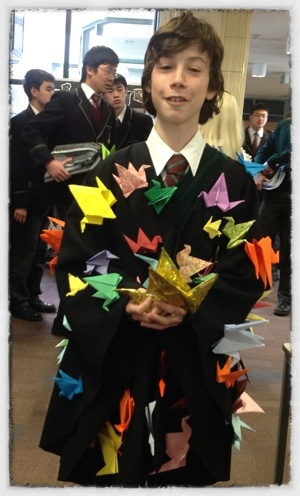
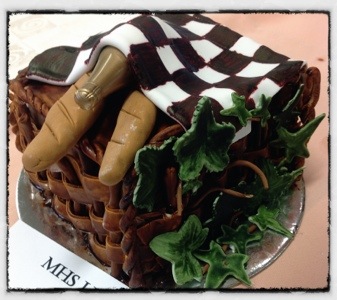
My school library blog has been keeping up with reading ambassadors for the National Year of Reading (#nyor12). These short and informal interviews are a pleasure to read, and reveal thoughtful responses to reading preferences. We’ve also recently celebrated 2012 Book Week with a hugely enjoyable ‘party’ in the library. I’ve included photos I think you’ll enjoy of our costume and cake competitions so that’s definitely worth checking out. This is the first Book Week celebration I’ve attended at Melbourne High School since I started a year ago, and it was fantastic. I was so impressed by the willingness of staff and students to dress up and play the part. The creativity displayed in our book-themed cake competition added a gastronomical dimension – who can resist cake? Yes, we did go on a bit about the cakes looking too good to eat but it didn’t last long.

I’ve been having such a good time resourcing the art curriculum in the last few months. My art blog churns out a diverse selection of inspiration to art students and teachers (I hope). This includes images, photography, design and animation.

Our students explored links to websites with antiquated encyclopedia images to create their ‘transformations’ which I combined in a slide show. The reduced image size doesn’t do justice to the details in the students’ work, so have a look at larger ones in Mihaela’s new art blog.

Yes! Our head of art now has a blog, and so do her students. This term our year 9s and 10s were lucky enough to get iPads, so we decided to get them to create Posterous blogs which we linked to Mihaela’s ‘mother blog’ and encouraged them to start snapping away with their iPad cameras so that they could develop a store of visual inspiration for their work. The beauty of a mobile device is the opportunity to capture photos as you go about your everyday activities. I’ve found the best images are the unexpected ones. I was inspired to get the art students blogging when I saw my dear friend, Marie Salinger’s, student blogs. Marie’s students have realised the rich potential of blogs in terms of journalling, reflecting, evaluating and just plain sharing. A blog is visual, it’s sequential, easy to access online and share with others; it invites responses and conversation. In her Visual Arts blog, Marie has reflected about the way in which iPads have enriched learning for her girls. The way Marie’s students used their blog to experiment with and evaluate iPad apps for drawing, then share with others, inspired me to talk to Mihaela about doing the same. Consequently I went into obsessive mode and lived and breathed art and apps for a couple of weeks, adding an Art Apps page in our LibGuides, my art blog, Pinterest, Flickr and Diigo.

Robot I am Apps used: Blender Pixeltwist                 (iphoneart.com)

Recently a dedicated team of students from the co-curricular group, Writing Competition, successfully wrote a book in a day. They had to collaboratively write at least 8,000 words and illustrate their story. The whole thing had to be done within 12 hours. I was very proud of the way they managed to work together and fuse their ideas and talents to produce a fantasy story for the Children’s Hospital. I hope to be able to share their book once I check the copyright.

Well, that’s it for now. Hope some of this has been useful to you.

Gagging on content, struggling to switch off

[slideshare id=13433007&w=427&h=356&sc=no]

Curation is one of the new popular concepts in the education world, particularly amongst librarians. In the same way as some previously trusted platforms for bookmarking content have become disappointing (Vodpod’s takeover by Lockerz) or slightly altered (Delicious), new forms of collecting, organising and sharing content have emerged. Pinterest, for me, as for many others, has proven useful for  easily capturing and categorizing images and videos, for example. Scoop.it has become very popular and a new way to search for educational content (even moreso than Pinterest which is still mainly used for personal collections eg wedding paraphernalia and crafts).
Joyce Seitzinger (@catspyjamasnz) has created an insightful slide presentation entitled ‘When educators become curators’. I particularly like Joyce’s description of the different types of digital curators – Closed Door, Hoarder, Scrooge, National Inquirer, and the Robot, although I haven’t actually met the ‘closed door’ curators, only ‘closed door’ recipients.
I can definitely relate to the idea of ‘gagging on content’ since, I have to admit, I’m addicted to information. As a teacher librarian this should be a positive thing since I’m in the business of curating and disseminating information for teachers. But an addiction is never a good thing and can get in the way of working efficiently or even living the real life. Sadly I’m often one of those people who can’t switch off, who regularly check for Twitter and Facebook updates while I’m out, whose inclination to share things I see and find could be viewed as compulsive. That’s why I’m reading Howard Rheingold‘s Net Smart: how to thrive online – or trying to.
Gagging on content can be managed by curation tools but balancing your life and curbing your desire to drink from the fire hydrant is just as important. And it’s so difficult to resist the temptation to connect to your networks when the conversation is so rich, when the new discoveries are so constant.
And so, if I can resist the temptation to check my phone so often, I might be able to learn from Howard how to develop attention and focus which will help balance my life by cultivating an internal inquiry into how I want to spend my time. Anyone else?
Still, at least if we’re connected we have an inside understanding of what our students feel like when they have to switch off and listen to one teacher for the whole period.

Fingerpainting is back as iArt

I was very excited to find artists using iPad apps to draw, or ‘fingerpaint’, wonderful art. In some cases these projects are collaborative – that aspect always excites me. There are people who are sceptical about technology, in terms of the quality of things produced by apps – and I have to say I was one of those who thought of art apps more in terms of sketching ideas rather than creating a serious art work – or those who rate new technologies for doing the same things they already do only online. I’ve had many conversations with these people, and I feel that there is only one way to change their minds (bearing in mind that you can’t change a closed mind, but you can certainly try to surprise their minds open) is to find amazing examples of technology-enabled projects.

Yesterday I stumbled across (don’t ask me to trace that thread back to its source) fingerpainters – artists who use the iPad and even iPhone or iPod Touch to create art with drawing/painting apps. I have these apps on my iPad and I’ve shown them to art teachers, but without an inspirational example, those apps just sit there in their folders doing not much. Of course, when you find an artist through your Google Reader of from Twitter lists, you know the discovery will lead to many more discoveries, and so I want to share some of these artists and works, their blogs and where they also live on Twitter and Flickr.

I started by discovering the artist Benjamin Rabe and his Flickr sets, including this one of finger paintings he did on his iphone or ipad. A painting on his phone!

Of course, when you discover an artist who has an online presence, they lead you to many more artists. This is how I came across the amazing Cedric Phillipe’s Flickr photostream and his fingerpaintings on his iPad and his iPod Touch. How on earth somebody manages to create an artwork on such a small screen, I’ll never know.

Mojitos

This one is done on his iPod Touch mainly using the app Brushes

This one is done on his iPad mainly using the app Brushes

Cedric has a wonderful Tumblr blog which you must see. This is where I found his stop-motion animation. What a treat!

&nbsp[vimeo http://www.vimeo.com/44310015 w=500&h=375]

An impressive little set that Cedric built for his animation. Have a look at photos here.

The Helen Keller quote at the bottom of the Woven Narratives webpage nicely summarises what I consider the most exciting about emerging technologies – the collaborative aspect. “Alone we can do so little; together we can do so much.” – Helen Keller. Woven Narratives are the collective works of artists’ collaborations using mainly iPad apps to create their art works.

Most of the works presented here were created and shared using only the iPad as a drawing and painting tool. Recent pieces have developed in three dimensions as small ‘soft sculptures’and the latest round of work has seen the development of a series of paintings on cardboard, which have been shared by post. Each of the works has travelled an average of 40,000 miles during its creation, bouncing back and forth via email or through the international postal system as its individual narrative unfolds.

Particularly interesting is the value-added aspect of this technology-enabled project:

The collaborations have helped both of us develop and extend our image making practice and have pushed our personal work into new and interesting directions. The narratives which develop throughout the process of making the works are playful, intriguing and entertaining. Many of them are hidden by the process of making, whilst others peek through to reveal themselves in colourful and often humorous ways. The result is an ongoing dialogue of signs, symbols, image-making and colour, a series of ‘Woven Narratives’, which engage the viewer in a ‘mesh’ of images and marks which share collective stories and experiences.

I can relate to the idea of process, and particularly collaborative process, resulting in new and exciting learning. Surely the experimental nature of emerging technologies is leading to new ideas and possibilities. If we allow for time to play…

In any case, have a closer look at Woven Narratives and the artists responsible. One of the artists, Jonathan Grauel, has discovered new possibilities for art making with mobile devices since an accident with a table saw left him without an index finger on his dominate hand and limited sensitivity in his thumb. When his wife and friends surprised him with an iPhone, he discovered a new joy in “finger painting.”

A blessing for art students and teachers is when artists share their art work, ideas and techniques. The blog Fingerpainted shares apps used to create art works which you can see for yourself. The About page shares the evolution of the blog. Here’s a link to the posts tagged with ‘apps’ – very useful and full of examples.

UK artist, Fabric Lenny, and US artist, Jonathan Grauel, have teamed up to produce a body of work in iPad despite the distance between them. Sketchshare is a series of 154 images which were painted simultaneously in the iPads.

You can view all these pictures done in real time in their Flickr stream.

Finally, here’s a video game fingerpainted entirely on the iPad. The music was also composed on the iPad.

[youtube http://www.youtube.com/watch?v=Zjx8Fa-k_RE&w=560&h=315]

I hope this post will inspire some art students and teachers. I’ll add an iPad/iPhone apps page in my online art resources very soon.

Connecting our students to themselves, each other and the world – VITTA presentation

Thank you to VITTA for giving Nick Fairlie and me the opportunity to “show and tell” our blogging process with 2 year 9 classes. Thanks to those brave souls who stayed for the late session (4-5pm). A huge thanks to Nick for trusting me to lead him and his classes into unknown territory, for making the whole experience a rich one, and for agreeing to present with me. I thought we did a pretty good job. It would have been fantastic to have our 2 students join us and talk about what they’ve learned from the experience but the session was unfortunately too late for them.

Here’s the presentation which gives you some idea of what we talked about.

edit#slide=id.p


[googleapps domain=”docs” dir=”presentation/embed” query=”id=1BG_ipEw6htBdlWMRThVc4l8uE0fzU2lBVv9XaAyN9VQ&start=false&loop=false&delayms=3000″ width=”960″ height=”749″ /]

Trailer for the Paralympic Games. Inspirational.

With the London Olympics underway and the Paralympics 30 days away, I thought I’d share this video with you – a video which captures so many inspiring qualities – endurance, toughness, persistance, passion, talent, collaboration and even more. It’s the trailer for the Paralympic Games.

Enough said.

[vimeo http://www.vimeo.com/45968190 w=400&h=300]

New Melbourne-based collaborative blog – Brassofthebear

Photo by Alexander (Sasha) Sheko

Brazen plug for my son, Sasha’s, new collaborative blog about Melbourne – Brassofthebear. It’s just new but there’s plenty to read already.  Here’s the ‘about’ –

Welcome to Brass of the Bear, a collaborative blog with a local focus written by people in and around Melbourne, Australia. The name of the blog is derived from Bearbrass, one of a few names by which Melbourne was originally known.

Brass of the Bear (BB) aims to feature a broad range of content within its local focus, such as:

  • Reviews of cafes, restaurants, bars and the such,
  • Information on local events, art, cinema and music
  • Photography, writing and other locally based creative content
  • Secrets, quirks, hidden locations and adventures to be had
  • Information and opinion pieces on local community and political issues

BB is seeking contributors in any of the above areas (or even anything relevant that doesn’t fit into the above categories). Contact us at brassofthebear@gmail.com. We’d love to hear from you.

Sasha asked me to contribute and so I wrote about Melbourne as a UNESCO City of Literature, highlighting events at the Wheeler Centre. Here’s a selection –

You  may or may not know that Melbourne is ‘a City of Literature’. I have no real way of predicting that since most of what I don’t know is common knowledge. In fact, Melbourne’s designation as aUNESCO City of Literature is apparently “acknowledgment of the breadth, depth and vibrancy of the city’s literary culture”. That makes me happy. And so Melbourne boasts a variety of literary organisations  and events to promote a culture of reading and engagement, events such as  Writers VictoriaExpress Media, the Australian Poetry Centre, the Melbourne Writers Festival and theEmerging Writers’ Festival.

You can read the rest here.

The Gertrude St Projection Festival is a good read.

Over the past couple of weeks (from 20 – 29 July, to be precise), Gertrude Street in Fitzroy has been home to a variety of projection art pieces, ranging from hypnotising geometric animations in shop windows to colourful patterns projected onto the entirety of one of the 20-odd story public housing towers. This year saw the fifth Gertrude Street Projection Festival (GSPF), featuring a large number of artists, including a number of collaborative works.

This is the first time I’ve seen the Projection Festival, and I really enjoyed it. Gertrude Street is one of my favourite streets, so much character.

Photo by Alexander Sheko

Other posts include Adventure – Footscray, Le Miel et La Lune restaurant review by James Zarucky, a very informative post about Yarraville by Ashley Onori, a story about the old Children’s Hospital (with photos which look apocalyptic) which is being demolished, and a review of the White Rabbit Record Bar in Kensington. The blog includes posts expressing political concerns (a letter to Daniel Andrews) and commentary on a film  from the National Film and Sound Archive’s Film Australia Collection.

I’m always supportive of collaborative efforts, especially when they’re shared online for others’ enjoyment, and I do love my city, so I’m looking forward to reading more from hopefully a growing list of contributors. If you have any expertise in any area of knowledge pertaining to Melbourne, or if you’ve recently attended an event which is worth writing about, leave a comment in the ‘About’ section of the blog.

Photo by Alexander Sheko

Button up, we’re out in the open

css.php