Mobile learning with no limits @VITTA

The Victorian Information Technology Teacher’s Association‘s Mini Conference, A contemporary learning series: mobile learning with no limits, was held last Friday at Ringwood Secondary College, and focused on 1:1 devices, how they could be used effectively in the classroom, and how they were relevant to the Australian Curriculum. The principal of Ringwood Secondary College, Michael Phillips, Outstanding School Leadership Award Winner, delivered the keynote plenary, Synch and Swim, which centred on the theme of Leadership for Learning that keeps ahead of the wave.

Disruptive technological change is rapidly shifting the balance between traditional models of teaching and learning and those that are more blended. The factory model of learning has finally closed for business.

Directions for learning are limitless as:
• distributive technologies allow 1-to-many;
• collaborative technologies encourage many-to-many;
• personalised learning is possible through 1-to-1;and
• distributive feedback technologies promote 1-to-many or many-to-many.

All of this is possible now in every classroom in every school.

Michael’s speech was a powerful message for educators and educational leaders to stop talking about 21st century teaching and learning as if it was set in the future, and accept that the future is here and requires a radical shift in teaching practice. When Michael said, “The factory model of learning has finally closed for business”, I felt like applauding and crying simultaneously, knowing that many schools were still in denial of this fact. Still, the conference participants were testament to the willingness to listen and learn, perhaps to embrace change.

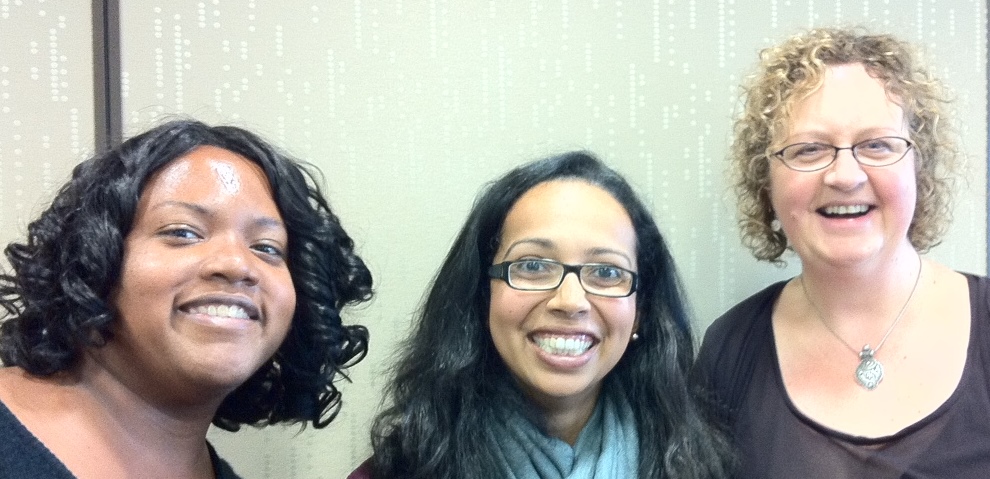
Concurrent sessions are slightly frustrating because you can’t be in more than one place at the same time. The first session I attended was run by Roland Gesthuizen, a fellow Google Certified Teacher whose long experience in presenting enabled him to lead a relaxed but dynamic session which drew participants into discussion. One of Roland’s interesting observations was that the iPad was a microwave – it’s not the same as a laptop,it doesn’t do everything, but what it does, it does well and fast. After a fertile discussion, Roland demonstrated how he used Google apps such as Moderator in his teaching, and gave a quick overview of his experience in Sydney at the Google Teacher Academy.

I enjoyed presentations by Kevork Krozian and Clare Rafferty, both from Ringwood Secondary College. I think that Ringwood S.C. would be an exciting place to teach and learn. Some sessions I missed unfortunately, including Cecilie Murray‘s 2 talks which were full to bursting, and Jenny Ashby‘s session which ran at the same time as mine. Jenny and I presented at what Jenny referred to on Twitter as ‘graveyard shift’, the last session of the day. Despite the hour, I was impressed by the attentive audience I had in my room, and grateful for the positive feedback at the end of the session. I was also privileged to have SLAV’s executive officer Catherine Ryan and VITTA’s Jo McLeay join my session. Thankyou for your support and kind words especially as I was reluctant to present – not a fan of public speaking, so much more comfortable writing a blog post. I must say, though, that I ended up enjoying the experience.

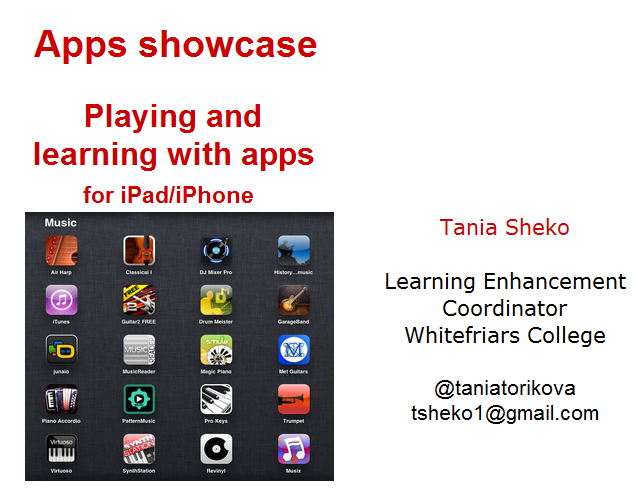
If you are interested in having a look at my iPad/iPhone apps showcase – a spectrum of apps strewn across the curriculum – you can see it as a slideshow here. After so many hours of research I’m thrilled if anyone finds my resource useful.
And it’s always fantastic to see people you know at conferences. Happily, I had the pleasure of seeing Jenny Luca (and being introduced to Megan – hope to God I’ve remembered your name correctly) and John Pearce again. The online network is brilliant for maintaining the conversation but face to face is still the best.


Naplan our benchmark? Why not “The Horizon Report?”

Our school is in the process of an external review. As learning enhancement coordinator, I was reviewed as part of a small group which included the learning support and transition coordinators.  During our meeting the reviewers focused on the NAPLAN results, and asked us how we used this data. We were encouraged to drill down into specific data which would allow us to address the specific issues. For example, if our students’ weaknesses were revealed in the area of writing, we would make it our business to find out if the weakness resided in the mechanics of writing, the critical thinking component, etc.

At some point during the meeting I started thinking about how we came to put so much emphasis on NAPLAN testing, and if we had any other criteria with which to evaluate our teaching. Surely there were more contemporary skills to base our assessment on – beyond spelling, grammar, numeracy, reading and writing? It’s pretty obvious that, although all these things are important, we’ve come a long way in terms of essential skills in the last few years.

Just look at The Horizon Report. Its discussion of technology adoption highlights critical challenges, and these include digital media literacy, new scholarly forms of authoring, publishing and researching (eg blogs and networked presentations). These trends and challenges are indicative of ‘the changing nature of the way we communicate, access information, connect with peers and colleagues, learn and even socialise’.

And yet how many schools are engaging in conversation about these challenges? Or are they still looking at spelling, reading and writing. During our meeting I was disturbed to hear educators blame the introduction of one-to-one notebook computers for the decline in writing standards. Don’t get me started on that.

Back to my original point – who looks at the Horizon Report in schools? At best it’s read as an interesting or challenging extra piece of information. Is it too challenging? Considered irrelevant? Too far from what we are doing so we just put it away since it isn’t seen as crucial to learning and teaching? Or is it that we refuse to acknowledge how ubiquitous technology has become and think we can prevent the adoption of things like mobile phones? And yet, The Horizon Report states: “Mobiles enable ubiquitous access to information, social networks, tools for learning and productivity, and much more”.

We are still focusing on the problematic nature of digital and mobile technologies – problematic because they disrupt our orderly, nineteenth century classroom. They create chaos. But we need that chaos, we need to shake up the traditional lessons to re-engage students and help them connect to and take ownership of their learning.

I see the problem residing in the disconnect between school and life. How can students be engaged in an artificial construct which separates knowledge into rigid compartments, knowledge which is delivered in a way which students find foreign and unengaging. Shouldn’t we look at how our students find what they need to know, how they create things, how they organise events within their networks? We still see this as separate from learning. We are convinced that young people’s online socialising is superficial, a waste of valuable time.

Howard Rheingold’s post, How does digital media impact youth political and civic engagement?says otherwise. Rheingold points toJoseph Kahne‘s very important empirical study about young people’s use of digital media and how it impacts their engagement — or lack of engagement — in civic affairs and politics.

That research, Kahne says in an interview, punctures some core myths about online activism, and strongly indicates that the virtual world nourishes youth engagement in real-world issues.

What we found is that young people were more likely to volunteer offline when they were part of online networks.

The question becomes, how can youth’s embrace of digital media and enthusiasm for the Internet be leveraged for social enterprise and civic engagement?

And I would add, how can youth’s embrace of digital media and enthusiasm for the Internet be leveraged for what happens in terms of teaching and learning at school?

Online, young people are gaining skills … how to work in a group, how to negotiate things, how to get organized, how to organize other people… We also found that their online participation increased their exposure to diverse viewpoints… 

How diverse are the viewpoints students are exposed to in the classroom? I really think, not diverse enough. Rather than shut down possibilities for our students to connect outside the classroom out of fear, we could enable connections and guide our students to behave responsibly and maturely. I would even go so far as to suggest that we encourage young people to join specific online groups to broaden their range of experiences. If we take students out on excursions then we could do the same online.

Does anyone teach in a school which formulates its strategic plan while looking at The Horizon Report?  

Here’s the full interview with Joseph Kahne taken from Howard Rheingold’s post.

[vimeo 24243522 w=400 h=295]

Does social media and the Internet fuel youth political engagement? from DML Research Hub on Vimeo.

Are we Copyright Cops?

I saw this film on Tom Barrett’s blog post. It’s a powerful film about young people’s behaviour on the web and the extreme reaction of the law as they succumb to ‘stealing’ that which is to easy to take.

[vimeo http://vimeo.com/23641818]

Not so long ago information wasn’t as accessible and tantalising as it is now. You only had one identity (unless you were a celebrity). Now people, predominantly young people, enjoy and possibly cultivate an online identity which may or may not be identical to their face-to-face identity. They enjoy audience most of the time through mobile technologies. Even when their blog posts claim that they are alone in their despair and will not be heard by anyone, they are generally enjoying the thought of being ‘read’ by their ‘friends’.

It’s an exciting time with the possibility of connecting with so many instantly, the possibility of finding so much information, viewing and copying so many images, so much music. It can be a confusing time, not knowing if something is true (as sometimes occurs with news on Twitter) or if it has been played with.

As educators we should try to understand the online existence from the inside, and from that perspective proceed with instruction and guidance so that young people approach that part of their life as wisely as we would hope they approach any part of their life. We should not overdramatise, not use fear-mongering, not pull them back. There is so much to be enjoyed, so much creativity possible. This needs to be tempered by an informed knowledge of how to use and share information, images and music responsibly and legally. So much is shared through Creative Commons, and it is a very good idea to attribute everything; it’s just manners.

I like the fact that this film is open source, and that it encourages people to remix and take a personal spin on what’s available.

It’s an exciting time. Let’s be open to it, be informed and respectful of each other. As educators let’s support young people in a world that doesn’t stand still, let’s not police them inappropriately.

Face2Face GTA meetup with friends

I like Judith Way’s style; she makes things happen. Soon after a few of us returned from Sydney as newly certified Google Teachers, Judith set up a time and place for a face-to-face meeting and debrief. The time – this Saturday 14th May 2-4.30pm, the place – Mill Park Library, 394 Plenty Road, Mill Park. Should be good. I’m looking forward to sharing GTASYD experiences together with Jess McCulloch, Tony Richards and Glenda Morris. The session can fit 30 people and there is still room for more, so if you’re interested you can add your name and details to this google doc. Pity the rest of our Victorian cohort is unable to make it – Corrie Barclay will be playing football and I’m not sure what is preventing the rest from attending. Still, it will be good to see everyone who’s coming; some are even coming down from the mountain! Others live just around the corner from me but I haven’t seen for a long time.

Hope to see you there!

Tech Talk Tuesdays – Chatting about Google Teacher Academy experience

There’s a first time for everything. Recently Glenda Morris and I were asked by Anne Mirtschin to talk about our experiences at the Google Teacher Academy in Sydney on Tech Talk Tuesdays.  Normally I would have been very nervous about speaking in front of an audience but the fact that Anne was running the show was very comforting, and there’s something to be said for talking to an unseen audience in the comfort of your own home with your slippers on, holding onto a cup of hot coffee  and your dog asleep next to you. I knew that Glenda felt the same way that I did, and presenting together was actually a lot of fun. I recommend it.

Happily, we had the company of people from  USA, NZ and Malaysia, as well as Australians. I hope I haven’t missed anyone – I have to say, trying to construct comprehensible sentences on the spot was challenging enough, and I found that, unless Glenda was speaking, I wasn’t able to keep up with the chat and questions, so luckily Anne had all that under control.

Our intention was not to present a detailed account of Google apps but to share our experiences, provide some ‘inside information’ about the Google space and agenda, and pull out a few examples of Google apps which had resonated with us.

Here is the slide presentation and you can listen to the archived recording of the session here.

[googleapps domain=”docs” dir=”viewer” query=”a=v&pid=explorer&chrome=false&embedded=true&srcid=12T82-uT2ja8RhLYYh79nrv8V2Tpn0IjiFzR073wYeWk&hl=en” width=”800″ height=”560″ /]

Sorry about the two blank slides; not sure why the pictures are not showing.

Whole school site for learning enhancement

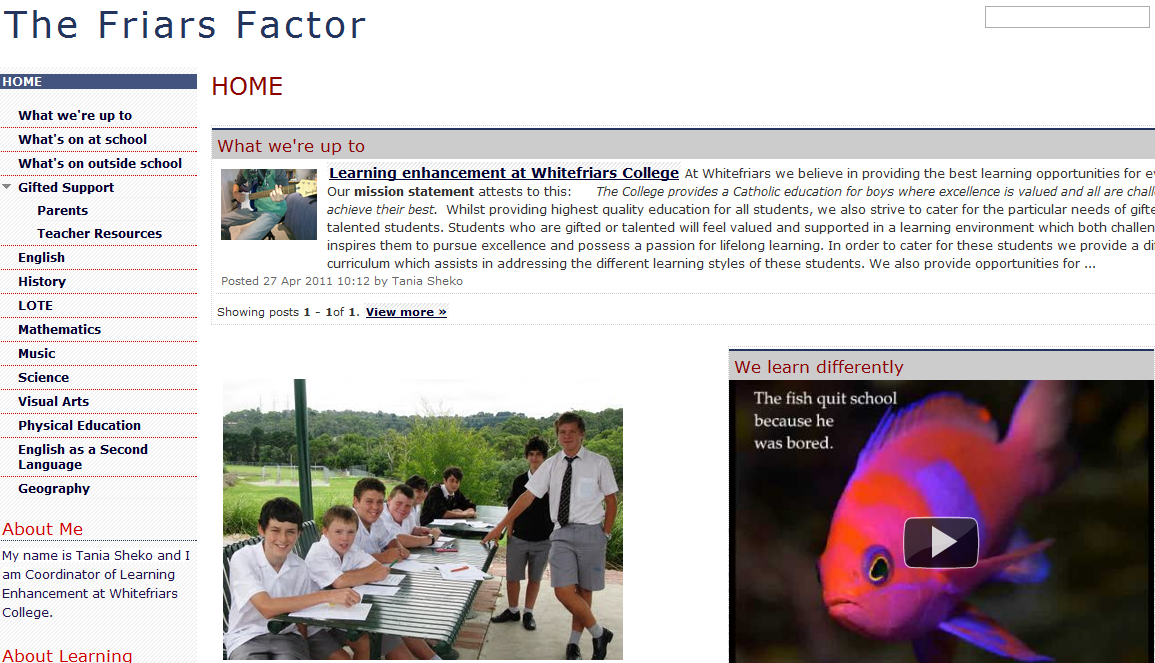
Lately a lot of my time and focus has been devoted to creating an online portal for learning enhancement at my school. Part of my brief for my new role was the promotion to parents of learning enhancement opportunities provided at school. I decided to try out Google Sites, supported in a major way by a talented colleague, Dawn, to whom I owe so much for her technological expertise. Here is the site at this point in time (click here).

                                                                                                                                                                                                                                                                                            I referred to The Friars Factor earlier as a portal because I think it’s a central place serving more than one purpose: an opportunity for members of the school community to write about events in detail and include images/videos (blog posts); resources defining and clarifying aspects of giftedness for both parents and teachers; resources to support teachers in providing a differentiated curriculum; the opportunity for teachers to develop a personal learning network (PLN) after reading blogs and connecting to bloggers; lessons/tutorials/games to extend students at point of need; the opportunity to read widely far beyond the confines of the curriculum; the opportunity for students to follow their passion; ideas and resources integrating technology into student-driven learning tasks.


What made me happy after the talk was receiving emails from teachers wanting to contribute resources or suggesting students who might like to write blog posts. That’s so satisfying, knowing that the school community wants to collaborate in the project. That indicates the start of ownership. Win.

Back from Google Teacher Academy, Sydney. Time to debrief.

So I’m back from Google Teacher Academy in Sydney, conducted in the Google offices located in gorgeous Pyrmont.

I suppose you’ve noticed my Google Certified Teacher badge taking pride of place in my blog’s sidebar. I hope that’s more a sign of what I’m going to share than any attempt at self promotion. So, you say, how was it? After the hype (which I half joking referred to on Twitter in Wonkian terms), it’s definitely time to share the experience.

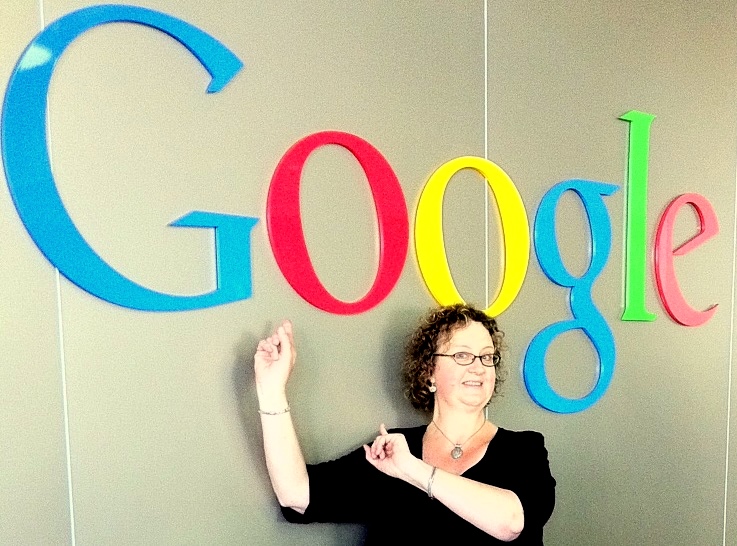
For me, it was a little like T.S.Eliot said in The Dry Salvages –  ‘We had the experience but missed the meaning’, that is to say, it was such a big experience, I had to come away from it to understand its impact. One and a half days in the Google offices but many weeks of suspense, attempts at imagined scenarios leading up to the much awaited day had put us all into an emotional state which delivered us to the Google headquarters as children at a birthday party. The mystery shrouding the event and Google interior wound up the intensity even tighter. It was fun spotting the large Google sign in the foyer of the building, spotting real people whose faces matched their tiny avatars on Twitter or Facebook, meeting for breakfast and become initiates by wearing the Google Teacher Academy name tags.

So, you’re saying, stop dragging out the preamble, get to the point: what was it like? What did you do?

Short answer: It was full on!! The Magic Hat had sorted us into teams; I was in Silverbrook. We sat at brightly google-coloured tables and, shortly after breakfast, were treated to Google Educators giving us an overview of the enormous range of Google tools: Search (web, specialised, multimedia, language, custom), Google Apps Education edition, Docs, Sites, Calendar, Blogger, BooksScholar, News, Blog Search, Alerts, Maps, Earth, Gmail, Chat, Talk, Mobile, and more. Added to these sessions, some of our 55 strong cohort had offered to present Inspiring Ideas. We were treated to Google Spreadsheets (Pat Wagner), Sites for student e-portolios (Joe Donahue), creating an augmented reality school tour (Chris Betcher), e-portfolios using Blogger and Apps (Rob Clarke), using Blogger and Video Chat for minimally invasive education (Tara Taylor-Jorgensen), and an inside view of Google Apps for Education in a school (Dorothy Burt).  At 6pm, in the last session: reflection and review, we shared our ‘Aha’ moments for the day with our group, and at 6.30pm we were treated to a lovely celebratory dinner.

You can breathe now.

How do I do justice to such an intensive day and from all angles? I can’t.  Obviously the breadth and depth of the material was overwhelming, and at times it was challenging to keep up and remain focussed. I really enjoyed what the members of our cohort had to share, and I wish we could have seen more of how the Google apps could be used in creative and innovative ways in the classroom. We really needed more time and I suppose that was the biggest drawback – cramming so much in so little time.

Was it what I expected? I’m not sure. It’s not that Google apps/Apps are not out there for everyone to see and learn about. In that sense, we learned nothing new. But seeing everything in one and a half days, we probably saw more than we would have if left to our own devices. In between we struggled to make a dent in activities which gave us the opportunity to put some of the Google tools to use.

Most of us agreed that meeting up, connecting, collaborating and sharing was the most valuable part of the experience. So many interesting, passionate and innovative people, and we would continue to collaborate on Twitter (#gtasyd and #gct) and the GCT Group (sorry, closed community). I am grateful for new friendships and acquaintances. Thankyou so much to our GTA leaders, Dana Nguyen, Dr Mark Wagner, Wendy Gorton, Kern Kelley, Danny Silva and Lisa Thumann, for your expertise and passion.

Next on the agenda is formulating an action plan – how we will share what we have learned, either through presentations or in the classroom. It’s difficult to decide where to start.

As a teacher librarian, I’d like to say to my colleagues – you are already well skilled in many of the Google tools. We are experts in Search, News, Scholar, Google Books,  and there are experts among us with things like Google Lit Trips. What we don’t know, we can learn from the excellent Google help and crib sheets.

So, having said that, here is my initial idea for a Google action plan – to create a community for Google PD either in Google Groups or Sites specifically for teacher librarians. This would be a place to share knowledge, ideas and material. There are experts amongst us, and it would be good to pool our collective talents to present professional development either face to face, or through slideshows and webinars. Glenda Morris and I are both GCT  TLs in Victoria, and when I spoke to Glenda about this idea, she was happy to take part. There is already so much prepared by Google, for example, take a look at all the material in Google Web Search: Classroom lessons and resources.

What do you think? I would love to receive feedback for this idea. And please, if I’ve missed something you wanted to know about the Google Academy experience, please ask.

(A big thankyou, also, to Lisa Perez (TL in Chicago) who initiated meeting Glenda and me before the conference, and encouraged us to join forces as TLs).

Why I play

Art by Lena Torikov

Before I bought my iPad, people would ask me what I planned to do with it. Why was I spending so much money? Was I certain it was worth it? How was the iPad going to be different from a notebook? Should I buy an iPhone instead?

I couldn’t answer any of these questions with any certainty. That’s why I was buying an iPad – to play, to gain an understanding of what an iPad enabled me to do, to figure out if iPads played a role in the changing face of learning in schools.

There’s nothing wrong with putting forward a suggestion before you have all the answers. I didn’t and don’t have all the answers for iPads in education, but I don’t want to wait until the time when it’s safe, when the majority of educators have understood the value of iPads and accepted their place in schools. If I wait that long, I’ll be on the tail end of a movement that doesn’t stay still. I won’t be a forward thinking educator but a safe follower who calls out for others to wait up.

If I waited until I was sure, I wouldn’t be where I am now. Where am I now? I’m on the road to finding out. The iPad apps session I recently did with staff at school was a way in – despite the best advice to hold off because I only had one iPad to pass around, to hold off because iPad education wasn’t a realistic option at my school, because people weren’t ready, because because…

Play is an essential part of being a teacher – it’s the learning part of teaching. Play is experimenting, discovery, it’s creative, it’s action, it moves into a new space. Wouldn’t it be great if play was compulsory at school? Instead of instruction from teachers to students, play would put everyone on the same playing field. Risk would be a prerequisite.

If we wait until it’s safe to do something, we’ve been left behind.

21 signs you’re a 21st century teacher

Yes, the phrase (is it a definition?) 21st century teacher has been bandied about and annoys some people, but whatever you want to call it, shouldn’t we all, as educators, use this checklist to check our relevance? Or at the very least, we could evaluate these checkpoints to determine whether we judge them to be important in the scheme of our work as educators.

As a teacher librarian I can only do these things if I find a willing teacher with a class. Not much you can do without a class – a one-off lesson doesn’t make a great deal of difference. Some of the things I have done with classes include:

  • Your students work on collaborative projects…with students in Finland/USA.
  • You share lesson plans with your teacher friends…from around the globe. Most teachers don’t see the point of sharing. Sorry, I don’t want to sound critical, but I’m talking about those I know both in my own school and colleagues in my city. I say, try it, and see how much more satisfying teaching becomes. What you get back is amazing. Not to mention valuable connections with other educators. Start a PLN!!
  • Your classroom budget is tight…but it doesn’t matter because there are so many free resources on the web you can use. Yes, there is so much out there. I collect it, share it, promote it, but don’t often have any takers. What’s the problem? Teachers are too busy, too content-driven, too VCE-focused (not their fault), too afraid, too put off by technology not working. All valid reasons, I’m not knocking teachers, but from my perspective, I’m always thinking about how I can make a difference here.
  • You realize the importance of professional development…and you read blogs, join online communities, and tweet for self development. Oh yes, definitely, perhaps compulsively. Love it. Highly recommend it. Does it eat into you personal life? It becomes your life.
  • Your students share stories of their summer vacation…through an online photo repository. Yes, one of my classes used Flickr to share aspects of their life with classes in Finland/USA
  • You showcase your students’ original work…to the world.  This is something I feel strongly about. Authentic audience, global sharing. Students love receiving comments from people outside the school. Whatever I create, I make sure it’s out there for everyone. I’m proud of what I/we do.
  • You have your morning coffee…while checking your RSS feed. What do you think I did before writing this post. The rest of my family are still asleep. Yes, I know, I’m nuts.

Some of these have given me ideas –

  • You give weekly class updates to parents…via your blog (I have documented class activity in blogs, but haven’t gone the step further to sharing with parents. What a great idea.
  • Your students participate in class…by tweeting their questions and comments. (I would love to do this but I’m not sure about permissions. Fear of social media is still prevalent at school. I think this needs education.
  • You ask your students to study and create reports on a controversial topic…and you grade their video submissions. (Teachers have begun to offer videos as presentation options, but a consistent assessment rubric would be a good idea, and there is still the feeling that writing is most important as this is what is assessed in year 12. Videos are okay in middle years but after that teachers start to get nervous, understandably. We need an assessment revolution.
  • You prepare substitutes with detailed directions…via Podcasts. What a great idea! Yesterday I was talking to a teacher from another school who records his corrections as podcasts. I love that. And I think it would be less laborious than squeezing everything you want to say in the margins.
  • Your students create a study guide…working together on a group wiki. Another great idea! I’ve seen nings allow students to discuss essay topics and texts so that ideas and content are developed collaboratively. I might search for examples of study guide wikis to see what these look like. Any suggestions?
  • You visit the Louvre with your students…and don’t spend a dime. Must do this with an art class. Or any class.
  • You teach your students not to be bullies…or cyberbullies. How do I convince teachers that taking the time to teach responsible and productive online behaviour is just as important as a content lesson? Again, I blame the system
  • You make your students turn in their cell phones before class starts…because you plan on using them in class.  Bit of a sore point at school; we still ban many things. I am required to chastise students who play games on their notebooks, but at the same time, I show them problem-solving games on my iPad. We need a mindshift.

The last point: You tweet this page, blog about it, “like” it, or email it to someone else…

Yes, I write a blog post, tweet it, and add it to Facebook. I’m not writing this for myself…

What about you?

Read the full list here.

iPad apps for problem solving

Higher order thinking is not what the students were consciously involved in while playing with iPad app games, but it’s what they were in fact doing. I gave my iPad to some of the boys at school one day and suddenly there was a small crowd standing around the player, intently involved and offering suggestions. I asked to film a small group of these boys demonstrating a few of the games. They were self conscious and so the natural banter and collaboration is lost but the demonstrations still stand. You can almost see the thinking process in action.

Rafter

[youtube=http://www.youtube.com/watch?v=QAmuSIpQUeA]

Unblock Me

[youtube=http://www.youtube.com/watch?v=PQp_dQ6ezxQ]

Glowpuzzle

[youtube=http://www.youtube.com/watch?v=IqAIbuqh65A]

Labyrinth – This one was cut short because of the glare

[youtube=http://www.youtube.com/watch?v=kPCCAXHCKeY]

I think there would be a fair amount of justification for these from an educational perspective, don’t you? Physics teachers might want to look into them, for example.

Thanks, guys!


Button up, we’re out in the open

css.php